Buy a Licensed Company
 Explore VASP Data
 Talk to an Expert


 Dren Hima
 is Head of Research at Coincub, leading research across digital asset regulation, licensing, market structure, tokenization and institutional adoption.
Tokenized Collateral Moves Faster and Weighs the Same

- US bank regulators give an eligible tokenized security the same haircuts as its conventional form, so a tokenized two-year Treasury note keeps the 2% in the capital rule’s table.
- ESMA’s review of tokenized CCP collateral keeps the eligible asset list fixed.
- Broadridge’s repo ledger averaged $359 billion a day in September 2026, while every tokenized US Treasury fund on RWA.xyz totals $14.69 billion.
- The Eurosystem has accepted DLT-issued bonds since 30 March 2026, after conversion into a format T2S-linked settlement systems can process.
- Fund tokens, crypto assets and synthetic wrappers bring redemption, valuation and issuer risks that continuous margining can turn into faster liquidity calls.
Broadridge’s Distributed Ledger Repo platform processed an average of $359 billion a day in September 2026, or $7.5 trillion across the month. Every tokenized US Treasury fund tracked by RWA.xyz added up to $14.69 billion on 16 October, about 4% of one average day on that single platform. All distributed tokenized real-world assets on the same tracker come to $39.24 billion. The repo figure is a flow and the token figures are stocks, and the gap still shows where institutions have put collateral on a ledger. It sits inside repo and post-trade workflows the banks already run, on government securities they already trade.
Regulators price the token as the asset underneath. The Federal Reserve, FDIC and OCC apply the same haircuts to an eligible tokenized security as to its conventional form. CFTC staff want tokenized investments of customer funds to carry rights equal or functionally equivalent to the traditional asset. ESMA began its review of CCP collateral from the position that tokenization “should not, in itself, justify a different prudential treatment.” A token earns no collateral credit for being a token. Whatever tokenized collateral is worth comes from moving the same assets faster, more often and across more custody silos, and its new risks come from that speed too.
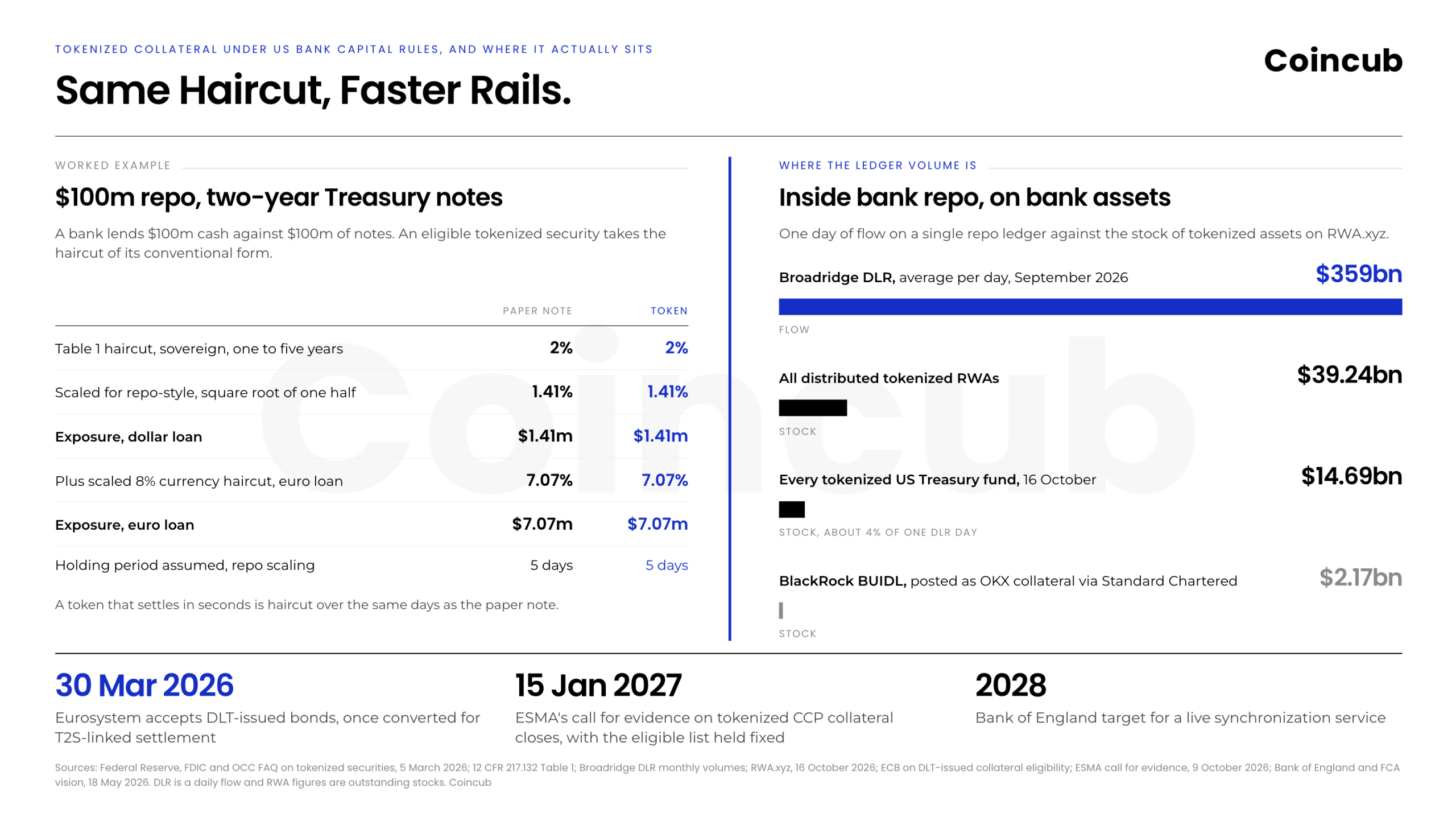

How tokenized collateral structures differ
Four structures carry the label, and a collateral taker underwrites a different chain of counterparties in each.
| Structure | What moves on the ledger | Where the asset sits | Live example | What the taker underwrites |
| Native DLT security | The security and its register entry | On the ledger | BX Digital settlement on Ethereum | Ledger finality, governing law, the issuer |
| Digital twin | A token entitlement to a custodied position | CSD or custodian | DTC tokenized entitlements | The custodian and token-to-position reconciliation |
| Collateral record | Ownership of, or a pledge over, a static position | Existing custodian | Kinexys Tokenized Collateral Network | Enforceability of the record against the custody books |
| Synthetic | A claim on the token issuer | Possibly nowhere on the holder’s behalf | Third-party linked securities | Issuer credit and bankruptcy remoteness |
Most institutional activity so far runs through the middle two rows. A digital twin keeps the security inside the depository and its legal framework, and the token carries the entitlement. A collateral record moves even less, leaving the position untouched and recording only who owns it or holds a lien over it. Both carry the legal rights of the conventional asset, and those rights get them through the regulatory tests below.
A synthetic Treasury token posted as margin is a claim on whoever minted it. SEC staff split tokenized securities into issuer-sponsored and third-party models in a statement on 28 January 2026. For third-party tokens, the staff warned that holders may face risks with respect to the tokenizer, bankruptcy among them, that a holder of the underlying security would not necessarily face.
Collateral analysis inherits every question of tokenized asset ownership and adds two more, whether the taker can perfect its interest and how fast it can sell after a default. The token standard answers neither. The custody agreement, the authoritative register and the collateral agreement do, under whichever law governs each.
Bank capital haircuts for tokenized securities
The banking agencies’ FAQ of 5 March 2026 defines an eligible tokenized security as one that confers legal rights identical to the non-tokenized form. It can qualify as financial collateral where the bank holds a perfected, first-priority security interest, or the legal equivalent outside the US. It then takes the haircuts of the non-tokenized security, whether the chain is permissioned or permissionless. A derivative referencing an eligible tokenized security gets the treatment of one referencing the conventional security. The agencies attach one standing condition. Banks holding tokenized securities must apply sound risk management, and the operational risk of the token lands in supervision.
Perfection is a state law question, and the route depends on what the token is. The 2022 UCC amendments carve investment property out of the new Article 12, so a tokenized Treasury held as a security entitlement stays under Article 8. Bitcoin and ether are the standard examples of controllable electronic records under Article 12, where a secured party with control takes priority over one that perfected only by filing, even an earlier filer. New York’s version took effect on 3 June 2026, with a transition period for existing transactions through June 2027, and more than 30 states had adopted the amendments before it.
The haircuts themselves sit in Table 1 of 12 CFR 217.132. A zero-risk-weight sovereign bond takes 0.5% with a residual maturity up to one year, 2% from one to five years, and 4% beyond five. Main index equities and gold take 15%. A currency mismatch between collateral and exposure adds an 8% foreign exchange haircut.
Take a bank lending $100 million in cash in a repo-style transaction against $100 million of tokenized two-year Treasury notes. Repo-style transactions may scale the table by the square root of one half, which turns the 2% haircut into about 1.41% and leaves a $1.41 million exposure. Denominate the loan in euros and the scaled 8% currency haircut stacks on top, for a combined 7.07% and a $7.07 million exposure. The token changed none of those numbers. The table assumes a 10 business-day holding period and the repo scaling assumes five, and a token that settles in seconds is haircut over the same days as the paper note.
Fund tokens follow the mutual fund line, which applies the highest haircut for any security the fund can invest in. A tokenized money market fund share therefore takes its haircut from the fund’s investment mandate, whatever the portfolio holds on the day it is posted.
CFTC rules for tokenized margin and customer funds
Three CFTC divisions issued Staff Letter 25-39 on 8 December 2025, covering tokenized real-world assets including Treasury securities and money market funds. It walks through eligible tokenized assets, legal enforceability, segregation, custody and control, haircuts and valuation, and operational risk, and calls the CFTC’s regulations technology-neutral. The same release launched a pilot letting futures commission merchants accept bitcoin, ether and USDC as customer margin. For the first three months of an FCM’s reliance, the pilot limits accepted assets to those three and requires weekly reports of digital assets held in customer accounts by asset type and account class.
The Market Participants Division also withdrew its 2020 advisory on accepting virtual currencies into segregation, citing developments that include the GENIUS Act.
Staff updated the crypto asset FAQs on 24 September 2026. FCMs and clearing organizations may now invest customer funds in tokenized forms of permitted investments when the token gives rights “the same or functionally equivalent” to those of the traditional asset, among other conditions. For tokenized government money market funds, staff expect a written acknowledgment letter from the custodian. Firms keeping required records on a public permissionless blockchain should be able to retain and produce them “under any circumstances,” a network outage included.
The same document keeps crypto assets, payment stablecoins included, off the list of eligible margin collateral for uncleared swaps. That list governs swap dealers under the CFTC’s uncleared margin rules. USDC can serve as futures customer margin under the pilot while staying ineligible for uncleared swap margin. A tokenized government money market fund needs both the rights test and the custodian letter before an FCM can put customer funds into it.
Eurosystem, ESMA and Bank of England collateral eligibility
| Authority | Measure | Date | Status on 17 October 2026 |
| Eurosystem | DLT-issued assets in CSDs eligible for credit operations | 30 March 2026 | Accepted, through T2S-reachable systems only |
| ECB | Pontes settlement of DLT transactions in central bank money | 21 September 2026 | Live, 24/7 availability planned |
| ESMA | Call for evidence on tokenized CCP collateral | 9 October 2026 | Open until 15 January 2027 |
| Bank of England | Tokenized equivalents of eligible collateral at CCPs and in Bank operations | 18 May 2026 | In development, synchronization service targeted for 2028 |
| FINMA | BX Digital licensed as first DLT trading facility | 18 March 2025 | Licensed, settles on Ethereum |
The Eurosystem opened its collateral framework to marketable assets issued in CSDs using DLT-based services from 30 March 2026. They must meet the ordinary eligibility criteria and be available for settlement in a CSDR-compliant system reachable via TARGET2-Securities. An ECB financial integration report adds that such an asset must still be converted into a representation format compatible with those settlement systems before a counterparty can mobilize it. Assets issued and settled entirely on DLT networks are the subject of further work, under a staggered approach that would admit subsets gradually. Progress there depends on changes to the CSD Regulation, MiCA and the DLT Pilot Regime.
The ECB’s Pontes service launched on 21 September 2026 with a dual model that settles through TARGET2 or on DLT, and lists 24/7 availability among its planned enhancements.
ESMA’s paper poses 30 questions and invites all interested stakeholders to answer. It states plainly that it “is not intended to reassess or expand the categories of assets eligible as CCP collateral.” It treats tokenized central bank money, tokenized deposits, e-money tokens and stablecoins as settlement assets. It asks whether haircut methodologies need adjusting, and notes that disposing of a digital twin after a default is likely to depend on processes inside custodial or CSD systems. Klaus Löber chairs ESMA’s CCP Supervisory Committee and put the baseline in one line. Collateral must be of high quality, legally enforceable, highly liquid, and easily operationally available, including after a clearing member defaults.
The UK plan keeps the eligible list fixed as well. The Bank of England and FCA vision of 18 May commits the Bank to work on tokenized equivalents of already eligible assets as collateral at CCPs and in its own operations. It also targets a live synchronization service for 2028. The FCA’s feedback statement of 14 September counted 123 responses, and most respondents agreed post-trade is the main opportunity, “particularly improving how collateral moves between parties.” The FCA will use the responses to build a joint roadmap with the Bank later in 2026.
English property law moved first. The Property (Digital Assets etc) Act 2025 received Royal Assent on 2 December 2025 and confirms that a thing can be personal property without being a thing in possession or a thing in action. The Law Commission’s recommendations on collateral arrangements for crypto-tokens remain under consideration. Its 2023 report called for a bespoke legal framework for crypto-token collateral and for statutory clarity on which digital assets fall within the Financial Collateral Arrangements Regulations, and left the decision to the Government.
FINMA licensed BX Digital as the first DLT trading facility in March 2025, settling securities on Ethereum with payments connected to Swiss Interbank Clearing and a smart contract tying payment to delivery. FINMA required a business continuity strategy covering the public blockchain setup, and it expects operators to check the technology they use down to the smart contract source code.
Live tokenized collateral platforms in 2026
BlackRock moved tokenized money market fund shares to Barclays as collateral for an OTC derivative in October 2023, the first live settlement on J.P. Morgan’s Tokenized Collateral Network. J.P. Morgan’s Kinexys unit describes the network as transferring collateral ownership “without moving assets in underlying ledgers,” starting with money market funds.
Clearing followed in July 2025, when Eurex Clearing launched DLT-enabled collateral mobilization on HQLAX’s ledger after a non-objection from BaFin. J.P. Morgan mobilized collateral for the Dutch pension investor PGGM, and Clearstream deposited it with Eurex Clearing as margin. J.P. Morgan called it the first live DLT-based collateral transaction for cleared derivatives initial margin.
In April 2026, OKX, BlackRock and Standard Chartered set up a framework letting OKX institutional and VIP clients post BUIDL as collateral held off-exchange at Standard Chartered while trading on OKX Middle East. BUIDL held $2.17 billion on RWA.xyz in mid-October. Standard Chartered called the deal the first time a globally systemically important bank had acted as custodian in such an arrangement.
DTCC announced its Collateral AppChain with Chainlink on 12 May 2026, pairing asset prices, valuations and movements on shared infrastructure for collateral providers, receivers, triparty agents and custodians. DTCC expects it to go live in the fourth quarter, with 24/7 near real-time collateral management as the stated aim.
On 15 July, more than 30 firms ran production transactions with DTC-tokenized assets, including collateral pledges, securities lending, a Treasury repo delivery-versus-payment trade and CCP margin workflows. The conversions ran on Besu, DTCC’s private network, and on the public Canton network. DTCC’s live trade log records tokenized collateral posted to meet CCP margin requirements with CME Group. Brian Steele, president of clearing and securities services, said the tokenized assets keep “the same investor protections, entitlements and ownership rights as traditional securities.” The DTCC Tokenization Service is scheduled to launch in October 2026.
Broadridge brought G7 securities into DLR on 2 September, describing the platform as embedded in existing trading and post-trade workflows and moving tokenized securities and cash in one coordinated transaction. It had averaged $351 billion a day in August, $7.4 trillion for the month. Its product page describes a shell methodology for using collateral held away in a segregated, no-lien account. Banks, a depository, an exchange group and a post-trade vendor built most of this list, and the plumbing of finance is taking in tokenization from the inside.
Tokenized collateral risks in stressed markets
Sasha Mills, the Bank of England’s executive director for financial market infrastructure, gave the shortest version in a speech on 1 October. “Collateral exists to absorb risk, especially in stressed conditions.” She listed legal enforceability, settlement finality, liquidity, valuation, custody, operational resilience and accessibility in stress as the features that count most.
A tokenized money market fund share is priced off a NAV the fund publishes on its own schedule. A margin engine that revalues continuously marks that share against a number that can be a day old, and an oracle carrying the NAV on-chain delivers it faster without making it fresher.
A taker holding a defaulted member’s fund tokens can redeem through the transfer agent on the fund’s timetable or sell to another eligible wallet. ESMA’s paper expects the timing of disposal for a native DLT asset to depend on liquidity, settlement mechanisms and external dependencies. Trading in tokenized assets outside banking hours has stayed thin, with weekend trading on the largest tokenized US equity platform at 0.55% of volume through May 2026. The 10-day holding period behind the supervisory haircut covers part of that gap, and an internal model should price the token’s own market depth separately from the bills inside the fund.
Bitcoin and ether reprice around the clock with no closing auction to anchor a margin call. USDC adds redemption risk and the issuer’s freeze powers, and a frozen balance is unavailable to the member who posted it and to the taker who needs to sell it.
DeFi has run automated collateral enforcement for years, and its design shows where continuous margining leads. On Aave, any position with a health factor below 1.0 can be liquidated by a third party, and liquidation bonuses follow a Dutch auction in which a lower health factor pays a higher bonus. No margin desk sits in that loop. The reward for selling grows as the collateral deteriorates, at any hour the chain produces blocks. Any 24/7 margin system faces the same arithmetic when an asset gaps lower overnight, whoever runs the liquidation.
ESMA asks whether continuous processing could produce liquidity and procyclicality effects, and whether tokenized arrangements create wrong-way risk where value depends on a specific issuer or platform. A margin call that settles in minutes leaves a member minutes to find the cash. Atomic settlement also gives up the netting that conventional clearing runs on, and Mills noted that tokenization “does not remove the value of multilateral netting.” A system that mobilizes collateral faster in calm markets will pull it faster in a sell-off.
Open questions for tokenized collateral in 2027
ESMA plans to assess responses in the first quarter of 2027. Its starting point already rules out a discount for tokenization itself, so any haircut adjustment that survives would most likely add margin for operational or legal risk.
The Eurosystem’s next step is DLT-native eligibility, admitted in subsets as the legal changes arrive. Until then, a natively issued bond reaches Eurosystem credit operations only after conversion into a format the T2S-linked settlement systems can process.
Collateral that moves around the clock needs cash that does too. Central bank money, tokenized deposits and stablecoins are competing for that settlement leg, and ESMA has filed all three under settlement assets. Sterling’s pace is set by the Bank of England’s 2028 synchronization target, and the euro’s by how quickly Pontes adds the 24/7 availability on its enhancement list.
Frequently Asked Questions (FAQ)
What is tokenized collateral? +
Tokenized collateral is an asset or claim that secures an obligation, where ownership, a pledge or the transfer instruction is recorded on a distributed ledger. It covers native DLT securities, digital twins of securities held at a depository, collateral records over positions that stay at a custodian, and synthetic tokens that are claims on their issuer.
Do tokenized Treasuries get a lower haircut than conventional Treasuries? +
No. US banking agencies apply the same haircuts to an eligible tokenized security as to its non-tokenized form. The capital rule's table sets 2% for a two-year Treasury note either way, on a 10 business-day holding period, and a currency mismatch adds 8%. Repo-style transactions can scale both by the square root of one half.
Can EU central counterparties accept tokenized collateral? +
ESMA is still gathering evidence. It is consulting until 15 January 2027 on how CCPs could use tokenized collateral. Its paper keeps the categories of eligible assets fixed and starts from the position that tokenization alone justifies no change in prudential treatment. It covers digital twins, natively issued assets and hybrid models.
Does the Eurosystem accept DLT-issued bonds as collateral? +
Yes, since 30 March 2026, for marketable assets issued in CSDs using DLT-based services. They must meet ordinary eligibility criteria and settle through a CSDR-compliant system reachable via T2S. Assets issued and settled entirely on DLT are still under study.
Can futures commission merchants accept bitcoin or USDC as margin? +
Under a CFTC staff pilot launched in December 2025, FCMs can accept bitcoin, ether and USDC as customer margin, limited to those three assets with weekly reporting for the first three months. Crypto assets, payment stablecoins included, remain off the eligible margin list for uncleared swaps.
What is the difference between a digital twin and a native DLT security? +
A digital twin is a token entitlement to a security that stays at a depository or custodian, such as DTC's tokenized assets. A native DLT security is issued, recorded and transferred on the ledger itself. ESMA's consultation looks at how each could be disposed of after a clearing member default.
What are the main risks of tokenized money market fund collateral? +
The NAV updates on the fund's schedule while margin engines can revalue continuously. Redemption runs through the transfer agent on the fund's timetable, and secondary demand outside banking hours has been thin. Bank capital rules haircut fund shares at the highest haircut of any security the fund may buy.
How does a lender perfect a security interest in tokenized collateral in the US? +
It depends on the asset. Tokenized securities held as security entitlements stay under UCC Article 8, since the 2022 amendments exclude investment property from Article 12. Bitcoin and ether fall under Article 12, where control beats filing for priority. New York's version took effect on 3 June 2026.
Will the Bank of England accept tokenized collateral? +
The Bank is working to let tokenized equivalents of already eligible assets serve as collateral at CCPs and in its own operations. It has targeted a live synchronization service for 2028, and a joint roadmap with the FCA is due later in 2026.