


 Buy a Licensed Company
  Explore VASP Data
  Talk to an Expert

 Dren Hima
 is Head of Research at Coincub, leading research across digital asset regulation, licensing, market structure, tokenization and institutional adoption.
Dren Hima
Dren Hima is Head of Research at Coincub, leading research across digital asset regulation, licensing, market structure, tokenization and institutional adoption.
Stablecoin License vs Bank Charter: What You Get in 2026

- Circle’s national bank cannot take a deposit or make a loan. The OCC granted final approval on 10 July 2026 for a trust charter limited to fiduciary custody and reserve management, and that is the shape every digital-asset applicant is being handed.
- Four regulators have now banned paying holders. MiCA Article 50, the GENIUS Act, the FCA’s PS26/10 and Singapore’s draft amendments of 1 September 2026 all forbid interest on a stablecoin, and the OCC has proposed extending the ban to affiliates and distributors through a rebuttable presumption.
- Circle booked $2,637 million of reserve income in 2025 and paid $1,662 million of it away in distribution and transaction costs, closing the year with a $70 million net loss from continuing operations. The yield the issuer is forbidden to pay is being paid by someone else.
- Hong Kong received 36 applications and granted two licenses, both to banks. Singapore’s draft law runs the other way and bars banks from issuing directly at all, requiring a separate licensed non-bank entity.
- No jurisdiction insures the token. The GENIUS Act gives holders priority over the reserve, and Adam Levitin’s reading of the same text puts them fifth in line behind repo counterparties, DIP lenders, professional fees and setoff claims.
Circle’s bank cannot take a deposit. The OCC granted final approval on 10 July 2026 for First National Digital Currency Bank, N.A., which will hold digital assets in a fiduciary capacity, will eventually manage the USDC reserve under federal supervision, and will not accept a dollar of deposits, will not extend a loan, and carries no federal deposit insurance. Ripple, Paxos, BitGo and Fidelity Digital Assets took conditional approval for the same charter type on 12 December 2025, and Stripe’s Bridge, Nomura’s Laser Digital and Morgan Stanley are waiting in the same queue.
So the question every general counsel in this business frames as license or charter has already been answered, and it was answered the same way in Washington, Brussels, London, Singapore and Hong Kong. You get a ring-fenced entity holding a full reserve that it cannot lend against and cannot pay a return on. The sign on the door changes and the structure underneath does not, which leaves two decisions that carry real money. Who captures the float, and who eats the loss when the reserve comes up short.
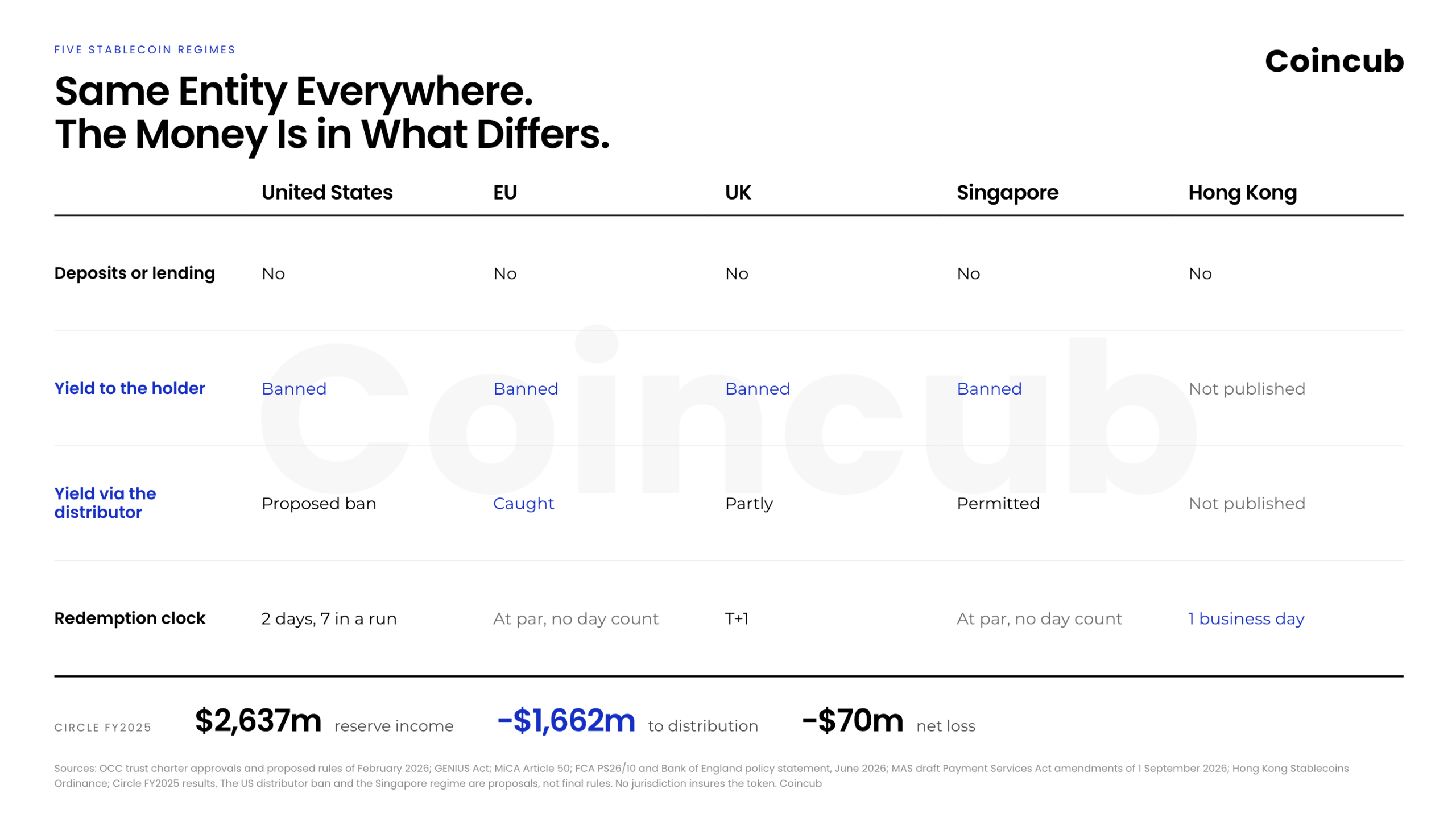

What the OCC is handing out is not a bank
A national trust charter is a fiduciary license with a federal seal, and the OCC has been unusually direct about the limits. Its August 2026 decision on World Liberty Trust Company grants digital asset custody in a fiduciary capacity, permits USD1 issuance on a nonfiduciary basis, and then states that the bank must limit its operations to those of a trust company, cannot accept deposits, and cannot become an insured depository institution or meet the definition of “bank” under the Bank Holding Company Act. The conditions run three years and include a $20 million tier 1 capital minimum and liquid assets covering 180 days of operating expenses, with an instruction to conform, cease or divest whatever does not comply with the GENIUS Act.
Those numbers are the interesting part, because they are small. The OCC’s February 2026 proposed rules set a floor of $5 million in capital for a federal qualified payment stablecoin issuer, with the agency noting that viable business models it has seen run between $6.05 million and $25 million, plus a liquidity backstop covering six to twelve months of operating expenses and a redemption obligation of two business days that stretches to seven calendar days only when redemptions pass 10% of outstanding issuance inside 24 hours. Against a de novo commercial bank, that is nothing. The entry ticket was never the hard part, because the constraint sits in what the entity is allowed to do once it opens.
State regimes survive underneath, and only to a point. A state-qualified issuer may operate under state supervision while consolidated issuance stays at or below $10 billion, and Treasury’s April 2026 principles require the state regime to be at least as stringent as the federal one in substance, not merely in form. Cross the threshold and the issuer notifies the OCC within five business days and transitions to federal oversight within 360 days or stops issuing. So a state license works below that ceiling and stops working above it, with the ceiling fixed in statute rather than left to supervisory judgment.
The float is the product, and four regulators are taxing it
Europe got there first and drew the widest perimeter. MiCA Article 50 bars issuers of e-money tokens from granting interest, bars service providers from granting it too, and then defines interest to include “any remuneration or any other benefit related to the length of time during which a holder of an e-money token holds such e-money token,” reaching net compensation and discounts paid by third parties and effects delivered through the pricing of other products. That was law in 2023.
The GENIUS Act took the narrow version, prohibiting an issuer from paying holders any form of interest or yield in connection with holding the token, and left the distribution channel alone. The OCC has now proposed to close that gap, creating a rebuttable presumption of violation where an issuer contracts with an affiliate or a related third party to provide yield, with “related third party” drawn wide enough to catch exchanges, wallets and white-label arrangements. Issuers can rebut in writing. Whether that survives the comment file is the single most consequential open question in US stablecoin economics.
Britain landed between the two. PS26/10, published on 30 June 2026, bars issuers from paying interest and bars third parties from passing on the return on backing assets, while leaving other rewards alive and promising further work on the competition and economic implications of interest, which is a regulator saying out loud that it has not finished thinking about this. Singapore’s draft goes further on the issuer and stops short on the channel, prohibiting interest, returns or other benefits attributable directly or indirectly to holding while expressly permitting revenue sharing with third parties.
Circle’s 2025 results show what the perimeter is worth, reporting $2,747 million of total revenue and reserve income, $2,637 million of that from the reserve alone, against $1,662 million of distribution and transaction costs, a net loss from continuing operations of $70 million, and $75.3 billion of USDC outstanding at the end of the period. Roughly 63 cents of every dollar of reserve income left the building through the distribution channel. The regulated, chartered, fully compliant issuer keeps around a third of what its own reserve earns, and the yield that the statute forbids it to pay reaches the holder anyway, in a different wrapper, from a different counterparty. Banks understand this perfectly well, which is why the Bank Policy Institute spent August 2025 arguing to close the loophole and cited a Treasury estimate of $6.6 trillion in potential deposit outflows if stablecoins can offer yield.
For anyone entering now, that split says the license was never the moat. Two firms holding identical charters, identical reserve rules and identical redemption obligations end up competing on who can buy shelf space at an exchange or a wallet, and the incumbent buying it has a multi-year head start and a renewed contract. A bank facing the same competition would raise the rate it pays for balances, which is the one instrument every regime here has removed. A stablecoin license and a bank charter are not two routes to the same business, because the mechanism a bank charter exists to support, funding yourself by paying the people who hold your liabilities, is the mechanism a stablecoin issuer is forbidden to use.
The Bank of England put a number on the tax
Where the other regulators legislate against the payment of yield, the Bank of England went after the yield itself. Its 22 June 2026 policy statement lets a systemic sterling issuer hold up to 70% of backing in short-term UK government debt and requires the remaining 30% to sit as unremunerated deposits at the Bank, up from the 60% floated in consultation and still a standing haircut on the only revenue line the business has. Deputy Governor Sarah Breeden paired it with a temporary issuance guardrail capping each systemic stablecoin at £40 billion and, notably, no restriction on holdings by households and businesses, so the constraint binds the issuer rather than the user.
The 30% floor is a reserve requirement wearing different clothes. An issuer running the maximum permitted book earns a market return on 70% of its assets and nothing on the rest, before it pays a distributor a penny. The consultation on the draft Code of Practice closes on 22 September 2026 with the Code finalized by year end, and the regime opens for business in 2027.
What you can hold, and how fast you have to hand it back
Underneath the interest ban sits a second set of rules deciding the same economics from the asset side. The OCC’s proposal confines reserves to cash, balances at the Federal Reserve, short-term Treasuries, qualifying repo backed by Treasury collateral, money market funds holding only eligible assets, and tokenized representations of those, excludes stablecoins and other crypto outright, and then bars rehypothecation of the reserve except in narrow circumstances along with any activity unrelated to issuance, custody or reserve management. Securities lending against the reserve, the obvious way to manufacture a few extra basis points, is closed off deliberately.
The FCA declined to widen the pool at all in its final rules, keeping backing assets narrow and refusing multi-currency holdings, while allowing tokenized versions of permitted assets in, permitting a 5% buffer, capping intragroup custodians at 20% of the backing pool and holding the whole pool on statutory trust for holders. MAS wants reserves at par at all times in segregated trust accounts with permitted custodians, backed by independent attestation and audit, and is weighing a minimum cash or deposit proportion of the kind the UK and EU already run. It also proposes quarterly stress testing against idiosyncratic and systemic shocks with board-level review, and reserves the right to impose additional capital or liquidity buffers on the results, which replaces a published ratio with supervisory discretion and makes the license harder to price in a business plan.
The redemption clock diverges most of all, and a run would be settled on it. Hong Kong requires redemption within one business day. The FCA landed on T+1 with the clock starting once identity checks complete, a concession to how redemption requests arrive in practice. The OCC proposed two business days and then wrote in a circuit breaker, stretching the window to seven calendar days when redemptions pass 10% of outstanding issuance inside 24 hours. An issuer serving all three markets runs to the tightest of them, because a holder in Hong Kong has no interest in where the pressure started.
Every one of those rules reads like a prosecutor drafted it, and in a sense one did. The CFTC fined Tether $41 million on 15 October 2021 after finding that the company held sufficient fiat reserves to back USDT for only 27.6% of days across a 26-month sample from 2016 to 2018, kept unsecured receivables and non-fiat assets in the reserve, and promised routine professional audits it never obtained. The monthly attestation requirement now sitting in the GENIUS Act, in MiCA, in the Stablecoins Ordinance and in the MAS framework is that finding turned into law.
Hong Kong gave it to banks, Singapore took it away from them
Hong Kong’s Stablecoins Ordinance was sold as the first purpose-built stablecoin licensing regime in the world, and its first licensing round produced two grants against 36 formal applications filed by the 30 September 2025 deadline. Both went to banks. HSBC took one directly and Standard Chartered took the other through Anchorpoint Financial, its joint venture with HKT and Animoca Brands, licensed on 10 April 2026 with full backing in high-quality liquid assets, independent audit and redemption within one business day. A 5.6% grant rate is not a licensing regime open to fintechs, whatever the ordinance says about eligibility.
Singapore drew the opposite conclusion from the same worry. MAS published draft amendments to the Payment Services Act on 1 September 2026 creating a standalone stablecoin issuance license, and banks and merchant banks cannot use it. They must issue through a separate licensed non-bank legal entity, which MAS explains in terms of containing contagion and keeping reserve assets segregated, and the licensee is then confined to the issuance business, allowed to transmit and custody its own coin without a further license and not much else. Consultation closes 16 October 2026.
Two regulators arrived at opposite mechanics from the same instinct. Hong Kong wants a bank’s governance standing behind the issuer, Singapore wants a legal wall between the issuer and the bank’s balance sheet, and neither will let the token be a deposit. An issuer choosing between them is choosing which relationship to a bank it prefers, because both regimes assume there is one.
Europe never offered a stablecoin license at all
MiCA is often described as creating a stablecoin regime, and for the fiat-pegged tokens that most of this industry issues it did something narrower, requiring an e-money token issuer to be an authorized credit institution or an electronic money institution. There is no bespoke stablecoin authorization to apply for, because the EU decided the closest existing thing was good enough and pointed everyone at it. The consequence is that an issuer’s European entry cost is the cost of an EMI, its supervisor is a national banking or payments authority, and the interest ban applied to it from the start rather than arriving three years later in a proposed rule.
Switzerland has been the holdout, with no purpose-built license and issuers structuring around bank relationships instead, and the Federal Council opened a consultation on 22 October 2025 that ran to 6 February 2026 and would end that. The proposal creates a payment instrument institution category to replace the fintech license, removes the CHF 100 million deposit cap that made the fintech license useless at scale, and gives the holder authority to issue a particular type of stablecoin under heightened anti-money-laundering diligence, alongside a lighter crypto institution category modeled on securities firm requirements. Switzerland spent two years watching everyone else write rules and is now writing broadly the same ones.
What happens when it breaks
Nothing here is insured. FDIC coverage runs to $250,000 per depositor at an insured depository institution, and a national trust bank is by construction not one of those, so a USDC holder has no more federal protection after Circle’s charter than before it. Hong Kong lifted its Deposit Protection Scheme limit to HK$800,000 on 1 October 2024 and a licensed stablecoin sits outside it. What every one of these regimes offers instead is the reserve, the segregation and the independent attestation, none of which pays out on a schedule when an issuer fails.
Which puts a great deal of weight on what happens to that reserve in an insolvency, and the honest answer is that nobody knows. The GENIUS Act says holders’ claims to the reserve rank ahead of all other claims in the case, and Morgan Lewis flagged in July 2025 that subordinating administrative expenses to token holders makes administrative insolvency more likely and a reorganization close to infeasible, which is a criticism that accepts the priority works. Adam Levitin argued on 2 December 2025 that it does not, because “priority” in Bankruptcy Code usage describes unsecured claims under section 726 while secured claims are satisfied separately under section 725, so repo and margin counterparties outside the automatic stay, a DIP lender holding a first-priority lien, professional fee carve-outs and prepetition setoff rights all clear before a token holder sees anything. He also reads the distribution clock as running fourteen days from the required hearing rather than from the filing.
The evidence splits here and no court has tested either reading. Levitin has the better of the mechanics, since the section 725 and section 726 distinction is textual rather than interpretive and the statute’s own carve-outs permit exactly the secured arrangements he points to, though the drafters plainly intended the opposite result. Both readings stay live until an issuer of consequence fails, and an issuer of consequence failing is precisely the scenario in which the answer becomes expensive. Anyone building a treasury policy around “holders have first priority” is building on a sentence that a bankruptcy court has never construed.
Supervision is the cost nobody prices at application
Anchorage Digital took the first federal digital-asset bank charter in January 2021, and fifteen months later the OCC hit it with a consent order for anti-money-laundering program deficiencies dated 21 April 2022, which stayed in force until the agency terminated it in 2025. Three years under an order, no fine, and a compliance build running the whole time, none of which shows up in a capital table or an application fee.
Getting to the seal has hardened as well. The OCC has warned applicants against treating chartering as iterative and told them to file everything the agency needs at first submission, which reads as a response to a queue full of firms that lodged a placeholder and expected to negotiate the rest. Its proposed rule gives the agency 120 days to act and starts that clock only once an application is judged substantially complete, so the published timeline measures the agency’s work rather than the applicant’s wait. Circle’s own charter, once granted, is scoped to custody for Circle and its affiliates with a limited set of institutional customers to follow, which is a reminder of what the first year of a charter buys. You get the right to hold your own reserve under your own supervision, and the customer business comes later if it comes at all.
The license you hold decides which shelves you reach
Treasury’s proposal of 17 August 2026 turns the global comparison into an operating constraint. From 18 January 2027, a digital asset service provider cannot offer a foreign-issued stablecoin unless the issuer has the technological capability to comply with lawful orders, with reliance on the issuer’s representation permitted after reasonable diligence. From 18 July 2028, the shelf is limited to permitted US issuers and qualifying foreign issuers, and the process for determining whether a home jurisdiction runs a comparable regime has not been proposed yet. There is no reverse solicitation escape hatch either, since responding to an unsolicited US inquiry counts as an unlawful offer. Comments close on 19 October 2026.
Tether solved this by renting a charter rather than applying for one. Anchorage Digital Bank issues USAT and handles issuance, reserve management, compliance and risk, an arrangement announced on 15 September 2025 and live the following January, which leaves the largest issuer in the world holding US distribution through somebody else’s national trust bank while USDT itself faces the 2028 cliff. That is a legitimate answer to the license question and one that most of the market underrates, because the entity that issues does not have to be the entity that owns the brand.
What is left to decide
Three questions do the work the license-versus-charter framing was supposed to do, and the first is where the float goes and whether the arrangement carrying it survives contact with a regulator. If distribution takes most of the reserve income, the license is a cost center and the economics live in a commercial contract that the OCC has proposed to presume unlawful, that MiCA already catches through Article 50(3), that the FCA has half-caught, and that MAS has expressly blessed. Same product, four different answers, and the answer determines the margin.
The second is whether the product needs a balance sheet. If it has to earn a return for the holder or fund lending, no stablecoin license anywhere permits it, and the instrument being described is a deposit. JPMD, live on Base since 12 November 2025 for institutional clients, is a deposit token, a claim on a bank issued by that bank, and it exists outside every framework discussed here because it does not need one.
The third is which shelf you need and by when. The UK’s savings-provision application window opens on 30 September 2026 and closes on 28 February 2027, with the regime commencing 25 October 2027 and firms that miss the window facing a pause in activity until authorized. Singapore’s consultation closes 16 October 2026, Treasury’s on 19 October 2026, and the GENIUS Act takes effect on 18 January 2027 at the latest. The sequencing is tight enough that a firm serving all three markets is drafting three applications at once, this quarter.
None of that resolves into a decision matrix, because the regimes have already converged on the entity and diverged on the economics. The structure is settled and identical almost everywhere. The money is in the parts still being argued over.
See more: Compare verified licensed companies
Frequently Asked Questions (FAQ)
Can a stablecoin issuer with a national trust charter take deposits or make loans? +
No. The OCC's charter conditions require the bank to limit its operations to those of a trust company, bar it from accepting deposits, and bar it from becoming an insured depository institution or meeting the Bank Holding Company Act definition of a bank.
Is a stablecoin covered by deposit insurance anywhere? +
No. FDIC coverage attaches to deposits at insured depository institutions, and the entities issuing stablecoins under these regimes are not insured depository institutions. Hong Kong's Deposit Protection Scheme, raised to HK$800,000 on 1 October 2024, does not reach licensed stablecoins either.
Can a stablecoin issuer pay interest to holders? +
No, in every regime examined here. MiCA Article 50 bars it and extends the ban to service providers and to third-party compensation, the GENIUS Act bars the issuer from paying it, the FCA bars issuers and bars third parties from passing on the return on backing assets, and MAS's draft bars benefits attributable directly or indirectly to holding.
How much capital does a federal qualified payment stablecoin issuer need in the US? +
The OCC's proposal sets a floor of the greater of the amount specified in its approval order or $5 million, and the agency has said viable business models it has reviewed run between $6.05 million and $25 million, plus a liquidity backstop covering six to twelve months of operating expenses.
What happens when a state-licensed issuer grows past $10 billion? +
It notifies the OCC within five business days and transitions to federal oversight within 360 days, or stops issuing new tokens.
Can a bank issue a stablecoin in Singapore? +
Not directly under the draft amendments published on 1 September 2026. Banks and merchant banks would have to issue through a separate licensed non-bank legal entity, which MAS frames as containing contagion and keeping reserve assets segregated.
When does the UK stablecoin regime start, and when do firms have to apply? +
The regulated activities commence on 25 October 2027. The savings-provision application window runs from 30 September 2026 to 28 February 2027, and firms that do not apply within it cannot rely on the transitional provisions.
Do stablecoin holders really have first priority if the issuer fails? +
That is what the GENIUS Act says and it has never been tested. Adam Levitin argues holders rank fifth in practice, behind repo and margin counterparties, DIP lenders, professional fee carve-outs and setoff claims, because Bankruptcy Code "priority" covers unsecured claims while secured claims are paid separately.