



 Buy a Licensed Company
  Explore VASP Data
  Talk to an Expert

 Dren Hima
 is Head of Research at Coincub, leading research across digital asset regulation, licensing, market structure, tokenization and institutional adoption.
Dren Hima
Dren Hima is Head of Research at Coincub, leading research across digital asset regulation, licensing, market structure, tokenization and institutional adoption.
AFSL Scope After BPS Financial: Capacity Beats Coverage

- The BPS Financial appeal turned on representative capacity, not on whether the principal’s AFSL reached the product, so a corporate authorized representative arrangement can be validly appointed, correctly registered and still leave the representative unlicensed.
- Scope is an intersection of entity, service, capacity, product class, client class, conditions and relief, and a mismatch on any single axis puts the conduct outside the authorization however well the others line up.
- ASIC treats dealing under s 766C(1) and arranging under s 766C(2) as separate selections on the license application, which means “licensed to deal in securities” says nothing about whether the entity may issue, act on behalf of a client, or arrange.
- Classification runs before license matching. Web3 Ventures and Wallet Ventures apply the same statutory discipline and reach opposite results, so novelty is no reason to over-classify and an investment-like return is no reason to assume the elements are made out.
- The wholesale client thresholds have not moved since 2001, and with roughly 18% of Australian adults qualifying as of 2024 against 1.9% in 2002, a wholesale-only authorization pushes the classification risk onto the licensee on every onboarding.
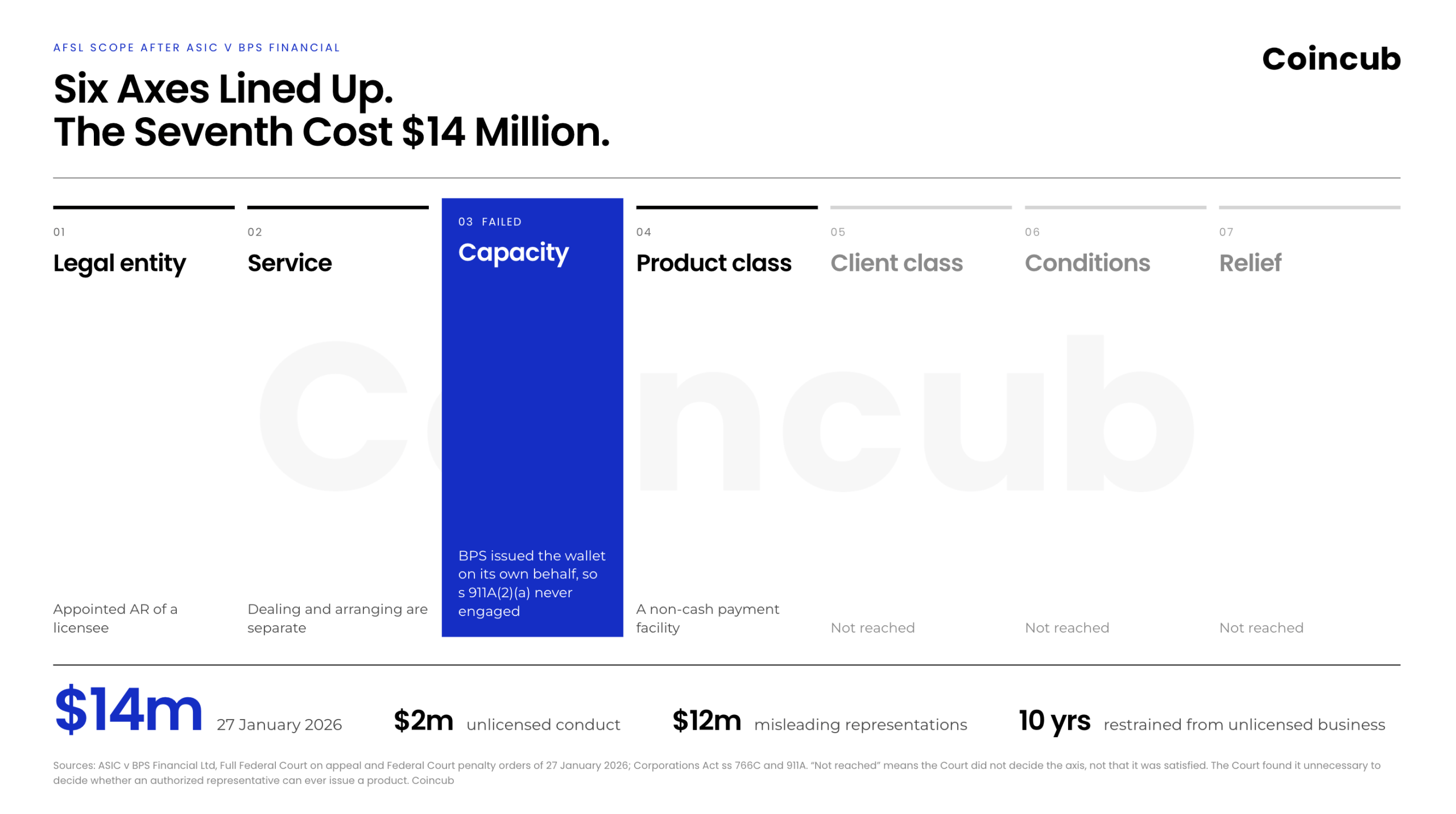
BPS Financial was a properly appointed authorized representative of an AFSL holder, PNI Financial Services, the appointment was real, and the Qoin Wallet it issued was a non-cash payment facility of exactly the kind an AFSL can cover. On 27 January 2026 the Federal Court ordered BPS to pay $14 million in penalties, $2 million of it for unlicensed conduct and $12 million for misleading representations, and restrained the company for ten years from carrying on a financial services business without a license of its own.
The representative-capacity question is what sank BPS, because the Full Federal Court held that BPS was acting on its own behalf when it issued the Qoin Wallet rather than as a representative of PNI, which meant the exemption in s 911A(2)(a) simply did not engage, and everything downstream of it (the register entry, the written authority, the principal’s product authorizations) became irrelevant. Whether PNI’s license reached the product was never the operative question.
Anyone still running AFSL due diligence as a coverage exercise, matching a product against a licensee’s authorization list and stopping there, is checking the wrong thing.

The exemption has two limbs and the second one is the hard one
Section 911A(2)(a) requires both that the person be an appointed authorized representative and that the relevant financial service be provided in a representative capacity, and the Full Court’s whole judgment sits on that second limb. Not every act of an authorized representative in providing a financial service is provided in that capacity, which is a proposition that sounds obvious written down and that a large slice of the market has been ignoring since 2001.
The factors the Court weighed are worth reading as a checklist rather than as a narrative, because they map onto how these arrangements get built. BPS developed the product before it engaged with the licensee, so the AFSL holder had no involvement at inception. BPS had already tried to act as authorized representative of a different licensee without a legal basis for doing so. BPS went looking for AFSL holders precisely because it lacked authority to issue on its own, conduct the Court described as “AFSL provisioning”. BPS prepared the key documents itself, including the disclosure material, and the mere mention in some of them that BPS was an authorized representative of PNI did not establish representative capacity. And the contractual relationships ran directly between BPS and the users, conferring benefits and assuming obligations on BPS rather than on the licensee.
Read together, those factors describe the license-rental model as it is commonly sold, where a product originator builds and owns the customer relationship and buys a regulatory wrapper afterward. Corporate authorized representative arrangements structured that way now carry a specific, quantified downside.
What the Court did not decide is equally load-bearing and gets flattened in most of the commentary. The Full Court found it unnecessary to decide whether an authorized representative can ever be an issuer of a financial product, so the proposition “an AR can never issue” is not the law, and a scope opinion that asserts it is overreaching. The honest formulation is narrower and less comfortable, because it holds that representative capacity is a factual question decided on the totality of the arrangement, that issuance makes it very difficult to satisfy, and that nobody yet knows whether any single one of the five factors is independently fatal. ASIC has flagged its own guidance as under revision following the appeal decision and says it will update INFO 251 during 2026, which means the regulator’s settled position on the point does not exist yet. A scope opinion should record that the question is open rather than assert a rule the Court declined to draw.
The adjacent exemption deserves the same scrutiny, because firms that fail the representative-capacity test tend to reach for the intermediary authorization in s 911A(2)(b) instead, and INFO 251 already blocks the obvious combination by stating that a trustee relying on that exemption cannot also be an authorized representative in relation to making offers, since the product provider cannot also be the party arranging the issue. Two exemptions that look interchangeable on a structure chart are doing different jobs, and stacking them collapses the separation each of them assumes.
Scope is an intersection, and every axis can fail on its own
Capacity is one axis of several, and a license authorization only answers a question when all of them are specified together. The operative combination is legal entity, financial service, service capacity, product class, client class, license conditions, and applicable relief, and a single mismatch on any one of them puts the conduct outside the authorization no matter how well the others line up.
ASIC publishes the grid itself, which is the useful part. Its carbon markets material sets out a table of possible authorizations that crosses financial service against financial product against client type, separating advice (general only, or personal and general) from dealing on behalf of another person, from dealing by issuing, from market making, from custody, from operating a registered scheme. The same page contains a small trap worth noticing, since custodial and depository authorizations already apply to all types of financial products, so a licensee holding one does not need to vary it to cover emissions units. Product-class breadth on the custody line does not convert custody into dealing, and a due-diligence note that reads “authorized in respect of all financial products” without naming the service is a note that says nothing.
The dealing verb carries more weight than most compliance matrices give it. ASIC’s application process distinguishes dealing within the meaning of s 766C(1) from arranging within the meaning of s 766C(2) as separate selections, and lets applicants take either or both, which means “licensed to deal in securities” is not a statement about whether the entity may issue, may acquire on behalf of a client, or may arrange for someone else to transact. The same source confirms that advice can be limited to general advice only for some products, that individual authorizations can be restricted to wholesale clients only or retail clients only, and that ASIC treats the service and product permissions as authorization conditions distinct from other conditions such as key person and standard conditions. Those are four separately variable dimensions recorded in the same block of text, and a due-diligence note routinely collapses all four into a single sentence.
Arranging does the most damage when it gets collapsed into advice, because it catches businesses that never touch the product. Introducers, comparison sites, execution-only interfaces, fintech front-ends that transmit applications to an issuer, and accountants walking a client through an SMSF establishment are all candidates for s 766C(2) analysis, and an advice authorization resolves none of it. An entity holding broad advice permissions and no arranging permission has a real problem the moment its advice process ends in a button that submits an application.
Market making and custody sit outside the dealing conversation entirely and get folded into it constantly. ASIC describes making a market as regularly quoting prices at which people can buy or sell financial products, and describes a custodial or depository service as holding a financial product, or a beneficial interest in one, on trust for a client, and neither description is satisfied by a dealing authorization however broadly drawn. A firm running a continuous two-way quote as principal is doing something the statute names separately, and a firm controlling the keys to a client’s tokenized holdings has a custody question to answer whatever its dealing permissions say.
Classify the product first, then look at the license
The instinct to start from the license wording and work backward is the second structural error, and the High Court closed the argument on it. In ASIC v Web3 Ventures, decided 17 June 2026, the Court unanimously held that Block Earner’s Earner product was a financial product on two independent routes, as a facility through which customers made a financial investment and as a derivative, reversing a Full Court decision that had found it was neither.
The s 763B reasoning is more useful than the outcome, since the contribution was AUD rather than cryptocurrency, users never held rights to the underlying crypto because Block Earner retained ownership throughout, and the 7% fixed return was a financial return “for” the investor even though Block Earner profited simultaneously, since the statute contains no requirement that the operator have skin in the game. On the derivative limb, the amount reconverted and returned varied by reference to the value of the digital asset and exchange rates, the conversion mechanism was integral to the arrangement rather than severable from it, and the exception for contracts for the future provision of services did not apply because the object of the arrangement was the yield. The Court treated the labels in the terms of use, including “lend” and “loan”, as inapposite to the true legal character of what the parties had agreed.
Against that sits ASIC v Wallet Ventures, where on 24 July 2025 the Full Federal Court dismissed ASIC’s appeal and held that the Finder Earn product was not a debenture, so Finder Wallet had not contravened the Act as alleged. The two results are read across the market as a contradiction, with Web3 Ventures cast as expansionary and Wallet Ventures as a brake, and that reading is wrong in a way that produces bad scope opinions.
Both decisions apply the same discipline, which is that the statutory elements of the asserted category have to be established on the arrangement as the parties built it. Substance over label cuts toward regulation when the substance satisfies the elements and away from it when the substance does not, and an economically investment-like return does not by itself satisfy the specific definition of a debenture. The operational consequence for a scope report is that novelty is not a reason to over-classify into whatever regulated box sits closest, and commercial resemblance is not a reason to under-classify either. Where the two cases genuinely leave the field unresolved is the space between them, since a yield-bearing arrangement that fails the debenture elements may still clear s 763B or s 761D on a different set of facts, and nobody should be writing that a product is outside Chapter 7 on the strength of one failed category.
Three courts read the same Block Earner contract and produced three different combinations of answers, with the primary judge finding a financial investment, the Full Court overturning that and rejecting the derivative limb as well, and the High Court restoring the first finding and adding the second. That spread is the warning for anyone mapping a novel product to an authorization list, because it shows the characterization question was genuinely hard on the documents.
Wholesale-only puts the classification risk on the licensee
An authorization restricted to wholesale clients fails the moment the client is legally retail, and a license review establishes only half of that. Whether the customers in front of the firm satisfy the statutory tests is a separate factual and legal question no amount of license reading answers, and the thresholds doing that work have not moved since 2001.
The Parliamentary Joint Committee on Corporations and Financial Services examined exactly this and reported in February 2025 recommending no increase, leaving the product value test at $500,000, the net asset test at $2.5 million and the gross income test at $250,000, with a suggestion that government consider a periodic review mechanism instead. The drift those unindexed numbers have produced sits in the Committee’s own report, which records that around 1.9% of Australian adults met the individual wealth tests in 2002, that roughly 18% qualified as of 2024, and that the figure is projected to reach 43.6% by 2041.
For a scope opinion the consequence is that wholesale-only restrictions now catch a far larger share of the population than they were drafted to catch, and regulatory interest in whether classification was performed properly rises with that share. A signed acknowledgment buried in an application form does not establish wholesale status, and a firm whose entire authorization set is wholesale-restricted carries the classification risk on every client it onboards.
The conditions layer is not administrative trivia
Everything above concerns the authorization block, and the authorization block is not the license. PF 209 sets out the standard conditions ASIC says will usually be applied, subject to individual circumstances, and the prescribed conditions under reg 7.6.04 of the Corporations Regulations apply in addition to those, which means a reviewer who has read the bespoke authorization paragraph and nothing else has read perhaps a third of the operative instrument.
Key person conditions bite hardest, because they can suspend an otherwise intact license. ASIC suspended the license of Focused Financial Advice in November 2025 after the firm provided financial services for more than two years without a key person, having failed to apply for a variation or notify ASIC within five days of the departure, and the suspension was lifted only in December once a variation was approved. MW Planning fared worse, suspended on 11 December 2025 for failing to appoint a replacement responsible manager after ASIC banned the incumbent, and cancelled outright on 4 May 2026 when the underlying problems went unfixed. In both cases the services and products paragraph was untouched throughout, and in both cases the license stopped working.
The cancellation of Pulse Markets, effective 11 February 2026, deserves particular attention from anyone who maintains a compliance manual. Among ASIC’s grounds were failures to adequately supervise the firm’s corporate authorized representatives, to monitor CAR websites and marketing, to maintain adequate compliance, breach and incident registers, and to keep compliance manuals containing accurate information about the license authorizations. A firm can hold a perfectly accurate license PDF and still lose the license because its internal description of that license is wrong, and ASIC treated the inaccuracy as a ground of cancellation rather than as a housekeeping complaint.
Absence from the license does not mean the conduct is unlawful
The mirror-image error runs the other way, and it produces false negatives in due diligence rather than false positives. ASIC Corporations (Non-cash Payment Facilities) Instrument 2026/167, which remade the 2016 instrument and extends the relief to April 2031, provides among other things that AFS licensees who advise about or arrange for the use of payment services do not need to hold an authorization to do so on their license. An activity absent from the authorization list is therefore not automatically outside the perimeter, and the defensible conclusion is an exemption conclusion rather than a scope conclusion, phrased so a reader can tell the difference.
Relief cannot be cited by title, though, because the entity, the service, the product and the facts all have to satisfy every operative condition, and the instrument has to have been in force across the relevant period. Precedent memoranda that cite class orders by number without a status check are the standard failure mode here, since the 2016 instrument that 2026/167 replaced had itself consolidated earlier relief, and the citation chain in most compliance manuals stopped updating years ago.
Everything on this page has a use-by date
ASIC withdrew RG 2 and RG 3 and folded their content into a reissued RG 1, published 16 June 2025 and updated again on 21 April 2026, which means a compliance manual citing the old licensing kit is citing withdrawn guidance. INFO 251 is under revision. Applications and variations run through the Regulatory Portal rather than through ASIC Connect, which handles authorized representative administration, so a report that says “ASIC Connect confirms the license scope” is describing the wrong system.
Digital assets move fastest and carry the sharpest date sensitivity, and the Digital Assets Framework received Royal Assent on 8 April 2026 and commences 9 April 2027, introducing digital asset platform and tokenized custody platform authorizations, and ASIC has said that many firms licensed on the current INFO 225 analysis will need to add DAP and TCP authorizations once that regime starts, with penalties for unlicensed operation reaching up to 10% of annual turnover. A Chapter 7 conclusion that is correct today has a known expiry.
One conflict on ASIC’s own site is worth flagging rather than smoothing over, since the deadline page still frames the application cutoff as 30 June 2026 while ASIC’s announcement of 25 June 2026 extended the no-action position to 30 September 2026, giving firms an additional three months and widening the scope to cover firms operating under authorised representative arrangements and intermediary authorisation arrangements with an AFS licence holder. The extension is the more recent statement and controls, but the earlier page has not been reconciled, so anyone relying on the regulator’s website should date the version they read.
Historic scope carries the same problem in reverse, because the register shows the position today and says nothing reliable about what was authorized when the conduct occurred. Variations, suspensions and cancellations all move the line, and a firm’s own copy of the original license plus its variation notices is the evidence that answers a question about 2023.
What a defensible conclusion looks like
The formulation that survives scrutiny names every axis and its assumption, so it reads closer to “on the information reviewed, the license appears to authorize this entity to provide this service in this capacity in relation to this product class to this client class, subject to these conditions, assuming the arrangement is properly characterized as this product, and we have separately considered this relief instrument” than to anything shorter. It is longer than a client wants, and it is the only version that holds up when someone tests it against the underlying contracts.
Naming the uncertainty is the part most reports skip, and the difference is between saying scope is unclear and saying which proposition is unresolved, because the second version tells a reader what further work would close it. Doubt about whether a facility is a derivative within s 761D is a different problem from doubt about whether a distribution model amounts to arranging under s 766C(2), and only one of them gets answered by reading the license again.
The alternative is the shorter sentence that BPS Financial’s arrangement would have passed, since the company held an appointment, the appointment sat on the register, and the principal held a license. None of that touched the question the Court decided the case on.
Frequently Asked Questions (FAQ)
Does a principal's AFSL cover everything its authorized representative does? +
No. The exemption in s 911A(2)(a) has two limbs, and the second requires the financial service to be provided in a representative capacity. The Full Federal Court held BPS Financial was acting on its own behalf when it issued the Qoin Wallet, so the exemption never engaged and the appointment itself did not save it.
Can an authorized representative issue a financial product? +
The Full Court found it unnecessary to decide, so there is no rule either way. On the BPS facts the five factors the Court weighed made representative capacity impossible to establish, and ASIC has flagged INFO 251 as under revision, so the regulator's settled position does not exist yet.
Is a dealing authorization enough to cover arranging? +
Not on its face. ASIC's application process treats dealing within s 766C(1) and arranging within s 766C(2) as separate selections that an applicant may take either or both of, which is why introducers, comparison sites and advice businesses that transmit implementation instructions need the arranging question answered on its own.
If an activity is absent from the AFSL authorizations, is it unlawful? +
Not necessarily. ASIC Corporations (Non-cash Payment Facilities) Instrument 2026/167 provides that AFS licensees advising about or arranging the use of payment services do not need an authorization for it on their license. The defensible conclusion in that case is an exemption conclusion rather than a scope conclusion, and every operative condition of the relief has to be satisfied.
Did the wholesale client thresholds change? +
No. The Parliamentary Joint Committee reported in February 2025 recommending no increase, leaving the product value test at $500,000, the net asset test at $2.5 million and the gross income test at $250,000, with a suggestion that government consider a periodic review mechanism.
When does the Digital Assets Framework start, and what does it do to existing authorizations? +
It received Royal Assent on 8 April 2026 and commences on 9 April 2027, introducing digital asset platform and tokenized custody platform authorizations. ASIC has said many firms licensed on the current INFO 225 analysis will need to add DAP and TCP authorizations once the regime starts, and the current no-action position runs to 30 September 2026.









