



 Buy a Licensed Company
  Explore VASP Data
  Talk to an Expert

 Dren Hima
 is Head of Research at Coincub, leading research across digital asset regulation, licensing, market structure, tokenization and institutional adoption.
Dren Hima
Dren Hima is Head of Research at Coincub, leading research across digital asset regulation, licensing, market structure, tokenization and institutional adoption.
Singapore DTSP License: 14 Months, Zero Licensees

- MAS’s Financial Institutions Directory lists 3,653 entities across 48 license types as of 7 September 2026, and Digital Token Service Provider is not one of them. Fourteen months after commencement, there is no public record of a single grant.
- The refusal power sits in section 138(3)(f)(iii), which lets MAS decline unless it is satisfied the public interest will be served. An applicant with clean books and clean officers can still be told no, and there is nothing to argue against.
- The First Schedule lists ten digital token services, including advice and research published to overseas readers, and section 137 presumes a secondary business that cannot be rebutted by showing the token service was incidental to something else.
- The widely reported penalty is wrong. Corporations face S$250,000 with no imprisonment, individuals face S$125,000 and up to three years, and both carry daily fines of S$25,000 and S$12,500 while the offense continues.
- MAS licenses what it can inspect. It revoked Bsquared Technology’s Major Payment Institution license on 14 May 2026 after an onsite inspection, and told Parliament on 5 August 2026 that close to 300 applications have produced 37 licensed digital payment token providers.
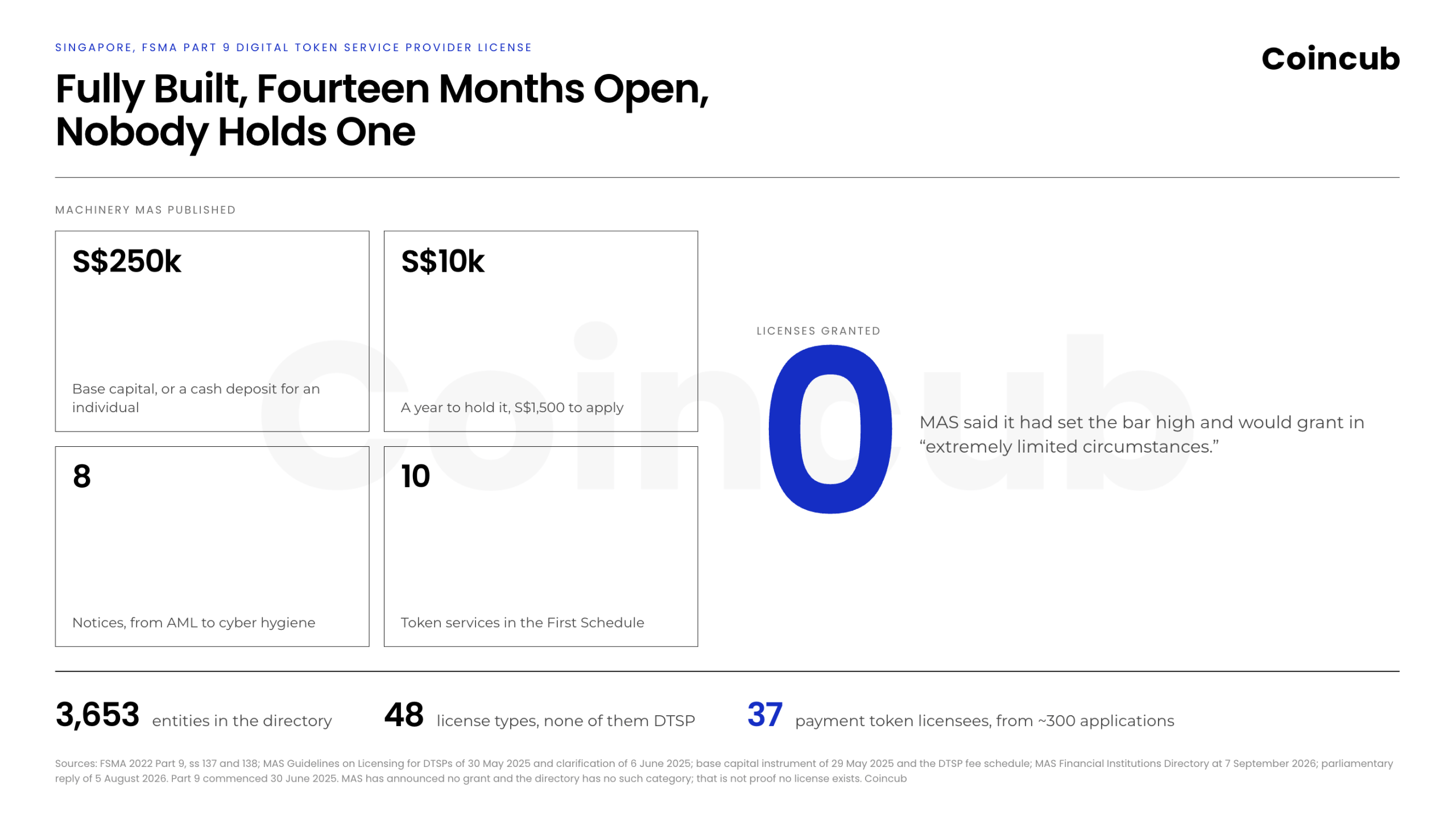
MAS’s Financial Institutions Directory lists 3,653 regulated entities across 48 license types, everything from Lloyd’s Asia Scheme to SGS Primary Dealer to Money-changing Licensee. Digital Token Service Provider is not among them. Part 9 of the Financial Services and Markets Act 2022 came into force on 30 June 2025, and fourteen months later the directory has no such category, MAS has announced no grant, and no firm has announced holding one.
Everything else exists. There is an instrument made on 29 May 2025 setting base capital at S$250,000 for companies, the same figure as a total capital contribution for partnerships, and the same figure again as a cash deposit lodged with MAS if the applicant is a human being. There is a fee schedule charging S$1,500 to apply and S$10,000 a year to hold it, with a pro-rating formula for the year of grant that distinguishes between 365-day and 366-day years. There is Form 1 to apply, Form 2 to approve a chief executive, and Form 3 for the annual audit. There is a stack of eight notices covering money laundering controls, suspicious activity reporting, regulatory returns, technology risk, cyber hygiene, conduct and disclosures. Somebody drafted a leap-year clause for a license nobody holds.
That gap between the machinery and the output is the whole story, and it was signposted before the regime started. On 6 June 2025 MAS put out a clarification saying it had “set the bar high for licensing” and would generally not issue one, because money laundering risks run higher in offshore-only models and MAS cannot supervise a firm whose substantive activity sits somewhere else. The same notice said MAS was aware of a very small number of affected providers and had already contacted them to discuss an orderly wind-down. Firms read that as a warning shot, and it was closer to a timetable.

What the guidelines say, and what section 138 does
The Guidelines on Licensing for Digital Token Service Providers, published 30 May 2025 and effective with the regime, put the position in a phrase that has been quoted in every law firm alert since. MAS will grant a license in “extremely limited circumstances,” and an applicant is expected to explain why it has a Singapore base while serving nobody in Singapore, show that it is already held to comparable standards where it does operate, and satisfy MAS that its structure raises no supervisory problem. Guidelines are not law, so a certain amount of industry commentary treated that language as posture, the kind of thing a regulator says before it quietly starts approving people.
But the operative constraint is in the statute, and it is broader than the guidelines. Section 138(3) sets out what MAS must be satisfied of before granting, and alongside the usual fit and proper test and financial condition test sits a limb requiring MAS to be satisfied that the public interest will be served by granting the license, followed by a catch-all covering any other criteria the Authority considers relevant. An applicant can clear capital, staff a compliance function, pass every named test, and still be refused on a ground that does not require MAS to identify a defect in the applicant at all. Section 138(5) gives a right to be heard before refusal, which is worth something, though a hearing on whether the public interest is served by licensing your business model is not a hearing you win with better documentation.
Taken together, the guidelines stop reading as discouragement and start reading as an accurate description of the discretion Parliament handed over. The bar works as a judgment MAS makes about whether a supervisory relationship is possible at all, rather than as a threshold a sufficiently well-capitalized firm eventually clears, and for a business whose front office, customers and counterparties are all somewhere else, MAS has already published its answer.
Ten services, and a presumption you cannot argue with
Most coverage of the regime describes it as a rule about offshore exchanges. The First Schedule is considerably wider than that, listing ten separate digital token services. Dealing in tokens and facilitating exchange are the obvious two. Then come accepting tokens from one account for transmission to another, arranging that transmission as principal or agent, and inducing or attempting to induce anyone to enter an agreement to buy or sell. Safeguarding a token where the provider has control is there, and so is carrying out a customer instruction relating to a token under control, which reaches staking services and managed execution rather than custody alone. Two further limbs cover the same acts performed on a digital token instrument, meaning the key or credential itself, which catches key management businesses that never touch a balance.
The tenth is the one that should worry people who do not think of themselves as a financial business. Any service relating to the sale or offer for sale of digital tokens that involves providing advice, directly or through publications or writings, in electronic or print form, is a digital token service. So is providing advice by issuing or promulgating research analyses or research reports. A Singapore-incorporated research shop publishing token analysis to a subscriber base outside Singapore is inside the definition on its face, and the fact that this reading sweeps in a good deal of what the industry calls media is not obviously an accident.
What removes the escape hatch is section 137. Where a person provides a digital token service while carrying on some other primary business, the Act presumes a secondary business of providing that service, and it then says in terms that the presumption is not rebutted by proof that the service was related or incidental to the primary business. The drafting anticipates the argument every founder makes, which is that the token piece is a small side activity attached to something else, and it forecloses it in advance. Exclusions do exist, and they are narrow. Technical service providers stay outside so long as they never come into possession of money or tokens, which covers hosting, data processing and network provision. Central bank digital tokens and limited purpose tokens such as loyalty points and in-game assets are carved out. Lawyers, accountants, liquidators and public statutory corporations sit in the Second Schedule. Utility and governance tokens fall away earlier, because a digital token has to be a digital payment token or a tokenized capital markets product before any of this engages, which is the single most useful line in the regime for teams building non-financial infrastructure.
The trigger is the desk, not the letterhead
Two separate hooks operate in section 137 and firms routinely check only one of them. Subsection (1) catches an individual or a partnership that, from a place of business in Singapore, carries on a business of providing any digital token service outside Singapore. Subsection (3) catches a Singapore corporation carrying on that business whether from Singapore or elsewhere. A founder with no Singapore entity and a desk in a coworking space is inside the first. A Singapore private limited company whose entire team sits in Dubai is inside the second, and moving the people accomplishes nothing while the company stays Singapore-incorporated.
Place of business is defined to include any location used for carrying on business, with the drafters going out of their way to name a kiosk that can be moved from one location to another. Permanent place of business, the thing an applicant is required to have, means each fixed location in Singapore used for carrying on the business, whether or not it all happens within a single building or at a single address. Whether the business is being carried on outside Singapore turns on facts rather than labels, and Gibson Dunn reads front-office location and customer location as doing most of the work, with MAS attaching particular weight to where the customers sit.
The individual limb produces the sharpest arithmetic in the regime. A natural person applying for a license lodges S$250,000 with MAS as security in the form of a cash deposit, rather than capitalizing a company with it, so a solo advisor publishing token research to overseas subscribers is looking at a quarter of a million dollars parked with the regulator, a Singapore office, an annual audit and a recurring fee, all against a license MAS has said it will generally not issue. No individual appears to have taken that trade.
The penalty everyone printed wrong
Coverage in June 2025 settled on a single number, and it circulated for a year. Break the rules and you face a S$250,000 fine and jail, roughly US$200,000, said the wire copy. Section 137(6) does not say that. A corporation convicted of carrying on an unlicensed digital token business faces a fine not exceeding S$250,000 and no imprisonment, because companies do not go to prison. An individual or a partnership faces a fine not exceeding S$125,000 or imprisonment up to three years or both. The headline merged the corporate fine with the individual prison term into a penalty that does not exist as stated.
The part nobody printed is worse for anyone tempted to run the clock. Both limbs carry a continuing-offense fine, S$25,000 per day for a corporation and S$12,500 per day for an individual, for every day or part of a day the offense continues after conviction. A firm that keeps serving overseas customers for three months after a conviction is looking at something north of two million Singapore dollars before anyone reaches for a director. That structure converts a one-time penalty into a meter, and it exists precisely because the drafters expected the conduct to be ongoing rather than a discrete event.
Licensees get their own exposure under section 138(9), where failing to meet ongoing financial or operational requirements without reasonable cause carries S$100,000 and a further S$10,000 for each day it continues. Drifting out of compliance inside the regime costs less than staying outside it, and the gap is narrower than most compliance budgets assume.
Bsquared, and why MAS licenses what it can walk into
Nothing explains the DTSP position better than what MAS did to a firm it could reach. On 20 May 2026 MAS announced it had revoked the Major Payment Institution license of Bsquared Technology with effect from 14 May 2026, sixteen months after licensing the firm on 1 January 2025. An onsite inspection during 2025 turned up significant weaknesses in risk management and conflict of interest policy, failures against the outsourcing guidelines in dealings with related entities, and, most damagingly, information provided to MAS that was false or misleading in material particulars on multiple occasions, from the application itself through to the inspection.
The sequence is the argument for the DTSP position in miniature, because MAS granted a license on the strength of an application, discovered during a physical inspection that the application had been misleading, and pulled the license. Every step of that depended on being able to walk into the business, read the books and interview the staff. Take the front office, the customers, the counterparties and the operational reality offshore, leave a Singapore-registered entity with a resident executive director and a fixed address, and the inspection that caught Bsquared catches nothing. The permanent place of business requirement in section 138(3)(a) exists so that MAS has somewhere to go, and MAS has been open about the fact that having somewhere to go is not the same as having something to look at.
MAS also noted it was reviewing the responsibilities of Bsquared’s key officers, which is the second half of the supervisory apparatus and travels even less well across borders. A regulator willing to license offshore-only models is a regulator promising an enforcement capability it does not have, and the reputational cost of that promise lands entirely on Singapore.
Close to 300 applications, 37 licensees, and an exodus that is hard to find
Answering a parliamentary question on 5 August 2026, DPM and MAS Chairman Gan Kim Yong gave the numbers for the domestic regime. Out of close to 300 license applications since digital payment token providers were brought under regulation in 2020, there are currently 37 licensees, with most of the remainder rejected or withdrawn once applicants understood what compliance required. That is an approval rate around one in eight, and it sits alongside a directory that today shows 38 Major Payment Institutions authorized for digital payment token services, the difference being a month of processing.
Those figures cut against a widely circulated claim that MAS has received over 500 applications with an approval rate below 10%, which appears in Tiger Research’s exodus report among other places. MAS’s own answer to Parliament is both more recent and more authoritative, and it is the number to use. The direction of travel in both versions is the same, which is that Singapore has been refusing most crypto applicants for six years, and the DTSP regime is a continuation rather than a rupture.
The exodus story is harder to resolve. Bloomberg reported in June 2025 that unlicensed exchanges including Bitget and Bybit were weighing exits, and Bitget’s own notice of 22 July 2026 confirms it is not licensed, approved, registered or authorized by MAS and restricts access from Singapore, without confirming the relocation reporting. On the other side, BeInCrypto argued the viral collapse narrative dissolves on contact with the licensing data, since the licensed population kept growing through the period. The honest position is that the evidence splits by what you count. Headcount and entity moves are real and mostly unquantified, and the licensed population grew anyway, so anyone claiming a measured exodus is working from anecdote rather than a register.
Nor is the receiving end of the supposed migration an open field. The SFC’s list of virtual asset trading platforms, updated on 29 May 2026, shows thirteen licensed operators plus three deemed-to-be-licensed applicants, and Hong Kong is assembling separate regimes for dealing, custody, advisory and asset management services, with an amendment bill expected before the Legislative Council during 2026. A firm leaving Singapore to get out from under a licensing perimeter is walking toward jurisdictions building their own, off the same FATF template, at roughly the same speed.
Externally, the assessment came out well. The FATF and APG mutual evaluation of Singapore published on 6 May 2026 rated the country largely compliant on Recommendation 15 and found mostly substantial effectiveness, while flagging an absence of counter-terrorist financing activity around funds transiting Singapore through banks and digital payment token providers. Closing off the models it cannot supervise and being graded on the ones it can is a coherent bet for MAS to make, whatever it costs in founders who leave.
The Hyperliquid listing is a label, not a case
For everything MAS can neither license nor prosecute, there is the Investor Alert List, and on 26 June 2026 it added Hyperliquid, one of the first major onchain protocols to land there. The list flags entities that might be mistaken for MAS-regulated firms. It carries no operational restriction and no finding of wrongdoing, and Hyperliquid said as much in response, adding that it had never claimed MAS authorization.
The instrument exists for exactly that situation. Where the substantive activity is a set of contracts on a public chain and the front end is a website, licensing has nothing to bite on and prosecution has nobody convenient to charge, so MAS reaches for the tool that shapes the information environment instead. Firms in this space tend to treat an alert listing as an accusation and respond defensively. Treating it as a disclosure obligation is more useful, because the listing is a statement about what users might wrongly assume, and the cheapest response is to stop letting them assume it.
The door Singapore opened on 1 September
Anyone reading the DTSP regime as evidence that Singapore has soured on digital assets should look at what MAS published on 1 September 2026, which is a consultation on amendments to the Payment Services Act that would create a dedicated stablecoin issuance license and put real cross-border machinery behind it. Comments close on 16 October 2026.
Two proposals in it speak directly to anyone who lost a business model in June 2025. MAS would allow stablecoins jointly issued by a Singapore issuer and a foreign issuer to sit inside the framework and carry the MAS-regulated label, which is the first time it has entertained a multi-jurisdictional issuance structure. And it would recognize a limited number of foreign-issued stablecoins regulated under a comparable overseas framework, aimed at wholesale cross-border use. Set against that, the framework hardens in the places MAS cares about, prohibiting interest paid to holders, requiring stress testing, and demanding recovery and orderly wind-down plans, with licensed issuers pulled into the FSMA as pertinent financial institutions. Ho Hern Shin framed it around tokenized markets needing a credible settlement asset.
The two regimes describe Singapore’s position precisely when they are set side by side. A firm sitting in Singapore, serving only foreign customers, supervised properly by nobody, gets refused. A firm sitting in Singapore, issuing an instrument whose reserves, redemption terms and wind-down plan MAS can inspect, gets a purpose-built license and an invitation to operate across borders. The variable is whether MAS holds the part of the business that can fail.
What in-scope firms are left with
For a Singapore-incorporated company or a founder with a desk here and customers everywhere else, the options have not improved since 2025, and applying is still the weakest of them. The strongest is getting inside a regime MAS does supervise, because a Payment Services Act license for digital payment token services covers domestic and overseas customers alike, and MAS confirmed in its June 2025 clarification that licensed providers serving Singapore may also serve customers outside it. Tokenized capital markets products point to the Securities and Futures Act instead. Either route means accepting a Singapore customer base, which is the trade being offered.
The second option is removing the Singapore hook, which means an operating entity incorporated elsewhere with the front office and the decision-making genuinely there, rather than a Singapore company with an offshore branch and a story. Section 137 catches Singapore corporations wherever they carry on the business, so re-domiciling the activity while keeping the Singapore parent achieves nothing. The third is narrowing to services outside the ten limbs, either by staying purely technical and never taking possession of money or tokens, or by working only in tokens that are neither payment tokens nor tokenized capital markets products.
One trap is worth naming for anyone who does get through. Regulation 8 lapses a license if the holder fails to start providing at least one authorized service within six months of grant, or stops providing them for a continuous six months. A dormant license held for optionality expires on its own, which removes the strategy of applying early and deciding later.
Fourteen months of an empty register is not a backlog and it is not a signal that the standard will soften once a suitable applicant appears. MAS built a complete licensing apparatus for a business model it had already decided it could not supervise, and it built it so the refusal would be lawful, documented and hard to characterize as a ban. That is a more durable position than a prohibition would have been, and firms still waiting for the first grant to set a precedent are reading a queue where there is a policy.
See more: Compare verified licensed companies
Frequently Asked Questions (FAQ)
Does a Payment Services Act license cover overseas customers? +
Yes. MAS confirmed on 6 June 2025 that providers licensed for digital payment token services to Singapore customers may also serve customers outside Singapore, and no separate FSMA license is needed for the same activity. Securities and Futures Act and Financial Advisers Act licensees and exemption-holders are similarly carved out by section 137(5).
Are utility and governance tokens caught? +
No. A digital token under Part 9 has to be a digital payment token or a digital representation of a capital markets product. Tokens used only for utility and governance fall outside that definition, and MAS said so directly in its June 2025 clarification.
Is publishing token research from Singapore a regulated activity? +
It can be. The First Schedule includes services relating to the sale or offer for sale of tokens that involve providing advice through publications or writings, and issuing or promulgating research analyses or reports. Whether a given publication is caught depends on the facts, and the drafting is broad enough that a Singapore-incorporated research business serving overseas readers should take advice rather than assume it is outside.
Can a firm argue its token activity was incidental to its main business? +
No. Section 137(2) and (4) presume a secondary business of providing the service, and state that the presumption is not rebutted by proof that the service was related or incidental to the primary business.
What happens to a DTSP license that is granted but not used? +
It lapses. Regulation 8 of the 2025 regulations ends a license where the holder does not begin providing at least one authorized service within six months of grant, or stops providing them for a continuous six months, subject to any longer period MAS allows.
What are the actual penalties for operating without a license? +
Under section 137(6), a corporation faces a fine up to S$250,000 with a further S$25,000 for each day the offense continues after conviction. An individual or partnership faces up to S$125,000, up to three years' imprisonment, or both, with a further S$12,500 per day. Licensees who breach ongoing requirements face S$100,000 plus S$10,000 per day under section 138(9).
How many crypto firms are licensed in Singapore? +
MAS told Parliament on 5 August 2026 that 37 digital payment token service providers are licensed out of close to 300 applications received since 2020. The Financial Institutions Directory showed 38 Major Payment Institutions authorized for digital payment token services as of 7 September 2026.









