


 Buy a Licensed Company
  Explore VASP Data
  Talk to an Expert

 Dren Hima
 is Head of Research at Coincub, leading research across digital asset regulation, licensing, market structure, tokenization and institutional adoption.
Dren Hima
Dren Hima is Head of Research at Coincub, leading research across digital asset regulation, licensing, market structure, tokenization and institutional adoption.
Tokenized Gold vs Gold ETFs in 2026: Who Holds the Bar

- The FCA’s 14 September 2026 call for input asks whether tokenized gold products sit inside the UK collective investment scheme and alternative investment fund perimeter, and an authorized firm cannot promote a product that lands inside it.
- PAX Gold and Tether Gold both set physical redemption at 430 tokens, around $1.85 million of metal at September 2026 prices.
- MiCA’s asset-referenced token register is still empty.
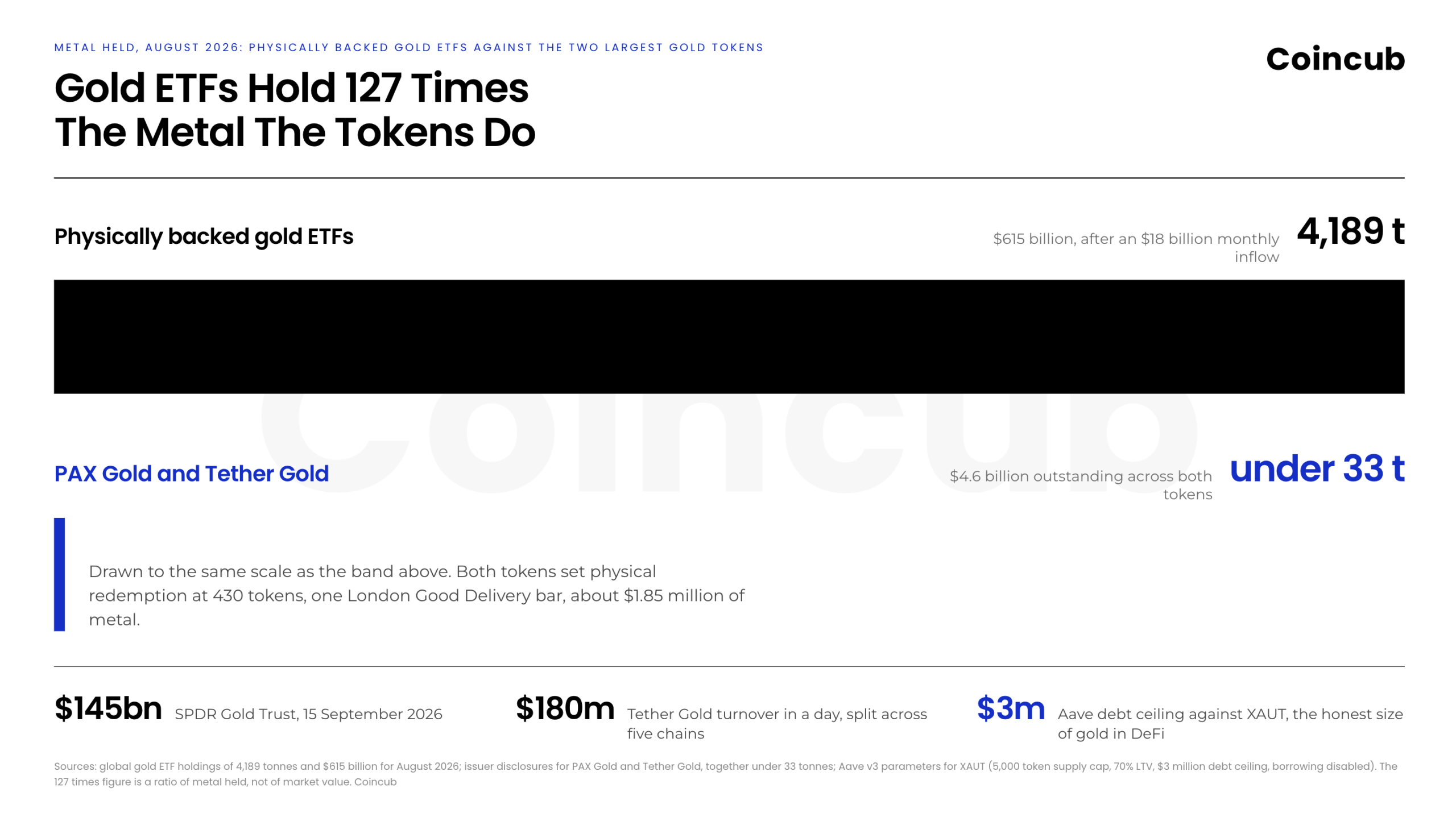
- Global gold ETFs held 4,189 tonnes in August 2026 against under 33 tonnes across the two largest gold tokens.
- Yield on a gold token comes from leasing the metal out, which turns an allocated holding into a credit exposure on top of it.
The FCA published a call for input on tokenized gold on 14 September 2026, and the question at its center is whether these products are funds. Paragraph 5.11 says a product representing direct ownership of an allocated bar, with no pooling and no management, is more likely to sit outside the collective investment scheme and alternative investment fund definitions. Paragraph 5.12 says fractional interests in a single bar that someone else manages and disposes of point the other way. Paragraph 5.2 concedes that for many gold tokens the legal and operational analysis will not be conclusive in either direction.
Most of the $4.6 billion of gold tokens outstanding sits between those two paragraphs.
The price question was settled years ago. A London Good Delivery bar, a share of a physically backed gold ETF and a gold token all track spot to within a rounding error, and the argument over which tracks better has stopped producing new information. What separates them is the legal identity of the claim, and no two major jurisdictions have landed on the same description of it.

What the FCA is asking about tokenized gold
The call for input closes on 23 October 2026 and is addressed to gold market participants, asset managers, technology providers and consumer groups. It sits alongside a feedback statement the FCA and the Bank of England published together on tokenization in wholesale markets, with a joint roadmap promised before the end of the year. Its commercial stakes come from what a collective investment scheme designation would do downstream. Under section 238 of FSMA, an authorized person cannot promote an unregulated collective investment scheme except through narrow exemptions, and section 240 blocks the same firm from approving someone else’s promotion. A gold token that lands inside the perimeter becomes a product no UK-authorized firm can market to the general public, whatever the quality of its reserves.
The paper also flags article 88F of the Regulated Activities Order at paragraph 5.17, pointing firms toward the qualifying cryptoasset definition as a separate question from the fund perimeter. A single token can therefore need two answers, one about whether it is a fund and one about whether it falls into the incoming spot cryptoasset regime. Firms operating in the UK have been running gold token businesses without either answer since 2019.
The wholesale case the FCA is testing has nothing to do with retail access. Paragraph 3.2 describes institutions mobilizing under-used gold as collateral in securities lending, with intraday movement and delivery versus payment. That is the prize London is playing for, and it depends on custody and title arrangements a vault and a clearing system will accept. Paragraph 2.8 is explicit about preserving the strengths of the existing market, naming trusted vaulting and the London Good Delivery framework as the things not to break.
Retail gets one paragraph and it reads like a gap analysis. Paragraph 3.9 lists what a buyer should be able to compare across products, including safekeeping and insurance arrangements, whether redemption is available, and the extent to which the structure is regulated at all. Paragraph 2.7 notes that products asserting to be tokenized gold have grown significantly in market capitalization over recent years.
Redemption minimums at PAX Gold, Tether Gold and GLD
Redemption is the feature that supposedly separates a token from a fund share. Paxos sets the floor at 430 PAXG plus the fee, one London Good Delivery bar, with the gold held by Paxos Trust Company in LBMA-approved vaults on a segregated basis. Tether runs the same number. Redeeming Tether Gold requires 430 XAUT, a 0.25% fee, a non-refundable verification deposit, and a Swiss delivery address, where TG Commodities arranges transit.
At roughly $4,300 an ounce in September 2026, 430 tokens is about $1.85 million. Tether Gold has close to 147,000 holding addresses. The share of them that can exercise the redemption right rounds to nothing.
Gold ETFs are blunter about the same limit. The SPDR Gold Trust handles creations and redemptions only with authorized participants dealing in blocks of 100,000 shares, and its own investor FAQ tells shareholders who want metal to go talk to their broker. Bank of New York Mellon acts as trustee, with JPMorgan Chase Bank and HSBC Bank plc custodying the bars in London. An individual holding GLD owns a beneficial interest in a trust, and the trust deals with the metal.
The practical difference at retail size is smaller than the marketing suggests. Below one bar, a token holder and an ETF holder both exit by selling into a market. What changes is who they are exposed to while they hold. The ETF holder faces a trust with a named trustee and two custodian banks. The token holder faces an issuer whose terms allow it to charge storage fees by minting itself new tokens and diluting everyone else, a provision Paxos has written into its documentation and has not used.
Allocation practice is where the FCA’s pooling test bites. Paxos records serial numbers, refiner stamps and weights against tokens and lets holders look up the bars behind their balance. That reads like the paragraph 5.11 case. A holder of 0.4 PAXG still owns a fraction of a bar that Paxos manages, moves and substitutes, which reads like paragraph 5.12. Both descriptions are accurate, and the FCA has not said which one controls.
Taking delivery and the London vault chain
The 430-token floor is one London Good Delivery bar, the unit the wholesale market moves. Custody is part of what makes a bar that unit. The LBMA calls vault managers the gatekeepers of the London market. Its own guide states that a bar only becomes and remains London Good Delivery to the extent a vault manager will accept it into the London vault.
Taking delivery therefore costs something that never appears in a fee table. A bar that leaves the recognized vault network loses the market’s standing presumption about its integrity, and readmission sits with a vault manager. Sellers in that position deal with assay and handling friction a bar in a London vault never encounters. Direct possession removes counterparty risk and adds a transaction cost visible only at the exit.
Vaulting also explains the geography. Paxos keeps its metal in London, inside the network the Good Delivery framework was written around, while Tether delivers to an address in Switzerland. A redeemer based anywhere else arranges onward transit and insurance on their own account, and that cost tracks distance instead of position size.
Physical gold is the cleanest claim and the hardest position to unwind at size. There is no issuer, no trustee and no wrapper for a regulator to reclassify, and the metal does not care what happens to any of the three. Selling at 4pm on a bad day means taking a dealer’s haircut, and the storage has to be procured, insured and audited by the owner. For a central bank or a family office working on a decade view, those are workable terms. A treasury desk that might need the position inside a week finds them expensive.
Who supervises the gold token issuer
The supervisory map changed in December 2025. The OCC approved Paxos Trust Company’s conversion from a New York limited purpose trust charter to a national trust charter on 12 December 2025, putting all of its US activity under federal supervision. Paxos markets PAXG as the only institutional-grade gold token issued under federal oversight, a claim that is currently true and says more about the field than about the product. National trust charters have become the structural answer for US token issuers across several asset classes.
The token itself still has no federal classification. The SEC and CFTC issued a joint interpretation in March 2026 sorting crypto assets into digital commodities, digital collectibles, digital tools, stablecoins and digital securities. The release never mentions gold, precious metals or physical commodities. Its stablecoin category is framed around a stable value relative to a reference asset like the dollar. The GENIUS Act’s payment stablecoin definition is keyed to a fixed amount of monetary value, which a gold-redeemable token does not promise.
Europe built the category and the register is still empty. Asset-referenced tokens are the MiCA bucket a commodity-backed token belongs in, and no issuer has been authorized under it since the regime opened, nearly two years in. Circle’s EU policy director Patrick Hansen reads that as structural failure. Nineteen e-money token issuers were authorized over the same period, between them running 29 stablecoins.
The requirements explain some of the reluctance. An ART issuer holds own funds of €350,000 or 2% of reserves, whichever is higher, and has to stop issuing once a token passes a million transactions and €200 million of daily payments. A European distributor still needs CASP authorization for the service it provides, while the instrument it distributes has no authorized issuer anywhere in the bloc.
Singapore took the narrowest route and got there first. The Precious Stones and Precious Metals Act defines an asset-backed token as an instrument backed by a precious metal that entitles the holder to it, and puts dealers under registrationwith the Ministry of Law’s AML division. Securities and derivatives under the Securities and Futures Act are carved out. The obligations are customer due diligence, record-keeping and suspicious transaction reporting, with no prudential or reserve requirement attached.
| Jurisdiction | Regime applied to a gold token | Reserve or capital rule |
| US | Issuer supervised as a national trust; no token category | None specific to the token |
| EU | Asset-referenced token under MiCA, zero authorizations | €350,000 or 2% of reserves, if authorized |
| UK | CIS and AIF perimeter under review; article 88F in play | Undecided |
| Singapore | Asset-backed token, AML registration | None |
| El Salvador | Digital asset framework covering the XAUT issuer | Attestation disclosure |
Tether Gold sits under El Salvador’s digital asset framework. Tether published its first XAUT-specific attestation in April 2025, covering 246,523 ounces against the tokens in issue. The token had been trading for five years by then, and BDO Italia is listed as the auditor on the current disclosures.
Liquidity, ETF scale and DeFi collateral capacity
Gold traded an average of $361 billion a day across major venues in 2025 and hit $965 billion a day in late January 2026, the highest on record. Physically backed gold ETFs held 4,189 tonnes and $615 billion in August 2026 after an $18 billion monthly inflow, the second largest on record in value terms. GLD alone carried $145 billion as of 15 September 2026, with iShares Gold Trust at $64.1 billion.
PAX Gold and Tether Gold together hold under 33 tonnes. Gold ETFs hold roughly 127 times as much metal. Tether Gold turns over on the order of $180 million in a day, a real market and a thin one next to a $145 billion fund whose authorized participants absorb size without moving a quote. That turnover is also split across Ethereum, BNB Chain, Arbitrum, Avalanche and Monad, so the depth on any one venue is a fraction of the headline.
The collateral story is smaller still. Aave onboarded Tether Gold to its v3 core instance on Ethereum after an August 2025 governance vote. The parameters set a 5,000 XAUT supply cap, a 70% loan-to-value, a 75% liquidation threshold, isolation mode and a $3 million debt ceiling. Borrowing the asset was left disabled. A parallel PAX Gold proposal recommended a 500 PAXG supply cap in November 2024 and was shelved in June 2025 in favor of the Tether asset, then reopened for the v4 instance in mid-2026.
Three million dollars of borrowing capacity against the world’s oldest collateral asset is the honest size of gold in DeFi today. Risk providers set caps against the depth they can liquidate into, and depth is the binding constraint.
The one structural advantage is timing. A gold token prints a price on a Sunday, when LBMA dealers and the New York equity session are both shut. Holding that quote to spot depends on a market maker’s inventory, since the issuer’s mint and redeem desk keeps business hours. A weekend fill is a view of Monday, backed by somebody’s book.
Fees and tax on gold ETFs and gold tokens
Published costs favor the tokens. GLD charges a 0.40% expense ratio and the trustee sells a small quantity of gold every month to pay it, so the metal behind each share shrinks over time. iShares Gold Trust charges 0.25%. Paxos takes roughly 0.02% on creation and destruction with no ongoing storage fee, and Tether charges 0% in management fees with 0.25% on subscription and redemption.
Those monthly sales carry a reporting tail. GLD is a grantor trust, which makes every sale of gold to cover expenses a small taxable disposition for each shareholder. The trust’s own FAQ says Treasury Regulations do not require the trust or brokers to report the gross proceeds on Form 1099-B, since the amounts are de minimis, and that some brokers report them anyway. Shareholders who receive nothing are pointed to a worked example on the sponsor’s website and told to calculate gain or loss themselves, twelve times a year. No equivalent paperwork arises on a gold token, since nothing leaves the reserve to pay for storage.
The SPDR Gold Trust’s investor FAQ states that gains recognized by individuals on the sale of a collectible, including gold bullion, held for more than a year are taxed at a maximum rate of 28%. That is settled, unhelpful, and an answer. The IRS has published nothing applying the collectibles rate to a gold-backed token and nothing excluding it. An allocator modeling an after-tax return on PAXG in a US taxable account is picking a rate.
Investment gold is exempt from VAT across the EU and the UK under regimes written for bars and coins. Whether a token entitling the holder to those bars inherits the exemption has not been answered by either tax authority. The unanswered VAT question moves an institutional after-tax comparison further than fifteen basis points of custody cost.
Yield-bearing gold and the leasing trade-off
Streamex brought a different answer to market in June 2026. GLDY is a gold-backed, yield-bearing tokenized securitypaying up to 3.5% annualized in additional gold through gold leasing, reaching brokerage accounts through Siebert Financial with custody at tZERO. Registering as a security answers the perimeter question by choosing a perimeter, which is the cleanest thing about the structure.
The yield is the part to read closely. Gold pays nothing while it sits in a vault. A 3.5% return means the metal has been lent to a counterparty, and the holder owns a claim on that counterparty’s performance alongside a claim on the metal. Bullion banks have run that trade for decades and it is well understood. It is also a different asset from allocated, unencumbered gold, and any product offering a yield on gold has made the swap.
The wind-down precedent is worth holding onto. The Perth Mint Gold Token was backed by metal at a mint owned by the Government of Western Australia. It was discontinued in April 2023, and holders had until 30 June 2023 to trade out through the market maker and until 31 October 2023 to exchange tokens for GoldPass certificates. The notice gave no reason. Provenance of the backing did not keep the wrapper alive.
What to check before allocating
Start with the document that defines the claim. For an ETF, that is a trust deed with a named trustee, named custodians and a redemption mechanism restricted to authorized participants. For a token, it is a set of terms the issuer can amend, and those terms decide whether storage costs arrive as a fee, as dilution, or not at all. The wind-down clause deserves a second reading, since it settles whether a holder receives metal, cash or a certificate when the issuer stops.
Then price the perimeter risk on its own. A gold token held by a UK-regulated firm faces a live question about promotion and fund classification that gets an answer within the next year. The EU version of that question has no answer available at all, since no authorized issuer route is open today. In the US the issuer is supervised and the instrument is unclassified.
Then read the reserve disclosure for what it leaves out. An attestation names a date, an ounce count and a firm, and says nothing about whether the metal is encumbered, lent or pledged unless someone asks it to. Request the cadence, the auditor, the bar list and a written statement on leasing. A product paying a yield has answered the leasing question already, and a product paying nothing should be able to put that in writing.
The metal is identical in all three. Buying the wrapper means buying a trustee, an issuer or a vault receipt, and the regulators pricing those three have not finished.
Frequently Asked Questions (FAQ)
Is tokenized gold the same as a gold ETF? +
No. A gold ETF share is a beneficial interest in a trust that owns allocated bars, with a named trustee and custodian banks standing between the investor and the metal. A gold token is a contractual claim on an issuer that holds bars and maintains the ledger. The price exposure is the same and the counterparty is different.
Can you redeem PAX Gold or Tether Gold for physical bars? +
Yes, at wholesale size. Both set the minimum at 430 tokens, one London Good Delivery bar, worth around $1.85 million at September 2026 prices. Tether Gold adds a 0.25% fee, a verification deposit and delivery to a Swiss address. Holders below one bar sell their tokens instead.
Is tokenized gold regulated in the European Union? +
Gold tokens fall inside MiCA's asset-referenced token category, and no issuer has been authorized under it since the regime opened. Distributors still need their own authorization for the services they provide. An EU buyer of PAXG or XAUT today is buying an instrument with no authorized issuer in the bloc.
How are gold ETFs taxed for US investors? +
Gains on physically backed gold ETFs are treated as gains on a collectible, taxed at a maximum long-term rate of 28% instead of the lower rates applied to most equities. The SPDR Gold Trust states this in its own investor materials. Whether the same rate reaches a gold token has not been addressed by the IRS.
What happens to token holders if a gold token issuer shuts down? +
The Perth Mint Gold Token is the only worked example. Its issuer gave holders about three months to sell through the market maker and roughly seven months to convert tokens into gold certificates. Nothing in the structure forced a distribution of metal to individual holders, and the terms of each token decide that question.
Can gold tokens be used as collateral in DeFi? +
Yes, within tight limits. Aave's Tether Gold listing carries a 5,000 token supply cap, a 70% loan-to-value and a $3 million debt ceiling in isolation mode, with borrowing of the asset disabled. Risk providers size caps against the depth they can liquidate into, and gold token depth is thin.
Which costs less to hold, a gold ETF or a gold token? +
On published fees, the token. GLD charges 0.40% a year and pays it by selling gold, while PAX Gold charges around 0.02% on creation and destruction with no ongoing storage fee. Tax treatment and issuer risk sit outside those numbers and usually outweigh them for a taxable institutional holder.
Does tokenized gold track the spot price accurately? +
Both major tokens are backed one-to-one by allocated metal and trade in line with spot, as gold ETFs do. An ETF gives up a little ground over time, since the trustee sells metal to cover the expense ratio, while the tokens charge at the point of creation and redemption instead.