Buy a Licensed Company
  Explore VASP Data
  Talk to an Expert

 Dren Hima
 is Head of Research at Coincub, leading research across digital asset regulation, licensing, market structure, tokenization and institutional adoption.
Dren Hima
Dren Hima is Head of Research at Coincub, leading research across digital asset regulation, licensing, market structure, tokenization and institutional adoption.
Tokenized Deposits vs Stablecoins: Three Ledgers, No Bridge

- No bank’s deposit token reaches another bank’s ledger yet.
- The Clearing House targets live cross-bank transactions for the second quarter of 2027.
- The FDIC’s proposed rule makes a tokenized deposit a deposit under the FDI Act and leaves stablecoin holders without pass-through insurance.
- The Bank of England dropped individual holding caps and set a £40 billion issuance ceiling per systemic sterling stablecoin.
- Fedwire and CHAPS close at weekends, so a weekend transfer between two banks stays unsettled until Monday.
Every deposit token that went live in 2026 moves money inside the bank that issued it. JPMorgan’s JPMD settles between JPMorgan accounts. Citi Token Services tokenizes balances held across Citi’s own global network. Wells Fargo built a proprietary chain for round-the-clock corporate payments. Three of the four largest banks in the United States shipped three ledgers, and none of them reaches the other two.
The Clearing House is building the bridge between them. Its design burns a token on one bank’s ledger, mints a token on another’s, and settles the fiat leg at the same moment. That single instruction contains the whole argument about tokenized deposits. A deposit token is a claim on one named bank, and getting two of those claims to trade at par takes a clearing arrangement standing between the issuers. Reach is the variable that decides which instrument a payment uses, and banks have chosen to buy reach the way they always have, by admitting members.
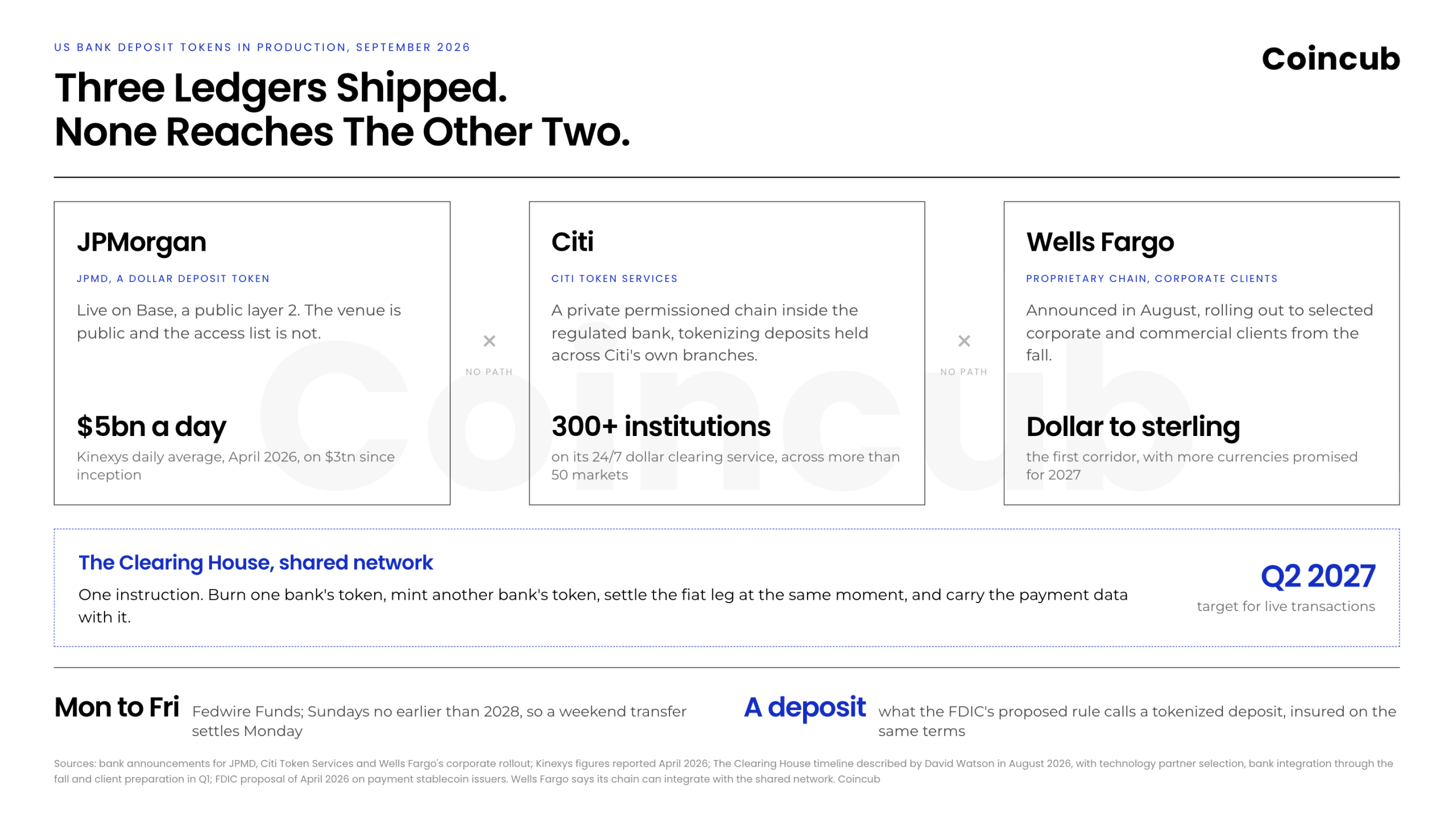

What banks shipped in 2026
JPMorgan put JPMD, a dollar deposit token, in front of institutional clients on Base, the Ethereum layer 2 built inside Coinbase. The venue is public and the access list is not. Kinexys, the bank’s blockchain payments unit, reported more than $3 trillion processed since inception and daily averages above $5 billion in April 2026.
Citi took the opposite route on infrastructure and the same route on access. Citi Token Services runs on a private permissioned chain inside the regulated bank, and it tokenizes deposits held across Citi’s own branches. In July the bank announced that Siam Commercial Bank had become its first financial institution client to go live, paired with Citi’s 24/7 dollar clearing service. That clearing network reaches over 300 financial institutions across more than 50 markets, the outer boundary of what a Citi token can touch.
Wells Fargo followed in August, with a limited rollout to selected corporate and commercial clients starting in the fall. The first corridor is dollar to sterling, with more currencies promised for 2027. The bank said its chain can integrate with the shared network The Clearing House is assembling.
That shared network was reported in June, when JPMorgan, Bank of America and Citi confirmed they were backing a common tokenized deposit system operated by The Clearing House, the payments utility the large banks already own. Its stated purpose is to keep corporate deposits inside the regulated banking system while giving treasurers programmable payments. Nothing about the individual products is experimental at this point. The corporate treasury use case is live, the volumes are real, and every one of these tokens stops at the edge of its issuer.
How a deposit token moves between two banks
David Watson, who runs The Clearing House, described the mechanism in August. A treasurer sends one instruction, one bank’s token is burned and another bank’s token is minted, the fiat settles simultaneously, and the payment data travels with the transaction. Watson put technology partner selection in the following months, bank integration work through the fall, client preparation in the first quarter and live transactions by the second quarter of 2027.
The burn-and-mint step exists for a reason that has nothing to do with blockchains. A deposit is a liability of a specific institution, and a token recording that liability carries the credit of the bank behind it. Two banks’ tokens are different instruments. They exchange at par when a clearing arrangement, a settlement account at the central bank and a membership agreement all sit underneath, the same apparatus that makes a wire from one bank to another arrive whole.
This is the ground the Bank for International Settlements chose for its attack on stablecoins. Its 2026 annual report judges them against singleness, elasticity and integrity and finds they fail the first, since secondary prices drift from par across issuers and chains. The report describes the result as closer to an exchange-traded fund share than a means of payment. Tokenized deposits are engineered to pass that test. They pass it inside the perimeter of the clearing arrangement, and the perimeter is the product.
Watson is candid about the size of that perimeter. He points to CHIPS, which settles over $2 trillion a day among 40 to 50 banks, as evidence that a network does not need universal coverage to be useful. He is right about wholesale dollars. The banks on CHIPS already hold correspondent relationships with each other, and admitting the next one is a legal and operational onboarding priced accordingly. His other line is the sharper one. Stablecoins trap liquidity, Watson says, and at the sums large treasurers move, trapped liquidity is the thing to avoid.
Settling the fiat leg when the central bank is closed
Every one of these products is marketed as round-the-clock. The settlement asset underneath runs on banking hours. Fedwire Funds operates 22 hours a day and the National Settlement Service 21.5, Monday to Friday. The Federal Reserve said in October 2025 that it intends to add Sundays and weekday holidays, no earlier than 2028, and it left a full seven-day schedule to future demand.
Britain is further out. CHAPS settles between 06:00 and 18:00 on weekdays. The Bank has confirmed a 01:30 opening from September 2027, and its May 2026 consultation puts weekend and bank holiday settlement no earlier than 2029, with a 22-hour, six-day schedule no earlier than 2031. Whether the end state is 22 hours across seven days or 23.5 is still a question the Bank is asking the industry.
A deposit token network running through a Saturday settles its fiat leg on Monday. Between those two points, one bank holds a claim on another that no central bank has extinguished. Pre-funding closes the gap, and pre-funding is the trapped liquidity Watson objects to in stablecoins. Intraday credit lines close it too, at the cost of the counterparty exposure the design was built to remove.
Citi’s first external transaction shows the shape of the problem. It moved a client’s money between Citi accounts in London and Bangkok over a weekend, and both legs sat inside one bank, so nothing had to settle between institutions at all. Once a second institution issues the receiving token, the weekend gap comes back, and the network operator has to decide who carries it.
The Bank of England is building for that. It opened a synchronization lab in May 2026 to test links between distributed ledgers and central bank money, and it describes extended hours as the enabler for conditional settlement across tokenized platforms. Those timelines run to 2029 and 2031, while the bank products reach corporate clients this year.
Deposit insurance and the GENIUS Act perimeter
American regulators spent the spring drawing the line between the two instruments in statute. The FDIC’s April proposal on stablecoin issuers states that a payment stablecoin excludes “a deposit (as defined in section 3 of the FDI Act), including a tokenized deposit recorded using distributed ledger technology”. A deposit stays a deposit whatever the recordkeeping technology. Nothing in a bank’s digital asset strategy changes its insurance position, its capital treatment or its access to the discount window.
Stablecoin holders sit outside that. Under the same proposal, reserves parked at an insured bank are covered to the issuer as a corporate depositor, and coverage does not pass through to the people holding the tokens. Issuers also face a concentration limit of 40% of reserve assets at any single eligible financial institution, which spreads large reserve pools across several banks and into Treasuries.
The GENIUS Act adds the commercial constraint. Issuers cannot pay interest or yield to holders, and the OCC has proposed treating affiliate arrangements that deliver yield as presumptive violations. A tokenized deposit has no such problem. It is a deposit, it pays whatever the bank pays on deposits, and a corporate treasurer parking eight figures overnight notices the difference immediately.
Two instruments, two rulebooks, and the asymmetry runs in the banks’ favor on cost. Deposit tokens required no new statute, no new license and no new supervisory regime. Stablecoin issuers received all three, along with reserve composition rules, concentration caps and a prohibition on the one feature that would make the product competitive for idle corporate cash.
Compliance screening and payment data on each rail
Integrity is the third BIS test, and it is where the two designs diverge on cost. A stablecoin issuer runs know-your-customer checks at the mint and at the redemption window. Everything between those points happens on a permissionless chain, where the issuer sees addresses and the wallets belong to whoever controls the keys. Large issuers can freeze a tagged address, and that happens after the fact.
A deposit token never leaves the customer file. The sender was onboarded by one bank, the receiver by another, sanctions screening runs where it already ran, and travel rule information sits in systems both institutions already operate. The compliance cost of a deposit token is a cost the bank paid years ago. That is the strongest argument for the model and the clearest statement of its limit. The payment reaches a party some member bank was willing to take on as a customer, and no further.
Payment data follows the same line. The Clearing House design moves remittance information with the transaction, the reconciliation problem in corporate payments. A correspondent chain sheds data at every hop, and a finance team spends the following week matching receipts to invoices. A stablecoin transfer carries an address, an amount and whatever a payment provider rebuilds off-chain.
Neither point is about speed. Both concern what the receiving institution can do with a payment once it lands, and that is where treasury integration gets expensive. Banks selling deposit tokens are selling an ERP-shaped product with settlement attached. Stablecoin infrastructure firms sell the settlement and leave the enterprise plumbing to a payment provider.
Where the money comes from when each instrument grows
Elasticity is the second of the BIS tests, and it separates the two instruments more cleanly than any legal argument. A stablecoin is issued cash in advance. Someone wires dollars, the issuer mints tokens, and the float grows only when a holder gives up money somewhere else. A bank creates a deposit when it makes a loan, and the tokenized version of that deposit inherits the same property.
That difference shows up on the balance sheet of the system. Stablecoin growth moves a deposit from a household or a company to the issuer, which parks it in Treasuries and bank deposits. The money stays inside the banking system and changes depositor, maturity and price. A cheap retail liability leaves and a wholesale one arrives, and the bank pays for the swap.
Europe shortcut that argument with a reserve rule. MiCA requires an e-money token issuer to hold 30% of reserves at credit institutions, rising to 60% for a significant issuer, so most euro stablecoin backing returns to bank deposits by regulation. The European Central Bank measured where the rest goes. Its April 2026 bulletin estimates a pass-through of 0.87 for the three largest euro stablecoins, so 87 cents of every euro issued ends up as sovereign bond exposure.
Scale keeps that theoretical for now. Euro-denominated stablecoins stood at about €450 million in January 2026, up from €50 million at the start of 2024, against a euro area deposit base in the trillions. European banks have had little reason to build what their American counterparts are building, and the ones experimenting are doing it for cross-border corporate flows.
The Bank of England’s £40 billion issuance ceiling
Britain arrived at the American asymmetry by a different road. In November 2025 the Bank consulted on capping individual holdings of systemic sterling stablecoins at £20,000, a proposal the industry read as a ceiling on the product itself. The policy statement published on 22 June 2026 dropped individual limits and replaced them with a single aggregate guardrail of £40 billion per systemic issuer, framed as temporary and subject to review.
The backing rules came with it. A systemic sterling issuer must hold at least 30% of its assets as deposits at the Bank and may hold up to 70% in short-term UK government debt. The consultation on the draft Code of Practice closes on 22 September 2026, the Bank wants the Code finalized by the end of the year, and regulated issuers can operate from 2027.
The economics follow from those two numbers. A £40 billion issuer earns gilt yields on at most £28 billion, holds the remaining £12 billion at the Bank, and passes none of the return to holders. A British bank issuing a sterling deposit token faces no issuance ceiling, no bespoke backing formula and no new code of practice, since it already holds a banking license and the deposits already sit on its balance sheet.
Wells Fargo’s first corridor is dollar to sterling. That puts its deposit token in the market the Bank has spent three years writing a stablecoin rulebook for, carrying none of that rulebook’s constraints.
Stablecoin float against wholesale settlement volume
The BIS put the stablecoin market at roughly $320 billion at the end of May 2026, with 99.4% of fiat-backed supply pegged to the dollar. Since then the float has gone the other way. It fell by about $10 billion between May and July, with Tether down from $190 billion to $184 billion and USDC off its March peak near $80 billion to $73 billion. June alone accounted for $7.7 billion of the decline, the largest monthly contraction in four years.
Volume moved in the opposite direction. Chainalysis puts adjusted stablecoin transfer volume at $28 trillion for 2025, growing at a 133% compound annual rate since 2023, with the adjustment stripping out wash trading and internal transfers. A shrinking float carrying rising volume means the same dollars turn over faster, the profile of a payment instrument rather than an inventory position.
Set that against the systems the banks run. The BIS reads $28 trillion as less than three business weeks of settlement at the largest US wholesale payment systems. Kinexys alone averages over $5 billion a day. The entire stablecoin sector is a rounding error on wholesale dollar flows, and it is a meaningful share of anything moving between counterparties who never had a correspondent relationship.
Where the two instruments compete
The contested territory is narrower than either side’s rhetoric suggests.
| Tokenized deposit | Payment stablecoin | |
| Legal claim | On the issuing bank | On the issuer, by contract |
| Par with the next instrument | Through a clearing arrangement | Through the secondary market |
| US insurance | Deposit insurance applies | No pass-through to holders |
| Yield to the holder | Whatever the bank pays | Prohibited |
| Reach | Members of the network | Anyone with a wallet |
| Settlement asset | Central bank money, in its hours | Issuer reserves, continuously |
Corporate movements between large banks, intraday liquidity and payment-versus-payment settlement belong to deposit tokens, and the clearing utility being built for them will work. Cross-border flows to counterparties with no bank relationship worth onboarding belong to stablecoins, and no amount of burn-and-mint plumbing reaches those counterparties.
A treasurer sees the split as a question about the other side of the trade. Paying a supplier who banks with a network member is one instruction, settled at par, insured, and reconciled with the payment data attached. Paying a supplier in a market where the correspondent chain takes three days and charges for the privilege is where a wallet starts to look reasonable. The friction moves to the off-ramp at the far end, where a local partner turns tokens into spendable currency.
A bank’s addressable market for a deposit token is the list of institutions its network admits. Citi’s number puts that list in the hundreds, and the stablecoin equivalent is anyone able to hold a wallet.
The honest gap sits between those two cases. No published dataset measures how much volume could go either way, and both camps argue from the flows they already serve. The Clearing House sizes the opportunity in CHIPS-scale wholesale dollars. Stablecoin issuers size it in remittance corridors and emerging market treasury operations the correspondent network priced out years ago. Those are different datasets describing different customers.
Three things would settle it. The first is whether The Clearing House hits its second quarter 2027 date. The second is whether mid-tier and foreign banks get access to the shared network on terms that make joining worthwhile. The third is whether the £40 billion guardrail binds on any issuer before the review meant to remove it. None of the three has an answer today.
What the year did settle is the legal question. A tokenized deposit is a deposit, supervised under rules that already existed, and a stablecoin is a separate instrument with its own license, its own reserve formula and a ban on paying its holders. Banks spent 2026 building on the side of that line where the rulebook was already written.
Frequently Asked Questions (FAQ)
What is a tokenized deposit? +
A tokenized deposit is a commercial bank deposit recorded on a programmable ledger. It stays a liability of the issuing bank and a claim of the depositor on that bank. JPMorgan's JPMD, Citi Token Services and Wells Fargo's corporate offering are all versions of the same structure, with the ledger changing and the underlying legal relationship staying put.
Are tokenized deposits covered by deposit insurance? +
The FDIC's April 2026 proposal states that the definition of deposit includes deposits in tokenized form. Insurance applies on the same terms as any other deposit at that bank. Stablecoin holders sit outside this. Reserves held at an insured bank are covered to the issuer as a corporate depositor, and that coverage does not pass through to token holders.
Can a tokenized deposit move between two different banks? +
Not yet in the United States. Each live product settles inside the network of the bank that issued it. The Clearing House is building a shared network that burns one bank's token, mints another's and settles the fiat leg at the same time, with live transactions targeted for the second quarter of 2027.
Why can tokenized deposits pay interest when stablecoins cannot? +
The GENIUS Act prohibits payment stablecoin issuers from paying interest or yield to holders, and the OCC has proposed treating affiliate yield arrangements as presumptive violations. A tokenized deposit is a bank deposit. It carries whatever rate the bank pays, and for corporate cash sitting overnight that difference decides the product.
Do deposit token networks settle 24/7? +
The tokens move continuously and the central bank leg does not. Fedwire runs Monday to Friday, and the Federal Reserve has said it intends to add Sundays no earlier than 2028. CHAPS settles on weekdays, with weekend settlement proposed for no earlier than 2029. A weekend transfer between two banks leaves an unsettled claim until the central bank reopens.
What did the Bank of England decide about stablecoin holding limits? +
The Bank dropped the individual holding caps it consulted on in 2025. Its June 2026 policy statement replaced them with an aggregate ceiling of £40 billion per systemic sterling stablecoin, described as temporary and subject to review. Issuers must hold at least 30% of backing at the Bank and up to 70% in short-term UK government debt.
How large is the stablecoin market compared with bank payment systems? +
The BIS put stablecoin market capitalization near $320 billion at the end of May 2026, and the float fell by about $10 billion over the following two months. Adjusted transfer volume reached $28 trillion in 2025, which the BIS reads as under three business weeks of settlement at the largest US wholesale systems.
Why are European banks slower to launch deposit tokens? +
Euro-denominated stablecoins stood at roughly €450 million in January 2026, a fraction of the dollar market and a rounding error against euro area deposits. MiCA also requires e-money token issuers to hold 30% of reserves at credit institutions, rising to 60% for significant issuers, so euro stablecoin growth returns most of its backing to banks.