


 Buy a Licensed Company
  Explore VASP Data
  Talk to an Expert

 Atis Shala
Atis is a senior analyst and community lead with four years of experience in crypto. He has a bachelor from the Rochester Institute of Technology.
Atis Shala
Atis is a senior analyst and community lead with four years of experience in crypto. He has a bachelor from the Rochester Institute of Technology.
How Crypto Derivatives Clearing Houses Work
- Clearing manages trade obligations. In a centrally cleared market, a central counterparty (CCP) becomes the legal counterparty to each clearing member.
- Initial margin and variation margin do different jobs. The first covers potential future exposure, while the second settles gains and losses as prices change.
- Customers, brokers and clearing members carry separate obligations. A retail trader usually deals with an intermediary, which in turn meets the clearing house’s requirements.
- Crypto exchange liquidation systems have their own safeguards. Insurance funds and auto-deleveraging handle failed liquidations, subject to each platform’s rules.
- Collateral and default rules decide the outcome under stress. The legal counterparty, asset segregation, accepted collateral and the order of loss absorption matter far more than an exchange’s advertised leverage.
Bitcoin can move sharply within minutes, yet a futures trade creates an obligation that survives every one of those price changes until the position is closed or settled. As a result, someone has to calculate what each side owes, collect enough collateral to cover the exposure and decide what happens if a participant cannot pay. That job is called clearing, and a crypto derivatives clearing house is the institution that performs it.
The machinery matters most when markets are under pressure. Because every trader’s loss is another trader’s gain, the system has to account for both sides even when one of them runs out of money. Regulated futures markets handle this through central clearing houses with formal membership and default rules. Many crypto derivatives exchanges, by contrast, run their own margin, liquidation and settlement engines. Both approaches manage risk, although the protections standing behind them can differ considerably.
What is a crypto derivatives clearing house?
A crypto derivatives clearing house manages the obligations that arise from contracts whose value depends on digital assets, such as Bitcoin futures or options. In regulated central clearing, the clearing house accepts trades, manages exposure between its members, calls for collateral and organises settlement. Moreover, if a member defaults, it follows a published process for handling the open positions and any resulting losses.

A simple Bitcoin futures trade shows why this matters. One participant buys a contract because they expect the price to rise, while another sells it and takes the opposite exposure. If the futures price then rises, the long gains and the short loses. Consequently, the clearing system has to make sure the losing side’s obligations can actually be met.
In a centrally cleared market, that assurance comes from a central counterparty standing between clearing members. Through novation or another legally defined arrangement, the CCP becomes the buyer to every clearing member that sells and the seller to every clearing member that buys. In effect, the original bilateral credit exposure is replaced by separate exposures to the CCP.
In the United States, a registered clearing house is known as a derivatives clearing organization (DCO). The Commodity Futures Trading Commission (CFTC) sets out the functions a DCO performs in its clearing organization guidance, together with requirements covering financial resources, risk management, settlement, customer funds and default procedures.
The exchange, the broker and the clearing house play different roles
Those roles become clearer once the main participants are separated. An exchange lists contracts and matches orders. A futures broker, meanwhile, accepts customer orders and manages the customer relationship. A clearing member, for its part, maintains a direct relationship with the CCP, posting collateral and meeting settlement obligations. Although a brokerage can also be a clearing member, many customers reach the CCP only indirectly.
US futures markets attach a regulated label to each of these functions. A designated contract market (DCM) is the exchange, a DCO is the clearing organization, and a futures commission merchant (FCM) is a regulated intermediary that handles customer orders and funds. Readers who want the full picture can see how DCM registration fits into this three-licence structure, including why every contract a DCM lists must clear through a registered DCO.
A crypto platform, on the other hand, may combine trading, collateral accounting, liquidation and settlement within a single corporate group. For that reason, the word “clearing” on an exchange’s website tells you very little until you know which legal entity owes performance and which rules apply when something goes wrong.
How a cleared crypto futures trade works
Having separated the roles, it becomes easier to follow a centrally cleared contract through its life. The sequence begins before the trade and continues until final settlement. While the order of individual checks varies from market to market, the underlying obligations stay broadly consistent.
Step 1: The trader enters an order
First, a buyer and a seller agree to opposite sides of a standardised futures contract on an exchange. The contract specifies its size, currency, reference price, trading rules and settlement method. Before the order goes through, the trader also needs sufficient funds or eligible collateral under the broker’s account rules to carry the position.
Step 2: The CCP takes on member-facing obligations
Next, once the trade is accepted for central clearing, the contract is recorded against the relevant clearing members. From that point, the CCP becomes responsible for performance under its rules, while each member owes the CCP whatever amounts fall due on its positions.
Step 3: The clearing house collects margin
The CCP then calculates collateral requirements for each member. Separately, each broker determines how much margin its customers must maintain, subject to exchange minimums and applicable regulation. In practice, a customer’s requirement may therefore exceed the amount the CCP attributes to the same position.
Step 4: Open positions are marked to market
Throughout the life of the contract, futures gains and losses are recalculated as settlement prices change. In conventional futures clearing, this daily process is called marking to market. Losses are collected and gains are paid out through the clearing system, which in turn limits how much unpaid exposure can build up. CME Clearing, for example, marks futures and options positions to market twice a day and calls members for settlement variation and initial margin in each cycle.
In addition, a CCP can call for collateral during the trading day whenever market conditions warrant it. The international Principles for Financial Market Infrastructures (PFMI), published by CPMI and IOSCO, expect CCPs to collect variation margin at least daily and to keep the operational capacity to make intraday calls.
Step 5: The contract is closed or settled
Finally, a trader can generally exit a futures position by entering an offsetting trade. Otherwise, the contract runs to expiry and follows its prescribed settlement process. Cash-settled contracts end with financial payments, whereas physically delivered contracts require the specified asset to change hands.
Initial margin, variation margin and maintenance margin
Margin sits at the heart of every step above, and it comes in three distinct forms. Initial margin covers potential future losses during the time needed to manage or close out a position after a default. To size it, a risk model estimates that exposure using factors such as market volatility, position size, concentration and the relevant closeout period. As a result, requirements can rise as conditions deteriorate.
Variation margin, by comparison, accounts for changes in value after the trade has been made. In futures clearing, gains and losses are typically settled in cash at least once a day, with additional intraday payments possible. These flows keep outstanding obligations from growing indefinitely, and CME’s mark-to-market explainer walks through the conventional futures example.
Maintenance margin, finally, is the amount an account must hold to continue carrying a position under its trading arrangement. When account equity falls below that threshold, the intermediary can demand additional funds or reduce or close the position. The exact timing, however, depends on the product, the broker and the account agreement.
A $100,000 position at five times leverage
A worked example shows how quickly leverage turns a modest market move into a large loss of equity. Suppose a trader holds $100,000 of long exposure to Bitcoin futures backed by $20,000 of account equity, giving effective leverage of five times. Now assume the futures price falls by 8% while the position size stays the same. For simplicity, the example ignores fees, funding, other holdings and any change in margin requirements.
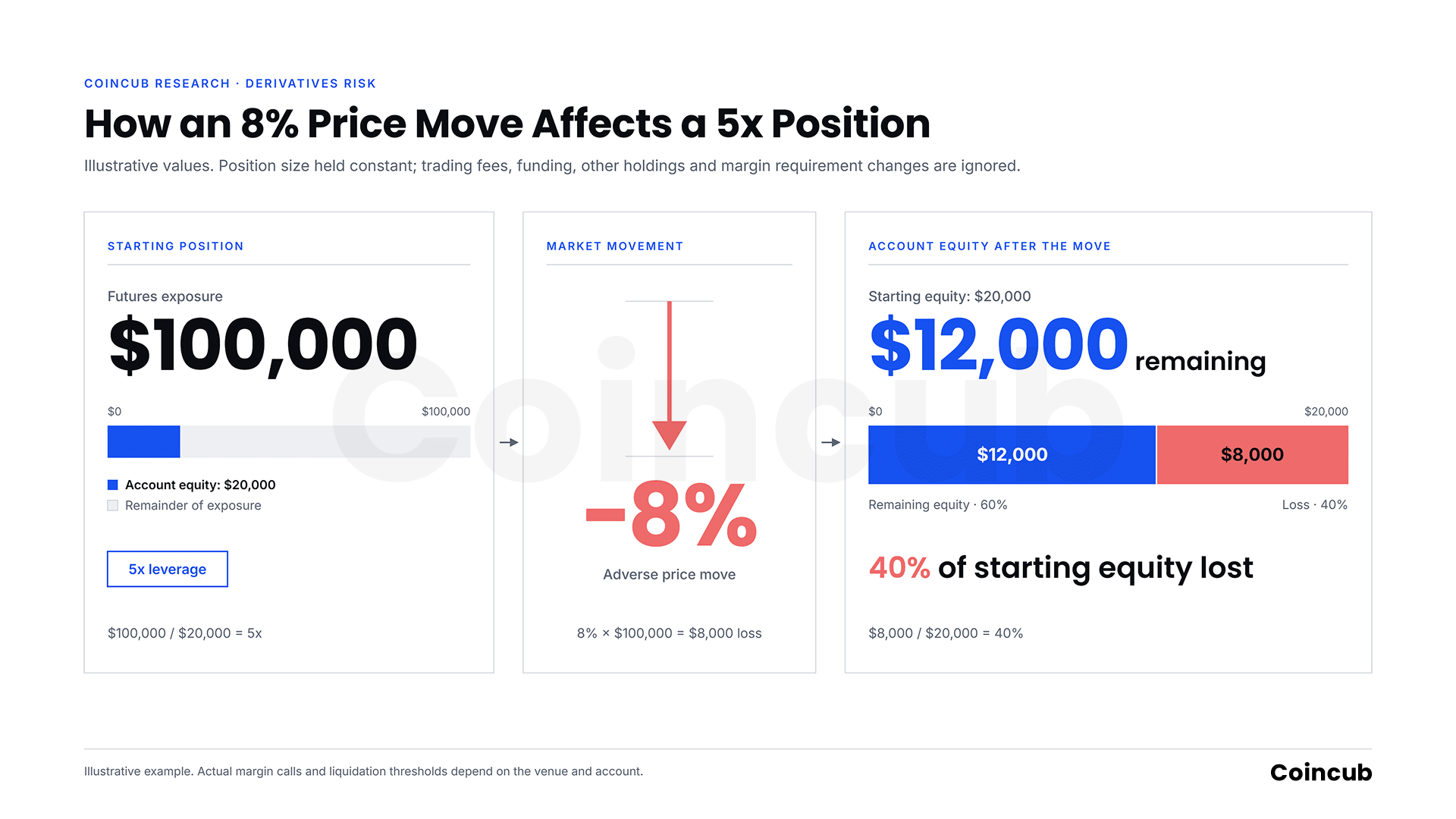
Under those assumptions, the position loses $8,000, leaving $12,000 of equity. In other words, an 8% market move wipes out 40% of the account’s starting equity. Whether a margin call or liquidation follows then depends on maintenance requirements, the account’s other positions and the venue’s risk rules. It is worth stressing that the example describes the trader’s own economics and should be read as an illustration with no connection to any published CME or exchange margin schedule.
How clearing houses decide how much risk to accept
Since margin is only as reliable as the model behind it, clearing houses invest heavily in measuring risk. Three tools do most of the work: risk models, collateral haircuts and stress testing.
Risk models, stress tests and portfolio offsets
A margin model estimates how much a portfolio could lose over a defined period. To do so, it draws on historical observations, hypothetical shocks or other approved methodologies that capture likely adverse moves. Clearing houses then backtest those models against realised outcomes and run stress tests that examine far more extreme events.
Portfolio offsets add a further layer, because two positions can partly cancel each other’s exposure. For instance, a long future and an eligible short position in a related contract might hedge one another, and recognising that offset can lower the collateral requirement. At the same time, the offset introduces basis risk, which is the possibility that the two contracts move differently under stress.
Collateral haircuts and wrong-way risk
Beyond the size of the position, the quality of the collateral matters just as much. A clearing system has to consider how quickly assets can be sold, whether they can be transferred reliably and how their value might change during a default.
To account for this, clearing houses apply a haircut, which is a discount to the value assigned to collateral. With a 10% haircut, for example, an eligible asset worth $10,000 counts for only $9,000 toward the relevant requirement. That discount leaves room for adverse price moves while the asset is being liquidated.
Crypto collateral, however, creates a particular problem when its value falls alongside the position it secures. A trader holding a leveraged Bitcoin long while posting Bitcoin as collateral can lose equity through both channels at once. This is a form of wrong-way risk, and a prudent risk engine therefore has to address it through eligibility limits, haircuts, stress scenarios or higher margin.
What happens when a clearing member defaults?
All of these preventive measures exist for one moment: the point at which a member fails to make a required payment or otherwise triggers a default under the rulebook. At that stage, the clearing house must stabilise the portfolio, meet its remaining obligations and allocate any losses according to established procedures.
In practice, default management can involve hedging open positions, auctioning portfolios to surviving members and, where permitted, transferring customer accounts to another member. The sequence depends on the product and on market conditions. CME Clearing’s default management overview, for example, explains that it seeks to move eligible, non-defaulting customer accounts to a healthy member when a firm fails.
It also helps to keep two events apart. A customer who fails a margin call and a clearing member that defaults to the CCP are distinct situations. The broker usually handles the first under its customer agreement, whereas the CCP’s formal default process concerns its direct, member-facing exposure.
The default waterfall, using CME Clearing as an example
When a member does default, the default waterfall determines who pays and in what order. A default waterfall is the sequence in which defined financial resources are applied to losses after a clearing member default, and its order matters because it decides when mutualised resources can be touched.
CME Clearing publishes separate safeguard arrangements for its futures and options service and for its interest rate swaps service. For futures and options, which include its Bitcoin contracts, its financial safeguards overview describes the following sequence:
- Defaulter resources: All available resources of the defaulting clearing member, including its performance bond collateral and guaranty fund contribution, are applied first, while its customers’ assets are excluded.
- CME Clearing’s own contribution: CME then commits its own capital and takes the first loss ahead of any surviving member.
- Guaranty fund: The prefunded contributions of non-defaulting clearing members in that service are used next.
- Assessment powers: If all prior layers are exhausted, CME can call additional assessments from clearing members, subject to the caps and rules in its rulebook.
Taken together, these layers provide successive buffers against an extreme loss. CME reports a dedicated contribution of $100 million to its futures and options waterfall and a separate $150 million for its interest rate swaps service. Since these figures belong to distinct clearing arrangements, only the $100 million layer is relevant when illustrating the Bitcoin futures waterfall. Furthermore, CME sizes the guaranty fund for each service to withstand the default of its two largest clearing members and their affiliates, a benchmark known as the Cover 2 standard. Because the exact resources and assessment limits can change, published rulebooks and current disclosures always take precedence over simplified diagrams.
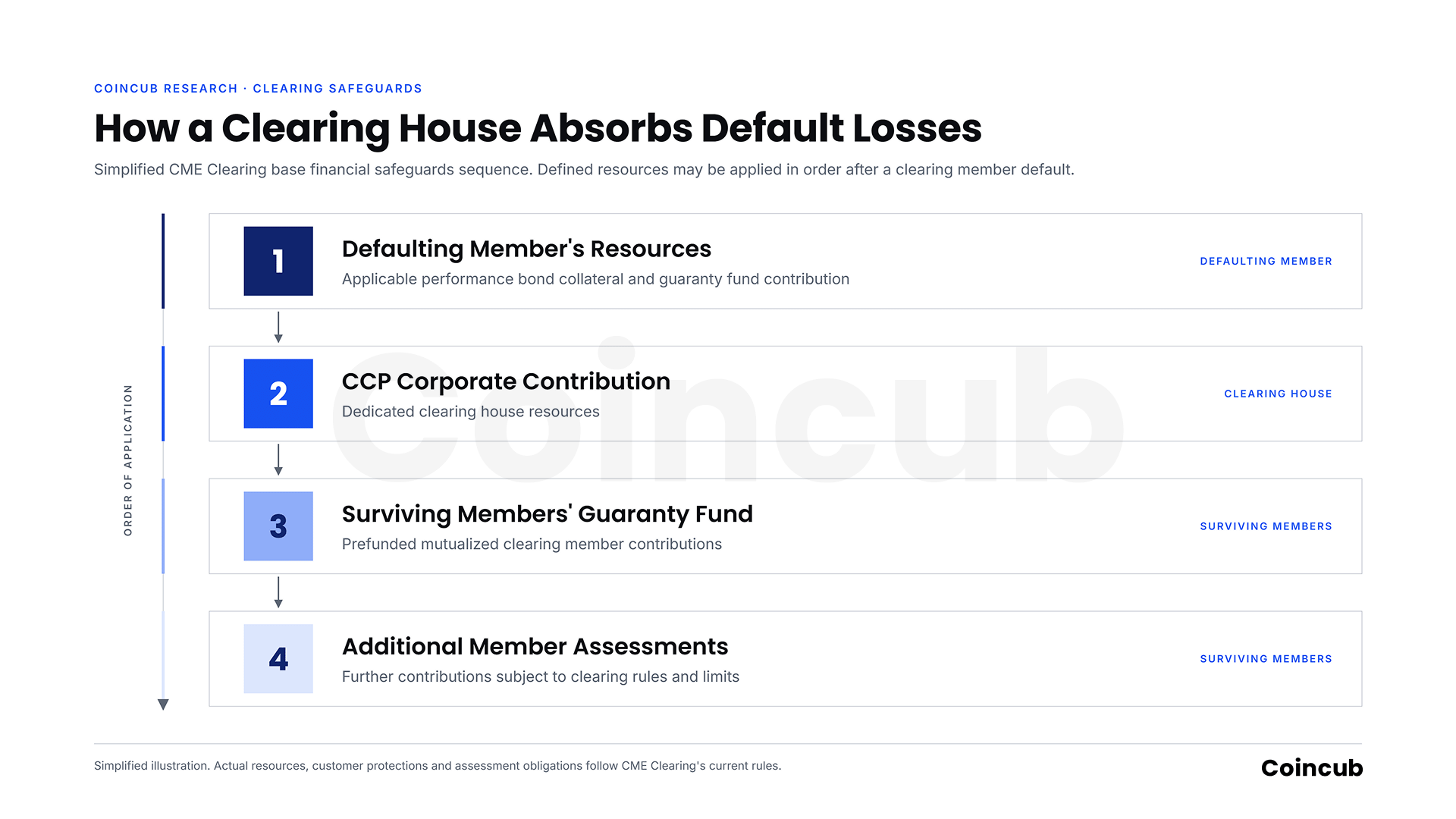
The first layer also highlights an important boundary. Under CME’s description, a defaulting member’s own resources can be applied to its losses, whereas its customers’ assets stay protected under the applicable segregation rules.
How crypto exchanges handle liquidations differently
Outside regulated central clearing, a trader opening a perpetual futures position on a crypto exchange usually meets a different operating model. Here, the platform calculates account equity, sets a liquidation threshold and runs an automated system that tries to close positions before losses exceed the available collateral.
To trigger liquidations, most venues use a mark price built from an external index and other adjustments, instead of relying solely on the last trade on the exchange. This design helps prevent an isolated price spike from setting off unnecessary liquidations, although each platform’s formula still deserves separate scrutiny.
Once the price reaches the liquidation threshold, the venue may reduce or take over the position under its rules and then try to close or transfer the exposure. During a fast move, however, the final execution price can be worse than the position’s bankruptcy price, which is the point at which the equity allocated to the position is exhausted. Whenever that happens, a deficit remains, and the exchange needs a way to cover it.
Insurance funds
The first line of defence against such deficits is usually an exchange insurance fund. Bybit’s insurance fund rules, most recently updated in March 2026, describe how the fund receives the surplus when a liquidation closes at a better price than the bankruptcy price and pays out when execution comes in worse. Bybit has also restructured how the fund is pooled: from December 2025 it began rolling out a New Listing pool covering the first 30 days of new USDT perpetual contracts and a Portfolio pool shared by up to nine contracts with similar risk profiles.
Auto-deleveraging
If a liquidation leaves a deficit that the relevant insurance fund cannot absorb, some platforms then turn to auto-deleveraging (ADL). Under ADL, the system closes or reduces positions held by profitable traders on the opposite side of the market, following the platform’s own priority rules.
Binance’s explanation of ADL, for instance, describes it as the final step taken when the applicable futures insurance fund cannot take on a bankrupt position, and it directs users to the governing exchange and clearing rules. The practical consequence is significant: a trader can see a profitable position closed during a market disruption without ever breaching their own margin requirement.
It follows that insurance funds and ADL are arrangements defined by each exchange. Their size, enforceability, calculation methods and loss-sharing rules all differ from those of a regulated CCP, so shared terminology can easily conceal important differences in legal protection.
Cash settlement, physical delivery and perpetual funding
Settlement rules shape the final obligations a clearing system has to fulfil, and the choice between cash and asset delivery also changes its operational risks. Three models are common in crypto derivatives.
Cash-settled Bitcoin futures
CME’s flagship Bitcoin futures contract represents five bitcoin and is financially settled, according to its contract specifications. Its final settlement is based on the CME CF Bitcoin Reference Rate. Accordingly, the holder of that contract settles the outcome in cash and never has to deliver or receive the five bitcoin.
Physically delivered derivatives
A physically delivered crypto future works differently, because the specified cryptocurrency must change hands under the delivery rules. That requirement adds custody, wallet, transfer and delivery-failure considerations to the clearing process.
Perpetual futures
Perpetual contracts, meanwhile, have no scheduled expiry at all. To keep the traded price close to the underlying reference market, exchanges generally rely on funding payments. When funding is positive, longs typically pay shorts, and when it turns negative, shorts typically pay longs. The formula, timing and payment arrangements, however, vary by venue.
Funding is therefore part of the product’s design. It operates separately from the CCP variation margin used to settle futures gains and losses in a conventional central clearing arrangement.
Regulated CCPs and crypto-native clearing compared
Putting the pieces together, the same price exposure can sit inside very different legal structures. A cash-settled Bitcoin future cleared through CME Clearing and a leveraged Bitcoin perpetual on a crypto exchange both respond to Bitcoin’s price. Where they diverge is in what happens after a participant fails.
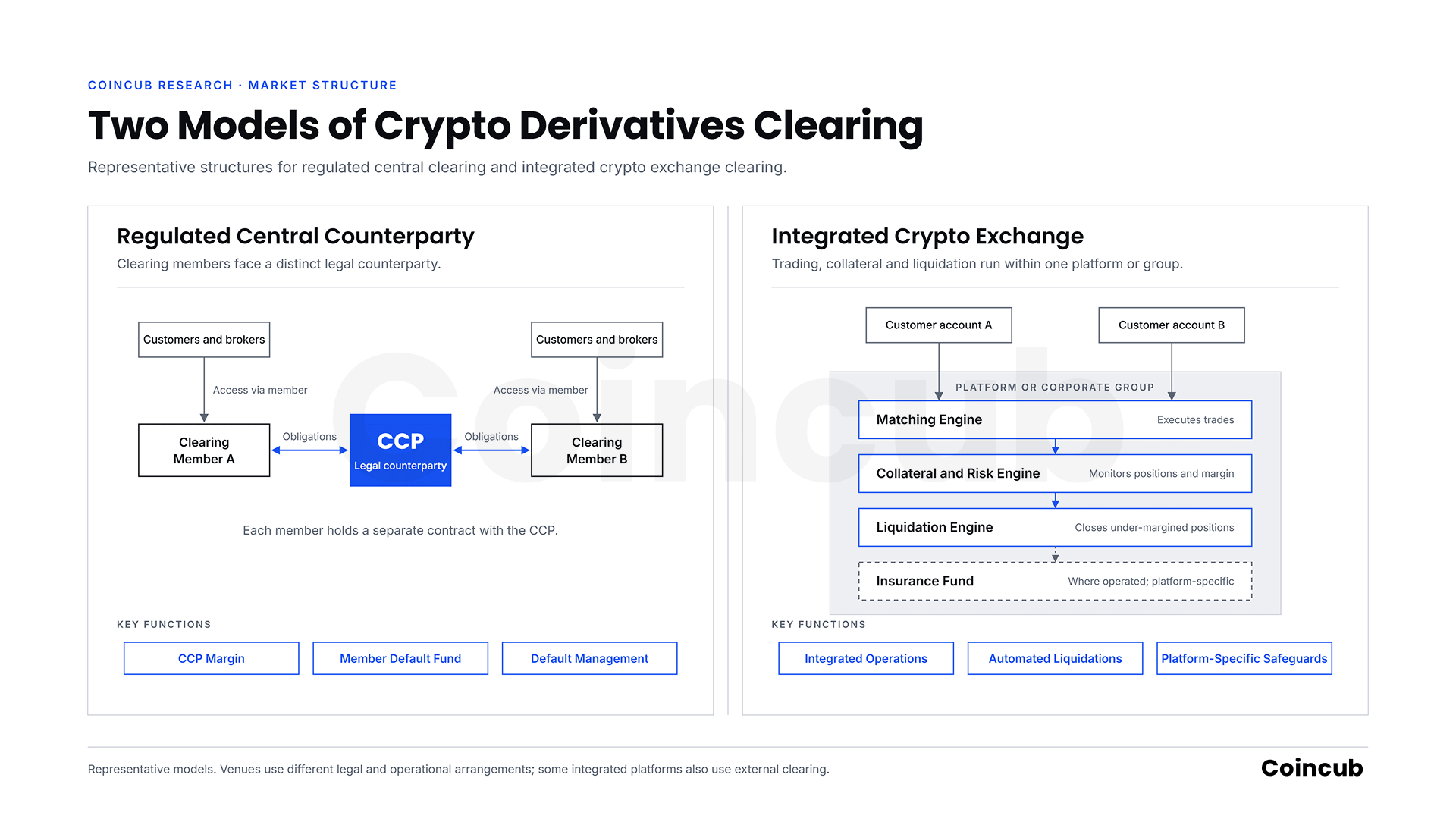
Seen side by side, each model has clear strengths. Central clearing offers a defined institutional framework with membership standards, supervision and published default procedures. Integrated exchange systems, in contrast, can update margin quickly and consolidate several functions in one account. Each design nonetheless creates its own dependencies and points of failure.
Beyond these two models, a third category is also worth watching: onchain derivatives protocols. In these systems, smart contracts may hold collateral, compute margin and liquidate positions without any conventional clearing member. Consequently, the risk shifts toward oracle quality, code security, governance powers, blockchain congestion and the ability of keepers or liquidators to act during market stress. Their protections therefore have to be assessed protocol by protocol.
How crypto derivatives clearing is regulated
Regulation determines which of these protections a trader can actually rely on. In the United States, the CFTC oversees registered DCOs under the Commodity Exchange Act and Part 39 of its regulations. Its core principles address financial resources, risk management, default procedures, settlement and the safeguarding of participant funds. Registration, however, attaches to a specific legal entity and activity, so a general claim that an exchange is “regulated” says little about whether its derivatives are centrally cleared.
Customer asset protection depends on the intermediaries as well. US futures customer funds are subject to segregation requirements, which the CFTC’s customer funds rulemaking sets out in detail. Segregation is a legal and operational arrangement with defined rights and limits; it offers no promise that market losses will be reimbursed.
In the European Union, meanwhile, EMIR governs central counterparty requirements and much of the derivatives clearing framework. The Markets in Crypto-Assets Regulation (MiCA) covers many crypto-asset services, yet its Article 2 scope provision excludes crypto-assets that qualify as financial instruments. As a result, a crypto derivative’s classification, together with the service being provided, determines which financial rules apply.
How to assess a clearing system before trading
With the regulatory backdrop in place, a practical review can start with the contract itself and work backward through the infrastructure. First, identify the legal counterparty and the entity holding your collateral. Then locate the relevant exchange, clearing and customer account rules. Marketing language about institutional-grade security rarely answers either question.
Second, study the margin methodology. Check which price triggers liquidation, whether portfolio offsets are allowed, how collateral haircuts are applied and what happens once account equity falls. For perpetuals, also find the mark price formula and the funding schedule.
Third, read the default procedure. A CCP should publish the resources and processes available after a clearing member fails. Likewise, an exchange-operated system should explain the applicable insurance fund, where its assets come from, whether fund balances are public and exactly when ADL can affect profitable positions.
Lastly, assess your practical ability to exit. Trading liquidity, withdrawal rules, system availability and the transferability of collateral all become critical when volatility rises. After all, a legally strong claim against an intermediary offers little immediate comfort if you cannot meet a margin call before the deadline.
Final Thoughts on Crypto Derivatives Clearing Houses
In short, crypto derivatives clearing is the system that turns an executed trade into enforceable, funded obligations. In regulated futures markets, that job falls to a central counterparty and its clearing members. On many crypto platforms, by contrast, an integrated risk engine monitors positions and manages liquidations under the exchange’s own rules.
Ultimately, the meaningful differences only appear under stress. Who posts margin? Which collateral is accepted? How quickly are losses settled? Whose resources cover a deficit, and what happens once those resources run out? A trader who can answer these questions understands both the price exposure of a contract and the infrastructure that supports it.
Frequently Asked Questions (FAQ)
Is a crypto exchange the same as a clearing house? +
An exchange matches trades, whereas a regulated central counterparty assumes specified obligations to clearing members and manages settlement and default risk. Some crypto exchanges run integrated clearing and liquidation functions, so both roles can sit inside the same group without delivering the legal protections of an independent CCP.
Does the clearing house hold a retail trader's margin? +
In conventional futures trading, a customer generally posts funds through a broker, while the clearing member maintains its own margin obligations to the CCP. Customer funds may be held in protected account structures governed by the relevant rules. The customer's account balance is therefore separate from both the clearing member's obligations and the CCP's resources.
What is the difference between initial and variation margin? +
Initial margin covers potential future exposure during a default management period. Variation margin, by contrast, settles gains and losses as market prices change, typically through daily or intraday payments in centrally cleared futures.
What happens if an insurance fund runs out? +
The outcome depends on the exchange's rules. Some crypto derivatives venues use auto-deleveraging to reduce profitable opposing positions once the applicable fund cannot absorb a liquidation deficit. A regulated CCP, on the other hand, follows its published default and recovery framework.
Are CME Bitcoin futures settled in Bitcoin? +
CME's flagship Bitcoin futures are financially settled against the CME CF Bitcoin Reference Rate, so they settle through cash payments with no delivery of bitcoin. Other crypto futures can follow different settlement rules.
Can a clearing house fail? +
Yes. Margin, default resources, stress tests and recovery plans reduce both the likelihood and the consequences of a failure, yet market, liquidity and operational risks remain. In an extreme event, the applicable CCP rules determine how losses and obligations are handled.