



 Buy a Licensed Company
  Explore VASP Data
  Talk to an Expert

 Dren Hima
 is Head of Research at Coincub, leading research across digital asset regulation, licensing, market structure, tokenization and institutional adoption.
Dren Hima
Dren Hima is Head of Research at Coincub, leading research across digital asset regulation, licensing, market structure, tokenization and institutional adoption.
Can Stablecoin Issuers Freeze Funds Without a Court Order?

- Section 4(a)(6)(B) allows issuance only where the issuer can comply with a lawful order to seize, freeze, burn or block its tokens.
- Tether burns frozen balances, Circle blocks transfers without burning, and the Paxos contract behind PYUSD can wipe a frozen address.
- Both major issuers reserve the right to move before a court order exists, and Tether is now being sued over one such freeze.
- Blacklisting a pooled contract locks every depositor inside it, as Zama’s users found when $12.6 million stopped moving.
- DAI carries no block list, and about 30% of the reserves behind DAI and USDS are stablecoins held mostly as USDC.
“A permitted payment stablecoin issuer may issue payment stablecoins only if the issuer has the technological capability to comply, and will comply, with the terms of any lawful order.” That is section 4(a)(6)(B) of the GENIUS Act. Section 2(16) defines the order as a federal writ or decree requiring a person to seize, freeze, burn, or prevent the transfer of payment stablecoins. Section 3(b)(2) runs the same test at the border, making it unlawful for a US digital asset service provider to offer a foreign issuer’s token unless that issuer holds the capability too.
The freeze function stopped being a compliance convenience somewhere in that drafting. It is now the price of the license and the price of US distribution. Every major fiat-backed token already carries one and the code is public. The arguments worth having are about who holds the key, what the switch does to a balance, and what has to happen before anyone pulls it.
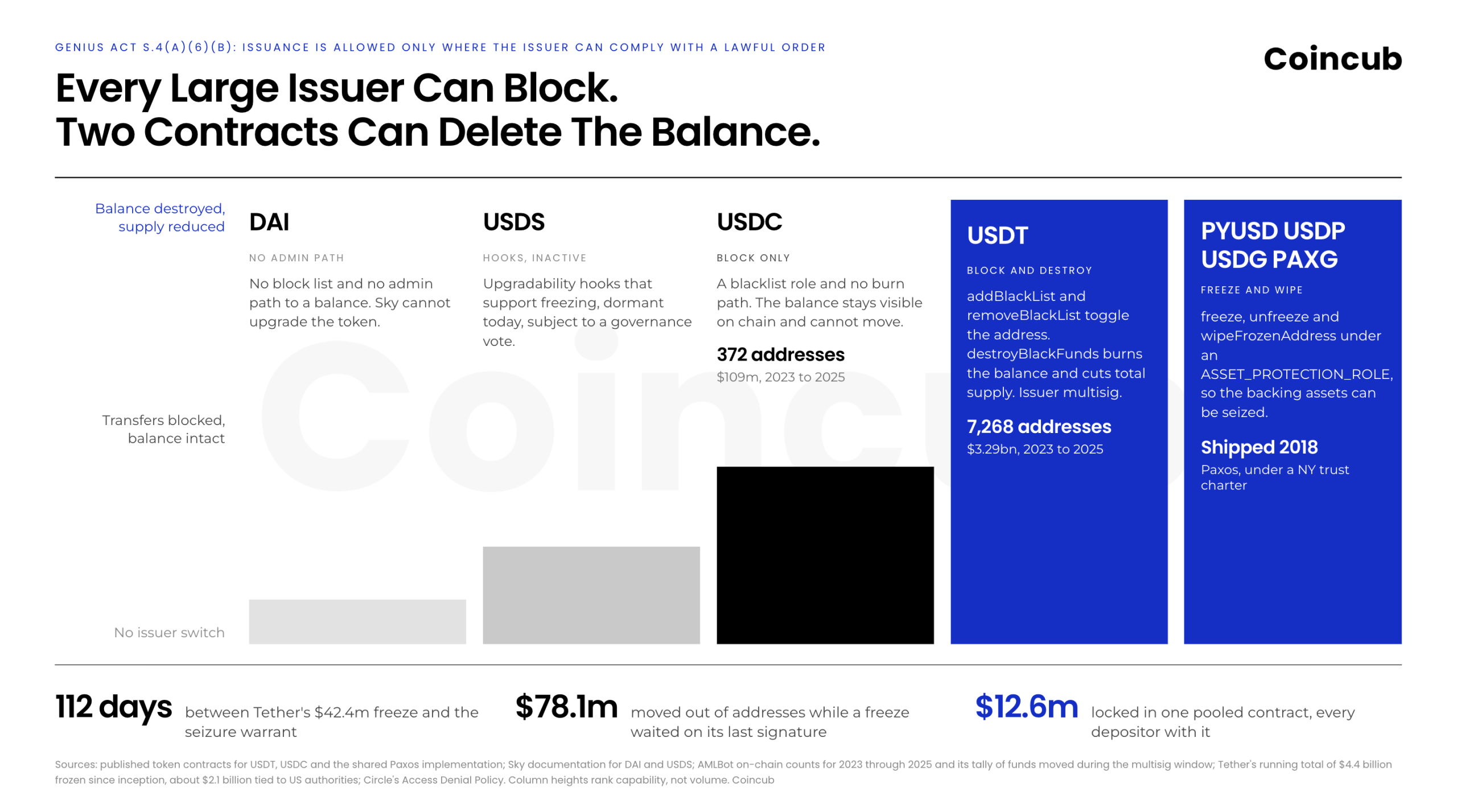

How the freeze functions differ across issuers
Tether’s Ethereum contract carries addBlackList and removeBlackList, which toggle an address on and off the block list. A third function, destroyBlackFunds, burns whatever a blacklisted address holds and cuts total supply by the same amount. Circle stops at the first step. A blacklisted USDC address keeps its balance visible on chain and can do nothing with it, and Circle runs no burn path at all.
Paxos publishes its token contracts, and the shared implementation hands an ASSET_PROTECTION_ROLE three powers. Two of them, freeze and unfreeze, work like a block list. The third, wipeFrozenAddress, removes the balance of an address already frozen, described in the repository as a way “to allow the appropriate authorities to seize the backing assets.” That same architecture sits behind PYUSD, USDP, USDG and PAXG, which puts the wipe capability under PayPal’s consumer stablecoin. None of it is a recent addition. Paxos shipped the role in 2018 under a New York trust charter, and the capability has been a supervisory expectation in that state far longer than it has been federal law.
| Token | Block transfers | Destroy the balance | Control |
| USDT | addBlackList | destroyBlackFunds | Issuer multisig |
| USDC | blacklist role | None | Issuer role holder |
| PYUSD, USDP, USDG, PAXG | freeze | wipeFrozenAddress | ASSET_PROTECTION_ROLE |
| DAI | None | None | No admin path |
| USDS | Upgradability hooks, inactive | None | Governance vote |
The volumes differ as much as the mechanics. AMLBot’s on-chain count for 2023 through 2025 puts Tether at 7,268 blacklisted addresses across Ethereum and Tron holding $3.29 billion, against 372 addresses and $109 million for Circle. Tether’s own running total for assets frozen since inception passed $4.4 billion by April 2026, with about $2.1 billion of it connected to US authorities. Some of that spread is distribution, since USDT carries far more retail volume on Tron, and some of it reflects how differently the two companies treat an inbound request.
What triggers a freeze before a court order exists
Tether blacklisted ten Ethereum addresses holding $42,417,785.62 on 30 October 2025, inside a window of under three minutes. The seizure warrant covering those funds issued on 19 February 2026, 112 days later. Two Thai businessmen sued Tether in the Southern District of New York on 31 August 2026 for conversion, trespass to chattels and unjust enrichment. Their complaint says Tether acted on an informal request from a Homeland Security Investigations agent, and that they held no account and no terms of service with the company. Tether called the suit a baseless attempt to interfere with its work with global law enforcement.
Nothing in Tether’s public posture treats that sequence as unusual. The company reports supporting more than 2,300 law enforcement cases across 65 countries, and it froze $344 million of USDT in coordination with OFAC and US agencies on 23 April 2026. Sanctions work cleaner, since the designation is itself the order. OFAC added four Central Bank of Iran wallets on 15 July 2026 and Tether froze $131 million the same day, taking the Iranian total to almost $475 million.
Circle writes the same discretion into policy. Its Access Denial Policy commits the company to orders from a “duly recognized U.S. or French authorized authority.” The next clause reserves the ability to act on “certain urgent law enforcement requests pending a valid court order.” Government requests citing sanctions activity or an imminent national security threat get the same treatment. France appears because Circle’s European issuance runs under an electronic money institution authorization the ACPR granted in July 2024. Holding a MiCA token puts a European supervisor and an American one on the same switch.
Circle used that discretion in March 2026, blacklisting 16 operational business wallets belonging to exchanges, casinos and forex services under a sealed New York civil matter, then reversing at least one of them. ZachXBT’s review of the record counted 15 theft cases since 2022 worth more than $420 million where the company moved slowly. The Drift exploit is the sharpest of them. More than $280 million in USDC crossed over 100 transactions in roughly six hours with no freeze. Speed is a policy choice at every issuer, and the two directions draw very different scrutiny.
A counterparty freeze lands on a trading desk with no notice and no case number. The address stops settling, the block list flag appears, and the explanation stays with the issuer and the agency that asked. Where the freeze runs ahead of a public order, there is nothing to look up. Desks carrying stablecoin settlement exposure have started writing freeze events into their default provisions, since the counterparty ends up solvent and unable to pay at the same time.
What counts as a lawful order
The statutory definition covers a final and valid federal writ, process, order, rule, decree or command requiring seizure, freezing, burning, or prevention of transfer. Treasury published proposed gatekeeping rules on 18 August 2026 with comments due 19 October, and put the definition itself back out for consultation, asking whether terms inside it need defining. The outer edge of the concept is open while the compliance dates close in.
The definition runs on federal law alone. Circle’s commitment to a French authority sits outside it, alongside a state court order, a state regulator’s directive and a foreign judgment. An issuer answering any of those acts on its own policy, with no statutory duty behind it.
That edge is where the Tether litigation sits. A verbal ask from an agent is no writ. Tether’s position is that acting on it served law enforcement, and the plaintiffs’ position is that federal seizure process has limits the company crossed. A court will now put a line somewhere between them.
The property question underneath the case has no settled answer either. Conversion and trespass to chattels are claims about interference with property the plaintiff owns, and what these plaintiffs owned was a balance in a ledger the defendant controls. Tether’s terms of service bind its direct customers. These two had no account and no contract, holding tokens bought on the secondary market. Whether an issuer owes procedural duties to a holder it never onboarded is the first real question in the case, and the answer reaches every stablecoin balance held outside a direct issuer relationship.
Verification of the obligation runs looser than the obligation. Treasury’s proposal would let a digital asset service provider rely on a foreign issuer’s written representation that it holds the technological capability. Reasonable due diligence has to sit behind that reliance, and the reliance fails only where the provider knows the representation is false. No exchange has to confirm that a freeze function exists, executes, or answers to any particular party before listing the token. The penalties behind the representation run heavier than the diligence standard, reaching criminal fines of $1 million and five years per violation, with civil penalties up to $100,000 a day.
Dates carry their own ambiguity. Section 3(b)(1) opens with “beginning on the date that is 3 years after the date of enactment,” putting the general prohibition on offering a non-permitted issuer’s stablecoin at 18 July 2028. Section 3(b)(2), the foreign-issuer capability test, carries no equivalent clause in the enacted text. Treasury’s proposal treats the foreign-issuer restriction as effective when the Act is, on 18 January 2027, while firm-side analysis has read the whole of section 3(b) as a 2028 problem. Both readings hold for different subsections. An issuer planning around 2028 on the strength of language sitting in the subsection next door is taking a position.
Contract-level freezes and pooled deposits
Judge P. Casey Pitts issued a text order on 29 May 2026 on an emergency ex parte motion. The class action behind it alleges that Overnight Finance’s creator moved more than $15 million out of a shared treasury, and about $12.5 million of that landed in Zama’s confidential USDC wrapper. Circle blacklisted the wrapper contract itself the next day, and all $12.6 million inside it stopped moving, deposits from unrelated users included. Zama’s chief executive put the flagged depositor at more than 99% of the contract’s funds and paused the firm’s confidential USDC, USDT and WETH products.
Circle had blacklisted at contract level before, taking 44 Tornado Cash addresses on the OFAC list on 8 August 2022 and freezing more than 75,000 USDC held there. What has grown since is the share of ordinary activity that lives in shared contracts. A bridge escrow, an automated market maker pool, a lending protocol’s reserve and a custodian’s omnibus wallet each present a single address to an issuer, and no issuer can blacklist part of one.
Ex parte relief sharpens it. A one-sided emergency motion produces an order with no defendant in the room, and the issuer executing that order cannot separate the depositor named in the pleadings from everyone else sharing the address. None of these contracts expose a function for pro rata unwinding. The depositors caught in the Zama freeze had no notice, no party to the case, and no step available to them beyond persuading Zama’s counsel to persuade Circle.
For a service provider the exposure runs in two directions at once. Section 3(b) puts the listing decision on the provider and backs it with a representation on file. The provider then holds customer balances in omnibus wallets that present one address to the issuer. Listing a token whose issuer freezes aggressively means carrying pooled-address risk for every customer in that wallet, and the customer agreement rarely spells that out.
Freeze execution delays on Tron and Ethereum
A freeze is a transaction, and it queues like any other. Tether’s blacklist calls route through a multisig, so the submission sits on chain in view before the confirming signatures land. AMLBot counted $78.1 million in USDT moved out of addresses inside that window since 2017, $49.6 million on Tron and $28.5 million on Ethereum. On Tron, 4.88% of blacklisted wallets got at least one transaction away, and some got three. One documented case left 44 minutes between request and confirmation.
Tether treats the lag as structural. A spokesperson called it “a trade-off for responsible responsiveness to a $100+ billion ecosystem” and pointed to the $2.7 billion frozen at that point. The same gap cuts the other way for counterparty screening. Block list status is readable from the contract and indexed by commercial services, and all of it reads confirmed state. An address can clear a check while a submitted freeze waits on its last signature.
Burning, reissuance, and victim restitution
Blocking and destroying are separate powers with separate consequences. A blocked balance still exists and can be released. A burned one leaves supply, and the GENIUS Act authorizes the Secretary of the Treasury and the Attorney General, acting jointly, to take appropriate steps to seize or cause to be burned any stablecoin.
Putting value back sits outside the statute. TRM Labs describes reissuance as depending on the issuer’s architecture, the legal process and the issuer’s own policies, with no codified path behind it. Tether burns and reissues, and AMLBot’s monthly series shows destroyed USDT spiking above $25 million in both September and November 2025 around restitution events. Circle runs no burn function, so a USDC recovery moves through redemption and a fresh mint on terms Circle sets.
For a victim, reissuance beats nothing and falls short of a judgment. The issuer decides whether to reissue, to whom, and on what timetable, working from facts a court may never rule on. A holder whose balance is burned without reissuance keeps a claim against a company that has already destroyed the asset the claim was about.
DAI, USDS, and the collateral behind them
DAI’s contract exposes no block list and no admin path to a balance, and Sky cannot upgrade the token. That property is the whole basis of its standing among people who wanted a dollar with no issuer switch in it. Sky’s newer USDS ships with upgradability hooks that support freezing, subject to a governance vote, and those controls sit inactive today.
The collateral reads differently from the contract. ARK Invest’s June 2026 breakdown puts stablecoins at about 30% of the reserves behind DAI and USDS, held mostly as USDC through the Peg Stability Module, with roughly $4.1 billion of USDC in the LitePSM alone. A freeze reaching that USDC leaves every DAI balance transferable and removes the arbitrage holding the peg. An unfreezable token leaning on $4 billion of a freezable one inherits a version of the exposure it was built to avoid.
The same logic runs through any wrapper, bridged representation or yield-bearing derivative of a centralized stablecoin. Redemption rights and freeze exposure travel with the underlying asset, whatever the token sitting on top of it can do. Lending protocols taking DAI as collateral inherit that chain, and a liquidation engine priced against a peg held up by $4 billion of USDC carries a dependency that rarely appears in its published risk parameters.
What issuer risk looks like in a custody policy
Self-custody does not defeat a contract-level freeze. A hardware wallet protects the key, and the block list check runs inside the token contract, above the wallet software entirely. What changes outcomes is the difference between an issuer freeze and a custodian freeze, and the two fail in different places.
A court order to a custodian reaches the account. The customer sees a withdrawal block while the tokens sit in an omnibus wallet that keeps transacting for everyone else, and lifting the order brings the balance back. An issuer freeze reaches the token at any address, including addresses the custodian never touched, and the custodian holding it has nothing to release. Where the omnibus wallet is the blacklisted address, every customer inside it freezes at once regardless of whose funds drew the order, and the custodian’s internal books become the only record of who owned what.
Custody of the key itself is moving. The OCC conditionally approved national trust bank charters for Circle, Ripple, Paxos, BitGo and Fidelity Digital Assets on 12 December 2025, and Circle took final approval for First National Digital Currency Bank on 10 July 2026. USDC issuance is going to a New York limited-purpose trust company rather than the national bank. The blacklist role stays under the same state supervisor that put the asset protection function into Paxos contracts years ago.
Treasury policy can price four things. The first is the key, since a single-signer freeze role and a published multisig threshold carry different operational risk. The second is whether the contract can burn or wipe, because that turns a freeze into a permanent loss with no redemption claim sitting behind it. The third is what the issuer’s published policy permits before an order exists, and both large issuers permit something. The fourth is where the position sits, since an address the holder controls can be frozen alone and a pooled contract cannot.
The rules arriving behind the statute add reporting to all of it. FinCEN and OFAC’s April 2026 proposal would require issuers to maintain “technical capabilities, policies, and procedures to block, freeze, and reject” impermissible transactions under proposed section 1033.240(a). Blocked property reports fall due within ten business days, and records stay for ten years. OFAC’s half of the same proposal builds the program around that capability. An issuer would screen against the SDN list, block property in which a designated person holds an interest, and report both blocked property and rejected transactions. Screening runs continuously, and a designation published in the morning binds a token that settles in twelve seconds. A permitted payment stablecoin issuer carries capital, reserve and attestation obligations alongside the freeze capability, and examiners will read all of them together.
Tether has until the foreign-issuer deadline to register under section 18 or give up distribution in the United States. Treasury has yet to publish how it will judge whether a home jurisdiction counts as comparable, which leaves the registration path incomplete on the regulator’s side. The capability question is the easy half. Tether has been demonstrating it since well before anyone required it, on requests that did not always arrive as orders.
Frequently Asked Questions (FAQ)
Can a stablecoin issuer freeze funds held in a self-custody wallet? +
An issuer can freeze any address holding its token. The block list check runs inside the token contract, above the wallet software entirely. A hardware wallet, a multisig or an air-gapped signer protects the private key and leaves the contract's decision untouched.
Which major stablecoins cannot be frozen by their issuer? +
DAI carries no block list and no administrative path to a balance, and its token contract cannot be upgraded. USDS includes hooks that support freezing, dormant today and subject to a governance vote. Every large fiat-backed token, including USDT, USDC and PYUSD, has an active freeze capability.
Does a freeze destroy the tokens? +
It depends on the issuer. Tether can burn a blacklisted balance with destroyBlackFunds, and the Paxos contract behind PYUSD and USDP can wipe a frozen address so the backing assets can be seized. Circle blocks transfers and leaves the balance sitting at the address.
Do issuers need a court order before freezing an address? +
Issuers can act ahead of an order in defined circumstances. Circle's published policy permits action on urgent law enforcement requests while a valid court order is still pending. Tether froze $42.4 million on an informal Homeland Security request 112 days before the seizure warrant issued, and is being sued over it.
What happens if my funds sit in a pooled contract that gets blacklisted? +
They stop moving with everyone else's. Circle blacklisted Zama's confidential USDC wrapper in May 2026 and locked $12.6 million, where one depositor accounted for more than 99% of the balance. Bridges, pools, lending reserves and omnibus wallets all present one address to an issuer.
How long does a freeze take to execute on chain? +
The window runs long enough for funds to leave. Tether's blacklist calls go through a multisig, and the submission is visible on chain before the final signatures confirm. AMLBot traced $78.1 million out of addresses during that gap since 2017, with one Tron case leaving a 44-minute window.
Can a freeze be reversed? +
A block can be lifted, and Circle has lifted one. The company unblocked at least one of the 16 business wallets it blacklisted in March 2026, and its policy provides for reversal once the authority confirms the obligation no longer applies. A burned or wiped balance is gone, and restitution then depends on the issuer choosing to reissue.
Does the GENIUS Act force issuers to add a freeze function? +
It conditions the license on the capability. Section 4(a)(6)(B) allows issuance only where the issuer can comply with a lawful order to seize, freeze, burn or block its tokens, and section 3(b)(2) applies the same test to foreign issuers reaching US customers through service providers.









