


 Buy a Licensed Company
  Explore VASP Data
  Talk to an Expert

 Dren Hima
 is Head of Research at Coincub, leading research across digital asset regulation, licensing, market structure, tokenization and institutional adoption.
Dren Hima
Dren Hima is Head of Research at Coincub, leading research across digital asset regulation, licensing, market structure, tokenization and institutional adoption.
Possession Is Nine Tenths of the Ledger: Tokenized Asset Ownership

- Of the four tokenization structures SEC staff mapped in January 2026, one moves the security itself.
- The September exemptive order makes every venue verify that a tokenized share carries the same dividend, voting, and liquidation rights as the conventional one.
- Swiss law lets a qualifying ledger hold the security itself under four statutory conditions, while the English property reform makes the token property without making it title to the underlying asset.
- Key control, custody, and legal title are three different questions.
- Insolvency sorts tokenholders onto five rungs from direct owner down to equity, and backing language settles none of that ranking.
The SEC’s exemptive order of 17 September gives tokenized US equities five years to trade onchain under conditions. One condition asks every venue to verify that a tokenized share gives holders the same rights and privileges as the conventional one. Regulators write verification duties for things that do not hold everywhere.
Four structures now share the word tokenized. A token can be the security itself sitting on an authoritative register. It can be a message telling an off-chain registrar to move a share. It can be an entitlement against a custodian holding that share. It can be a swap that tracks the price and carries nothing else. Quotes across all four can match to the cent while the rights underneath them diverge completely.
Real-world asset tokenization sells itself on ownership, and ownership is the one thing the token standards leave undefined. Sorting it out means reading the governing documents, the authoritative register, the custody arrangement, and the insolvency waterfall as four separate questions.

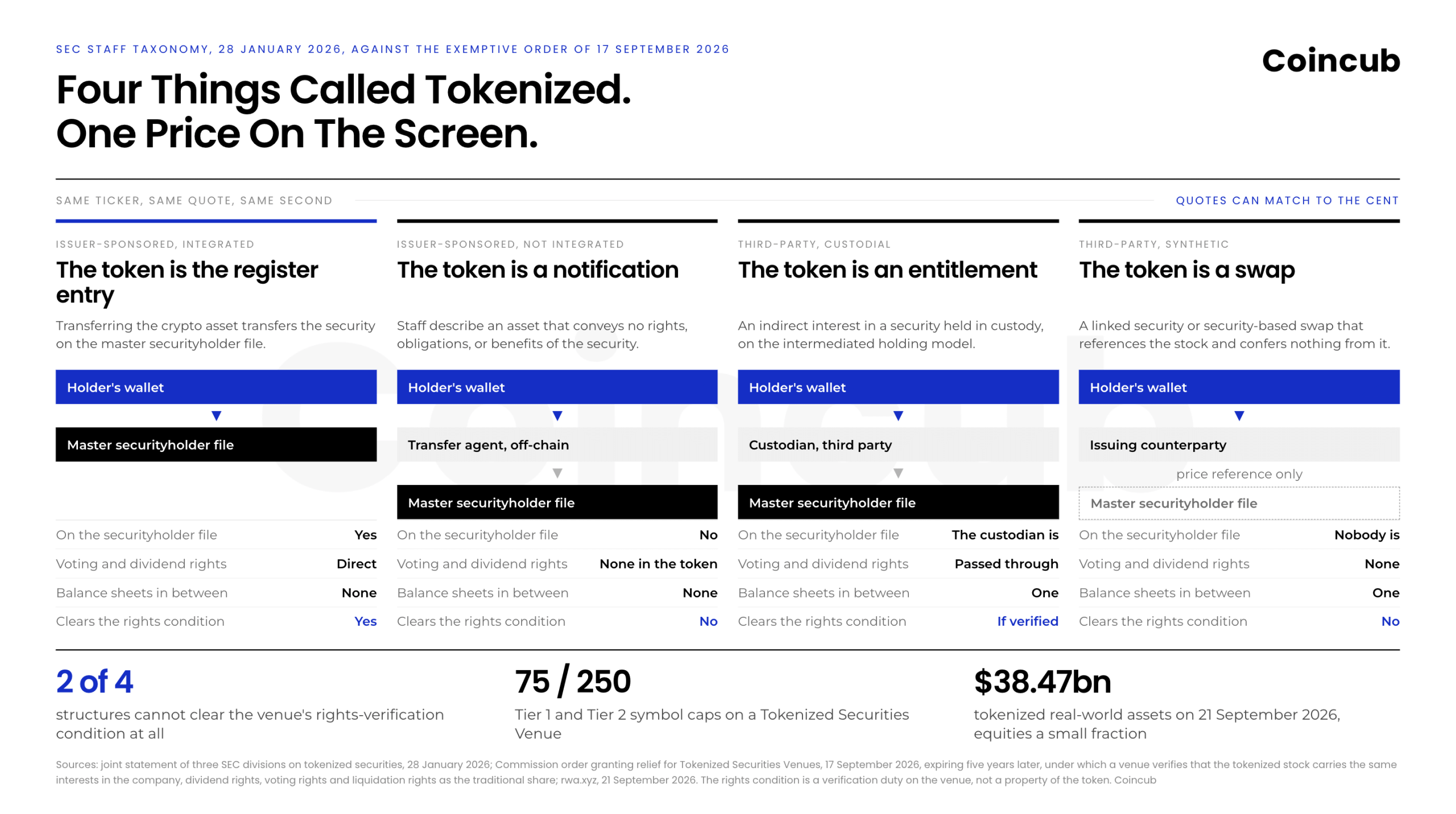
The four tokenization models in the SEC’s taxonomy
Three SEC divisions published a statement on tokenized securities on 28 January 2026 that split the field into issuer-sponsored and third-party models. The split does most of the analytical work available in this market.
In the first issuer-sponsored model, the issuer integrates the ledger into its ownership records, and a transfer of the crypto asset on the network results in a transfer of the security on the master securityholder file. The token is the register entry. The holder’s name reaches the company’s books through the wallet address itself, and dividends, votes, and corporate actions run off that record.
The second issuer-sponsored model looks identical from a wallet. The security is issued off-chain, the holder receives a corresponding crypto asset, and the staff describe that asset as one that “does not convey any rights, obligations, or benefits of the security.” Its onchain records are not integrated into the master securityholder file. Moving the token signals an intention to transfer and triggers an update somewhere else, on a timetable the transfer agent controls.
Third-party structures add a party the issuer never dealt with. One version gives the holder a tokenized security entitlement, an indirect interest in a security held in custody, borrowing the intermediated holding concept US commercial law already runs the equity market on. The other version is the third party’s own instrument, a linked security or a security-based swap that references the stock and confers no equity, voting, or information rights from the company named on the screen. The staff note that holders face risks with respect to the third party, bankruptcy among them, that a holder of the underlying security would not necessarily face.
A buyer looking at four tickers with the same price is looking at a register entry, a notification, a custodial claim, and a derivative. The governing documents decide which one arrived. The token standard, the chain, the auditor, and the marketing page are all silent on the question, and a product built on any of the four can be well run or badly run within its own structure. What changes across the four is the list of parties whose failure reaches the holder.
What the SEC Innovation Exemption requires of a trading venue
Relief for Tokenized Securities Venues arrived as a Commission order on 17 September 2026 and expires five years later. A TSV runs permissioned automated market maker liquidity pools and escapes exchange registration, alternative trading system registration, and Regulation NMS Rules 611 and 602(e). Firms providing liquidity escape the dealer definition in Exchange Act Section 3(a)(5).
Size limits track the limit up, limit down tiers. A venue may list 75 Tier 1 symbols, the S&P 500 and Russell 1000 names plus qualifying ETPs, capped at 0.25% of the prior month’s average daily share volume. Tier 2 covers the rest of the NMS universe at 250 symbols and 2.5% of average daily volume. Breach the volume cap once and nothing happens. Breach it again and the venue pauses trading in that name for three months.
Smart contracts used by a venue have to be auditable, public, and deployed on a public permissionless ledger. A venue must halt a tokenized name whenever trading stops in the underlying stock. Where an unaffiliated third party did the tokenizing, the venue gives the issuer written notice and an opportunity to object before listing it. And the venue verifies that the tokenized stock carries the same interests in the company, dividend rights, voting rights, and liquidation rights as the traditional share.
Two of the four structures cannot clear it at all. A synthetic tracker confers nothing from the referenced issuer. A token that conveys no rights, obligations, or benefits of the security cannot be verified as carrying the same ones. The order pushes US onchain equity trading toward the structures where the holder ends up on the securityholder file or holds an entitlement that reaches it.
The issuer-notice condition deserves attention from anyone building a wrapper. A third party can tokenize a listed company’s stock without that company’s involvement, and the order requires written notice to the issuer with an opportunity to object before listing. That puts a venue admitting third-party tokenizations into a relationship with every issuer on its board, and it hands issuers a say in whether a wrapper on their stock trades at all.
Scale gives the whole exercise some perspective. Tokenized real-world assets tracked by rwa.xyz stood at $38.47 billion on 21 September 2026, with equities a small fraction of the total. Five years of conditional relief have been written ahead of the float they apply to.
Ledger-based securities in Switzerland and digital property in England and Wales
Switzerland settled the constitutive question in private law. Article 973d of the Code of Obligations, in force since 1 February 2021, lets a right become a ledger-based security through a registration agreement between the parties, after which the right can only be asserted and transferred through that ledger. The ledger has to satisfy four conditions. Creditors rather than the debtor hold the power of disposal. Integrity is protected against unauthorized change, for instance by joint administration among independent parties. The content of the rights, the functioning of the ledger, and the registration agreement are recorded in the ledger or in linked data. Creditors can verify their own entries without help from third parties.
Minting an ERC-20 contract satisfies none of that on its own. The registration agreement does the legal work and the ledger architecture has to earn the four conditions. A Swiss token whose issuer retains unilateral control over balances fails the first condition before anyone reaches the securities analysis.
England and Wales took a narrower step. The Property (Digital Assets etc) Act 2025 received Royal Assent and came into force on 2 December 2025, confirming that a thing can be the object of personal property rights even though it fits neither of the two historical categories. The Law Commission states plainly that the Act leaves it to the courts to develop this third category by delineating its boundaries and the rights that attach to third category things.
The reform makes the token capable of being owned. It does nothing to the land register, the share register, or the copyright in the image an NFT points at. A holder can have good title to a digital object and no claim at all on the asset its metadata names. Collateral treatment is still open, with HM Treasury reviewing the Law Commission’s recommendations on financial collateral arrangements.
Custody models and who legally holds the asset
Custody arguments in this market collapse three questions into one. Who can move the token, who holds the underlying asset, and who has title to it are answered by a key, a custody agreement, and a register. Those three can point at three different parties. Answering one of them leaves the other two open, and each carries its own document and its own governing law.
Self-custody gives the holder direct control of the token and removes the wallet custodian as a counterparty. It leaves the underlying rights exactly where the documents put them. A holder with the key to a token in the second issuer-sponsored model still depends on a transfer agent to recognize the move, and corporate actions run through whatever identity mapping the issuer maintains.
Omnibus custody pools client tokens under the custodian’s control. Clients typically hold contractual or beneficial interests in the pool, and the analysis turns on commingling, shortfall allocation, and whether the custodian may rehypothecate. Client-specific segregation improves tracing and makes identification easier in a failure, though a dedicated wallet or a sub-account on the custodian’s system carries no proprietary effect by itself. A trust deed or a custody agreement supplies that effect or nothing does.
Intermediated holding inserts a securities intermediary between the investor and the registered security. That is the architecture behind the tokenized entitlement model, and the investor’s claim runs against the intermediary’s records and the intermediary’s insolvency law. It puts the holder one layer further from the issuer than a direct holder sits.
Smart contract vaults move control into program logic while leaving privileged powers with whoever holds the admin keys. Multisignature and MPC arrangements distribute those keys across signers. The contract between the parties allocates authority to instruct a signature, and the threshold scheme only distributes the technical ability to produce one. Signer identity, key storage, deadlock procedure, and recovery terms belong in the custody review alongside the cryptography.
On-chain settlement and legal transfer of ownership
Four events sit inside one tokenized trade. The parties agree. The ledger validates a state transition. Cash moves irrevocably. The applicable law and the authoritative register recognize the buyer. A well built delivery-versus-payment design can collapse those into one moment, and nothing about a blockchain does it automatically.
Hong Kong turned that into a disclosure obligation. The SFC’s circular of 2 November 2023 treats tokenized securities as traditional securities with a tokenization wrapper and applies the same business, same risks, same rules principle. Intermediaries have to tell clients whether off-chain or on-chain settlement is final, what limits apply to transfers, whether a smart contract audit was conducted before deployment, what the key administrative controls and business continuity plans cover, and how custody is arranged.
Every one of those questions has a wrong answer that still produces a working screen. A wallet can display a confirmed token balance hours before the registrar books the holder, and the reverse happens whenever a transfer agent updates a record before anything moves onchain. Sanctions screening, whitelist logic, and transfer-agent hours all open windows where the two records disagree, and the governing documents decide which record wins.
Chain-level events produce a second class of mismatch. A reorganization, a fork, or a network outage can leave the ledger and the register disagreeing over facts neither party caused, and the documents have to name who reconciles them and how fast. Administrative overrides run the other way, since a freeze or a forced transfer moves a balance with no instruction from the holder. Most tokenholder agreements handle both in a sentence or skip them. A holder reading one should find what happens to a balance after a fork and who carries the loss on a mistaken transfer.
The cash leg has been the binding constraint in production. Weekend trading on the largest tokenized US equity platformran at 0.55% of volume through May 2026, held down by prefunding demands and the absence of central bank money outside banking hours. Atomic settlement strips out the multilateral netting that makes conventional clearing capital-efficient, and someone has to fund the difference across the weekend. A design that settles instantly and ties up capital for two days has moved the cost onto the balance sheet.
Tokenholder priority in an issuer or custodian insolvency
Insolvency is the test that separates the four structures reliably, and it sorts holders onto five rungs. Direct owners hold the asset and watch the issuer fail around them. Beneficiaries under an effective trust or segregated arrangement can identify assets held for them. Secured creditors hold a perfected interest in collateral owned by the issuer. Unsecured creditors hold a redemption promise. Equity holders wait for a surplus that usually never arrives.
A reserve attestation shows assets at a moment, leaving liabilities, encumbrances, rehypothecation rights, and the name on the account unaddressed. The useful version reconciles both sides, confirming that verified eligible assets minus encumbrances cover total redeemable token liabilities. A cryptographic demonstration that a wallet holds coins proves nothing if the same collateral has been pledged elsewhere.
Some issuers do write the strong version. Paxos states that holders of PAX Gold own the underlying physical gold held in custody by Paxos Trust Company, with the metal allocated in LBMA vaults in London. That language describes a proprietary claim on identified bars through a trust company. Set it against a token whose documents promise delivery of gold on demand and the gap only opens the day the issuer cannot deliver. Tokenized gold products sit across that whole range, under different custodians and different supervisors.
Third-party tokenization adds a layer the SEC flagged directly. Buying a custodial wrapper around a blue-chip share inserts a balance sheet between the holder and the company, and the wrapper can fail while the underlying issuer thrives. Nothing in the price feed signals which entity the holder is exposed to.
If the issuer, the platform, and the custodian all stopped operating this week, what could the holder prove, remove from the estate, and transfer or redeem without them? Structures with good answers tend to name a trustee, an authoritative register, and a mechanism for replacing a failed custodian, and they set out how a shortfall is allocated before one happens.
What ERC token standards specify about ownership
Token standards specify software behavior and stop there. ERC-721 is explicit about the ambition, with a motivation section covering physical property such as houses and unique artwork, and equally explicit about the delivery, a standard API to track and transfer distinguishable tokens. Nothing in the interface makes a ledger entry into a deed.
ERC-3643 shows what a regulated token needs and what those requirements cost the holder. The standard reached Final status and specifies an identity registry linking wallets to verified investors and country codes, a compliance contract enforcing caps on investors per country and tokens per investor, and a transfer pre-check. It also specifies partial or complete freezing per wallet, a global pause, recovery where an investor loses key access, agent-initiated forced transfers that bypass compliance checks, and mint and burn. An owner appoints the agents holding those powers, and the specification contemplates automated systems and smart contracts filling the agent role on regulatory triggers.
Those functions serve court orders, sanctions screening, and lost-key recovery. They also make the token an administered instrument, and the signer set behind the agent role becomes part of the credit analysis alongside the issuer. Proxy upgradeability extends the same exposure to the code itself, since the implementation a buyer reviewed can be swapped for one chosen later by whoever controls the proxy admin.
ERC-4626 defines its claim narrowly. The standard is Final and describes vault shares as a claim to ownership on a fraction of the vault’s underlying holdings, scoped precisely to what the vault contract holds. Point a vault at off-chain collateral and the share accounting still reconciles while the legal claim depends on the entity holding that collateral. A correct conversion function is a statement about the contract’s arithmetic. Whether the reserves sit outside an insolvency estate is settled by a trust deed and the law governing it.
Bank regulators reached the same conclusion from the other direction. The Federal Reserve, FDIC, and OCC clarified on 5 March 2026 that an eligible tokenized security should generally receive the same capital treatment as the non-tokenized form, calling the capital rule technology-neutral. Supervisors price the exposure underneath and disregard the wrapper. A bank running that analysis works from examination files, in-house counsel, and a supervisory dialog it can appeal to. A treasury team or a fund buying the same instrument works from a product page and whatever the issuer has chosen to publish.
The authoritative register names who holds the security. The custody agreement sets out who holds the asset and on what terms. The insolvency waterfall determines what survives a failure. Securities clearing and tokenized funds are moving onto ledgers at speed. Onchain equity trading will arrive in the United States well before the case law does, and those three documents are still where the answer sits.
Frequently Asked Questions (FAQ)
Does buying a tokenized asset make you the legal owner of the underlying asset? +
Only in some structures. SEC staff identified one issuer-sponsored model where transferring the token transfers the security on the master securityholder file, and a second where the token conveys no rights, obligations, or benefits of the security at all. Third-party models give either an entitlement against a custodian or synthetic exposure through a linked security or swap.
Does holding the private key mean you own the asset? +
Key control establishes technical power over the token. Whether that amounts to ownership of an off-chain share, bond, or property interest depends on the governing documents and the authoritative register. England and Wales confirmed that a digital object can be personal property, and that reform leaves land registers and share registers untouched.
What does the SEC Innovation Exemption require of tokenized stock? +
A Tokenized Securities Venue must verify that the tokenized stock gives holders the same interests in the company, dividend rights, voting rights, and liquidation rights as the traditional share. Venues also face symbol and volume caps by tier, public auditable smart contracts on a permissionless ledger, halt synchronization, and issuer notice for third-party tokenizations.
Do tokenized stocks carry voting rights? +
It depends on the structure. A linked security or security-based swap confers no equity, voting, or information rights from the referenced issuer. A tokenized security entitlement passes rights through a custodian. Only the integrated issuer-sponsored model puts the holder on the securityholder file directly.
What makes a token the security itself rather than a record of it? +
Swiss law gives the clearest template. A registration agreement ties the right to a qualifying ledger, and the ledger must give creditors the power of disposal, protect integrity against unauthorized change, record the rights and the agreement, and let creditors verify their own entries unaided.
Is on-chain settlement the same as legal settlement? +
No. Trade agreement, ledger state transition, cash finality, and legal recognition of the new owner are four separate events. Hong Kong's SFC requires intermediaries to disclose whether off-chain or on-chain settlement is final, along with transfer limits, smart contract audit status, administrative controls, and custody details.
What happens to token holders if the issuer goes bankrupt? +
Recovery follows the legal position the documents create. Direct owners, trust beneficiaries, perfected secured creditors, unsecured redemption claimants, and equity holders sit on descending rungs. SEC staff warned that third-party tokenization exposes holders to bankruptcy risk that a holder of the underlying security would not necessarily face.
Do token standards like ERC-3643 or ERC-4626 guarantee anything about ownership? +
They specify software behavior. ERC-3643 gives agents the power to freeze wallets, pause transfers, recover tokens, and force transfers that bypass compliance checks. ERC-4626 defines vault shares as a claim on a fraction of the vault's holdings, and where the collateral sits off-chain the legal claim rests on the entity holding it.