Buy a Licensed Company
  Explore VASP Data
  Talk to an Expert

 Atis Shala
Atis is a senior analyst and community lead with four years of experience in crypto. He has a bachelor from the Rochester Institute of Technology.
Atis Shala
Atis is a senior analyst and community lead with four years of experience in crypto. He has a bachelor from the Rochester Institute of Technology.
British Columbia vs. Alberta vs. Quebec MSB: How Provincial Rules Compare in 2026

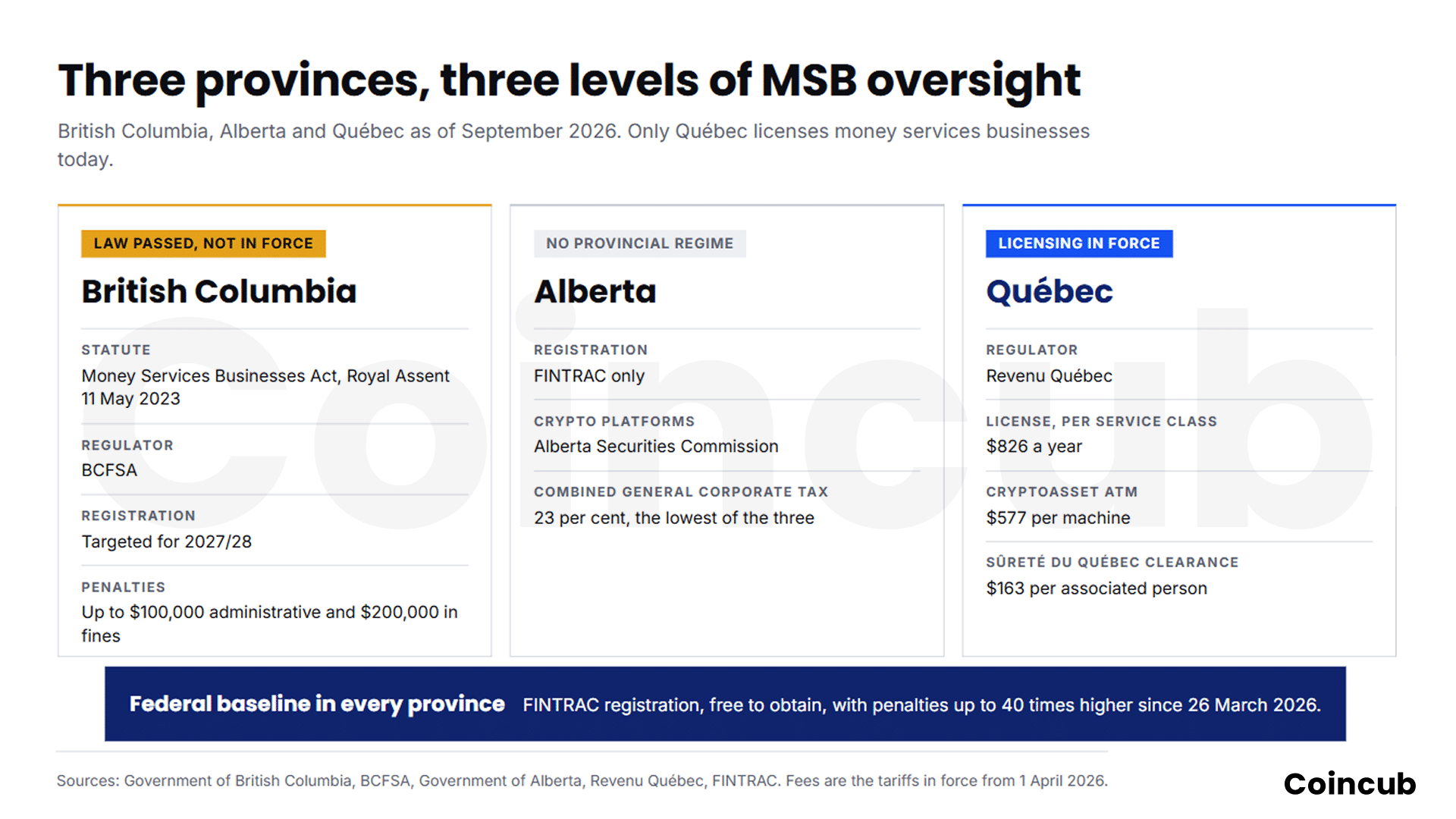
- Quebec is the only one of the three provinces that licenses MSBs today: Revenu Québec issues licenses under the Money-Services Businesses Act, with police checks and 2026 to 2027 fees of $826 per service class.
- British Columbia’s Money Services Businesses Act received Royal Assent on 11 May 2023 but takes effect only through regulation, and the BC Financial Services Authority’s latest service plan targets implementation in 2027/28.
- Alberta has no provincial MSB regime, so an Alberta MSB answers to FINTRAC for its money services and to the Alberta Securities Commission if it runs a crypto trading platform.
- FINTRAC registration applies in all three provinces, costs nothing and, since 26 March 2026, carries maximum penalties up to 40 times higher than before.
- Combined general corporate income tax rates are 23% in Alberta, 26.5% in Quebec and 27% in British Columbia.
- Crypto ATMs need a per-machine provincial license only in Quebec, at $577 or $849 if they dispense cash, while Ottawa proposed a national crypto ATM ban in 2026.
Why the Province Still Matters Under a Federal Regime
British Columbia, Alberta and Quebec regulate money services businesses (MSBs) in three different ways. Quebec requires a provincial license from Revenu Québec on top of federal FINTRAC registration, British Columbia has passed a registration law that is not yet in force, and Alberta relies on federal rules alone. As of September 2026, any British Columbia vs Alberta vs Quebec MSB decision therefore comes down to one extra license in Quebec, a pending regime in British Columbia and no provincial MSB layer in Alberta.
The British Columbia government described the gap itself. When it introduced its Money Services Businesses Act in March 2023, it counted 578 MSBs in the province and noted that Quebec was the only other province regulating the sector, which it had done since 2012. The bill answered a recommendation of the Cullen Commission, the province’s public inquiry into money laundering, yet more than three years later its registration regime is still waiting for regulations.
This comparison covers the federal baseline, each province’s rules, a side-by-side table, the corporate and tax differences behind many incorporation decisions, and how crypto businesses are treated in each province.

The Federal Baseline Every Canadian MSB Shares
Every MSB in the three provinces starts from the same federal rulebook. Businesses that deal in foreign exchange, transfer money, issue or redeem money orders or deal in virtual currencies must register with FINTRAC before they begin to operate. Registration is free, but the chief executive, president, directors and anyone owning or controlling 20% or more must provide criminal record checks, and foreign MSBs that direct services at Canadians must register as well.
Registration then triggers a full compliance program. FINTRAC expects a compliance officer, written policies, a risk assessment, training, client identification, record keeping and reporting, including a Large Virtual Currency Transaction Report for crypto amounts of $10,000 or more. The stakes rose on 26 March 2026, when the Strengthening Canada’s Immigration System and Borders Act gave FINTRAC maximum penalties up to 40 times higher, compliance orders and mandatory compliance agreements.
Payment firms can face a second federal registration. Since 8 September 2025, businesses that perform retail payment activities must be registered with the Bank of Canada before they start, and this guide explains when a crypto business falls under Canada’s RPAA. The practical federal steps, including buying an existing BC-incorporated MSB, are set out in this guide on how to get an MSB license in Canada.
None of these federal duties change with the province. What changes is the layer each province adds on top, and that layer ranges from a full license to nothing at all.
Quebec: The Only Province Licensing MSBs Today
Quebec adds the most demanding provincial layer. Since 13 September 2021, Revenu Québec has administered the regime that the Autorité des marchés financiers (AMF) ran before, and the Money-Services Businesses Act requires a license of the right class before a business offers any of six services. Those services are currency exchange, funds transfer, traveller’s cheques and money orders, cheque cashing, ATM operation and, since 1 April 2025, cryptoasset ATM operation.
Approval depends on people as much as paperwork. Revenu Québec’s license application details require information on directors, officers, ultimate beneficiaries, lenders and employees in Quebec who provide money services, and each of them goes through a Sûreté du Québec security clearance. The business also needs a respondent who lives in Quebec, must keep its records in the province, and can expect a decision within 50 days in 90% of cases.
Quebec’s 2026 Fees and Penalties
The fees are annual and published in Revenu Québec’s list of fees and tariffs. From 1 April 2026 to 31 March 2027, they are $826 per service class, $272 per ATM, $577 per cryptoasset ATM and $163 for each person cleared, with indexation frozen until March 2029. Operating without a license exposes a company to fines of $15,000 to $200,000 on a first offence, and both limits double for a repeat offence.
The AMF still matters in Quebec, only for different businesses. Crypto trading platforms that deal with Quebec residents register as dealers under securities law, and the AMF’s register of cryptoasset trading platforms lists 10 of them, including Coinbase Canada, Kraken’s Canadian entity, Shakepay and Wealthsimple.
British Columbia: A Law Passed, Waiting to Start
British Columbia has the law but not yet the regime. The Money Services Businesses Act received Royal Assent on 11 May 2023 and names the BC Financial Services Authority (BCFSA) as the regulator, yet the province’s anti-money laundering page, updated in April 2026, still describes the Act as coming into force through regulation. Until that happens, a BC-based MSB operates under FINTRAC registration alone.
What the BC Act Will Require
Once in force, the Act will require MSBs to register with BCFSA, pass broad background checks and file regular reports. Bill 19 of 2023 defines money services as foreign exchange dealing, remitting or transmitting funds by any means, and issuing or redeeming money orders, traveller’s cheques and similar instruments, plus any services added by regulation. Virtual currency is not named in that definition, so the provincial regime’s reach over crypto businesses will depend on regulations that have not yet been made.
The enforcement tools are substantial. BCFSA will be able to impose administrative penalties of up to $100,000 per contravention, and courts can fine a corporation or an individual up to $200,000, with up to two years’ imprisonment for individuals.
When Registration Is Likely to Start
BCFSA’s own planning shows the start date moving. Its 2025/26 service plan pointed to implementation in 2026/27, while the 2026/27 to 2028/29 service plan aims to complete readiness in 2026/27 and implement the Act in 2027/28, adding that implementation is subject to government direction. Businesses therefore have time to prepare, but existing MSBs will also have to register and pass the background checks, so a clean ownership file matters now.
That matters because a FINTRAC listing alone proves little about a business, as this look at Canada’s MSB registry shows, and British Columbia hosted 578 of the more than 2,000 FINTRAC-registered MSBs counted in 2023. A provincial check will add a second filter for buyers and partners of BC companies.
Alberta: Federal Rules Only
Alberta adds no provincial layer for money services. The province’s list of regulated financial service providers covers credit unions, loan and trust corporations, ATB Financial, insurers, pension plans and securities, with no category for currency exchange or money transfer. An Alberta MSB therefore answers to FINTRAC for its money services and, where its activities qualify, to the Bank of Canada as a payment service provider.
Other provincial rules can still apply to specific products. Crypto trading platforms operating in Alberta fall under the Alberta Securities Commission, whose registrant toolkit for crypto asset trading platforms sets out expectations under the national framework of the Canadian Securities Administrators (CSA). Consumer lending is also separate, since a business that adds payday loans needs Alberta’s payday loan business licence.
Alberta’s Fintech Sandbox
Alberta offers flexibility of a different kind. Its regulatory sandbox under the Financial Innovation Act has accepted applications since 4 July 2022. Approved firms with a physical presence in the province can test new financial products with temporary exemptions from provincial statutes such as the Consumer Protection Act, the Loan and Trust Corporations Act and the Personal Information Protection Act.
The sandbox has clear limits for MSBs. It excludes securities law, including the Alberta Securities Act, and as a provincial program it has no power over federal FINTRAC duties, so it offers no route around MSB registration. Its value lies in testing adjacent products, such as lending or payment features, while the core money services stay under federal rules.
BC vs Alberta vs Quebec MSB Rules Side by Side
Set next to each other, the three provinces sit at three distinct points on the same scale. The table compares their provincial MSB layers as of September 2026, before any federal rules are added.
| Question | British Columbia | Alberta | Quebec
|
|---|---|---|---|
| Provincial MSB law | Money Services Businesses Act (2023), not yet in force | None | Money-Services Businesses Act, in force since 2012 |
| Provincial regulator | BCFSA, once the Act takes effect | None for MSBs | Revenu Québec (the AMF until 12 September 2021) |
| Form of approval | Registration | Not applicable | License for each service class |
| Services covered | Foreign exchange, remittance, money orders and traveller’s cheques, plus services added by regulation | Not applicable | Six classes, including ATMs and cryptoasset ATMs |
| Background checks | Broad checks once in force | FINTRAC checks only | Sûreté du Québec clearance for each associated person |
| Provincial fees | Not yet set | None | $826 per class, $272 per ATM, $577 per cryptoasset ATM, $163 per person (2026 to 2027) |
| Local presence | Not yet known | None | Respondent living in Quebec; records kept in Quebec |
| Maximum provincial penalties | $100,000 administrative penalty; $200,000 fine | None | $200,000 for a company’s first offence, doubled on repeat |
| Crypto trading platform regulator | BC Securities Commission, under the CSA framework | Alberta Securities Commission, under the CSA framework | AMF |
Two patterns run through that table. Quebec is the only province where every money service carries a provincial price tag and a police check today, and British Columbia is building a registration model backed by penalties of a similar size. Alberta’s absence of a provincial regime lowers entry costs, although it also leaves partners and banks with FINTRAC registration as the only public signal of legitimacy.
A Worked Example: Ten Crypto ATMs in Each Province
A simple scenario shows what those rules mean in dollars. Take an operator running ten two-way crypto ATMs that dispense cash, with four people who would need a provincial background check:
- Quebec. The operator pays 10 × $849 in annual machine fees plus 4 × $163 for security clearances, or $9,142 in provincial fees in the first year and $8,490 in each later year at 2026 to 2027 rates.
- British Columbia. The operator pays no provincial MSB fees today, although BCFSA may set registration fees once the Act takes effect.
- Alberta. The operator pays no provincial MSB fees.
FINTRAC registration is free in all three cases, so the provincial layer accounts for the whole difference in direct licensing cost. Compliance staff, systems and audits usually cost more than any of these fees, and they are needed in every province.
Corporate and Tax Differences Behind the Choice
Provincial MSB rules are only part of the decision, because the province of incorporation also sets corporate tax rates and ownership-disclosure duties. The table compares the three on the factors that most often shape where an MSB or crypto business is set up.
| Factor | British Columbia | Alberta | Quebec
|
|---|---|---|---|
| Provincial general corporate tax rate | 12% | 8% | 11.5% |
| Combined with the 15% federal rate | 27% | 23% | 26.5% |
| Provincial small business rate | 2% | 2% | As low as 2.2% on eligible income for taxation years beginning after 29 April 2026 |
| Beneficial ownership records | Private transparency register since 1 October 2020 | Private records proposed in a 2025 consultation | Ultimate beneficiaries declared to the public enterprise register |
The federal and British Columbia rates come from the Canada Revenue Agency’s corporation tax rates page, while Alberta and Quebec collect their own corporate tax and publish their rates through Alberta’s tax rate page and Revenu Québec’s 2026 small business announcement.
Alberta’s tax position is the largest single difference. At the general rates, a company with $1 million of taxable income pays about $230,000 in combined corporate tax in Alberta, $265,000 in Quebec and $270,000 in British Columbia, before any other taxes or credits.
Transparency runs the other way. British Columbia’s transparency register is closed to the public and open only to the company’s directors and to authorities such as the police, the CRA, the BC Securities Commission and FINTRAC. Alberta consulted in 2025 on requiring similar private records, whereas Quebec’s corporate transparency rules require companies to declare anyone holding 25% or more and make the register searchable by a person’s name. Buyers doing due diligence on an MSB will therefore find the most public ownership information in Quebec.
Crypto ATMs and Trading Platforms Across the Three Provinces
Crypto businesses see the sharpest provincial differences. For crypto ATMs, only Quebec charges a provincial license, at $577 per machine for 2026 to 2027 or $849 when the machine also dispenses cash, while operators in British Columbia and Alberta rely on FINTRAC registration alone. The risk picture is shared, though: FINTRAC’s May 2024 advisory on virtual currency ATMs named Metro Vancouver and the Greater Montréal Area among the three national hotspots for suspicious activity and flagged notable volumes in Edmonton and Calgary. What operators must check at the machine is set out in this guide to Bitcoin ATM KYC requirements in Canada.
That provincial gap may soon matter less. The Spring Economic Update 2026 proposed to ban crypto ATMs nationally, and on 6 May 2026 Finance Canada said that the details would follow in legislation, citing studies that link 85% to 98% of crypto ATM transactions to illicit activity.
Crypto trading platforms follow a national securities framework instead. The CSA’s list of platforms authorized to do business with Canadians named 20 platforms on 18 September 2026, and the AMF keeps its own list of those authorized to deal with Quebec residents. Transfers between platforms also carry the travel rule, whose data fields are explained in this guide to Canada’s crypto travel rule.
Choosing a Province for an MSB
The right province depends on what the business does and where its customers are, because provincial rules follow the services as much as the head office. Quebec’s Act includes specific rules for businesses based outside the province, so incorporating elsewhere does not remove the need for a Quebec license when offering money services there.
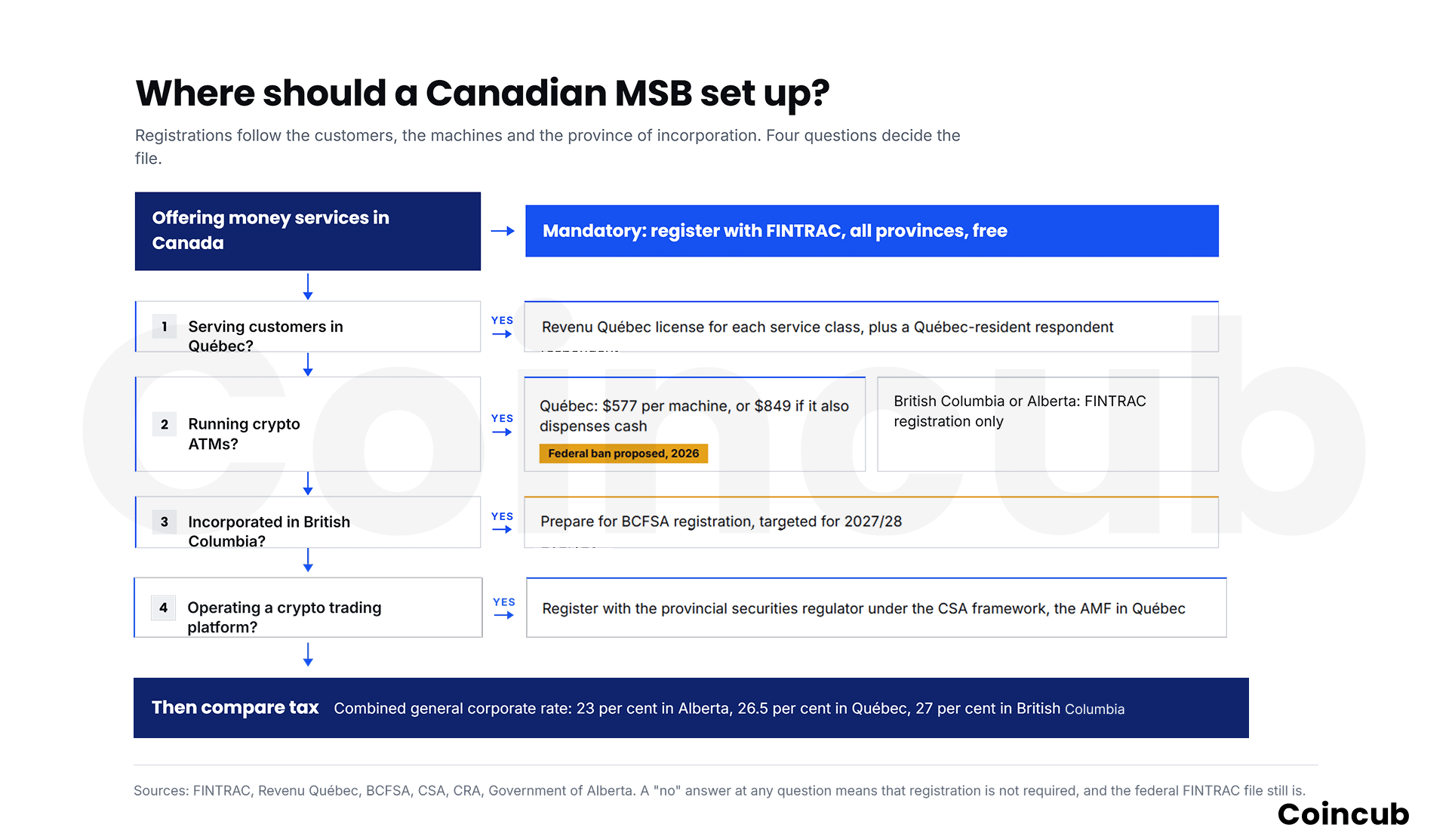
Five questions usually settle the choice:
- Will the business serve customers in Quebec? A Revenu Québec license is needed for each money service offered there, along with a respondent who lives in Quebec.
- Will it run crypto ATMs? Quebec machines need per-machine licenses, BC and Alberta machines need only FINTRAC registration, and the federal ban proposal applies to all three.
- Does tax drive the decision? Alberta’s combined 23% general rate is the lowest of the three provinces.
- Is the company based in British Columbia? It should budget for BCFSA registration and background checks once the Act takes effect, currently targeted for 2027/28.
- Do banks and partners need strong public signals? Quebec’s license and public ownership register give counterparties the most to verify.
Some founders prefer to buy rather than build. An existing FINTRAC-registered MSB for sale can shorten the federal timeline, although new owners still face FINTRAC updates and, in Quebec, fresh security clearances for new associated persons.
Final Thoughts
For an MSB choosing between British Columbia, Alberta and Quebec, the provincial layer ranges from nothing to a full, police-checked license. Alberta offers the lightest regulatory footprint and the lowest corporate tax, and British Columbia offers a similar position today with a registration regime on the way. Quebec offers the most verifiable standing at the highest compliance cost, with a license that applies to anyone serving Quebec customers. Every option still starts with FINTRAC. The wider national picture is summarised on this Canada crypto regulation page, the crypto license map shows how Canada compares with other jurisdictions, and a global VASP database that tracks more than 30,000 registered crypto companies.
Frequently Asked Questions (FAQ)
Which Canadian provinces regulate money services businesses? +
Quebec is the only province with an MSB licensing regime in force, administered by Revenu Québec since 2021. British Columbia passed a Money Services Businesses Act in 2023 that is not yet in force, and Alberta relies on federal FINTRAC registration alone.
Do I need a provincial MSB license in Alberta? +
Alberta has no provincial MSB license, so a money services business based there registers with FINTRAC and, if it performs retail payment activities, with the Bank of Canada. Crypto trading platforms in Alberta also answer to the Alberta Securities Commission.
When will British Columbia's MSB Act take effect? +
British Columbia's Money Services Businesses Act received Royal Assent on 11 May 2023 but takes effect only through regulation. BCFSA's 2026/27 to 2028/29 service plan targets implementation in 2027/28, subject to government direction, and no registration deadline has been set.
How do MSB license costs compare in BC, Alberta and Quebec? +
For 2026 to 2027, Quebec charges $826 per service class, $272 per ATM, $577 per cryptoasset ATM and $163 per person cleared. British Columbia has not set provincial fees yet, and Alberta charges no provincial MSB fees at all.
Can a BC or Alberta company serve Quebec customers without a Quebec license? +
A company offering money services in Quebec needs a Revenu Québec license wherever it is incorporated. The Act includes rules for businesses based outside Quebec, such as a respondent who lives in the province, and FINTRAC registration alone does not satisfy them.
Which province has the lowest corporate tax for an MSB? +
Alberta has the lowest general corporate income tax of the three, at 8% provincially or 23% combined with the 15% federal rate. Quebec's combined general rate is 26.5% and British Columbia's is 27%, while small business rates are lower in all three.
Do crypto ATM operators need a provincial license in BC or Alberta? +
Crypto ATM operators in British Columbia and Alberta need no provincial license, only FINTRAC registration as virtual currency dealers. Quebec requires a per-machine license costing $577, or $849 with cash dispensing, and a federal ban on crypto ATMs was proposed in 2026.