Buy a Licensed Company
  Explore VASP Data
  Talk to an Expert

 Dren Hima
 is Head of Research at Coincub, leading research across digital asset regulation, licensing, market structure, tokenization and institutional adoption.
Dren Hima
Dren Hima is Head of Research at Coincub, leading research across digital asset regulation, licensing, market structure, tokenization and institutional adoption.
Taxing Agentic Income: How AI Agents Trigger Crypto Tax Liability
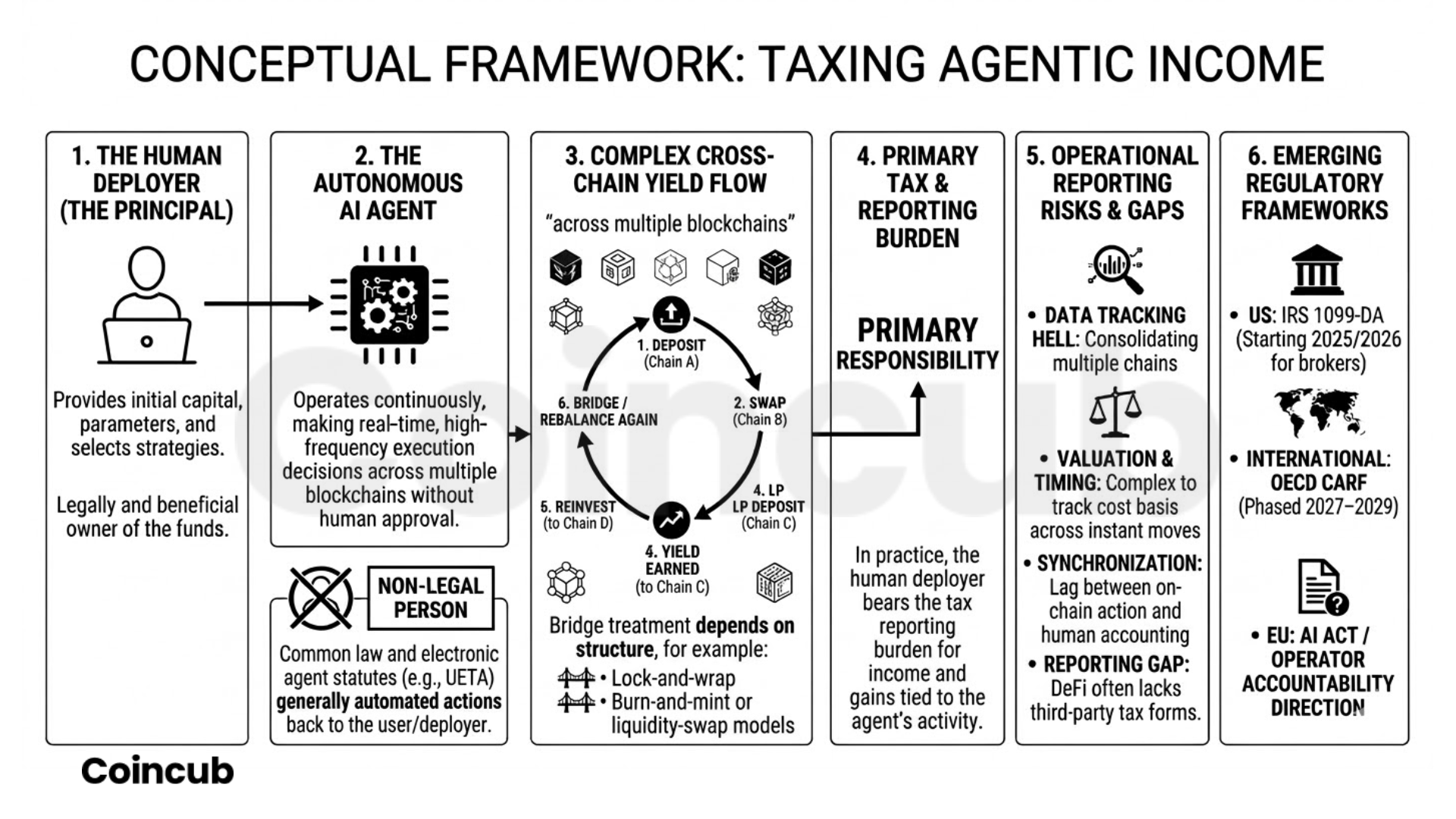
- Agentic income is already possible. AI agents can move funds, trade tokens, and interact with DeFi protocols via wallets and smart contracts without human approval for each action.
- The tax burden still sits with the human deployer. Current legal frameworks do not treat AI agents as separate legal taxpayers. In practice, the person or company using the agent carries the reporting obligation.
- DeFi activity still has a major reporting gap. Centralized brokers are subject to 1099-DA reporting rules, but non-custodial DeFi activity typically does not include third-party tax forms, leaving users to track everything themselves.
- Cross-chain and high-frequency activity create the biggest risk. Token swaps, liquidity pool deposits, rewards, and certain bridge designs can all trigger taxable events. When an agent does this at speed, bookkeeping becomes the real problem.
- Compliance will likely need AI too. If autonomous agents keep handling financial activity, businesses will need automated tax and reconciliation tools just to keep up with transaction volume and valuation.
The intersection of artificial intelligence, decentralized finance (DeFi), and global tax law is creating a real problem: “agentic income.” This happens when software agents with wallet access and preset financial objectives start trading, moving funds, and generating revenue without a human approving each step.
When an autonomous AI agent independently routes capital through decentralized liquidity pools, bridges assets across multiple blockchain networks, and algorithmically harvests yield, a practical question arises: Who holds the ultimate tax liability, and how is it reported?
The key is separating what the technology can do from what tax reporting systems can actually handle. This analysis categorizes the landscape into four distinct areas: what is clearly true today, what is likely but not legally settled, where the actual reporting bottlenecks sit, and where forward-looking inferences suggest the law is heading.

What is True Today
To understand the tax implications, we must first examine the established infrastructure that enables agentic income and the confirmed boundaries of current tax reporting law.
AI Can Already Start Moving Money
The infrastructure required for an AI agent to hold and transfer money without human latency is being actively built. Because traditional banking requires legal identity and KYC processes, blockchain ecosystems serve as the primary settlement layer for AI.
However, protocols are now bridging this gap to facilitate machine-to-machine commerce. The x402 protocol, for example, revives the HTTP 402 “Payment Required” status code, allowing an AI agent to instantly pay for API access or data using stablecoins over HTTP without managing subscriptions or accounts.
Simultaneously, traditional payment networks are establishing frameworks for agentic commerce. Visa has introduced the “Trusted Agent Protocol,” while Mastercard has launched the “Agent Pay” framework, utilizing “agentic tokens.” Rather than being fully mature, globally deployed infrastructure, these are newly introduced frameworks designed to authenticate AI agents, bounded by user-defined limits, to distinguish legitimate automated transactions from malicious bots.
For tax purposes, the relevance of these payment rails is straightforward: they reduce friction in automated transactions, thereby increasing the volume of taxable events an agent can trigger. They also introduce new metadata and tokenized audit trails that compliance systems may eventually utilize to trace agentic actions back to a human principal.
The 1099-DA Reporting Gap for Decentralized Finance
A confirmed reporting gap in the United States compounds the volume of transactions generated by autonomous agents.
The U.S. Treasury and the IRS finalized regulations requiring digital asset brokers to report gross proceeds on the new Form 1099-DA for 2025 transactions, with cost-basis reporting mandated for certain transactions beginning in 2026. This provides a clear reporting structure for assets held on centralized exchanges.
However, AI agents typically operate using non-custodial smart contract wallets to interact directly with decentralized protocols. Crucially, Congress repealed the legislative effort to extend broker reporting requirements to decentralized finance (DeFi) platforms in April 2025. The nullification of the DeFi broker reporting rules means that Form 1099-DA obligations are currently limited to custodial intermediaries.
Consequently, when an autonomous AI agent earns yield across non-custodial DeFi protocols, there is no centralized entity obligated to issue a 1099-DA to the IRS or the user. The reporting blind spot is a confirmed reality, placing the full burden of transaction tracking and self-reporting directly on the human or corporate deployer.
What is Likely but Not Settled
The legal attribution of an AI’s autonomous actions to a human operator is directionally clear under existing frameworks, but the specific application to complex tax enforcement remains unsettled.
U.S. Agency Law and “Electronic Agents”
In the United States, the legal classification of autonomous software relies heavily on traditional agency law and electronic contracting statutes. Under the Uniform Electronic Transactions Act (UETA) and the Electronic Signatures in Global and National Commerce (E-SIGN) Act, a legally binding contract can be formed by the interaction of “electronic agents.”
UETA’s prefatory notes and statutory language state that an electronic record or signature is attributable to a person if it results from that person’s action, including the actions of an electronic agent programmed and used by that person. This establishes the baseline that the automated transactions bind the human user.
However, while UETA validates the underlying electronic records and signatures, it does not automatically resolve the full tax architecture of autonomous systems. Establishing that an agent’s token swap contractually binds a human is not the same as establishing clear regulatory guidance on the fiduciary duties of the agent’s developer, or how the IRS will handle systemic calculation errors made by the algorithm without human oversight. The baseline attribution is likely settled, but the downstream tax enforcement mechanisms are not.
The EU AI Act and Operator Accountability
In the European Union, the regulatory approach focuses on risk categorization rather than electronic contract attribution. While the EU AI Act places strict requirements on autonomous systems, its limitations regarding financial agents are specific.
The AI Act’s “high-risk” classification (Annex III) for finance is tied to specific use cases, notably systems used to evaluate creditworthiness or assess risk and pricing in life and health insurance. It does not broadly classify standard DeFi yield farming algorithms as inherently high-risk.
Furthermore, while European policy discussions heavily favor the concept of “single-point operator accountability” (where the natural or legal person who deploys the system bears liability), this is currently an emerging policy framing. It represents the likely direction of EU law, focusing on human organizational accountability and explicitly rejecting AI legal personhood. Still, it is not yet settled black-letter law for all cross-chain financial actions.
Where the Real Reporting Risk Sits
The immediate risk for deployers of agentic capital is not a lack of legal definition; rather, the sheer speed of these bots makes traditional tax tracking impossible. U.S. tax law treats digital assets as property, meaning nearly every movement or exchange is a taxable event. When an AI operates at scale, the administrative burden becomes the primary liability.
High-Frequency Token Swaps
An AI agent programmed for portfolio optimization will rebalance assets continuously. If the agent detects volatility and swaps Ethereum (ETH) for USD Coin (USDC) via a decentralized exchange, the IRS treats this as a sale of ETH followed by a purchase of USDC. The principal owes capital gains tax on the appreciation of the ETH relative to its cost basis at the exact moment of execution. Because an agent may execute hundreds of these micro-swaps daily, the principal must track the cost basis and holding period for every fraction of a token moved.
Staking, Yield, and Liquidity Pools
When an AI agent engages in yield farming by depositing assets into lending protocols, the rewards (governance tokens or rebase expansions) are treated as ordinary income. The taxable amount must be calculated based on the fair market value in USD at the precise moment the agent receives the tokens.
Furthermore, depositing tokens into a liquidity pool in exchange for a Liquidity Provider (LP) token is widely interpreted by tax professionals as a taxable crypto-to-crypto exchange. Therefore, the agent’s entry into a yield-generating position generally triggers a realization event for the principal, regardless of the yield earned later.
Cross-Chain Bridging Dispositions
A sophisticated agent will move capital across different blockchain networks (e.g., from Ethereum to Solana) to capture a higher yield. The tax treatment of these cross-chain bridging events hinges on the underlying smart contract mechanics selected by the AI. While the IRS does not provide a neat official taxonomy for every bridge architecture, tax professionals generally view these events through standard property disposition rules:
- Lock and Wrap Bridges: If the agent uses a bridge that locks the original asset and mints a wrapped synthetic version on the destination chain, this is generally viewed as a non-taxable transfer, as the principal retains beneficial ownership of the locked token.
- Burn and Mint / Liquidity Swap Bridges: If the agent selects a bridge that permanently burns the token on the origin chain or swaps it through a cross-chain liquidity pool, this is widely interpreted as triggering a taxable disposition.
Because an AI agent inherently optimizes for speed and lowest transaction fees, it may frequently select “burn and mint” bridges. In doing so, it inadvertently forces the principal to recognize capital gains on the entire bridged amount. Without tax-aware programming, an agent’s search for marginal yield can trigger tax liabilities that outpace the generated profit.
Common Agentic AI Actions and Their Likely Tax Treatment
| AI Agent Action | Likely Tax Treatment |
| Swapping ETH for USDC on a DEX | Usually treated as a taxable disposal of ETH and acquisition of USDC |
| Receiving staking rewards | Usually treated as ordinary income at fair market value when received |
| Harvesting governance tokens from a DeFi protocol | Usually treated as ordinary income when the tokens hit the wallet |
| Depositing tokens into a liquidity pool and receiving LP tokens | Widely interpreted as a taxable crypto-to-crypto exchange |
| Using a lock-and-wrap bridge | Generally viewed as a non-taxable transfer |
| Using a burn-and-mint bridge | Widely interpreted as a taxable disposal |
| Moving funds through a cross-chain liquidity swap | Often treated as a taxable disposal because one asset is exchanged for another |
| Rebalancing a portfolio across multiple tokens | Can trigger repeated capital gains or losses on each disposal |
| Selling reward tokens later | Usually creates a second taxable event, capital gain or loss from the value at receipt |
| Operating entirely through non-custodial DeFi protocols | Usually leaves the user with full self-reporting responsibility, without third-party tax forms |
Where the Article is Making a Forward-Looking Inference
Given the trajectory of autonomous systems and global tax policy, we can infer several likely developments regarding how authorities will adapt to agentic income.
The “Unowned Agent” Dilemma
Economic theorists point to a looming issue: AI agents could eventually spawn secondary sub-agents without explicit human direction. If an originally deployed agent funds a fleet of sub-agents, the legal nexus of ownership becomes attenuated. These derivative entities would operate entirely via smart contracts, effectively becoming “unowned” and creating a scenario primed for tax arbitrage. While entirely untested in court, regulators would likely try to trace control and funding back to the original deployer and argue beneficial ownership from there.
Global Tax Dragnets: The OECD CARF Timeline
Because blockchains are borderless, an autonomous agent’s activity constitutes a continuous flow of transnational capital. To counter the erosion of global tax transparency, the Organization for Economic Co-operation and Development (OECD) developed the Crypto-Asset Reporting Framework (CARF).
While currently a framework, the timeline for implementation is materializing. The OECD commitment list shows that participating jurisdictions are set to begin their first automatic exchanges of crypto-asset tax information in a phased rollout across 2027, 2028, and 2029.
We infer that while purely decentralized smart contracts currently evade U.S. 1099-DA reporting due to the April 2025 repeal, the CARF standard will eventually capture agentic activity globally. The framework’s broad definition of “Relevant Crypto-Assets” includes stablecoins and tokenized financial assets. The moment an AI agent interacts with a regulated stablecoin issuer, a fiat off-ramp, or a compliant service provider in a participating jurisdiction, the transaction data will likely be captured and shared internationally.
Agentic Tax Compliance Workflows
The operational reality of managing agentic income dictates that manual accounting cannot keep pace with high-frequency, cross-chain yield farming. We can safely infer that corporate tax compliance will become heavily reliant on specialized AI intelligence systems.
Major accounting firms and tax software providers are building federated teams of micro-agents to audit autonomous activity. These compliance agents are designed to monitor wallet addresses, categorize transaction metadata (distinguishing between a bridge and a swap), and query pricing oracles to determine real-time fair market value. These systems operate on a “Human-in-the-Loop” (HITL) model, in which the AI performs complex data reconciliation. Still, human professionals maintain fiduciary control and sign off on final return submissions.
Conclusion
The taxation of agentic income highlights a growing friction point between autonomous execution capabilities and rigid tax reporting structures. While the core legal attribution of an AI’s actions to its human deployer is directionally clear under laws like UETA, the practical application of this liability creates a severe compliance burden.
Because autonomous payment protocols enable high-frequency transactions, and because Congress repealed 1099-DA broker reporting for DeFi platforms in early 2025, operators of financial AI are left with a massive reporting blind spot. The immediate risk is administrative: an algorithm optimizing for yield can inadvertently trigger thousands of capital gains dispositions through cross-chain bridges and liquidity pools. Until tax-aware programming and agent-driven compliance tools become standard, the tracking, reconciliation, and reporting burden falls on the human or corporate deployer.
Frequently Asked Questions (FAQ)
What is agentic income?
Agentic income is income generated by software agents that can move funds, trade, stake, bridge assets, or interact with DeFi protocols autonomously.
Who pays tax when an AI agent trades crypto
The human or company that deploys and controls the agent is generally responsible for reporting and paying taxes.
Are token swaps by AI agents taxable?
Usually yes. If an AI agent swaps one crypto asset for another, it is generally treated as a disposal of the original asset and may result in a capital gain or loss.
Are staking or yield farming rewards taxable if an AI agent earns them?
Yes, in most cases, rewards are treated as income at fair market value upon receipt.
Are cross-chain bridge transactions taxable?
Sometimes. The answer depends on how the bridge works. Some structures may be treated more like transfers, while others may be treated like taxable disposals.
Do DeFi protocols send tax forms like Form 1099-DA
Usually no. That is one of the biggest compliance problems with non-custodial DeFi activity.
Why is agentic income harder to report than normal crypto trading?
Because the agent can execute a large number of transactions across multiple chains and protocols in a short period, this makes cost basis tracking and valuation much harder.
Can an AI agent be treated as its own taxpayer?
Not under current mainstream legal frameworks. AI is not generally recognized as an independent legal person for tax purposes.
What happens if an AI agent creates another sub-agent?
That area is still unsettled, but regulators would likely try to trace control and funding back to the original deployer.
What is the biggest risk for users of financial AI agents today?
The biggest risk is not that the trades happen, but that they are not tracked and reported correctly.
If you want, I can also give you a table for this article and tell you exactly where to place it.