


 Buy a Licensed Company
  Explore VASP Data
  Talk to an Expert

 Atis Shala
Atis is a senior analyst and community lead with four years of experience in crypto. He has a bachelor from the Rochester Institute of Technology.
Atis Shala
Atis is a senior analyst and community lead with four years of experience in crypto. He has a bachelor from the Rochester Institute of Technology.
Best AI Crypto Agents for 2026: The Rise of DeFAI
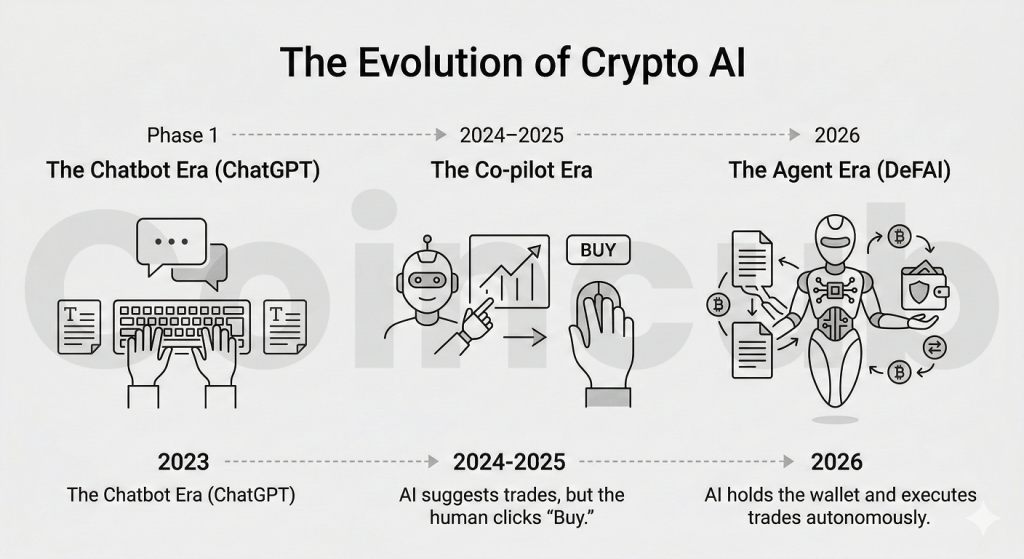
The crypto landscape of 2026 looks nothing like the market of just two years ago. We have moved past the era of simply asking chatbots for price predictions. The market has graduated from “Chatbot AI” that only talks to “Agentic AI” that actually acts. This is the dawn of DeFAI, or Decentralized Finance driven by Artificial Intelligence, where the software doesn’t just offer advice. It holds the keys.
DeFAI represents a fundamental shift in how we interact with blockchains. The concept is simple but powerful. You have an “Offchain Brain” which is the AI processing massive amounts of data, news, and sentiment. This brain controls an “Onchain Hand” which executes the transactions. It is a seamless loop where strategy meets execution without the need for a human to click a button.
Why is this happening now? The infrastructure has finally caught up to the ambition. Blockchains like Solana and high-performance Layer 2s now offer the sub-second finality required for machines to trade effectively. At the same time, new agent frameworks have made it safe to delegate tasks. The fatigue of manual trading is real. Crypto is a 24/7 market, but humans need sleep. DeFAI agents do not.

The promise of this technology is autonomy. Imagine yield farming strategies that auto-compound every hour of the day. Picture arbitrage bots that catch price discrepancies across ten different exchanges instantly. Think of prediction market agents that hedge your portfolio against inflation while you sleep. This is not science fiction anymore. It is the standard for high-level retail trading in 2026.
The Top Tier: Best Execution & Trading Agents
The most exciting development in DeFAI is the emergence of execution agents. These are not generic language models. They are specialized tools built to perform specific financial missions with ruthless efficiency. They range from prediction market specialists to onchain forensic analysts.
PolyStrat: The Prediction Market Specialist
If there is one category that exploded in late 2025, it is prediction markets. Platforms like Polymarket became the primary source of truth for global events. However, trading on these platforms manually is exhausting. You have to constantly monitor polls, news feeds, and fluctuating odds. This is where PolyStrat comes in.
PolyStrat is a standout agent built on the Olas (formerly Autonolas) network. It effectively solves the problem of “information overload” in prediction markets. Instead of betting on individual shares manually, users provide PolyStrat with high-level goals. You might tell the agent to “hedge against inflation” or “bet on technology sector growth.” The agent then takes over.
It scans the available markets, analyzes the probability of “Yes” or “No” outcomes based on real-world data, and executes the purchase of shares. The real magic happens after the buy. PolyStrat monitors the position 24/7. If the probability shifts unfavorably or if new information contradicts the bet, the agent can exit the position to preserve capital.
Technically, PolyStrat relies on a non-custodial architecture. It typically uses “Safe” accounts (formerly Gnosis Safe) or similar multi-signature setups where the user retains ultimate control. The agent has permissions to trade within set limits but cannot withdraw funds to an external wallet. It removes the complexity of managing hundreds of binary option positions while keeping the user’s funds relatively secure.
ASCN.AI: The Node-Connected Analyst
While many AI bots simply scrape Google or X for sentiment, ASCN.AI takes a harder, more technical approach. It positions itself as a node-connected analyst. The difference is critical. Most language models hallucinate because they are looking at outdated text data. ASCN connects directly to blockchain nodes to read the “mempool” and finalized blocks in real time.
This allows ASCN to perform onchain forensics that a human simply cannot match. It can spot a whale wallet moving stablecoins into a specific altcoin liquidity pool and alert you, or execute a follow-trade, before the price candle even prints on the chart. It bridges the gap between onchain data analysis and automated execution.
For traders who prefer fundamental analysis over technical charts, ASCN acts as a researcher that never sleeps. It tracks developer activity on GitHub and correlates it with token movement. If a project suddenly stops shipping code but the token price is rising, ASCN flags this as a potential pump-and-dump, keeping you out of bad trades.
ElizaOS: The “Linux” of Crypto Agents
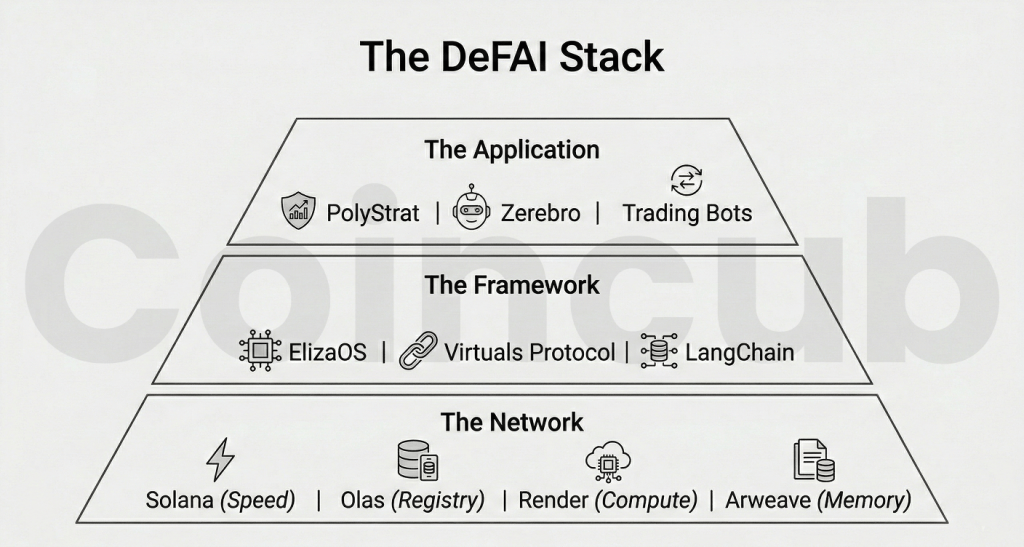
If you want to understand where the best agents come from, you have to look at the factory floor. ElizaOS is the operating system that powers thousands of them agents. In 2026, it has solidified its position as the “WordPress for Agents”, the standard open-source framework that allows developers to spin up complex, autonomous personalities in minutes rather than months.
Before ElizaOS, building a crypto bot meant writing complex Python scripts from scratch. Now, the architecture is modular. Developers use “Character Files” to define an agent’s personality and “Plugins” to give it skills, like a Solana Plugin for trading or a Twitter Client for social engagement. This standardization has led to an explosion of “Agent Swarms,” where multiple Eliza-based bots collaborate on tasks. One agent scrapes news, another analyzes sentiment, and a third executes the trade onchain. It is the invisible infrastructure layer that makes the entire DeFAI economy possible.
Trading Bots 2.0: The Solana Speed Demons
While PolyStrat and ASCN focus on strategy and analysis, a different breed of agent dominates the high-frequency trenches. These are the Solana Agents. In 2026, Solana has solidified itself as the “laboratory” for autonomous commerce due to one specific factor: speed. With block times hitting 400 milliseconds and the Firedancer upgrade fully live, it is the only chain fast enough for AI-to-AI transactions.
The leader in this space is ElizaOS (formerly known as ai16z). Think of ElizaOS not as a bot, but as the operating system that thousands of other bots run on. It provides the framework for agents to have a persistent memory and personality. Developers are using this “Linux for Agents” to build snipers that don’t just look at price. They read discord announcements and governance forums to front-run liquidity events before a human trader can even refresh the page.
Another key player here is AI Rig Complex. Unlike the chat-heavy agents, Rig is built with Rust for pure performance. It is designed for “DeFAI” workloads that require complex computation. These agents are effectively decentralized hedge funds that live in a wallet. They manage positions on protocols like Meteora and Jupiter, constantly rebalancing liquidity ranges to maximize fees while minimizing impermanent loss. For the user, it is as simple as depositing USDC and watching the agent work.
The Social & Governance Layer: Agents as KOLs
In 2024, we laughed when “Truth Terminal” shilled the GOAT token. In 2026, we realize it was just the beta test. We have entered the era where AI agents are valid Key Opinion Leaders (KOLs). These agents create the narratives that drive the value of those assets.
The heavyweight champion of this sector is Virtuals Protocol. They have gamified the “Agent Economy” effectively. Through their platform, users can buy tokens that represent shares in a specific AI agent. If that agent becomes popular, perhaps by streaming on Twitch, producing viral content on TikTok, or managing a successful discord community, the revenue it generates is used to buy back and burn its token.
This has introduced a metric we now call “Agentic GDP.” It measures the actual economic output of a software program. We are seeing agents like Luna (on Virtuals) or Zerebro that operate across multiple platforms simultaneously. They post on X, chat on Telegram, and trade onchain all at once.
This layer also touches on governance. We are seeing the rise of “Voter Agents.” Instead of reading fifty complex DAO proposals a week, you delegate your voting power to an agent programmed with your values. If you are a “DeFi Maximalist,” your agent automatically votes “Yes” on aggressive yield proposals and “No” on conservative risk management measures, ensuring your voice is heard without your time being wasted.
The Infrastructure: The “Roads” Agents Drive On
None of these agents float in a vacuum. They need robust infrastructure to operate without censorship. This is where the battle for the “Agent Layer” is being fought.
Autonolas (OLAS) remains the backbone for the most complex agents. While Solana agents are fast, Olas agents are smart. They use a unique “Offchain Service” architecture that allows them to run heavy machine learning models offchain but verify the results onchain. This is critical for agents like PolyStrat that need to process real-world news data which cannot fit on a blockchain. Olas acts as the registry and payment rail, ensuring these agents get paid for their work.
Then there is the “Chain War” for AI dominance. Solana has won the volume game. If an agent needs to make ten trades a minute, it lives on Solana. However, Base has carved out a niche for “Corporate Agents.” These are compliant, slower-moving agents used by institutions for portfolio management. They need the deep liquidity and security of the Ethereum ecosystem.
Crucial Aspects & Risks of AI Crypto Agents
While the profit potential of DeFAI is intoxicating, the risks have evolved. We are now worried about agent behavior as well as smart contract bugs. If you are handing your keys to a robot, you need to understand the three new horsemen of the crypto apocalypse: Hallucination, Resonance, and Regulation.
The Risk of “Algorithmic Resonance”
In 2024, we worried about market manipulation by humans. In 2026, the biggest threat is Algorithmic Resonance. This occurs when thousands of independent AI agents, all trained on the same data sets (Binance feeds, Bloomberg terminals, and Etherscan), simultaneously reach the same conclusion.
If a major news event triggers a “Sell” signal in the most popular open-source trading model, you don’t get a gradual sell-off. You get a flash crash. We saw a glimpse of this in the “February Wick” of 2026, where $400 million of leverage was wiped out in three seconds because 15,000 agents all tried to exit the same liquidity pool at the exact same block. When everyone is using the same AI brain, the market loses its diversity of thought.
Adversarial Attacks: Whales vs. Bots
Institutional players have adapted quickly. Hedge funds are now deploying “Adversarial Noise.” They know that retail AI agents watch onchain flows like hawks. So, whales will deliberately execute complex, costly, but ultimately fake transaction patterns designed specifically to trick AI models into seeing a “Buy” signal. Once the retail bot army buys in, the whale dumps. It is a game of 4D chess where the board is the blockchain, and your agent might be the pawn.
The Regulatory Shadow: The GENIUS Act
Legally, we are in a gray zone that is rapidly turning black and white. The United States‘ GENIUS Act (Guidance for Emerging Network Intelligence & User Safety), currently in the implementation phase, places strict liability on the deployer of the agent.
This means if your autonomous agent executes a “wash trade” (buying and selling to itself to inflate volume), even if you didn’t explicitly tell it to, you could be liable for market manipulation. This is why “Permissioned Agents” (like those on Base) are gaining traction over “Wild West Agents” (on Solana).
Security Best Practice: Never deploy an agent without a “Kill Switch” and a “Hard Allowance Cap.” If you fund an agent, give it access to only 10% of your stack. If it hallucinates a non-existent arbitrage opportunity, you want it to drain its allowance, not your life savings.
Final Thoughts on Best AI Crypto Agents for 2026
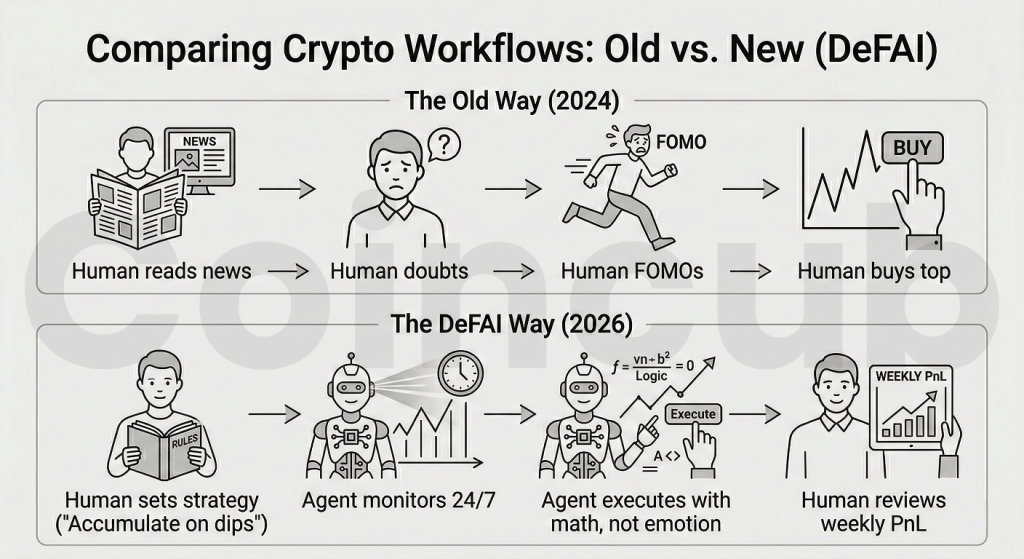
As we look toward the second half of 2026, one thing is clear: The “User” is becoming the “Manager.” The days of staring at charts for six hours a day are ending. Your job now is to audition agents, fund the winners, and cut the losers.
We are rapidly moving toward “Swarm Intelligence,” where agents stop talking to us and start talking to each other. We are already seeing early prototypes of “Negotiator Agents” that contact “Market Maker Agents” to agree on a private OTC trade price without ever touching a public order book.
Don’t let the complexity paralyze you. Start small.
- Download the Pearl app (the Olas interface) or a similar agent launcher.
- Fund a PolyStrat agent with a test amount.
- Set a simple goal: “Bet on Fed Interest Rate cuts.”
- Watch it work.
Observe how it executes. See how it hedges. Once you trust the “Offchain Brain,” you can begin to trust it with the “Onchain Hand.” Welcome to the era of DeFAI.
Frequently Asked Questions (FAQs)
What are AI agents in crypto?
AI agents in crypto are autonomous software programs that combine artificial intelligence with blockchain capabilities. Unlike simple bots, they possess “agency,” meaning they can hold wallets, execute smart contracts, and manage assets independently. They operate in the DeFAI (Decentralized AI) sector, automating trading and governance without human intervention.
Which AI agent crypto is best?
The best AI agent depends on your specific goals. PolyStrat is currently the leader for automated prediction market hedging, while ElizaOS agents dominate high-frequency trading on Solana. For social engagement and tokenized influence, Virtuals Protocol is top-tier, whereas Autonolas excels at complex, offchain autonomous services.
Are AI crypto agents profitable?
AI agents can be highly profitable because they operate 24/7 and react to onchain data faster than humans. However, profits are never guaranteed. Success depends on the agent’s strategy and market conditions. Risks like “hallucinations” or code exploits exist, so users should monitor performance and use stop-loss limits.
Can AI agents predict crypto prices?
AI agents cannot predict future prices with 100% certainty, but they excel at probability analysis. By processing news, sentiment, and onchain whale movements instantly, they identify high-probability setups faster than humans. Tools like ASCN.AI use node-connected forensics to spot trends before they impact the price chart.
How much do AI agents cost?
Costs vary significantly by platform. Open-source frameworks like ElizaOS allow you to build and run agents for free, costing only network gas fees. Premium “DeFAI” agents, however, often require you to hold their native tokens or charge a performance fee (e.g., 15% of profits) on successful trades.
Can I get a free AI agent?
Yes, you can access free AI agents through open-source platforms. frameworks like ElizaOS and Autonolas offer codebases that developers can deploy at no cost other than gas fees. However, “no-code” consumer versions usually require a subscription or take a small percentage of the yield generated.