Buy a Licensed Company
  Explore VASP Data
  Talk to an Expert

 Atis Shala
Atis is a senior analyst and community lead with four years of experience in crypto. He has a bachelor from the Rochester Institute of Technology.
Atis Shala
Atis is a senior analyst and community lead with four years of experience in crypto. He has a bachelor from the Rochester Institute of Technology.
The Euro Stablecoin Pivot: How MiCA is Changing European Liquidity

- MiCA replaces Europe’s fragmented national rules with a single, harmonized framework. It mandates that any stablecoin tracking a fiat currency must qualify as a highly regulated E-Money Token (EMT) issued by an authorized credit or electronic money institution.
- Authorized issuers can no longer rely on opaque offshore banking. They must provide redemption rights at par on demand, back assets fully with liquid reserves, maintain a 3% own-capital buffer, and custody at least 60% of their backing inside European banks.
- The multi-year grace period for crypto-asset service providers ends on July 1, 2026. After this date, platforms face strict enforcement and are legally required to halt operations or drop non-compliant assets if they lack full authorization.
- Because the world’s largest stablecoin (USDT) did not secure EU EMT status, it faced a wave of delistings across regulated European exchanges. This regulatory barrier effectively stripped it of its universal “shelf space” on the continent
- With the offshore dollar giant sidelined, compliant alternatives have filled the vacuum. Notably, Circle’s EURC saw its market share double from 17% to roughly 42% over 12 months, turning the euro stablecoin from a rounding error into a strategic asset class.
- The regulatory boundary splits liquidity pools. Market makers must use different base assets in Europe versus the rest of the world. This division thins out order books on EU venues, makes cross-border arbitrage more complex, and temporarily raises execution costs for large institutional trades.
- Beyond Europe, MiCA is serving as a definitive template for global regulators. The EU’s insistence on supervised banking reserves is putting intense pressure on the traditional offshore stablecoin model worldwide, carving out a strict “two-track” digital asset ecosystem.
The Euro Stablecoin
For most of crypto’s history, the euro was an afterthought in stablecoins. The dollar ran the show. Traders priced everything in dollar-pegged tokens, market makers parked their float in them, and euro stablecoins were a rounding error that existed mostly for European convenience. That arrangement is now being rewritten in Brussels rather than on a trading desk. The European Union’s Markets in Crypto-Assets regulation, known as MiCA, has done something no market force managed in a decade. It has made the euro stablecoin a serious asset class, and it has done so by changing the rules of who is allowed to operate in Europe at all.
This article explains what MiCA actually requires, why it has reshuffled the stablecoin leaderboard inside Europe, what the shift means for liquidity and trading, and how the pieces are likely to settle as the final deadlines arrive. The story matters far beyond Europe, because the EU is the first major economy to put a comprehensive rulebook around stablecoins, and the rest of the world is watching how it plays out.
What MiCA Set Out to Do
MiCA is the EU’s attempt to bring the entire crypto-asset market under one harmonized framework rather than a patchwork of national rules.

Before MiCA, a crypto business faced different expectations in France, Germany, Malta, and everywhere else. MiCA replaces that fragmentation with a single authorization that, once granted, lets a firm operate across all member states. For stablecoins specifically, it creates clear categories and clear obligations, ending the era when an issuer could mint a euro-pegged token with no defined legal status.
Two Kinds of Stablecoin
MiCA splits stablecoins into asset-referenced tokens, which track a basket or a mix of assets, and e-money tokens, which track a single official currency such as the euro or the dollar. Most of the stablecoins traders use day to day fall into the e-money token category, and that category carries the strictest and clearest set of rules. Understanding those rules is the key to understanding everything that followed.
The framework set a transitional period to let the market adjust, but that runway has an end. The first of July 2026 marks the close of the EU-wide transition for crypto-asset service providers. After that date, any entity offering crypto services in the EU without full MiCA authorization is in breach of EU law and must stop serving EU customers. Deadlines with real consequences are what turned a regulation into a market event.
The Rules That Reshaped the Market
The specific obligations on e-money token issuers are demanding, and they are the reason the leaderboard changed.
Who Is Allowed to Issue
Under MiCA, an e-money token must be issued by an authorized credit institution or an electronic money institution. A pseudonymous team cannot simply deploy a contract and call it a stablecoin. The issuer has to be a regulated financial entity, supervised by a national competent authority, and subject to ongoing oversight. This single requirement disqualifies a large share of the tokens that previously circulated freely.
Backing and Reserves
The reserve rules are strict and specific. Issuers must maintain full liquid asset backing, provide redemption rights at par value on demand, hold their reserves prudently, cover at least three percent of reserves with their own capital, and keep a majority of the backing inside European banks.
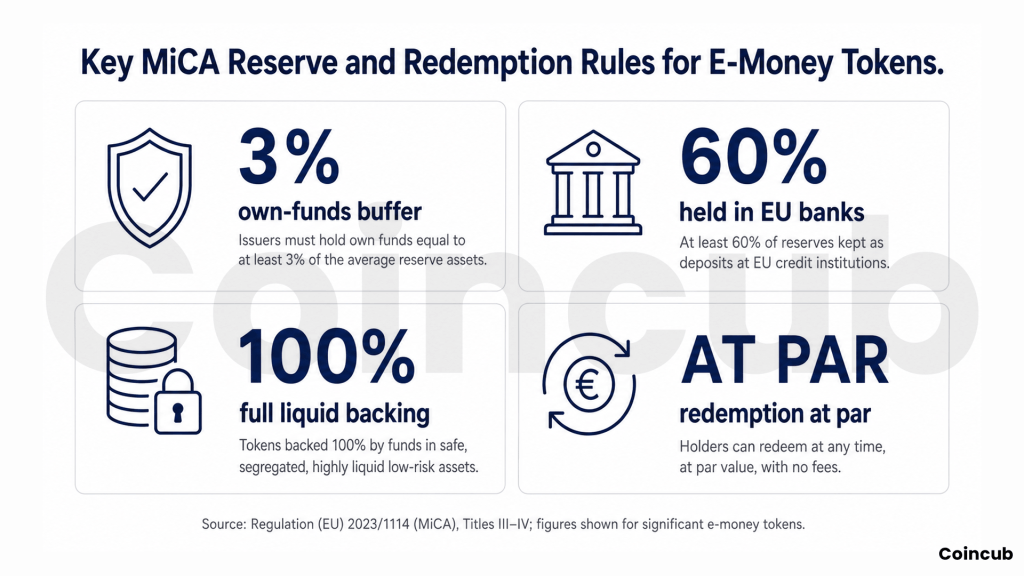
The chart above captures the headline numbers. Each one exists to ensure that a holder can always redeem a euro token for a euro, even under stress, and that the reserves are not sitting in opaque or risky instruments offshore.
Audits and Transparency
Issuers must submit to regular audits and ongoing disclosure. The point is to remove the central anxiety that has haunted stablecoins for years, the question of whether the reserves are really there. MiCA answers that question with supervision rather than with promises, which is a meaningful shift in how trust is established.
Why USDT Lost Its European Footing
The most visible consequence of these rules has been the retreat of the largest stablecoin in the world from regulated European venues.
MiCA created a stark, binary result. Compliant stablecoins gained access to the European market, and non-compliant ones faced delisting. The dominant dollar stablecoin did not secure the e-money token authorization on the EU’s terms, and the result was a wave of delistings across regulated European exchanges, along with the withdrawal of older euro tokens that did not meet the new standard.
Most people that are not that familiar with crypto yet have the wrong idea on what a delisting actually is. A delisting does not make a token vanish. It means regulated European platforms can no longer offer it to their EU customers, so traders inside the bloc lose the easy on-venue access they relied on. For an asset whose entire value comes from being the universal unit of account across exchanges, losing shelf space on an entire continent’s regulated venues is a serious blow to its role there.
The Vacuum and Who Filled It
Regulation abhors a vacuum as much as nature does. With the largest dollar token sidelined on EU venues, compliant alternatives stepped into the gap. The dominant euro token in particular benefited, gaining its position less through marketing and more through regulatory default, as the compliant option left standing when the rules took effect.
The Market Cap Divide: USD Stablecoins vs. EUR Stablecoins
To understand the scale of the Euro stablecoin pivot, one must look at the staggering structural imbalance between dollar-denominated and euro-denominated digital assets. The global stablecoin landscape is overwhelmingly dollarized, sitting at an all-time high of over $320 billion. In sharp contrast, the entire euro-denominated stablecoin sector is a nascent drop in the financial bucket, hovering around $770 million (€450 million).
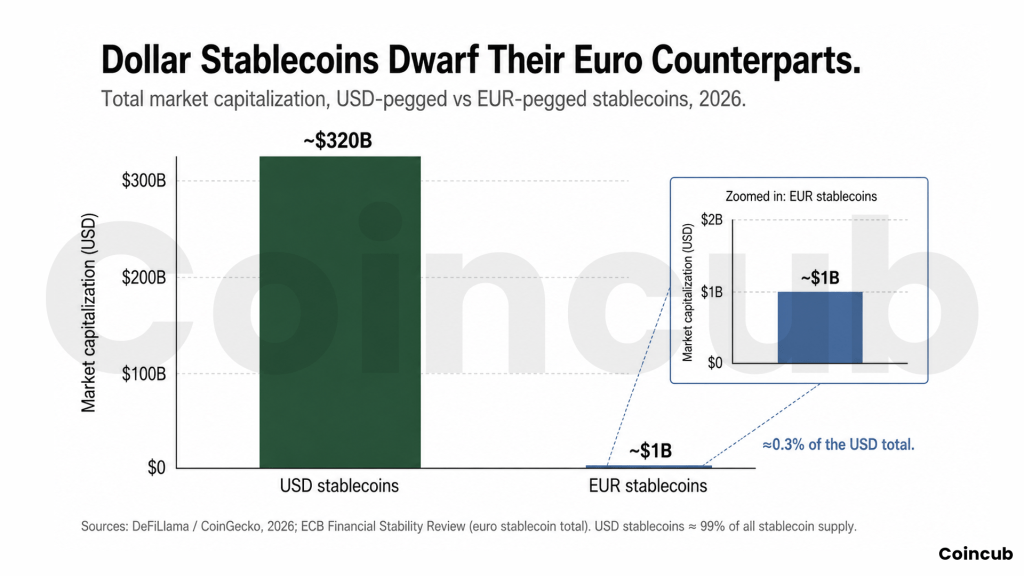
Historically, this massive gap meant euro options were starved of organic utility, as global market infrastructure automatically gravitated toward deeply liquid dollar pairs like USDT and USDC. However, the narrative is rapidly shifting from absolute size to compliant quality. While euro tokens represent less than one percent of the macro stablecoin supply, their growth trajectory is explosive, surging from just €50 million to record highs within two years.
Backed by MiCA’s strict legal guarantees, major European banking institutions are mobilizing to issue native euro tokens. As the July 2026 enforcement deadline shuts out unlicenced offshore entities, this market cap chasm is poised to narrow, finally positioning the euro as a formidable, regulated sovereign rail in digital finance.
The Rise of the Compliant Euro Stablecoin
The clearest winner of the MiCA era so far is the euro stablecoin category itself, which went from afterthought to strategic asset.
Circle’s EURC emerged as the dominant euro stablecoin, climbing from roughly seventeen percent to around forty-two percent of the euro stablecoin market over twelve months, with a market capitalization in the hundreds of millions and over half of the euro stablecoin market by some measures.
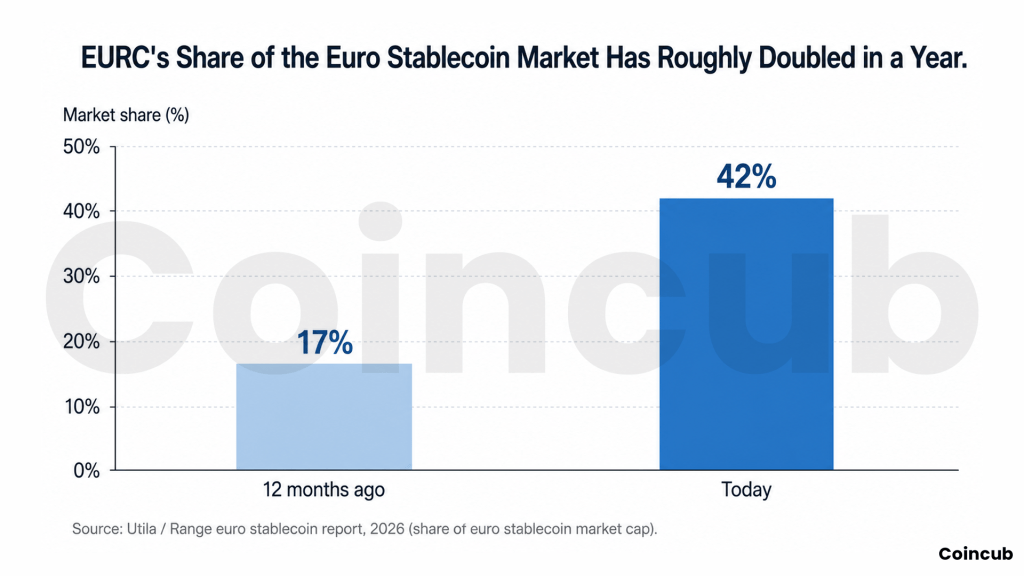
The trajectory in the chart is the story in one image. A token that was one option among several became the clear leader as regulation rewarded compliance and punished its absence.
A Crowded but Authorized Field
The euro stablecoin space is not a monopoly. As of early 2026 the roster of EU-authorized stablecoins included a dozen or so names spanning both euro and dollar pegs, issued by entities authorized across France, the Netherlands, Finland, Malta, Luxembourg, and Germany. The table below lists a representative sample to show how broad the authorized field has become.
| Stablecoin | Peg | Example issuer base | Status |
|---|---|---|---|
| EURC | Euro | France | Authorized |
| EURCV | Euro | France | Authorized |
| EUROe | Euro | Finland | Authorized |
| EURI | Euro | Germany | Authorized |
| USDC | Dollar | Authorized in EU | Authorized |
| USDG | Dollar | Authorized in EU | Authorized |
The presence of authorized dollar tokens alongside euro ones matters, because it means European traders still have a compliant dollar option even as the largest offshore dollar token retreats from regulated venues.
What This Does to Euro Stablecoin Liquidity
The regulatory reshuffle has real and sometimes uncomfortable consequences for how liquidity flows.
Split Liquidity Pools & Harder Arbitrage
The forced retreat of the dominant dollar token from EU venues hits professional participants hardest. Market makers and institutional traders now have to split their liquidity. Inside Europe they build pairs around compliant tokens such as the authorized dollar stablecoin or the leading euro stablecoin, while global markets keep running on the offshore dollar token. Liquidity that was once pooled is now divided along a regulatory border.
Because the base assets on European and offshore venues have desynchronized, arbitrage between them becomes more complex. A trader can no longer assume the same dollar token sits on both sides of a cross-exchange trade. Bridging the gap requires moving between different base assets, which adds steps, cost, and risk to the arbitrage that normally keeps prices aligned across venues.
Temporarily Thinner Books
In the short run, trading large volumes inside Europe becomes more expensive. The compliant dollar token and the leading euro token need time to build the depth that the offshore dollar token spent years accumulating. Until that depth arrives, European order books are thinner for big trades, and the cost of moving size is higher. This is a transition cost rather than a permanent state, but it is being felt now.
The Euro Pair Opportunity
There is an upside hidden in the friction. As euro stablecoins gain depth, genuinely liquid euro-denominated trading pairs become possible at scale for the first time. European users and businesses that think in euros gain a native settlement asset that does not force them through the dollar. Over time this could make the euro a real unit of account in crypto rather than a convenience wrapper.
Winners, Losers, and the In-Between of Euro Stablecoin Issuers
Compliant euro stablecoin issuers won the most, gaining share and strategic relevance. Authorized dollar stablecoins with EU standing also benefited, becoming the compliant dollar option on regulated venues. Regulated European exchanges that did the work to comply gained a clearer, safer operating environment.
The largest offshore dollar token lost shelf space and on-venue access across the bloc. Older euro tokens that did not meet the standard were withdrawn. Traders who relied on deep, unified dollar liquidity inside Europe lost convenience, at least during the transition.
Many businesses and users sit in a middle zone, adjusting workflows, re-pricing pairs, and deciding which compliant token to standardize on. The table below summarizes the landscape.
| Group | Effect of MiCA | Net position |
|---|---|---|
| Compliant euro issuers | Gained share by default | Winner |
| Authorized dollar tokens | Became the EU dollar option | Winner |
| Largest offshore dollar token | Delisted on EU venues | Loser, on EU venues |
| Pro traders and market makers | Split pools, harder arbitrage | Mixed, higher friction |
| European users and businesses | Native euro settlement emerging | Improving over time |
The Global Ripple of Compliant Stablecoin Issuers
What happens in Brussels does not stay in Brussels. MiCA is the first comprehensive stablecoin regime in a major economy, and it is becoming a reference point.
Regulators elsewhere are studying the EU approach as a possible model, particularly its insistence on regulated issuers, full backing, and redemption rights. If similar frameworks spread, the offshore model that dominated the last decade faces pressure in more than one jurisdiction, and compliance becomes a global strategic question rather than a regional one.
For now the result is a two-track world. Inside regulated venues, compliant tokens with transparent reserves and supervised issuers dominate. Outside them, the older offshore model continues, deeper and more liquid but without the regulatory blessing. Traders and businesses increasingly have to choose which track they operate on, and that choice carries consequences for access, cost, and risk.
The long-run direction seems clear even if the timing is not. Regulation is moving toward demanding that stablecoins behave like the regulated money instruments they resemble. The euro stablecoin pivot in Europe is an early, concrete example of what that future looks like, and it suggests that compliance, not just liquidity, will define which tokens endure.
How Europe Reached This Point
The pivot did not happen overnight. Understanding the sequence makes the present landscape less confusing.
For most of the last decade, stablecoins operated in a grey zone in Europe. They were widely used, lightly understood by policymakers, and governed by no dedicated rules. That uncertainty suited incumbents, because the largest issuers could grow without meeting any defined standard. It also left users exposed, because no one was obliged to prove that reserves existed or that redemption would work under stress.
MiCA was negotiated over several years as the EU tried to balance innovation against consumer protection and financial stability. Rather than switching on all at once, it phased in, with stablecoin provisions arriving ahead of the broader rules for service providers. This staggered approach gave issuers time to seek authorization and gave exchanges time to decide which tokens they could keep offering.
A transitional window let existing providers continue operating while they pursued full authorization. That window is what makes the first of July 2026 such a pivotal date, because it is the moment the grace period ends and enforcement becomes the default. The market spent the transition repositioning, which is why the share shifts and delistings clustered in this period rather than spreading evenly over years.
The Mechanics of Compliance for an Issuer
It is worth understanding what an issuer actually has to do, because the burden explains why so few tokens cleared the bar.
Securing Authorization & Managing the Reserve
An issuer must obtain authorization as a credit institution or an electronic money institution from a national competent authority. This is a substantial regulatory undertaking involving capital requirements, governance standards, and ongoing supervision. It is the kind of process that established financial firms are built for and that pseudonymous crypto teams are not.
Once authorized, the issuer must hold reserves that are fully backing, liquid, prudently invested, and largely held in European banks, with a slice of the issuer’s own capital on top. Managing such a reserve is an operational discipline in itself, requiring custody relationships, audit processes, and constant reconciliation between tokens in circulation and assets held.
Honoring Redemption
The promise that anchors the whole structure is redemption at par on demand. A holder must always be able to return one token and receive one euro. Honoring that promise under all conditions, including periods of market stress, is what separates a regulated e-money token from the looser arrangements that preceded it. The discipline is demanding, and it is exactly the discipline that builds durable trust.
Risks and Open Questions
The pivot is not a finished story, and several tensions remain unresolved.
- Concentration Risk: By rewarding compliance, MiCA has concentrated the euro stablecoin market around a small number of authorized issuers, with one clear leader. A market that leans heavily on a single dominant token carries its own systemic questions, even if that token is well regulated. Healthy competition among several strong authorized issuers would reduce that concentration over time.
- The Offshore Gap: Because the largest dollar token continues to dominate globally while being sidelined on EU venues, a structural gap persists between European and offshore liquidity. How that gap narrows, whether through compliant dollar tokens building depth or through other adjustments, is one of the most important open questions for traders operating across both worlds.
- Innovation Versus Caution: Every strict framework faces the criticism that it raises barriers high enough to deter newcomers. Supporters argue that the rules simply demand the seriousness that money instruments deserve. Critics worry that only large, well-resourced firms can comply, narrowing the field. The balance MiCA strikes between protection and openness will be judged over the coming years rather than settled today.
Practical Guidance for European Users and Businesses
For people and companies operating in the EU, the abstract policy shift translates into a few concrete decisions.
Standardize on Compliant Tokens
The simplest protective move is to favor stablecoins that hold MiCA authorization, whether euro or dollar pegged. Building treasury and trading workflows around authorized tokens reduces the risk of being stranded when a non-compliant asset is delisted from your venue.
Plan for the Transition Costs
Anyone trading size inside Europe should expect thinner books and wider spreads on certain pairs during the adjustment, and plan execution accordingly. Splitting orders, using limit rather than market orders, and timing large trades for deeper liquidity windows all help manage the friction.
Watch the Deadlines
The July 2026 end of the transitional period is the date that turns rules into enforcement. Service providers without full authorization must stop serving EU customers, so users should confirm that the platforms they rely on are authorized, rather than discovering the gap after access is cut.
Treat the Euro Option Seriously
For businesses that operate in euros, the maturing euro stablecoin market offers a way to settle and hold value without routing through the dollar. As depth improves, the euro option becomes more practical, and early familiarity is an advantage.
What It Means for the Everyday Holder
Beneath the institutional reshuffling sits a simpler question. What changes for an ordinary person who just wants to hold a stable digital euro or dollar?
The trade-off is straightforward. A holder on a regulated European venue now has more confidence that the stablecoin they hold is fully backed and redeemable, because a supervised issuer stands behind it. At the same time, the menu of available tokens is shorter, since non-compliant options have been removed. For most users, that exchange of variety for assurance is a reasonable one.
The practical lesson is to pay attention to which platform holds your stablecoins and whether it is authorized. A token that is fine on an offshore venue may not be available, or may be in the process of being delisted, on a regulated European one. Keeping value in compliant tokens on authorized platforms reduces the chance of an unwelcome surprise.
The most underrated benefit of the new regime is the legal right to redeem at par. In the old world, a holder trusted that a token could be cashed out. In the new one, that ability is a supervised obligation of the issuer. For anyone who remembers past episodes where stablecoins wobbled from their peg, that shift from trust to obligation is the quiet heart of the whole reform.
A Note on the Euro Stablecoin Option
For European holders specifically, the maturing euro stablecoin gives a way to hold digital value in their own currency without taking on hidden dollar exposure. Someone who earns and spends in euros previously had to route through a dollar token and accept the exchange-rate wobble that came with it. A deep, compliant euro token removes that friction, letting holders stay in euros from end to end. As liquidity in these tokens deepens, the everyday case for choosing the euro option grows stronger, and the dollar stops being the unavoidable default for European users.
Frequently Asked Questions (FAQ)
What is MiCA in simple terms? +
MiCA is the European Union's comprehensive regulation for crypto-assets. It replaces a patchwork of national rules with a single framework, creating clear categories and obligations for crypto businesses and stablecoin issuers across all member states. For stablecoins, it defines who may issue them, how they must be backed, and how they are supervised.
Why was USDT delisted from European exchanges? +
The largest dollar stablecoin did not obtain the e-money token authorization on the EU's terms, which requires a regulated issuer, full liquid backing, redemption at par, and supervision by a national authority. Under MiCA, regulated European platforms cannot offer non-compliant stablecoins to EU customers, so the token was delisted across those venues even though it remains widely used offshore.
Which euro stablecoin is winning under MiCA? +
Circle's EURC has become the dominant euro stablecoin, rising from around seventeen percent to roughly forty-two percent of the euro stablecoin market over twelve months. It gained that position largely by regulatory default, as the compliant option left standing once the rules took effect and non-compliant alternatives were sidelined.
What does MiCA require of a euro stablecoin issuer? +
An e-money token issuer must be an authorized credit institution or electronic money institution, maintain full liquid asset backing, offer redemption at par value on demand, hold at least three percent of reserves as its own capital, keep a majority of reserves in European banks, and submit to regular audits and ongoing supervision.
How does MiCA affect crypto liquidity in Europe? +
It splits liquidity along a regulatory border. Inside Europe, market makers build pairs around compliant tokens such as authorized dollar and euro stablecoins, while offshore markets keep using the older dollar token. This makes cross-venue arbitrage more complex and temporarily raises the cost of trading large size in Europe until compliant tokens build comparable depth.
When is the final MiCA deadline? +
The first of July 2026 marks the end of the EU-wide transitional period for crypto-asset service providers. After that date, any entity providing crypto services in the EU without full MiCA authorization is in breach of EU law and must cease serving EU customers. It is the point at which the rules shift fully into enforcement.
Does MiCA affect stablecoins outside Europe? +
Directly, it governs only the EU, but its influence reaches further. As the first comprehensive stablecoin regime in a major economy, MiCA is becoming a template that other regulators study. Its emphasis on regulated issuers, full backing, and redemption rights is shaping a global conversation about how stablecoins should be supervised.