


 Buy a Licensed Company
  Explore VASP Data
  Talk to an Expert

 Atis Shala
Atis is a senior analyst and community lead with four years of experience in crypto. He has a bachelor from the Rochester Institute of Technology.
Atis Shala
Atis is a senior analyst and community lead with four years of experience in crypto. He has a bachelor from the Rochester Institute of Technology.
The Silent Cost of Being a Liquidity Provider

- Advertised APR only tracks incoming revenue, not outgoing losses. A glittering triple-figure yield can easily mask a net negative investment.
- Automated Market Makers (AMMs) are mathematically hardwired to sell your winning assets and buy more of your losing assets to keep the pool balanced.
- The gap between what your assets are worth in a pool versus simply holding them in a wallet grows whenever prices diverge. Unless the price ratio returns to exactly where it started, that loss becomes permanent upon withdrawal.
- Narrowing your price band to maximize fees multiplies capital efficiency, but it also multiplies impermanent loss by 3.5x or more and risks earning zero fees if the price moves out of range.
- Disregard the fee counter and track your Net Return vs. Holding (HODL). Studies show that over half of concentrated liquidity providers would have made more money by doing absolutely nothing and holding their coins.
- Liquidity provision is a directional bet on stability. It thrives in quiet, range-bound markets, but it underperforms holding during strong bull runs and deepens your losses during market crashes.
- Gas fees from constant rebalancing, smart contract vulnerabilities, token depreciation, and unexpected tax liabilities create a heavy financial drag that dashboards conveniently omit.
The Duality of Being a Liquidity Provider
There was a guy who started providing liquidity, and for a while it felt like a cheat code. He’d deposit two tokens into a pool, walk away, and come back to find fees quietly stacking up in his account. No trading, no charts to watch, no timing the market. Just money trickling in for doing nothing. He told his friends about it like he’d found a glitch the rest of the world hadn’t noticed yet.
What he didn’t see was the meter running underneath. Every time the two prices drifted apart, the pool quietly rebalanced against him, selling off the winner and loading up on the loser, so that simply holding the two coins in his wallet would have left him richer. The fees were real, but so was the bleed. And the further the prices diverged, the wider the gap grew between what he had and what he could have had.
By the time he did the math, the cheat code had a catch he’d never read. The house wasn’t paying him to play, but rather paying him to absorb a risk he didn’t know he’d taken on.

This article is the explanation that guy needed before his first deposit. It covers what really happens when you provide liquidity, why the advertised yield is the least important number on the screen, how impermanent loss works without the intimidating math, and how a clear-eyed provider can decide whether the trade is worth it.
What Providing Liquidity Actually Means
Before the costs make sense, the mechanics have to.
You Are Running a Tiny Exchange
When you deposit two assets into a pool, you are not lending them out and you are not staking them for a network. You are stocking the shelves of an automated currency exchange. Traders swap against your inventory, and in exchange for letting them, you collect a small fee on every swap. Your deposit becomes the float that makes those trades possible.
The Pool Always Rebalances Against You
Here is the part the dashboards never highlight. An automated market maker keeps the pool balanced according to a formula. When the price of one asset rises, traders buy it out of your pool until the pool price matches the wider market. That means the pool is constantly selling you out of the asset that is going up and loading you with the asset that is going down. You end up holding more of the loser and less of the winner, by design.
Fees Are the Payment for That Service
The fees exist to compensate you for the rebalancing and the risk. The entire question of whether providing liquidity is worth it comes down to a single comparison. Did the fees you earned exceed the value you lost by letting the pool rebalance your bag? That lost value has a name.
Meet Impermanent Loss
Impermanent loss is the difference between what your deposit is worth inside the pool and what those same assets would have been worth if you had just held them in your wallet.
Why It Is Called Impermanent
The “impermanent” label is optimistic, and a little misleading. The loss is only undone if the prices of the two assets return to the exact ratio they had when you deposited. If you withdraw while they are still diverged, the loss becomes entirely permanent. Many providers discover that the word “impermanent” was doing a lot of quiet work to make the risk sound temporary.
It Grows With Divergence
The further the two prices move apart, the larger the loss. The relationship is not linear, and it accelerates as divergence widens.
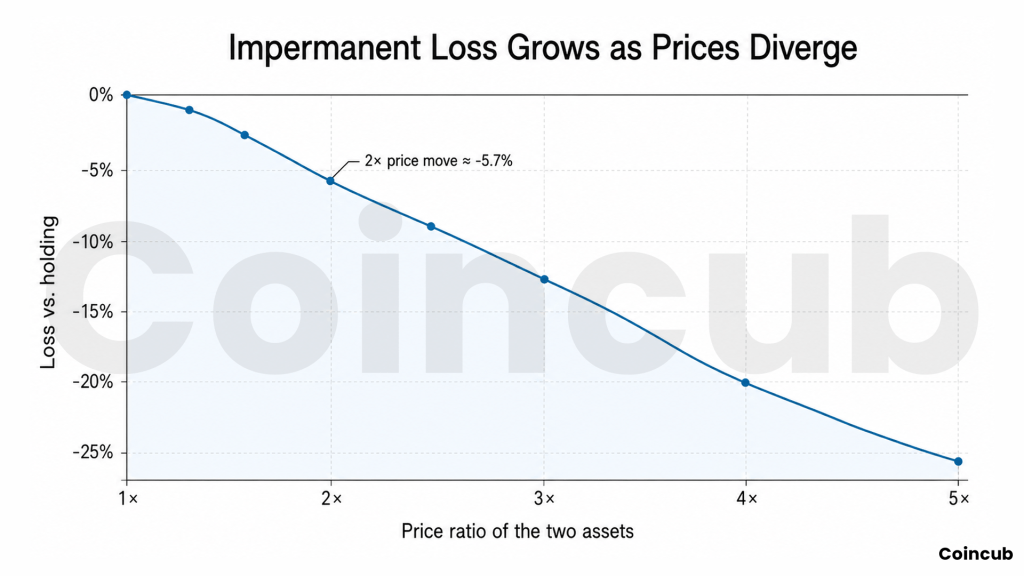
The curve above tells the whole story. A modest price move costs you very little. A large one, in either direction, opens a real gap between the pool outcome and the simple act of holding. Notice that the loss appears whether the price goes up or down. There is no direction that protects you.
A Plain Numbers Example
Suppose you deposit one ETH worth two thousand dollars and two thousand dollars in stablecoin, for four thousand dollars total. ETH then doubles. If you had held, you would have three thousand in ETH plus two thousand in stablecoin, for five thousand. Inside the pool, the rebalancing leaves you with a position worth roughly four thousand eight hundred. The energy of that two hundred dollar gap is impermanent loss. The fees you earned have to clear that gap before you see a single cent of true profit.
The Yield Illusion
The advertised yield is the most seductive and least trustworthy number a provider sees.
Why High APR Can Still Lose Money
A pool can show a glittering annual percentage yield and still leave its providers poorer than holders. The yield measures only the fees flowing in. It says nothing about the impermanent loss flowing out underneath. A study of concentrated-liquidity providers found that more than half of them ended with net negative returns once impermanent loss was counted against their fee income.
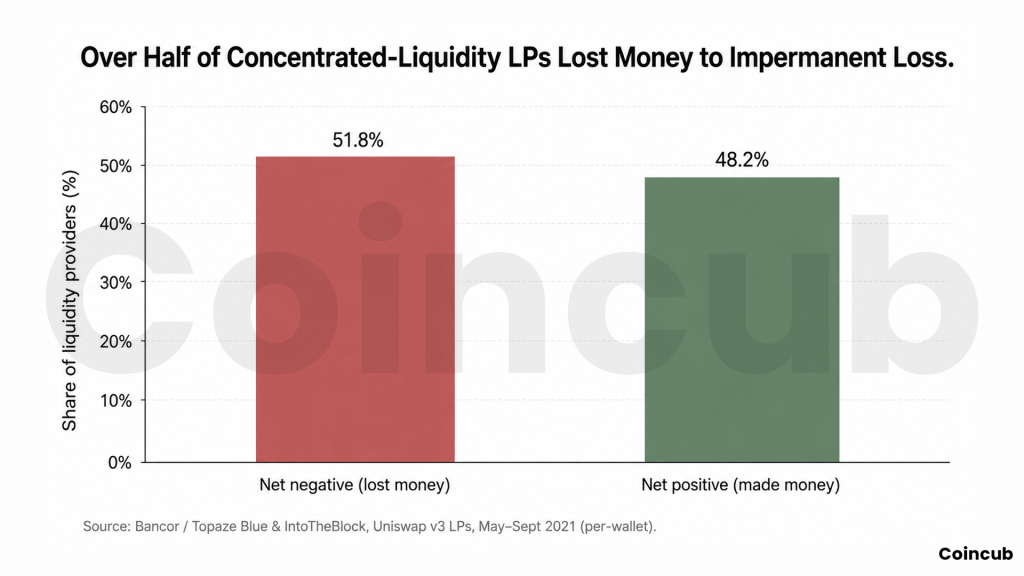
That figure deserves a pause. The majority of people doing the thing that looked like easy passive income would have done better holding their coins and going outside. The yield was not a lie. It was simply the wrong number to watch.
The Number That Actually Matters
The only metric that matters is net return versus holding, often called “versus hodl.” It asks the honest question. After fees and after impermanent loss, did providing liquidity beat the boring alternative of doing nothing? If a dashboard does not show you this, it is showing you the rainbows & sunshine half of the story.
Concentrated Liquidity Raises the Stakes
Newer designs let providers concentrate their capital into a narrow price band. This is powerful and dangerous in equal measure.
How Concentration Works
Instead of spreading your liquidity across every possible price, you tell the pool to deploy it only between, say, eighteen hundred and twenty-two hundred dollars. Within that band your capital does far more work, earning the fees that would otherwise have been spread thin. Concentrated designs can increase capital efficiency by a factor of thousands compared to older pools.
The Hidden Multiplier on Loss
That efficiency has a price. Concentrating liquidity also concentrates impermanent loss. Research indicates the impact of impermanent loss can be around three and a half times higher with concentrated liquidity, even for a fairly wide range, and the narrower the band, the worse it gets. You are using leverage, whether or not anyone called it that.
Going Out of Range
There is a second trap unique to concentrated positions. When the price moves outside your chosen band, your position stops earning fees entirely and converts fully into whichever asset is now the losing side. You are left holding the falling asset, earning nothing, watching the market continue without you. Active providers manage this by constantly adjusting their ranges, which brings its own costs.
The Costs Nobody Puts on the Dashboard
Impermanent loss is the famous silent cost. It is not the only one.
Gas and Rebalancing Fees
Every deposit, withdrawal, and range adjustment is a transaction with a network fee. Active management of a concentrated position can mean many such transactions, and on a busy network those fees add up quietly until they have eaten a meaningful slice of your returns.
Smart Contract Risk
Your funds sit inside a smart contract. If that code has a flaw, or if the protocol is exploited, the pool can be drained in a single transaction. This risk does not appear in any yield figure, yet it is the one that can take everything at once rather than a little at a time.
Token Depreciation
If one of your pooled assets is a smaller or newer token, it can simply fall and never recover. Impermanent loss assumes prices might revert. A token that goes to near zero turns a temporary-sounding loss into a permanent hole, and the fees rarely compensate for that.
Opportunity Cost
Capital locked in a pool is capital not doing anything else. Sometimes the best comparison is not against holding the two tokens, but against a safer yield you gave up to chase a flashier one.
| Cost | Visible on dashboard? | When it bites | Who feels it most |
|---|---|---|---|
| Impermanent loss | Rarely | As prices diverge | Volatile pairs |
| Out-of-range time | Sometimes | Price exits your band | Concentrated positions |
| Gas and rebalancing | No | Every adjustment | Active managers |
| Smart contract risk | No | During an exploit | Everyone in the pool |
| Token depreciation | No | When a token collapses | Pairs with risky assets |
| Opportunity cost | No | The whole time | Anyone with alternatives |
A Worked Comparison Across Three Scenarios
Numbers make the trade-off concrete. Imagine depositing four thousand dollars split evenly between ETH and a stablecoin, then comparing the outcome to simply holding those same assets across three different market paths.
Scenario One: Sideways Market
ETH wanders up and down but ends roughly where it started. Impermanent loss is minimal because the price barely diverged, and the constant trading generated a steady stream of fees. This is the scenario where providing liquidity shines. The provider finishes ahead of the holder, because the fees were pure profit on top of a position that barely moved.
Scenario Two: Strong Rally
ETH doubles in a clean upward move. The pool dutifully sold ETH the whole way up, so the provider captured only part of the gain. The fees collected during the rally help, yet they rarely cover the full gap. The holder, who kept every coin, comes out clearly ahead. This is the scenario that teaches new providers the hard lesson that a bull run is the worst time to be rebalanced out of the asset that is running.
Scenario Three: Sharp Decline
ETH falls by half. The pool bought more ETH on the way down, so the provider holds a larger quantity of the falling asset than the holder does. Both lose money, but the provider loses slightly more on the asset side, partly offset by fees. The lesson is that providing liquidity does not protect you on the downside. It can deepen it.
| Market path | Holder result | Provider result | Who wins |
|---|---|---|---|
| Sideways | About even | Even plus fees | Provider |
| Strong rally | Full upside captured | Partial upside plus fees | Holder |
| Sharp decline | Loss on holdings | Slightly larger loss plus fees | Holder, narrowly |
The pattern is consistent. Liquidity provision rewards calm, range-bound markets and punishes strong directional moves in either direction. Your expectation about which path is likely should drive whether you provide at all.
Active Versus Passive Provision
The word passive gets attached to liquidity provision constantly, and for concentrated positions it is the wrong word.
The Passive Approach
A passive provider deposits into a broad-range or full-range pool and largely leaves it alone. Returns are lower because the capital is spread thin, but the position rarely needs attention and never falls out of range. For correlated or stable pairs this can be a reasonable, low-effort way to earn fees.
The Active Approach
An active provider runs concentrated positions, narrowing the range to earn outsized fees, then adjusting that range as the price moves. This can produce strong returns in the right hands. It also resembles a part-time job. Each adjustment costs gas, demands attention, and carries the risk of mistiming the market. Many active providers underestimate how much the constant management erodes their edge.
Choosing Honestly
The honest question is whether you want a hands-off position that earns modestly or a hands-on strategy that competes against sophisticated firms running automated range management around the clock. Pretending an active strategy is passive is how people end up out of range, earning nothing, and wondering where their yield went.
Metrics Every Provider Should Watch
A short dashboard of the right numbers replaces the single misleading APR.
Fees Earned Versus Impermanent Loss
This is the core comparison. Track cumulative fees against the running impermanent loss, not against zero. Only when fees clearly exceed impermanent loss is the position truly profitable.
Time In Range
For concentrated positions, the share of time your liquidity actually sits within its active band determines how much it earns. A position that spends half its life out of range is working at half capacity while still exposed to the downside.
Net Return Versus Holding
The final scoreboard. After fees, impermanent loss, and gas, did the position beat simply holding the two assets? If a tool does not surface this number, calculate it yourself, because it is the only verdict that matters.
A Simple Decision Framework
Before depositing into any pool, a short set of questions filters out most of the regret.
The Five Questions
Ask how correlated the two assets are, because correlation is the single biggest driver of impermanent loss. Ask whether the pool has real, sustained volume rather than a temporary incentive. Ask what your honest view on the price relationship is over your time horizon. Ask whether you are prepared to monitor and adjust, especially for a concentrated position. Ask what the safer alternative yield is, so you know what you are giving up.
Reading the Answers
If the assets are uncorrelated, the volume is thin, you expect a big move, and you do not plan to watch the position, the framework is telling you to hold instead. If the assets move together, the volume is deep, you expect sideways action, and you will monitor it, providing liquidity may genuinely pay. The framework does not make the decision for you. It makes sure the decision is informed rather than hypnotized by a yield figure.
Common Mistakes That Cost Providers the Most
The same handful of errors shows up again and again in the stories of providers who walked away poorer than they started.
Chasing the Highest Yield
The pools advertising the most eye-watering yields are usually the most volatile or the most thinly traded, which means their impermanent loss risk or their rug risk is highest. The yield is high precisely because the risk is high. Sorting pools by advertised APR and picking the top one is close to the worst possible selection method.
Ignoring Correlation
Pairing two unrelated assets, such as a major coin with a small speculative token, almost guarantees large impermanent loss because the prices will drift apart. Providers who match assets by yield rather than by correlation are setting themselves up for the gap to widen relentlessly.
Forgetting About Range
New concentrated-liquidity providers often set a tight range to maximize fees, then forget about it. The price drifts out of the band within days, the position stops earning, and they only notice weeks later when they wonder why the fees stopped. A tight range demands active attention, not a set-and-forget mentality.
Confusing Fees With Profit
The most fundamental mistake is treating the rising fee counter as proof of profit. Fees are revenue, not profit. Until they exceed the impermanent loss beneath them, the position is losing, no matter how cheerful the number on the screen looks.
Overcommitting Capital
Because the early fees feel like free money, providers sometimes add far more than they can afford to have locked, illiquid, and exposed to smart contract risk. Sizing a position as if it were a savings account, when it behaves more like an active trade, leaves people overexposed when the market finally moves.
A Note on Taxes and Record Keeping
The silent cost has a paperwork cousin that surprises providers at the end of the year.
Deposits and Withdrawals Can Be Taxable
In several jurisdictions, entering and exiting a pool, and sometimes the receipt of fee rewards, can be treated as taxable events. A provider who hops between pools chasing yield can generate a thicket of small taxable disposals, each one needing a cost basis and a date. The tax drag is real even when the headline returns looked fine.
Keep Records as You Go
Reconstructing pool activity months later is painful, because the on-chain history mixes deposits, fee accruals, rebalances, and withdrawals into a dense stream. Logging each action when it happens, with the dollar value at the time, turns a year-end nightmare into a simple summary. The same habit also forces you to confront your true net result, which is exactly the number the dashboards hide.
The Lesson From That Sunday
He went back to providing liquidity eventually, but he never again looked at the APR first. He learned to open the position and immediately ask what holding would have done, and to keep asking every few days. The dashboards still glowed with their inviting yields, and the fees still trickled in cent by cent.
The difference was that he now knew what was trickling out underneath, and he only stayed in the pool when the honest math said the service he was providing was being paid for. That single shift, from watching the yield to watching the net result, was the whole education.
Frequently Asked Questions (FAQ)
What is the silent cost of being a liquidity provider? +
The silent cost is mainly impermanent loss, the gap between what your deposited assets are worth inside a pool and what they would have been worth if you had simply held them. It accumulates quietly underneath a rising fee number, so providers often feel they are profiting right up until they withdraw and compare the result to holding.
What is impermanent loss in simple terms? +
It is the value you give up because the pool automatically rebalances against you, selling you out of the asset that rises and loading you with the asset that falls. The larger the price divergence between the two assets, the larger the loss. It only reverses if prices return to their original ratio, otherwise it becomes permanent when you withdraw.
Why can a pool show high APR and still lose me money? +
Because the advertised yield only measures the fees flowing in and ignores the impermanent loss flowing out. A study of concentrated-liquidity providers found more than half ended with net negative returns once impermanent loss was counted, despite attractive headline yields. The number that matters is net return versus simply holding.
Is concentrated liquidity safer or riskier? +
It is more capital efficient and riskier at the same time. Concentrating your liquidity into a narrow price band can earn far more fees, but it can also multiply impermanent loss by roughly three and a half times or more, and your position stops earning entirely if the price exits your chosen range. It behaves like leverage.
When does providing liquidity actually make sense? +
It makes the most sense for highly correlated pairs, such as two stablecoins, where prices barely diverge and impermanent loss stays small, combined with deep and sustained trading volume. A view that the pair will trade sideways rather than make a big directional move also favors providing liquidity over holding.
How do I measure whether I am really profiting? +
Compare your position against simply holding the two assets, a metric often called versus hodl, rather than against the headline APR. Account for fees earned, impermanent loss, gas and rebalancing costs, and any opportunity cost. If the net result does not beat holding, the pool is not paying you enough for the risk.
What costs do dashboards usually hide? +
Beyond impermanent loss, dashboards typically omit gas and rebalancing fees, smart contract risk if the protocol is exploited, the chance that a pooled token depreciates and never recovers, and the opportunity cost of capital you could have deployed elsewhere. Seeing all of these together is the best defense against being dazzled by a single yield figure.