Buy a Licensed Company
  Explore VASP Data
  Talk to an Expert

 Atis Shala
Atis is a senior analyst and community lead with four years of experience in crypto. He has a bachelor from the Rochester Institute of Technology.
Atis Shala
Atis is a senior analyst and community lead with four years of experience in crypto. He has a bachelor from the Rochester Institute of Technology.
Liquid Restaking: The Strategy for Boosting Yield

- Liquid restaking allows you to reuse your staked ETH through EigenLayer to secure additional networks, earning a second stream of yield on the exact same asset.
- Instead of freezing your funds, you receive a liquid restaking token (LRT) that remains fully usable for trading, lending, or acting as collateral across the wider DeFi ecosystem.
- By stacking base Ethereum staking rewards with payments from Actively Validated Services (AVSs), typical returns sit at a realistic 8 to 12% APY.
- The extra yield comes with compounded risk; your ETH can now be penalized (slashed) for validator faults across every single additional service your operator secures.
- Relying on a tall stack of intersecting protocols increases the surface area for bugs, a reality highlighted by the $293 million Kelp DAO security incident in April 2026.
- Using your LRTs as collateral to borrow and restake amplifies your vulnerabilities, risking rapid, cascading liquidations if the token temporarily depegs from ETH.
- Liquid restaking is a powerful tool for informed, long-term ETH holders, but the extra yield is strict compensation for taking on significant, multi-layered complexity.
Liquid Restaking Compared to Staking
Liquid restaking lets you earn two layers of yield from the same Ethereum at once, pushing returns that normally sit around 3 to 4% up toward 8 to 12% APY. You deposit ETH or a staking token into a protocol like Ether.fi or Renzo, it restakes your ETH through EigenLayer to help secure other networks, and you receive a liquid token such as eETH or ezETH that you can keep using across DeFi while it earns. The catch is that every extra layer of yield comes with an extra layer of risk, and in 2026 that trade-off is the whole story.
This article explains restaking in plain terms: where the second yield actually comes from, how liquid restaking tokens keep your capital usable, what the realistic returns are, and the specific risks that have already cost users hundreds of millions of dollars. The goal is to let you judge whether the extra yield is worth the extra exposure.
Liquid restaking reuses your staked ETH to secure extra services on EigenLayer, stacking AVS rewards on top of normal staking yield for roughly 8 to 12% APY. You get a tradable token (an LRT) that stays usable in DeFi. The price is layered risk: slashing on every service, smart-contract bugs across several protocols, and depeg risk during stress.

Start With Staking, Then Add a Layer
To understand restaking you first need plain staking. When you stake ETH, you lock it up to help secure the Ethereum network and earn a reward for doing so, around 3 to 4% a year in 2026. Liquid staking improves on this by giving you a token in return, such as stETH, that represents your staked ETH and can be used elsewhere while the original keeps earning. That solved the problem of staked ETH being frozen and idle.
Restaking adds one more layer. EigenLayer, the protocol at the center of this idea, lets you take staked ETH and pledge it a second time to secure additional services built on top of Ethereum. These services are called Actively Validated Services, or AVSs, and they include things like data availability layers, oracles, and bridges that need their own security. By reusing Ethereum’s economic security, an AVS does not have to bootstrap its own from scratch, and in exchange it pays rewards to the restakers who back it. That second reward stream is the source of the extra yield.
The bigger idea behind all of this is shared security. New blockchain services normally face a chicken-and-egg problem, because they need a large pool of staked capital to be secure, but attracting that capital is hard before anyone trusts the service. EigenLayer lets them rent security from Ethereum’s existing pool of staked ETH instead. That is why restaking is sometimes described as a marketplace for trust, where stakers supply security and AVSs pay for it. The double-yield you earn is your share of that payment.
What Liquid Restaking Adds
Plain restaking has the same drawback that plain staking once did. Your ETH gets locked into EigenLayer and becomes illiquid. Liquid restaking fixes this the same way liquid staking did, by giving you a token that represents your restaked position.
You deposit ETH or a staking token into a liquid restaking protocol such as Ether.fi, Renzo, or Kelp DAO. The protocol handles all the restaking complexity behind the scenes, choosing operators and allocating to AVSs, and issues you a liquid restaking token, or LRT, such as eETH or ezETH. That token keeps earning both the base staking reward and the AVS rewards, while you remain free to trade it, lend it, or use it as collateral elsewhere in DeFi. In effect your capital is working in three places at once: securing Ethereum, securing AVSs, and staying usable in the wider market.
A handful of protocols dominate this space. Ether.fi issues eETH and routes restaking through EigenLayer. Renzo offers ezETH with its own method for selecting operators and allocating to AVSs. Kelp DAO aggregates restaking across multiple operators and services. They differ in details, but the user experience is similar: deposit, receive an LRT, and let the protocol manage the moving parts. By 2026 these liquid restaking tokens collectively held tens of billions of dollars in total value locked, making restaking one of the largest single categories in DeFi rather than a niche experiment.
Where the Yield Comes From
It is worth being precise about the two income streams, because understanding them is the key to understanding the risk. The chart below breaks the yield into its parts and sets it beside the matching stack of risks.
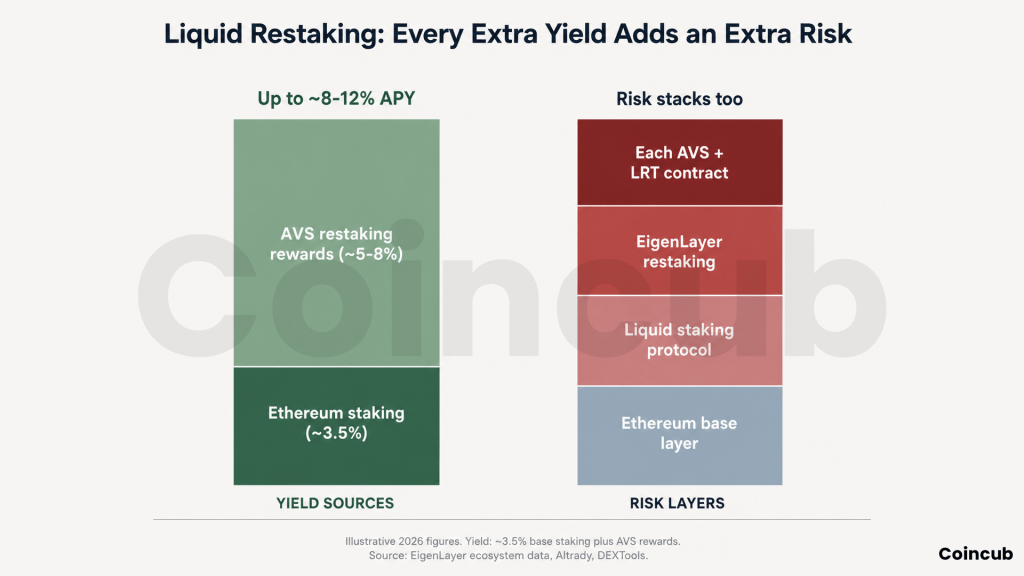
The first stream is the standard Ethereum staking yield, roughly 3 to 4% APR in 2026, earned for helping secure the base network. The second is the AVS rewards, paid by the additional services your restaked ETH helps secure. Stacked together, typical liquid restaking yields run about 8 to 12% APY, with spikes above 15% during periods of high demand for AVS security. The exact figure depends on which AVSs your protocol backs and how generously they reward operators and delegators.
| Approach | What you earn | Roughly what you risk |
|---|---|---|
| Plain staking | Base Ethereum reward, about 3-4% APR. | Ethereum slashing only, plus lock-up. |
| Liquid staking | Same base reward, but with a usable token (e.g. stETH). | Adds the staking protocol’s smart-contract risk. |
| Liquid restaking | Base reward plus AVS rewards, about 8-12% APY. | Adds EigenLayer, every AVS, and the LRT contract. |
Table 1. Moving up the yield ladder means adding layers of both reward and risk.
The Risks You Are Actually Taking
The defining feature of liquid restaking is that risk stacks just as yield does. Each layer that adds income also adds a way to lose money, and these are not hypothetical concerns. They have already played out.
Slashing Across Every Service
Staking carries slashing risk, where a portion of staked ETH can be permanently taken away if a validator misbehaves. Restaking multiplies this. Your ETH can now be slashed not only for faults on Ethereum but for faults on every AVS your operator secures. If an operator you delegate to fails to validate correctly or acts maliciously on any of those services, you inherit a share of the penalty. More services backed means more reward, and also more independent ways to be slashed.
Layered Smart-Contract Risk
When you hold an LRT, your capital depends on a tall stack of code: the LRT protocol itself, the EigenLayer contracts beneath it, the underlying liquid staking protocol, and Ethereum’s base layer, plus the contracts of every AVS your restaking touches. A bug at any single layer can cause losses. This is not theoretical. Kelp DAO suffered a security incident in April 2026 involving roughly $293 million, a stark reminder that more protocol layers mean more surface area for something to go wrong.
Depeg and Cascade Risk
An LRT is supposed to track the value of the ETH behind it, but that link can stretch during stress. A depeg of 5 to 10% is not unusual when liquidations cascade through DeFi. The danger is the feedback loop. If a slashing event or a depeg drops an LRT below its expected value, and that LRT is being used as collateral in lending markets, it can trigger liquidations that push the price down further, which triggers more liquidations. Because modern DeFi is so interconnected, a problem in one restaking token can ripple outward into a wider event.
There is a subtler risk worth naming as well: complexity itself. Because a liquid restaking position spans staking, restaking, and often a third DeFi venue where the token is deployed, very few users can fully trace where their capital sits or what would happen to it under stress. That opacity is its own hazard. When something breaks, people who do not understand the structure are often the slowest to react and the hardest hit. Understanding the position is part of managing the risk, not an optional extra.
The Top Liquid Restaking Protocols
As of mid-2026, the liquid restaking sector manages over $11 billion in total value locked (TVL). While the core mechanism, depositing ETH to receive a yield-bearing liquid restaking token (LRT), is standard, the platforms handling your assets operate quite differently.
Ether.fi (eETH): The Market Leader
Commanding nearly $5 billion in TVL, Ether.fi is the undisputed heavyweight. Its token, eETH, boasts the deepest liquidity in DeFi and is heavily integrated into major lending markets like Aave. The protocol utilizes a non-custodial, permissionless node operator model, making it the go-to choice for users prioritizing decentralization and deep market integration.
Renzo (ezETH): The Algorithmic Manager
Renzo offers a completely hands-off approach. Rather than requiring users to manually evaluate which Actively Validated Services (AVSs) to support, Renzo uses an algorithmic model to dynamically balance yield and risk. It automatically selects operators and allocates assets, making ezETH highly popular among investors who want maximum capital efficiency without active portfolio management.
Kelp DAO (rsETH): A Lesson in Layered Risk
Kelp DAO grew by aggregating restaking across multiple networks, but its history highlights the sector’s fragility. In April 2026, a vulnerability in a cross-chain bridge integration led to a $293 million exploit, leaving roughly 18% of the rsETH supply unbacked. Though Kelp’s core contracts were secure, the event perfectly illustrated how relying on external protocol layers creates massive new attack vectors.
Underpinning all of these platforms is EigenCloud (the 2026 rebrand of EigenLayer), the foundational security marketplace. Choosing an LRT ultimately means deciding whose smart contracts you trust to navigate that marketplace.
The Loop Temptation
Because LRTs stay usable in DeFi, some users chase even higher returns by looping: depositing an LRT as collateral, borrowing against it, buying more ETH to restake, and repeating. Done carefully this amplifies yield. Done carelessly it amplifies everything else, because a modest depeg or slashing event can cascade through the leveraged position and wipe it out. Looping turns the layered risks described above into concentrated risk, and it is the fastest way the double-digit yields turn into double-digit losses.
How to Get Started With Liquid Restaking
Getting into liquid restaking is mechanically simple, which is part of the risk, because the ease of clicking deposit hides the complexity underneath. The basic path is to hold ETH or a liquid staking token, choose a reputable liquid restaking protocol, deposit, and receive your LRT. From there the token earns automatically and you can hold it or deploy it elsewhere.
The careful version adds a few steps of judgment. Research the protocol’s audit history and how long it has operated without incident. Understand which AVSs and operators your deposit will back, since that determines both your reward and your slashing exposure. Decide in advance how much of your ETH you are willing to expose to the extra layers, rather than defaulting to all of it. And be honest about whether you plan to use the LRT as collateral, because the moment you do, you take on DeFi liquidation risk on top of everything else.
A sensible starting posture treats restaking yield as a bonus on ETH you already intend to hold long term, not as a reason to take on leverage or to chase the highest advertised number. The protocols offering the very highest yields are often backing the riskiest set of services, and that yield is compensation for risk rather than a free lunch.
Why Restaking Matters Beyond Yield
Even setting personal returns aside, restaking is reshaping how blockchains get built. By letting new services borrow Ethereum’s security, it lowers the barrier to launching infrastructure like data availability layers, oracle networks, and cross-chain bridges. Supporters argue this makes the whole ecosystem more capital efficient, since the same staked ETH can underwrite many services at once instead of each one raising its own security separately.
Critics counter that this same efficiency concentrates risk. If a large share of the ecosystem leans on the same pool of restaked ETH, a serious slashing or contract failure could ripple across many services at once. This debate, between capital efficiency and systemic fragility, is one of the most important in DeFi today, and it is unresolved. A reasonable reader can find both the promise and the caution persuasive, which is precisely why the topic deserves careful attention rather than hype.
It is also worth distinguishing restaking from the higher-yield schemes that often surround it. A genuine 8 to 12% on ETH, drawn from base staking plus real payments for securing real services, rests on identifiable sources of value. That is fundamentally different from a token promising 100% returns out of thin air. The discipline is to keep that distinction clear, since the restaking label is sometimes borrowed to dress up far riskier products. Knowing where each percentage point of your yield comes from is the simplest test of whether a return is real or an illusion.
Is Liquid Restaking Worth It?
Liquid restaking is one of the more compelling yield strategies in crypto, and that is exactly why it deserves a clear head. The extra few percentage points of return are real, and for ETH you intend to hold anyway, putting it to work can make sense. The question is whether the added yield compensates you for the added layers of slashing, smart contract, and depeg risk, which it may or may not depending on the protocols involved and how you use the token.
A measured approach favors established protocols with strong audit histories, avoids putting your entire ETH position into a single LRT, and treats looping with deep caution if not outright avoidance. The base case for restaking is sound. The losses tend to come from stacking aggressive strategies on top of an already layered product. Matching your exposure to how much complexity you actually understand is the core discipline here.
It also helps to keep the headline yield in perspective. An advertised 12% APY is a snapshot, not a guarantee. AVS rewards fluctuate with demand for security, token incentives can taper, and a single slashing or depeg event can erase a year of extra return in an afternoon. Treating the quoted number as a ceiling that can fall rather than a floor that will hold is the more realistic frame, and it guards against the disappointment that drives people into riskier loops chasing the yield they expected.
The Honest Conclusion
The honest conclusion is that liquid restaking is a powerful tool that rewards understanding and punishes complacency. For an informed holder who sizes the position sensibly, sticks to audited protocols, and resists the pull of leverage, it can be a reasonable way to make idle ETH work harder. For someone who deposits on the strength of an advertised number without grasping the layers beneath it, the same product can become an expensive lesson. Technology is not the danger. Using it without understanding it is.
Frequently Asked Questions (FAQ)
What is liquid restaking in simple terms? +
It is reusing your staked ETH to secure extra services through EigenLayer, earning a second yield on top of normal staking, while receiving a tradable token that keeps your capital usable in DeFi.
How much can you earn with liquid restaking? +
Typical yields in 2026 run about 8 to 12% APY, combining roughly 3 to 4% base staking yield with additional AVS rewards. Returns can spike above 15% during high demand, but they vary with the services backed.
What is an LRT? +
A liquid restaking token, such as eETH or ezETH, represents your restaked ETH plus its earned yield. It stays tradable and usable as collateral while the underlying position keeps securing networks and earning rewards.
Is liquid restaking safe? +
It carries more risk than plain staking. You face slashing across multiple services, smart-contract risk at several protocol layers, and depeg risk during market stress. Real incidents, like the roughly $293 million Kelp DAO event in April 2026, show these risks are concrete.
What is the difference between staking and restaking? +
Staking secures Ethereum and earns a base reward. Restaking reuses that same staked ETH to also secure additional services on EigenLayer, earning a second reward on top. Restaking adds yield and a matching set of extra risks.
Can I lose my ETH with liquid restaking? +
Yes. Funds can be lost to slashing if an operator misbehaves on any service you back, to a smart-contract bug at any protocol layer, or to a depeg that triggers liquidations if you use the token as collateral. These are real, documented risks, not just theoretical ones.
Should beginners try liquid restaking? +
Beginners are usually better served by understanding plain staking and liquid staking first. Restaking adds several layers of risk that are hard to judge without that foundation, so it suits users who already grasp how the underlying pieces work.