


 Buy a Licensed Company
  Explore VASP Data
  Talk to an Expert

 Atis Shala
Atis is a senior analyst and community lead with four years of experience in crypto. He has a bachelor from the Rochester Institute of Technology.
Atis Shala
Atis is a senior analyst and community lead with four years of experience in crypto. He has a bachelor from the Rochester Institute of Technology.
Recovery Scams: Why Most “Crypto Recovery Services” Are Actually Frauds
- Fraudsters weaponize the emotional exhaustion and desperation of previous scam victims, often buying or sharing contact lists within criminal networks to initiate a second round of fraud.
- Due to the immutable nature of public blockchains, confirmed transactions cannot be reversed. Any service promising a technical “hack-back” or guaranteed recovery is a scam.
- Fraudulent services rely on an “advance-fee” model, constantly fabricating new reasons, such as liquidity injections, blockchain taxes, or wallet synchronization fees, to extract more money.
- Recovery scammers frequently forge legal credentials and fake badges to impersonate legitimate law firms, exchange security teams, and government agencies like the FBI, SEC, or CFTC.
- Private entities have no legal authority to seize assets or compel exchanges to return funds. Legitimate recovery requires immediate reporting to official portals (such as ic3.gov) and exchange compliance teams to freeze assets downstream
The Second Scam After the First Scam
You lost funds to a fake investment platform. Within days, a stranger contacts you on Telegram, WhatsApp, or email, claiming to be a blockchain expert, a lawyer, or a government agent who can trace your stolen crypto and return it to your wallet. All they need is a small fee to get started.
This is how crypto recovery scams typically begin, and they have become one of the most common follow-on frauds in the digital asset space. Most people targeted by these schemes have already lost money in a previous scam, which is exactly why fraudsters pursue them. Victims are emotionally exhausted, financially stressed, and eager to believe recovery is possible. That mix of desperation and hope is fertile ground for a second round of fraud.
Most public-facing crypto recovery services sell impossible guarantees, exploit technical confusion, and demand more money upfront. According to the FBI’s Internet Crime Complaint Center (IC3), recovery scams gathered more than 10,500 complaints in 2025 alone, with estimated losses of $1.4 billion. This article explains how these schemes work, why most are fraudulent, the warning signs, and safer steps after a crypto loss.

What Is a Crypto Recovery Scam?
A crypto recovery scam is a fraud where someone claims they can recover stolen, lost, or scammed cryptocurrency in exchange for fees, personal information, wallet access, or additional crypto payments. The scammer plays the role of a savior. The victim, shaken by an earlier loss, often hands over more money hoping to get their original funds back.
These schemes come in many formats. Some scammers pose as blockchain forensic investigators with screenshots of tracing reports. Others pretend to be hackers who can brute-force a wallet or reverse a transaction. Many impersonate law firms with fake bar numbers, fabricated case files, and professional-looking websites. Some claim to be government agents from the FBI, SEC, CFTC, or foreign regulators. Others pose as asset recovery departments at major exchanges like Binance, Coinbase, or Kraken. A separate category involves impersonation of real companies, where scammers pretend to work for well-known blockchain analytics firms or cybersecurity providers.
Legitimate investigators and analytics companies do exist, and they often support law enforcement on complex cases. The problem is that many public-facing recovery services aimed at retail victims make promises no honest provider could keep. Between February 2023 and February 2024, cryptocurrency scam victims further exploited by fictitious law firms reported losses totaling over $9.9 million, according to the IC3. That figure has continued to grow as fraudsters refine their tactics.
Why Crypto Scam Victims Are Targeted Again
Why do scammers target crypto victims twice? Because the second attempt is often easier than the first. The scammer already knows the victim has money to lose, has recently experienced a financial shock, and is actively searching for help. That combination of grief, urgency, and willingness to act makes repeat victimization unusually common.
Victims may feel shame about the original loss, which discourages them from talking to family or filing reports through official channels. Many also misunderstand how blockchain finality works, so a confident promise of transaction reversal can sound believable. Contact information from earlier scams is frequently sold or reused among criminal networks, which is why some victims report being approached within hours of their first loss.
Scammers also monitor public spaces where victims gather. Complaint forums, Reddit threads, X posts, Telegram groups, and YouTube comment sections under crypto-scam videos all attract opportunistic fraudsters posing as fellow victims or helpful experts. Some fake recovery firms go further and buy Google ads or optimize their websites for terms like “recover stolen crypto.”
This pattern has a name. A recovery room scam happens when fraudsters target previous fraud victims by promising to recover lost money for a fee, sometimes after requesting remote access or sensitive account details. The CFTC describes this as a form of advance-fee fraud, in which the victim is asked to pay upfront for a much bigger sum they will supposedly receive later. Once you recognize that the second offer of help is part of the same broader pattern, the emotional pull of “just one more payment” begins to fade.
How Fake Crypto Recovery Services Work
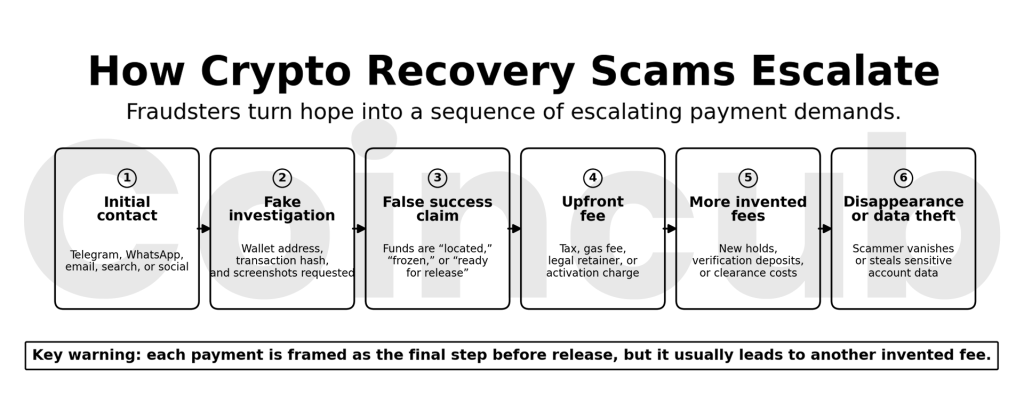
Most crypto recovery scams follow a recognizable script.
Step 1: The hook
The scammer contacts the victim through Telegram, WhatsApp, Instagram, email, or X, or appears high in search results. Opening lines often claim they recovered millions for clients last month, that their blockchain experts can reverse the transaction, or that the victim’s stolen USDT has been frozen in a recovery wallet awaiting release.
Step 2: The fake investigation
The scammer asks for the wallet address, transaction hash, scam platform name, screenshots, and personal contact details. These requests can feel legitimate because real law enforcement reports do require similar information. The difference is that a real investigator works through verified channels, while a scammer uses the data to build credibility and personalize the next stage.
Step 3: The false success claim
The scammer announces that the funds have been located, frozen, or approved for release, often sharing a fake dashboard, a forged court order, or a screenshot of a recovery wallet showing the victim’s lost balance.
Step 4: The upfront fee
The payment request follows, labeled as a processing fee, tax, gas fee, legal retainer, smart contract activation fee, wallet synchronization fee, or clearance certificate. Amounts often start small to build trust, then escalate.
Step 5: The escalation
Once the first payment clears, more fees appear. A new regulatory hold requires another tax. A compliance officer demands a verification deposit. Each fee comes with urgency and a promise that release is imminent.
Step 6: The disappearance or data theft.
Eventually, the scammer vanishes with the money.
Some operations focus on stealing sensitive data such as ID scans, passwords, or remote-access credentials, leading to drained bank accounts or full identity theft.
The CFTC reminds the public that legitimate government agencies never ask victims to pay money to recover funds, and that recovery fraudsters often ask for personal, payment, or account information as part of the scheme.
Why Most Crypto Recovery Claims Are Technically Misleading
A clearer picture of how blockchains work helps explain why so many recovery promises fall apart under inspection.
Once a transaction is confirmed on most public blockchains, it stays final. The transaction is signed by the wallet’s private key and broadcast to a decentralized network of validators. There is no central authority that can rewind the ledger, even when the transfer was the result of fraud. A wallet address by itself also reveals little about a person’s identity. Mapping an address back to a real-world individual usually requires data from a regulated exchange, a subpoena, or another legal process.
Some recovery scams claim to reconstruct a lost private key or seed phrase. The cryptography behind modern wallets makes this computationally impossible. A 12-word or 24-word seed phrase represents a number so large that brute-forcing it would take longer than the age of the universe with current technology. Anyone who claims they can recover a lost seed phrase is almost certainly running a scam.
Other scammers offer to hack back the original fraudster’s wallet. Such a hack would typically be illegal, and a legitimate firm would avoid advertising this service. The FBI also notes that private sector recovery companies cannot issue seizure orders to recover cryptocurrency. Only courts and law enforcement, working through proper legal channels, can compel an exchange to freeze or release funds.
Here is an important distinction. Blockchain tracing is possible. Recovery is much harder. Tracing means following stolen funds across wallets, bridges, mixers, and exchanges. Recovery means actually getting those funds back, which usually requires the assets to land at a regulated exchange that cooperates with law enforcement after a valid court order. The window for that is often short.
Can stolen crypto be recovered?
Sometimes, but rarely in the way most recovery services advertise. Recovery is most realistic when stolen funds are quickly traced to a regulated exchange that can freeze assets after a valid legal request, and when the case is handled through official reporting channels. The FTC encourages consumers to report crypto scams to the FTC, CFTC, SEC, IC3, and the exchange used to send the money.
Red Flags of a Fake Crypto Recovery Service
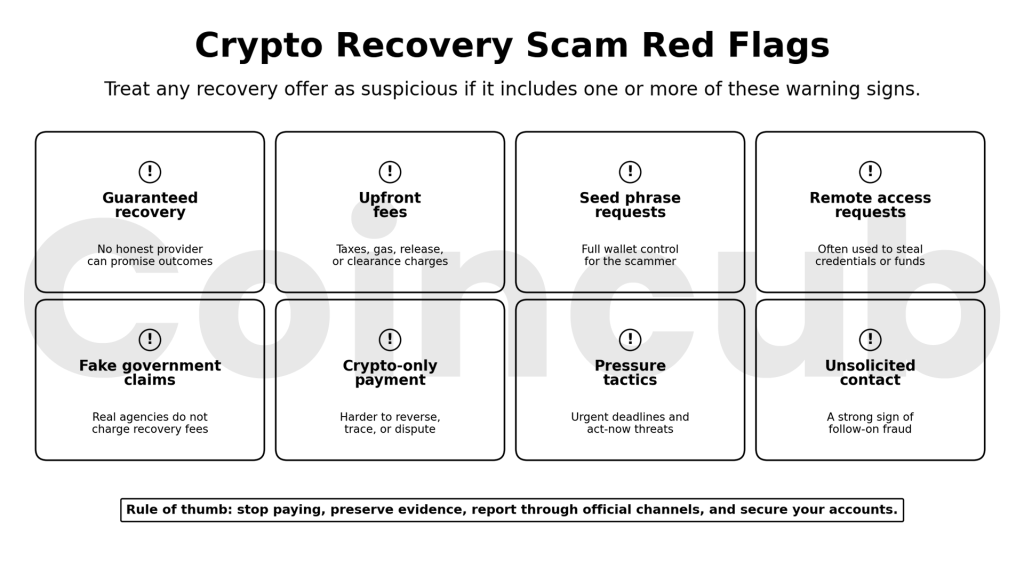
The warning signs of a crypto recovery scam tend to overlap across cases.
- Guaranteed recovery. Honest investigators avoid guarantees because outcomes depend on tracing speed, exchange cooperation, jurisdiction, and other factors outside any firm’s control.
- Upfront fees before any results, especially fees labeled as gas, taxes, clearance, activation, or release.
- Claims that a confirmed blockchain transaction can be reversed. Confirmed transactions on major blockchains generally stay final once recorded.
- Requests for your seed phrase or private key. The CFTC has stated that it would never ask for your private keys or seed phrases, and the same standard applies to any reputable provider.
- Remote access requests through software like AnyDesk or TeamViewer, which often lead to drained accounts and stolen credentials.
- Impersonation of government agencies. Real agencies avoid contacting crypto victims to demand recovery fees or release taxes.
- Fake law firm branding. The FBI has warned that scammers fabricate entire legal identities, complete with forged documents and impersonations of real attorneys.
- Pressure and urgency, such as “act within 24 hours or your funds will be released to the scammer.”
- Vague company identity: missing team pages, generic stock photos, and a domain registered weeks ago.
- Crypto-only payment. Demands for payment in BTC, ETH, USDT, or gift cards make funds harder to trace.
- Fake testimonials, including stock images, copied reviews, and fabricated success stories.
- They contacted you first. Unsolicited offers of help through WhatsApp, Telegram, Instagram, X, Facebook, or email are among the strongest signals of a recovery scam.
The FBI recommends demanding notarized proof of identity and bar licensure from anyone claiming to be a legal representative, and verifying any alleged government affiliation directly through official channels rather than links provided by the contact.
Common Types of Crypto Recovery Scams
Recovery scams take several recurring shapes.
Fake Blockchain Forensic Experts
These scammers present themselves as professional investigators, producing generic tracing screenshots, fake case files, and reports that mimic legitimate blockchain analytics tools, leaning on technical jargon to impress the victim.
Fake Law Firms
Fictitious law firms have become one of the most prominent forms of recovery fraud. The FBI cautioned that these scammers impersonate actual lawyers and law firms, produce counterfeit documents, refer scam victims to a crypto recovery law firm, and request payment in crypto or gift cards. Some pretend to have already filed a recovery claim on the victim’s behalf and demand fees to continue.
Fake Government or Regulator Agents
Scammers pose as officials from the FBI, SEC, CFTC, Interpol, or tax authorities, using spoofed phone numbers, forged badges, and fake email domains. The CFTC has emphasized that real federal agencies avoid collecting recovery fees.
Fake Exchange Employees
These scammers claim the victim’s funds are frozen on a real exchange such as Binance, Coinbase, Kraken, or OKX, and that release requires a fee or KYC payment. Reputable exchanges avoid demanding release fees in this way.
Fake Hackers
Some scammers promise to hack the original fraudster’s wallet, brute-force a private key, or reverse a blockchain transaction. These claims are technically unrealistic and almost always lead to further payments.
Fake Smart Contract Recovery
A growing variant tells victims their assets are locked in a smart contract and require a release fee, gas top-up, or signed approval. The supposed contract is usually a fake interface designed to drain whatever the victim still holds.
Are crypto recovery hackers real? Most crypto recovery hackers advertising to consumers are scams. Honest investigators avoid asking for your seed phrase, avoid promising to hack wallets, and avoid guaranteeing results.
What Legitimate Crypto Recovery Help Looks Like
Limited legitimate pathways can sometimes help after a crypto scam, and they look very different from what fake recovery firms advertise.
Real help usually focuses on documentation, tracing, and coordination with official channels rather than guaranteed recovery. A legitimate provider may trace stolen funds across the blockchain, prepare a clear report for law enforcement with transaction hashes and wallet addresses, identify deposit addresses linked to known exchanges so investigators can submit freeze requests, organize evidence into a structured timeline, coordinate with attorneys who handle civil recovery, advise on notifying the exchange involved, and perform cybersecurity cleanup if a wallet, device, email account, or seed phrase was compromised.
Honest providers avoid guaranteeing recovery, avoid asking for seed phrases, avoid surprise mid-process fees, avoid claiming a direct government affiliation without proof, avoid discouraging law enforcement contact, and avoid insisting on crypto-only payment.
A legitimate blockchain analytics report can document what happened, but it remains separate from actually recovering funds. The report becomes useful when paired with law enforcement action, exchange cooperation, or civil legal process.
Major analytics firms generally avoid offering retail recovery services. Chainalysis, for example, has worked with law enforcement on cases that recovered substantial sums for victims, but its retail-facing guidance directs individual victims to report scams to local authorities. Scammers often impersonate well-known brands like this to lend credibility to fake services.
What To Do If You Lost Crypto to a Scam
Acting carefully in the hours and days after a crypto loss matters.
Step 1: Stop sending money
Halt all payments for taxes, release fees, gas fees, or verification deposits. Each additional payment compounds the loss without improving the chance of recovery.
Step 2: Preserve evidence
Save transaction hashes, wallet addresses, website URLs, chat logs, email headers, screenshots, phone numbers, social media profiles, exchange receipts, and bank transfer details. Organize everything into a single folder with clear timestamps.
Step 3: Report quickly
For U.S. readers, the main reporting channels are the FBI Internet Crime Complaint Center at ic3.gov, the FTC at ReportFraud.ftc.gov, the CFTC complaint portal, the SEC tip and complaint form, and your local police department. The FBI urges anyone victimized to file with IC3 and contact a local FBI field office with as much transaction information as possible.
Step 4: Contact the exchange
If the funds passed through a regulated exchange, notify its fraud or compliance team as soon as possible. Provide transaction hashes, wallet addresses, and the timeline of events. Faster notification gives the exchange a better chance of freezing assets before they move on.
Step 5: Secure your accounts
Change passwords on your email, exchange accounts, and any related services. Enable two-factor authentication using an authenticator app rather than SMS where possible. Revoke wallet permissions for unfamiliar smart contracts. Move any remaining crypto to a fresh wallet with a new seed phrase. Scan your devices for malware and review browser extensions for anything suspicious.
Step 6: Treat any later contact as suspicious by default
This includes individuals claiming to be lawyers, investigators, exchange agents, government officials, or fellow victims who happen to know someone who can help. The FBI has warned that scammers often have detailed knowledge of previous transactions, which they use to gain trust before extracting more money.
How To Check a Crypto Recovery Company Before You Trust It
If you are still considering a recovery service, treat the decision the way you would any high-stakes financial choice.
Start by searching the company name combined with words like scam, complaint, lawsuit, review, and fraud. Pay attention to detailed accounts from multiple sources rather than short, glowing testimonials. Verify the business registration in the jurisdiction where the company claims to operate, and confirm the physical address exists.
If the company claims to be a law firm, look up the named attorneys in the bar directory of the relevant state or country. Real bar numbers can be verified through public registries. Check for a real team with verifiable professional histories rather than stock photos and invented bios.
Look at the domain age. Many recovery scam sites are only weeks or months old, even when the marketing copy claims years of experience. Be cautious of reviews that all sound similar or appear only on the company’s own pages. Ask for a written scope of work that explains exactly what the firm will do, what it cannot do, and how it will charge.
Refuse any request for your seed phrase, private key, exchange password, or remote access. Walk away from any company that guarantees recovery or insists on payment exclusively in cryptocurrency. If a company claims to work with a specific regulator, contact that agency directly through its official website to verify the relationship.
How can you tell if a crypto recovery service is fake? The strongest signals are guaranteed results, upfront fees, requests for seed phrases or remote access, fake government claims, pressure tactics, and vague explanations of how recovery will actually happen.
Why Fake Crypto Recovery Services Appear So Often Online
Many victims find scam recovery services through ordinary searches and social media, which raises a fair question: why are these scams so easy to find?
Fraudsters invest heavily in search engine optimization for urgent terms like “recover stolen crypto,” “crypto recovery expert,” and “blockchain forensic recovery.” Some run paid ads on Google and social platforms targeting users who recently searched for scam-related help. Others publish fake testimonials, set up dozens of similar websites, and seed comment sections on Reddit, YouTube, and X with fabricated success stories.
Some operations impersonate victims to recommend their own services. A comment that reads like a grateful customer praising “Investigator X” is often part of the same scam operation, amplified by bots and sock-puppet accounts.
The FBI has also warned about fake versions of official sites, including imitations of the IC3 website. The bureau advises typing ic3.gov directly into the address bar rather than clicking sponsored search results. Being visible on Google does not make a company trustworthy.
Common Myths About Recovering Stolen Crypto
A few persistent myths drive much of the demand for recovery scams.
Myth 1: “A hacker can get it back.” Hacking wallets or exchanges is generally illegal and sits outside legitimate recovery work. Anyone offering this service is almost certainly running a scam.
Myth 2: “A blockchain transaction can be reversed.” Once confirmed on a major blockchain, reversing a transaction through technical means is generally impossible. Recovery depends on freezing funds at a downstream exchange, often through legal process.
Myth 3: “If funds are visible on-chain, they are recoverable.” Visibility and control are different things. A tracer may see exactly where funds moved without having any way to compel their return.
Myth 4: “A private investigator can force an exchange to return funds.” Exchanges generally respond to law enforcement requests, court orders, and legal process. Private investigators can assist with documentation, while only legal channels can compel release.
Myth 5: “One more fee will unlock my money.” This is the classic advance-fee pattern. Each new fee is a fresh extraction, and the supposed release rarely arrives.
Myth 6: “A professional-looking law firm website means it is real.” The FBI has documented many cases of polished websites built specifically to defraud crypto victims. Surface appearance is among the least reliable indicators.
How To Avoid Being Scammed Twice
A short list of habits offers strong protection against follow-on fraud. Treat unsolicited offers of help with deep suspicion, especially through Telegram, WhatsApp, Instagram, or email. Keep your seed phrase and private keys offline and share them with no one. Refuse remote-access requests from anyone you cannot independently verify, and stay away from recovery firms that demand payment in cryptocurrency. Verify any government or regulator claim by visiting the agency’s official website.
Report the original scam quickly through official channels rather than waiting until after recovery. Talk to a trusted family member, friend, or financial professional before sending any additional payments. Stay skeptical of urgency, especially countdown clocks and act-now messages. Avoid acting on success stories in comment sections, which are often staged.
Accept the uncertainty of recovery from the start. Some funds can be recovered through proper channels, especially when reports are filed quickly and stolen assets land at a cooperative regulated exchange. Many cases never reach that outcome. Setting realistic expectations protects you from the emotional vulnerability fake recovery services exploit. The safest step after a crypto scam often involves stopping further losses, preserving evidence, reporting through official channels, and securing your accounts rather than hiring a recovery company.
Conclusion: Real Help Does Not Begin With Another Payment
Crypto recovery scams thrive on the same emotional dynamics that made the original scam possible: hope, urgency, and trust placed in the wrong person. Most public-facing recovery services targeting retail victims are fraudulent or so misleading that they amount to the same thing. They sell guarantees that no one can keep, lean on technical confusion, and steadily extract more money through invented fees.
Real recovery is rare and usually depends on a combination of fast reporting, exchange cooperation, law enforcement action, and sometimes formal legal process. Even then, the outcome is uncertain. Anyone who promises a different reality, especially in exchange for an upfront fee, deserves serious skepticism.
If you have been a victim, the loss reflects the skill of the operators rather than any failing on your part. The best immediate action is to stop paying anyone who promises recovery for a fee, preserve every piece of evidence you can, report through official channels like the IC3, FTC, CFTC, and SEC, and secure your wallets, devices, and email accounts. After a crypto scam, the most important recovery may be preventing the next loss.
Frequently Asked Questions (FAQs)
Are crypto recovery services legitimate?
Some offer genuine blockchain tracing and investigation support, often working with law enforcement on complex cases. Many public-facing recovery services aimed at retail victims, however, are scams. Treat upfront fees, guaranteed results, and requests for seed phrases as strong warning signs.
Can stolen crypto be recovered?
Sometimes, but recovery is difficult and uncertain. The best chances come from fast reporting to law enforcement and the exchange involved, especially when stolen funds can be traced to a regulated exchange willing to freeze assets after a valid legal request.
Can someone reverse a crypto transaction?
Generally, no. Confirmed blockchain transactions on major networks are designed to be final. Recovery depends on action at downstream exchanges or through legal channels rather than on reversing the transaction itself.
Should I pay a recovery company upfront?
Extreme caution is warranted. Upfront fees rank among the most consistent red flags of a recovery scam, especially when paired with guarantees of success or demands for payment in cryptocurrency.
What should I do first after losing crypto?
Stop sending further payments, save all evidence such as transaction hashes and chat logs, report the scam to the FBI IC3, FTC, CFTC, and SEC, contact the exchange involved, and secure your wallets, devices, and email accounts.
Is it safe to give a recovery expert my seed phrase?
No. Your seed phrase or private key gives full control of your wallet to anyone who holds it. Reputable recovery services avoid requesting that information, and any such request should be treated as an attempt to steal whatever assets remain.