Buy a Licensed Company
  Explore VASP Data
  Talk to an Expert

 Atis Shala
Atis is a senior analyst and community lead with four years of experience in crypto. He has a bachelor from the Rochester Institute of Technology.
Atis Shala
Atis is a senior analyst and community lead with four years of experience in crypto. He has a bachelor from the Rochester Institute of Technology.
Stablecoins: The Fuel to Power the Future of Finance
Stablecoins don’t make headlines the way Bitcoin and memecoins do. There’s no drama in a coin that costs exactly one dollar, until you realize that coin just processed more transactions in a single year than Visa and Mastercard combined.
Key Takeaways:
- Stablecoins are cryptocurrencies pegged to stable assets, most commonly the U.S. dollar, and have grown from a niche crypto utility into a $283.7 billion global financial infrastructure.
- In 2024, total stablecoin transfer volume reached $27.6 trillion, surpassing Visa and Mastercard combined, with transaction volume growing 83% year-over-year by mid-2025.
- Adoption spans retail users in inflation-hit economies, freelancers receiving cross-border payments, and Fortune 500 treasury departments seeking cost efficiencies.
- The four main types of stablecoins are fiat-collateralized, crypto-collateralized, commodity-backed, and algorithmic, with fiat-backed coins like USDT and USDC dominating over 93% of the market.
- Key use cases include cross-border remittances, B2B payments, decentralized finance (DeFi), and currency preservation in countries with volatile local currencies.
- Stablecoins are increasingly differentiated from Central Bank Digital Currencies (CBDCs), which are state-issued and government-controlled, while stablecoins remain privately issued and market-driven.
- Regulatory frameworks such as the U.S. GENIUS Act and Europe’s MiCA are providing the legal clarity expected to accelerate institutional and retail adoption globally.
In 2024, the world moved $27.6 trillion through stablecoins. Not speculative bets on crypto’s next bull run. Not NFT hype. Just digital dollars, quietly settling payments, crossing borders in seconds, and landing in the wallets of freelancers in Southeast Asia, small businesses in Latin America, and treasury departments at Fortune 500 companies. By August 2025, that number had already surpassed $4 trillion in transaction volume for the year alone, an 83% surge over the same period in 2024.

We are not watching the future of money arrive. It is already here. And it’s called a stablecoin.
What Is a Stablecoin, Really?
If Bitcoin is digital gold (volatile, speculative, finite), then a stablecoin is digital cash: predictable, programmable, and pegged to something stable, typically the U.S. dollar.
Stablecoins are cryptocurrency tokens engineered to hold a fixed value. Most are fiat-collateralized, backed dollar-for-dollar (or euro-for-euro) by real-world reserves held by the issuer. Others are crypto-collateralized, backed by overcollateralized crypto like Ethereum. A smaller class are commodity-backed, tied to physical assets like gold. And a now-largely-discredited category, called algorithmic stablecoins, tried to maintain their peg through code alone, a strategy that collapsed catastrophically with TerraUSD in 2022.
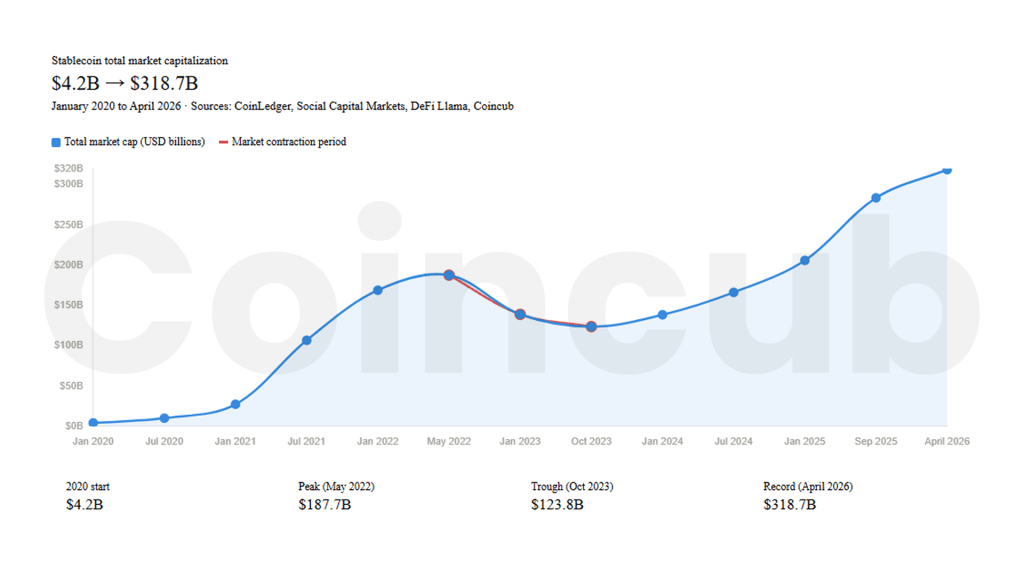
Today, the market is dominated by two giants: Tether (USDT), which holds roughly 69% of the market with a $173 billion market cap, and USD Coin (USDC), sitting at approximately $73.6 billion. Together, they account for over 93% of the entire stablecoin ecosystem. As of September 2025, the total stablecoin market cap had reached a record $283.7 billion, up from just $4.2 billion in January 2020, a nearly 68-fold expansion in five years.
The first stablecoin, BitUSD, launched in 2014 and never found traction. Tether arrived later that same year and changed everything.
The Numbers That Rewrote the Narrative
For years, critics dismissed stablecoins as a niche utility inside crypto trading, a tool for moving between Bitcoin positions without cashing out to the bank. That story no longer holds.
The scale of what stablecoins now process is staggering. In 2024 alone, total stablecoin transfer volume surpassed the combined transaction volume of Visa and Mastercard by 7.68%. Monthly transaction volume hit $1 trillion in November 2024. By 2019 to 2024, the cumulative total reached $219.4 trillion across 8.6 billion individual transactions.
The market cap trajectory tells an equally dramatic story. During the 2020 to 2021 crypto bull run, the combined cap of the top 10 fiat-backed stablecoins exploded from $5 billion to $181.7 billion, a 3,121% increase in roughly two years. Even after the brutal 34% contraction of 2022 to 2023, triggered largely by the TerraUSD collapse and the broader crypto winter, recovery was swift. By September 2025, the market had not only recovered but set a new all-time high.
Stablecoins now account for roughly 30% of all on-chain crypto transaction volume. That share is growing. TRM Labs, one of the leading blockchain analytics firms, put it plainly in their 2025 report:
“We are still just at the beginning of the stablecoin adoption curve.”
Who Is Actually Using Stablecoins?
The user base of stablecoins is more diverse, and more surprising, than most people expect. It is not primarily tech-savvy crypto traders. Increasingly, it is ordinary people in extraordinary financial circumstances.
Demographics of Stablecoin Users
Geographically, adoption is highest where traditional finance fails people most. South Asia was the fastest-growing region for crypto adoption in 2025, recording an 80% year-over-year increase in transaction volume between January and July, reaching approximately $300 billion total. India ranked first in overall crypto adoption globally, with Pakistan and Bangladesh also in the top 20, despite an official crypto ban in Bangladesh. In Latin America, 71% of stablecoin activity is tied to cross-border payments, the highest share of any region globally. In Argentina and Venezuela, over 30% of digital wallets now hold stablecoins for everyday spending, a direct response to hyperinflationary local currencies.
Institutional Stablecoin Users
Institutionally, the shift has been equally dramatic. A June 2025 survey by EY-Parthenon found that 100% of financial institutions and corporates surveyed were aware of stablecoins, with 13% already using them and 65% expecting interest to grow in the near term. Among current corporate users, 62% use stablecoins to pay suppliers, as B2B applications dominate. Perhaps most tellingly, 87% of corporates believe stablecoin adoption could create a competitive advantage for their organization. Active usage is highest among organizations with revenues of $10 to $50 billion, where 19% are already using them for payments.
The professional services sector leads enterprise adoption at 23%, followed closely by financial services. Among mid-sized firms, 50% report achieving cost savings of 10 to 20% through stablecoin use compared to traditional payment rails.
Retail adoption, meanwhile, is growing fastest in the developing world. Global retail-led crypto transactions rose by more than 125% between early 2024 and the same period in 2025. The freelancer economy is a notable sub-story: the number of freelancers globally paid in stablecoins grew by 39% compared to the first half of 2024, drawn by real-time settlement, lower fees, and freedom from punishing currency conversion costs.
Neobanks and fintechs have accelerated this mainstreaming. Platforms like Revolut and Nubank have integrated stablecoin transfers for over 60 million users combined, normalizing the technology for people who have never heard the word “blockchain.”
The Use Cases Driving Adoption
Five categories account for the overwhelming majority of real-world stablecoin activity:
Cross-order Payments and Remittances Through Stablecoins
Cross-order payments and remittances remain the killer app. Traditional international transfers through correspondent banking networks take 2 to 5 days and charge fees of 1 to 3%, sometimes far more in emerging markets. Stablecoins settle in seconds for a fraction of the cost. Revolut uses USDC and USDT to help businesses pay international suppliers without incurring foreign exchange fees, translating to savings of $10,000 to $30,000 on a $1 million transaction. In Southeast Asia alone, $18.6 billion in stablecoin remittances were sent in the first half of 2025, and over 43% of B2B cross-border payments in the region now utilize stablecoins.
Payments Through Stablecoins
Payments were the largest use case segment in 2024, accounting for 39.4% of the stablecoin market by revenue share. Stripe, which began supporting USDC payouts in 2023, reinforced its commitment with a $1.1 billion acquisition of Bridge in 2024, enabling businesses to accept digital dollars on blockchains like Solana and settle in fiat at lower cost. Visa has expanded its USDC settlement pilot with Crypto.com, now allowing select merchants to settle cross-border payments in minutes.
Stablecoins in Decentralized Finance
DeFi (Decentralized Finance) is where stablecoins serve as the essential liquidity layer, the digital equivalent of the money market. They are used as collateral for loans, as the base currency for trading pairs, and as a stable store of value within otherwise volatile smart contract ecosystems.
Stablecoins in Treasury Management
Treasury Management is attracting institutional capital at scale. Yield-bearing stablecoins, generating returns by holding tokenized treasuries and money market instruments, grew their market cap from $1.5 billion in early 2024 to over $11 billion by May 2025, a 5,284% increase in just over a year. BlackRock’s BUIDL and Ondo Finance’s OUSG represent a new category: tokenized short-term U.S. Treasuries that combine the programmability of blockchain with the safety of sovereign debt.
Currency Preservation Through Stablecoins
Currency Preservation in inflation-hit economies rounds out the picture. Where local currencies are rapidly losing value in countries like Argentina, Turkey, Nigeria, and Venezuela, stablecoins offer citizens a way to hold dollar-denominated value without a U.S. bank account. Argentina and Turkey recorded a 60% increase in crypto adoption amid their currency crises, with stablecoins as the primary vehicle.
Stablecoins vs. CBDCs: The Battle for Digital Money
No conversation about stablecoins is complete without addressing their government-engineered counterpart: Central Bank Digital Currencies, or CBDCs.
On the surface, they look similar. Both are digital, both aim for price stability, both promise faster and cheaper payments. But beneath those shared features lie fundamentally different philosophies about who controls money, and that difference has become one of the defining geopolitical fault lines of 2025.
CBDCs are digital representations of sovereign fiat money, issued directly by a central bank and placed on its balance sheet, just like banknotes. They are legal tender. As of July 2025, 137 countries representing 98% of global GDP are exploring CBDCs, with 49 currently in pilot stages. China’s e-CNY, the EU’s Digital Euro, and the UAE’s Digital Dirham are among the most advanced pilots.
Stablecoins are private tokens issued by companies like Tether or Circle. They are liabilities of those private issuers, not the government. Their trust model is built on reserve quality, transparency, and audits rather than sovereign guarantee.
The core contrasts across four key dimensions are captured in the table below:
| Dimension | Stablecoins | CBDCs |
| Issuer | Private companies or DAOs (e.g. Tether, Circle) | Central banks (e.g. Fed, ECB, PBOC) |
| Legal Status | Not legal tender; privately regulated | Legal tender; sovereign liability |
| Blockchain | Public, decentralized (Ethereum, Tron, Solana, Sui) | Permissioned, government-controlled ledgers |
| Privacy | Pseudonymous; KYC required on centralized platforms | Full government transaction visibility |
| Programmability | Smart contracts, DeFi, conditional logic | Stimulus targeting, spending restrictions, expiry dates |
| Trust Basis | Reserve quality, audits, issuer reputation | Full faith and credit of the state |
| Current Scale | $283.7B market cap; $4T+ in 2025 volume | Pilots in 49 countries; limited live deployment |
| U.S. Policy Stance | Actively promoted via GENIUS Act (July 2025) | Opposed by White House and Congress |
Key Differences Between Stablecoins and CBDC
- Control and Issuance: CBDCs are state-controlled; stablecoins are market-driven. A CBDC is government money in digital form, carrying the full faith and credit of the state. A stablecoin is a private contract: you trust the issuer, not the government.
- Privacy: Stablecoins run on public blockchains, making transactions transparent but pseudonymous. CBDCs give governments full transaction visibility, a feature governments frame as anti-fraud and anti-money laundering, but which critics see as a surveillance risk.
- Programmability and Monetary Policy: Both are programmable. But CBDCs give governments the unprecedented ability to implement direct stimulus payments, apply conditional spending restrictions, or set expiration dates on funds. In less democratic contexts, this level of programmability could mean direct control over individual economic behavior.
- Geopolitics: Here is where it gets genuinely fascinating. The United States government has explicitly chosen stablecoins over CBDCs as its preferred digital money strategy. The Trump administration’s 2025 executive order prioritizes stablecoins as the mechanism for “safeguarding the global role of the U.S. dollar.” The GENIUS Act, passed in July 2025 as the first comprehensive U.S. stablecoin law, enshrines that preference in federal legislation. Meanwhile, the EU and China are doubling down on CBDCs, pursuing digital sovereignty over their own currencies against the tide of dollar-backed stablecoins. As the Atlantic Council observed, the broad adoption of U.S. dollar-backed stablecoins could actively reverse the de-dollarization trend that many geopolitical rivals are counting on.
The result is a world where stablecoins and CBDCs are less competitors than parallel experiments running simultaneously, one driven by private innovation, the other by state authority.
What is the Future of Stablecoins?
There is a regulatory tailwind now that didn’t exist 12 months ago. The GENIUS Act gives the U.S. stablecoin market a clear legal framework for the first time. Europe’s MiCA regulation, which made Circle the first MiCA-licensed stablecoin issuer in July 2024, is driving USDC adoption in remittance corridors across Latin America and Southeast Asia. A majority of corporate non-users surveyed by EY-Parthenon said that supportive legislation increases their interest in adoption by 81%.
Market forecasts point to continued expansion. The global stablecoin market was estimated at $166.3 billion in 2024 and is projected to reach $1 trillion by 2035, growing at a compound annual rate of nearly 18%. Monthly transaction volumes are forecast to approach $1 trillion by late 2026.
But the numbers only tell part of the story. The more resonant truth is what stablecoins actually represent for the hundreds of millions of people who live outside the reach of a stable currency or accessible banking system: a dollar that stays a dollar, with no bank required, no border in the way, and no inflation eating it overnight.
That is not a niche product. That is infrastructure.
Frequently Asked Questions (FAQs)
What are the top 5 stablecoins?
The top 5 stablecoins by market capitalization as of 2025 are Tether (USDT) at $173 billion, USD Coin (USDC) at $73.6 billion, DAI, First Digital USD (FDUSD), and Ethena USDe. USDT and USDC together account for over 93% of the entire stablecoin market.
What are the 4 types of stablecoin?
The four types of stablecoins are fiat-collateralized (backed by currencies like the USD), crypto-collateralized (backed by digital assets like Ethereum), commodity-backed (tied to assets like gold), and algorithmic (using code-based mechanisms to maintain their peg, though this model largely collapsed after TerraUSD in 2022).
Is BTC a stablecoin?
No, Bitcoin (BTC) is not a stablecoin. Stablecoins are designed to hold a fixed value, typically $1. Bitcoin’s price is highly volatile, regularly fluctuating by tens of thousands of dollars. Bitcoin is better described as a decentralized store of value or speculative digital asset, not a stable medium of exchange.
What is an example of a stablecoin?
Tether (USDT) is the world’s most widely used stablecoin, with a $173 billion market cap and over $20 billion in daily trading volume. Pegged 1:1 to the U.S. dollar, it is used globally for cross-border payments, crypto trading, remittances, and as a dollar substitute in countries with unstable local currencies.