


 Buy a Licensed Company
  Explore VASP Data
  Talk to an Expert


Arweave (AR) Price Prediction 2026-2030: Powering the Permanent Web
- Arweave’s 2026 story depends heavily on whether it can push the network beyond storage into actual compute use cases.
- The core bull case is not just adoption, it is the storage endowment model locking AR out of liquid circulation as network usage grows.
- AI data provenance is one of the article’s strongest narratives because Arweave offers permanent, auditable storage for datasets and records.
- Arweave is not competing with Filecoin in the same lane, permanent storage and temporary contract-based storage solve different problems.
- Long-term upside exists, but the whole thesis still depends on execution, especially developer adoption, enterprise usage, and whether AO gains real traction.
Arweave’s 2026 story centers on the maturation of the AO Computer, which launched its mainnet on February 8, 2025. After more than a year of live operation, the network is shifting from “new compute layer” to proven adoption metrics. The core bull case remains the Storage Endowment model, which locks AR out of circulation as more data is permanently stored. AI data provenance continues to be one of the strongest narratives, because Arweave offers immutable, auditable storage for training datasets and records. Arweave is not competing with Filecoin in the same lane, permanent storage and temporary contract-based storage solve different problems.
Current Market Snapshot
- Current Price: ~$1.68-$1.74
- All-Time High: ~$90.94 (November 2021)
- Market Cap: ~$110-$114 Million
- Circulating Supply: ~65.65 million AR (hard cap 66 million)
Key Calls and Scenario Projections:

- 2026: AO maturation year. With the mainnet already live for 13+ months, focus shifts to developer adoption and endowment growth. Base scenario: $3.00-$4.50.
- 2030: Long-term maturity. If Arweave becomes the default permanent archive for AI data and Web3 records, targets of $25+ remain feasible.
What is Arweave?
The Core Network (Blockweave)
Arweave is a decentralized storage network designed to offer permanent data preservation for a one-time, upfront fee. Unlike centralized cloud providers that rely on recurring monthly subscriptions or decentralized networks that utilize contract-based time limits, Arweave focuses entirely on data immutability.
The architectural foundation of Arweave is a derivative structure known as the “blockweave.” In a traditional blockchain, nodes only need the most recent blocks to validate new transactions. In the blockweave, every new block is cryptographically linked not only to its immediate predecessor but also to a randomly selected historical block (the “recall block”) from anywhere in the network’s history.
To successfully mine a new block and claim the AR token rewards, a miner must mathematically prove they possess this randomly selected recall block. This consensus mechanism, known as Succinct Proofs of Random Access (SPoRA), forces data replication. Miners are economically incentivized to store as much of the Arweave dataset as possible because holding a broader dataset statistically increases their probability of possessing the required recall block.
The data stored across this distributed network forms the “Permaweb,” an immutable version of the internet hosting HTML pages, dApps, media, and records that cannot be altered or deleted by a central authority.
The AO Computer: From Launch to Maturation
Arweave’s utility expanded with the AO Computer. After more than a year of live operation, the network is moving from launch narrative to adoption metrics. The key question in 2026 is no longer whether AO ships, but whether it can sustain developer activity, persistent processes, and more data anchored to Arweave’s data layer.
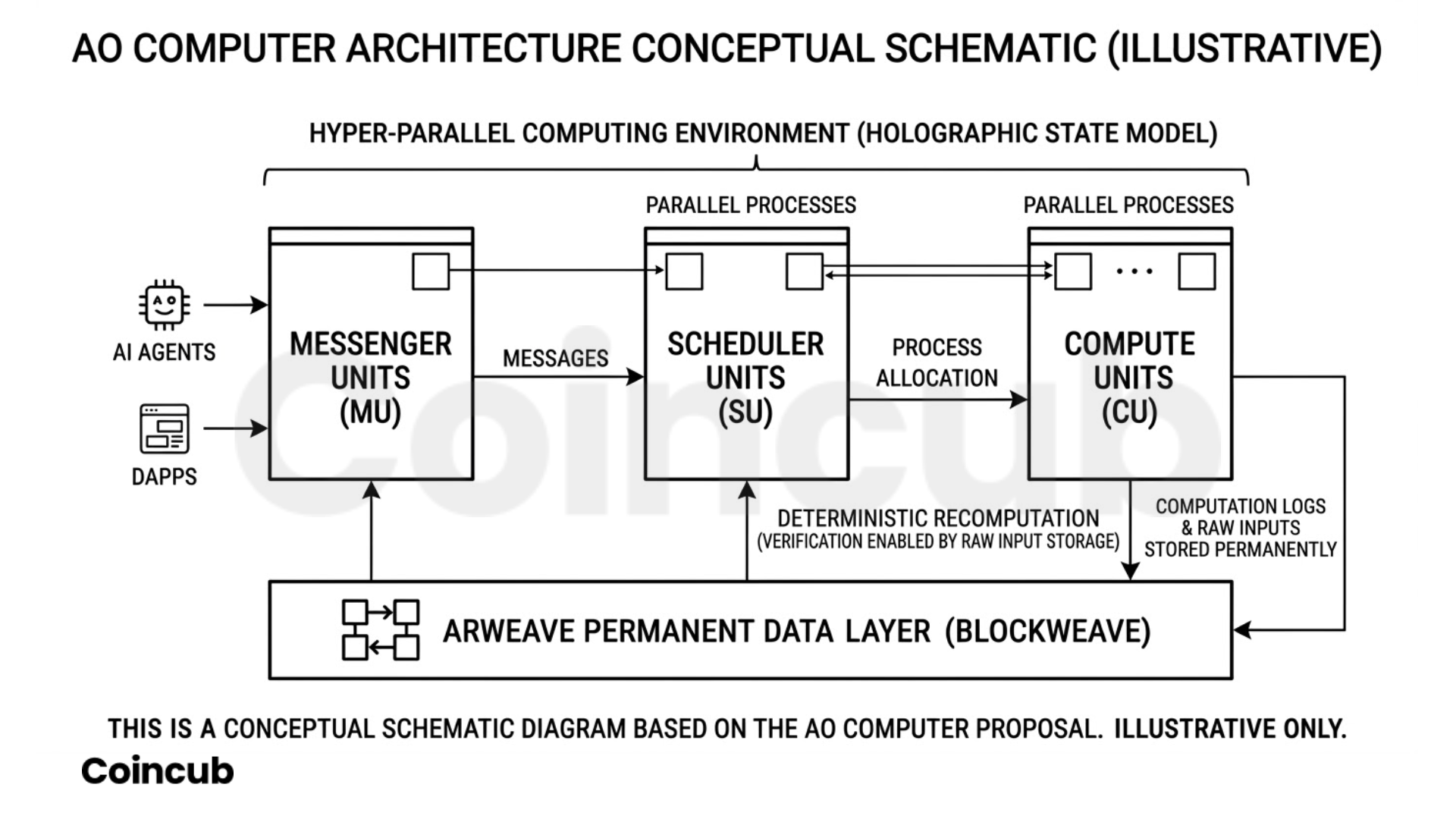
Traditional smart contract platforms operate on a shared-memory model, in which all nodes must reach consensus on a single global state, thereby requiring sequential transaction processing. AO bypasses this by adopting an “actor-oriented” programming paradigm. In the AO architecture, individual smart contracts (or “processes”) operate independently and communicate via a native message-passing standard.
The system is separated into specialized units to distribute the workload:
- Messenger Units (MUs): Route messages between processes.
- Scheduler Units (SUs): Sequence and number messages to ensure cryptographic ordering.
- Compute Units (CUs): Process computational workloads and resolve application states.
AO achieves its scaling capabilities through a concept known as “holographic state.” The network does not require all nodes to perform computations to agree on the state of an application. Instead, it ensures that the raw inputs and message logs are written permanently to the Arweave blockweave. Because the inputs are cryptographically secure and available, participants can trustlessly recompute the application’s state at any time.
Arweave Price History
The AR token traded between $0.30 and $0.50 throughout early 2020. The network experienced rapid expansion during the 2021 cryptocurrency bull market, significantly aided by its integration into the Solana non-fungible token (NFT) ecosystem.
As creators realized that storing high-resolution data directly on chains like Solana was prohibitively expensive, Arweave became a standard for off-chain metadata storage. This surge in network utilization correlated with the AR token reaching its all-time high of approximately $90.94 in November 2021.
Following macroeconomic tightening in 2022 and 2023, AR entered a severe bear market, with its price declining by over 90% and stabilizing in a multi-year consolidation zone. During this period, the Arweave core team shifted its primary development focus toward building the AO computing layer.
In March 2026, AR trades in the $1.68-$1.74 range, putting its market capitalization around $110-$114 million. Because roughly 65.65 million tokens are already in circulation out of the 66 million hard cap, new inflation is barely a factor for the asset. At these levels, the market appears cautious, but the thesis now depends less on launch speculation and more on whether AO can show sustained usage, more data writes, and visible endowment growth.
Factors That Impact Arweave
The AI Data Provenance Narrative
A notable catalyst for Arweave in 2026 is the overlap between permanent storage and the demands of the artificial intelligence sector. As AI foundation models scale, verifying the origin and integrity of AI training data has become a recognized industry challenge.
When AI datasets are stored on centralized servers, they can be altered or deleted, making the resulting AI systems difficult to audit. Arweave offers a potential solution by serving as an immutable ledger for AI training data and model weights. Once a dataset is ingested into the blockweave, its origin and timestamp become permanently verifiable.
If the broader market and regulatory bodies begin to prioritize verifiable data trails for AI compliance, Arweave could see a noticeable uptick in corporate storage demand.
Tokenomics & The Storage Endowment
Arweave’s valuation relies significantly on its economic model: the Storage Endowment. This mechanism is designed to remove AR tokens from the liquid market as network adoption grows.
Users pay a single, upfront transaction fee to store data. A small fraction goes to the miner immediately, while the vast majority (historically around 80% to 85%) is deposited into the Storage Endowment. The protocol prices this upfront fee based on a highly conservative assumption that storage hardware costs will only decline by 0.5% per year. Historically, digital storage costs have decreased much faster, averaging closer to a 30% annual decline.
Because actual hardware costs drop faster than Arweave’s 0.5% estimate, the purchasing power of the AR locked within the endowment theoretically compounds over time.
What Changes in 2026
The 2026 narrative is no longer about launch, AO is already live. The focus is now on scaling: more AO processes running, more data permanently anchored to the Permaweb, and measurable growth in the Storage Endowment. The Arweave 2.6 hard fork, activated in March 2023, already lowered barriers for miners, and ongoing Solana data-availability integrations continue to bring external ledger data onto Arweave.
Arweave Price Prediction 2026-2030
These forecasts utilize scenario-based modeling, balancing the mechanics of Arweave’s Storage Endowment against adoption risk now that AO has already been live on mainnet since February 2025. All projections use the March 2026 baseline price range of roughly $1.68-$1.74.
To understand where higher price targets come from, we have to look at how the network removes tokens from circulation. Industry modeling provides a useful hypothetical: if Arweave’s total network utilization scales to 10 Petabytes (PB) and the storage fee averages ~200 AR per Terabyte (TB), roughly 1.7 million AR tokens would be locked in the endowment. Given the 66 million maximum supply, locking up over 2.5% of all tokens for every 10 PB of storage creates a clear limit on the available supply. If the AO compute activity accelerates the rate at which data is written to the network, this token sink mechanism speeds up accordingly.
Arweave Price Prediction 2026
- Bear Scenario ($1.50): AO adoption grows slowly, developer activity stays niche.
- Base Scenario ($3.00-$4.50): Steady increase in AO processes and data writes drives measurable endowment growth.
- Bull Scenario ($6.50-$9.00): AO achieves product-market fit with AI agents and cross-chain applications, accelerating token lock-up.
Arweave Price Prediction 2027-2028
To reach higher targets in 2027 and 2028, Arweave needs to bridge the gap between being a niche crypto tool and becoming standard web infrastructure. The path to the $18.00-$32.00 range relies almost entirely on enterprise integration. For example, as organizations face stricter AI data regulations, they may turn to Arweave to store unalterable audit logs. If this happens, large entities will need to buy and spend AR. This steady corporate buying, combined with those same tokens being locked in the storage endowment, would mechanically drive the price up during these years.
Arweave Price Prediction 2029-2030
By 2030, the compounding effect of the Storage Endowment could lock away a significant portion of the circulating supply, provided network utilization maintains a steady upward trajectory.
- Bear Scenario ($2.50 – $12.00): Adoption remains confined to specific crypto use cases. Traditional enterprises opt for cheaper temporary storage alternatives, capping overall network scale.
- Base Scenario ($25.00 – $60.00): Arweave establishes itself as a reliable permanent storage rail for the decentralized internet, and the AO ecosystem hosts persistent autonomous agents that generate consistent network revenue.
- Bull Scenario ($80.00 – $100.00+): AO demonstrates sustained utility alongside incumbent smart contract platforms. In this scenario, the massive volume of tokens locked in the 10PB+ storage models requires new buyers to pay heavy premiums to access the network.
| Year | Conservative Low | Base / Average | Optimistic High | Key Variables & Dependencies (post-AO mainnet) |
| 2026 | $1.50 | $3.00 – $4.50 | $6.50 – $9.00 | AO adoption metrics and endowment growth rate. |
| 2027 | $7.00 | $10.50 – $18.00 | $26.00 | Enterprise compliance usage; token flow into the endowment. |
| 2028 | $14.00 | $27.00 – $32.00 | $45.00 | Maturation of the DePIN sector; active AI agent workloads. |
| 2030 | $17.00 | $30.00 – $60.00 | $80.00+ | Supply scarcity dictated by the compounding Storage Endowment model. |
Arweave vs. Competitors
Arweave vs. Filecoin (FIL)
Arweave and Filecoin address different operational requirements within the storage sector. Filecoin operates on a contract-based, monthly subscription model designed to compete with providers like AWS on the cost of temporary, bulk data storage. Storage providers engage in continuous bidding to hold data for the duration of a client’s contract. However, if a user fails to renew their contract, the network deletes the data.
Arweave operates on an endowment model designed for permanence. It charges a premium, one-time, upfront fee to guarantee that data remains immutable. For use cases demanding unalterable records (such as preserving blockchain histories or safeguarding AI datasets), Arweave’s structure provides guarantees that contract-based networks simply do not.
Arweave AO vs. Render and Akash
In the decentralized compute sector, Render focuses on distributed GPU computing for graphics and visual effects. At the same time, Akash Network serves as a generalized decentralized cloud computing marketplace for leasing idle CPU/GPU power.
Both Render and Akash offer transient compute power; once a task is complete, the instance vanishes. Arweave’s AO supercomputer is designed for stateful computation tied to an immutable data layer. Because computational requests and outputs on AO are logged on the Arweave blockweave, the history of the computation can be audited over time, distinguishing it from platforms that operate strictly as hardware rental marketplaces.
| Network | Main focus | How it works | Permanent data storage | Best fit | What makes it different |
| Arweave | Permanent storage and verifiable compute | One-time storage payment, data written to the blockweave, AO adds parallel compute on top | Yes | Archiving, AI data provenance, immutable records, on-chain history | Combines permanent storage with an endowment model and a compute layer tied to auditable data |
| Filecoin | Temporary decentralized storage | Contract-based storage deals that must be renewed over time | No | Cheap bulk storage, storage marketplaces, flexible retention periods | Better suited for recurring storage agreements rather than permanent records |
| Render | Decentralized GPU compute | Connects GPU providers with users who need rendering or graphics workloads | No | Rendering, visual effects, GPU-heavy creative workloads | Focused on compute power, not permanent storage or verifiable archival history |
| Akash | Decentralized cloud marketplace | Lets users lease idle CPU and GPU infrastructure from distributed providers | No | General cloud workloads, app hosting, flexible compute demand | Works more like a decentralized cloud provider than a permanent data network |
| AO on Arweave | Stateful decentralized computation | Processes communicate through message passing, while logs and inputs are anchored to Arweave | Yes, through Arweave | AI agents, verifiable apps, persistent autonomous processes | Compute activity can be tied back to immutable data and message history |
Is Arweave a Good Investment?
The strict 66-million-max supply limits inflation risk. The Storage Endowment creates a tangible supply sink; if the network reaches multi-petabyte scale, millions of AR tokens are mathematically removed from circulation. Furthermore, the AO Computer seeks to expand Arweave’s usefulness beyond niche storage and into the larger cloud computing and AI markets.
Permanent storage commands a premium over transient decentralized networks like Filecoin and traditional Web2 databases. If the market decides that the vast majority of data does not require absolute permanence, Arweave’s adoption curve will stall. Additionally, the AO Computer faces intense competition from established smart contract platforms like Ethereum and Solana, which benefit from highly liquid markets and entrenched developer loyalty.
Arweave is a specialized building block within the Web3 ecosystem. It may appeal to investors with a multi-year time horizon who are targeting the intersection of data provenance and decentralized AI, provided they understand the execution risks surrounding the AO network’s long-term adoption.
How to Buy and Store Arweave (AR)
Buying AR is straightforward on major exchanges such as Binance, KuCoin, and Kraken. If you are converting local fiat currency to crypto, it is always a good idea to check local guidelines, such as those in the US, to avoid compliance issues. Pairing your exchange account with top crypto-friendly banks can also make the deposit and withdrawal process much smoother.
Native AR tokens cannot be stored on standard Ethereum Virtual Machine (EVM) wallets (like MetaMask) due to the network’s distinct architecture. To hold native AR and interact with Permaweb applications, users must utilize dedicated Arweave wallets, such as the non-custodial ArConnect browser extension. Integrating these wallets with hardware devices is recommended for long-term security.
Frequently Asked Questions (FAQ)
What is Arweave?
Arweave is a decentralized storage network built for permanent data storage through a one-time upfront payment.
What makes Arweave different from Filecoin?
Arweave focuses on permanent, immutable storage. Filecoin is built more around temporary, contract-based storage.
What is the AO Computer?
AO is Arweave’s compute layer. It is designed to let developers run decentralized applications, agents, and processes on top of Arweave’s permanent data layer.
Why does AO matter for AR price?
If AO drives more data and application activity onto the network, more AR may flow into the storage endowment, which could tighten available supply.
Is Arweave an AI-related crypto project?
Partly, yes. The article ties Arweave to AI through data provenance, auditability, and permanent storage of datasets and records.
What is the storage endowment?
It is Arweave’s economic model, in which most of the upfront storage fee is set aside, creating a long-term token sink tied to network usage.
Is AR inflationary or deflationary?
AR has a hard cap of 66 million tokens, and the article argues that growing network use can lock tokens away fast enough to create deflationary pressure on liquid supply.
What could push the Arweave price higher by 2030?
The main drivers are AO adoption, enterprise demand for permanent records, AI data usage, and greater amounts of AR being locked up by storage demand.
What are the biggest risks to the Arweave thesis?
Weak developer adoption, slow AO traction, premium pricing for permanent storage, and competition from other storage or compute networks.
Can Arweave reach its higher long-term targets?
It can, but only if adoption becomes real and sustained. The article’s higher targets depend on execution, not hype alone.