


 Buy a Licensed Company
  Explore VASP Data
  Talk to an Expert


Stablecoin Payroll: Benefits, Costs and Risks for Businesses

- Stablecoin payroll changes the settlement rail, not the employment relationship. Withholding, benefits, reporting, and recordkeeping obligations continue to apply in full.
- The IRS states that the fair market value of digital assets paid as wages, measured in U.S. dollars on the date of receipt, is subject to income tax withholding, FICA, and FUTA, and must be reported on Form W-2.
- Keeping salaries denominated in fiat and delivering them as stablecoins is the cleaner structure. It keeps minimum-wage tests, overtime maths, and exchange-rate treatment legible to auditors.
- The GENIUS Act, signed on 18 July 2025, regulates payment-stablecoin issuers. It takes effect on the earlier of 18 January 2027 or 120 days after final rulemaking, and it does nothing to alter employment or payroll law.
- Real savings live in the corridor, not the technology. A payment to a contractor in a market with expensive correspondent banking may cost far less onchain; a domestic ACH deposit almost certainly will not.
- The cost you quote internally must include the employee off-ramp. A transfer that costs cents onchain can cost the worker 2% to 5% to reach local currency.
- Wrong-network and wrong-address transfers are usually unrecoverable, which makes test transfers, allowlisted addresses, and documented recovery procedures the minimum viable control set.
Why the Settlement Rail Is the Easy Part
Paying people in stablecoins has moved from a crypto-native curiosity to a line item on real treasury agendas. The pitch is straightforward: dollar-referenced tokens settle in minutes, on weekends, across borders, without a chain of correspondent banks taking a cut at each hop. For a company paying forty contractors across twelve countries, that is a genuinely attractive proposition.
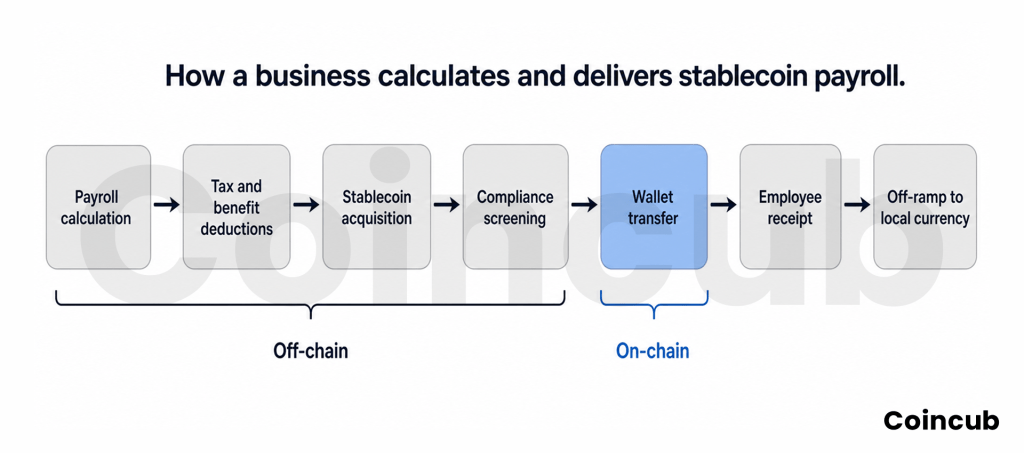
The complication is that stablecoin payroll only replaces one stage of the payroll process. Everything before the transfer, including gross-to-net calculation, withholding, benefit deductions, sanctions screening, and payroll-register reconciliation, still happens exactly as it did before. This article covers how the flow actually works, what it costs once you count conversion and off-ramp charges, where the legal obligations sit, and which businesses should be running a pilot rather than a rollout.
What Is Stablecoin Payroll?
Stablecoin payroll is the practice of delivering compensation using tokens designed to track a fiat currency, most commonly the U.S. dollar. USDC and USDT are the usual instruments. The employer runs payroll as normal, then settles the net amount onchain instead of through a bank transfer.

The distinction that matters most is between denomination and delivery. A $4,000 monthly salary can remain denominated in U.S. dollars while being delivered as roughly 4,000 units of a dollar stablecoin. The contract, the payslip, and the tax filings all speak in dollars. The token is the envelope, not the amount.
Four arrangements get grouped under the same label, and they carry different obligations:
- Employee payroll, where the worker is on the books and full withholding applies
- Contractor payouts, where the worker invoices and handles their own tax
- Optional salary splits, where an employee elects to receive part of net pay onchain
- Post-payroll conversion, where the employee receives fiat and buys stablecoins themselves, which is not payroll at all
Only the first three are your problem as an employer. Confusing them is the most common source of compliance error. A company that tells itself it is “paying contractors in USDC” when the contractors are functionally employees under local law has a misclassification problem that the payment rail did not create and will not solve.
The useful mental model is narrow: stablecoin payroll swaps the pipe between your payroll system and your worker’s account. It does not reduce a tax bill, override wage-payment law in a jurisdiction requiring legal tender, or make a worker payable who is blocked for sanctions or eligibility reasons. Everything upstream of the pipe, and most of the compliance surface, is unchanged.
How Does a Stablecoin Payroll Payment Work?
The onchain transfer is one stage in a seven-stage process. Compressing the whole thing into “we send USDC” is how companies end up with unreconciled payroll registers and unhappy auditors. The full flow looks as follows:
- Payroll calculation: Gross pay, hours, overtime, and allowances are computed in the local fiat currency of the employment contract.
- Deductions: Income tax withholding, social contributions, benefit deductions, and garnishments are applied. This produces a net fiat figure.
- Stablecoin acquisition: The company buys or draws down the required stablecoin from a treasury balance, exchange account, or payment provider. A spread applies here.
- Compliance screening: Recipient addresses are screened against sanctions lists and internal risk policy. Employer-of-record providers typically handle this; if you run payroll in-house, you own it.
- Wallet transfer: The transaction is broadcast on an agreed network. Gas is paid by the sender or abstracted by the provider.
- Employee receipt: The worker sees the balance in a wallet or provider account.
- Off-ramp: The worker converts to local currency, or holds the stablecoin. This is where most of the worker-side cost appears.
The “Big Three” of Stablecoin Payrolls
Three operational details deserve standing procedures. Wallet verification should require a small test transfer before any first payment to a new address, and addresses should be allowlisted with a change-freeze window. Network selection must be documented per employee, because sending USDC on Ethereum to an address the worker only monitors on Solana produces a support ticket at best and a permanent loss at worst. Reconciliation requires that every transaction ID be written back to the payroll register alongside the fiat amount, the exchange rate used, and the timestamp, because your auditor will ask.
Failed payments need a written procedure before the first payroll run, covering who is contacted, what the re-send authority is, and how the employee is made whole while the issue is resolved.
Who Runs Each Stage of a Stablecoin Payment?
The seven stages get divided differently depending on the model you choose, and the division determines where your liability sits.
| Stage | In-house payroll + exchange | Crypto payroll platform | Employer of record |
| Gross-to-net calculation | You | You or the platform | Provider |
| Withholding and filing | You | You | Provider |
| Stablecoin acquisition | You | Platform | Provider |
| Sanctions screening | You | Platform | Provider |
| Wallet transfer and gas | You | Platform | Provider |
| Reconciliation to the register | You | Shared | Shared |
| Liability if it goes wrong | You | Mostly you | Contractually shared |
The middle column is where most companies land, and it is also the column where responsibility is most often misread. A payroll platform that executes transfers is not usually assuming your withholding or filing liability, whatever the marketing implies. Read the contract for the indemnity language rather than the feature list.
Integration With the Systems You Already Run
The reconciliation problem is the one finance teams raise first and vendors discuss last. Your general ledger expects a fiat amount, a date, and a counterparty. An onchain payout produces a token amount, a block timestamp, a transaction hash, and an exchange rate that depends on where and when you sourced the tokens.
Bridging those requires a convention agreed in advance: which rate source, at what moment you strike it, and how you treat the difference between the rate at acquisition and the rate at transfer. That difference is small for a dollar stablecoin and rarely exactly zero, so decide now whether it books to an FX gain or loss account or gets absorbed into payroll expense. Agreeing this before your first run costs an hour; agreeing it during year-end audit costs considerably more.
What Are the Main Benefits for Businesses and Workers?
Settlement Speed and Availability
International bank transfers can take two to five business days and stop entirely at weekends and public holidays. Stablecoin transfers settle in minutes and do not observe banking hours. For a contractor invoicing on the last day of the month before a long weekend, that is a real difference in working capital.
Reduced Correspondent-Banking Friction
A wire routed through two or three intermediary banks can accumulate charges at each hop, and the sender frequently cannot predict the total in advance. Stablecoin transfers have a more visible cost structure, though the conversion spreads on either end still need counting.
Access in Underbanked Corridors
Workers in markets with capital controls, unreliable banking, or limited access to USD accounts often find a dollar-referenced balance materially more useful than a delayed local-currency deposit. This is the single strongest argument for stablecoin payroll, and it is worker-led rather than employer-led.
Programmability and Auditability
Payments can be batched, scheduled, or released against conditions, and every transfer carries an immutable transaction record. That record simplifies proving that a payment was made, though it does nothing to prove the payment was calculated correctly.
A Caution on Cost Claims
Payroll and stablecoin providers publish case studies citing large percentage savings against multi-bank wire routing. Those cases are real, and they are also selected. They describe expensive corridors, not average ones. Do not carry a vendor’s headline percentage into your own business case without recalculating it for the specific corridors you actually pay into.
What Does Stablecoin Payroll Cost?
The honest answer is that the onchain fee is the smallest line in the table. Eight cost categories apply:
| Cost category | Who pays | Typically overlooked? |
| Payroll or employer-of-record fees | Employer | No |
| Stablecoin purchase spread | Employer | Yes |
| FX margin on non-USD payroll | Employer | Yes |
| Blockchain gas fees | Employer or provider | No |
| Custody and wallet infrastructure | Employer | Sometimes |
| Employee off-ramp and withdrawal | Employee | Almost always |
| Tax, legal, accounting, reconciliation | Employer | Yes |
| Errors, rejected transfers, support | Both | Yes |
A worked example makes the point. The assumptions below are illustrative and must be replaced with quotes for your own corridor.
Scenario: paying a $3,000 monthly invoice to a contractor in a market where inbound USD wires are slow and intermediary-bank charges are common.
| Line item | Bank wire | Stablecoin payout |
| Sending fee | $35 | $0 (provider-absorbed) |
| Intermediary bank deductions | $15 to $40 | $0 |
| Purchase spread (0.15%) | n/a | $4.50 |
| Network fee | n/a | $0.50 |
| Recipient bank / off-ramp (assume 1.5%) | $10 | $45 |
| Settlement time | 2 to 5 business days | Minutes |
| Illustrative total cost | $60 to $85 | $50 |
The gap narrows considerably once the worker’s off-ramp is included, and in some markets the off-ramp spread reaches 3% to 5%, which reverses the comparison entirely. Run this table for each corridor with real quotes before deciding anything. The same exercise for a domestic ACH deposit, which costs well under a dollar, will usually show no case for stablecoins at all.
The Internal of a Stablecoin Payroll Cost Nobody Quotes
The table above prices transactions rather than the people who now have to think about transactions.
Adding a stablecoin rail creates recurring internal work: a monthly reconciliation that a bank statement used to handle automatically, a quarterly legal check across jurisdictions, an address-management process, an incident procedure, employee support for wallet questions, and new controls for your auditor to test. For a two-person finance team this can consume several days a month in the first two quarters.
That cost is front-loaded and mostly invisible in vendor comparisons, and it declines sharply once the process stabilises. The practical consequence is that stablecoin payroll rarely pays for itself at small volume. Paying six contractors $2,000 a month, the corridor savings will not cover the overhead. Paying two hundred, they might comfortably.
Reading Vendor Pricing Honestly
Three patterns recur in provider pricing pages. “Zero fees” frequently refers to the platform’s own transaction fee while the conversion spread sits elsewhere, so ask for the all-in rate on a specific $1,000 conversion rather than the fee schedule. Gas absorption is often conditional on network and volume, and a provider absorbing gas on a low-cost chain may pass it through on Ethereum mainnet during congestion. Employee-side costs are usually excluded entirely, because the provider does not charge them, which does not mean the employee avoids them. If you are presenting a savings figure to a board, include the worker’s withdrawal cost or expect the number to be challenged later.
Is Stablecoin Payroll Legal and Taxable?
Wage-payment law is jurisdictional, and in the United States it varies by state as well as federally. Several states require wages to be payable in cash or its equivalent, and some restrict payment in scrip or non-cash instruments. Before paying a single employee onchain, this question needs a jurisdiction-specific answer from local counsel, for every jurisdiction where you have workers.
Using the United States as an illustration rather than a universal rule: the IRS treats digital assets as property, and its guidance on digital asset transactions states that the fair market value of digital assets paid as wages, measured in U.S. dollars on the date of receipt, is subject to federal income tax withholding, FICA, and FUTA, and must be reported on Form W-2. The medium of payment is immaterial to whether remuneration constitutes wages. Contractors paid in digital assets receive Form 1099 reporting on the same fair-market-value basis.
There is a second tax event that catches companies out. If an employer pays wages using appreciated digital assets held on its balance sheet, disposing of that property to satisfy a wage obligation can trigger a recognised gain or loss for the employer. Buying stablecoins at par immediately before payroll largely avoids this, but a company paying out of a long-held treasury position should model it.
Employees and Contractors Are Different Problems
For an employee, the employer carries withholding, employment-tax, reporting, benefits, minimum-wage, and often wage-payment-method obligations. Every one of those survives the switch to a stablecoin rail, and several of them constrain it directly. Minimum-wage compliance, for example, is measured against the fiat value delivered, so a worker who bears a 4% off-ramp cost to access their pay raises a question your legal team should answer before payroll runs, not after.
For a contractor, the obligations are lighter and different. The contractor generally handles their own tax, and the employer’s duties centre on reporting, sanctions screening, and correct classification. This asymmetry is why almost every sensible pilot starts with contractors. It is also why the classification question needs to be settled first: paying a misclassified worker onchain does not reduce the exposure, and the public transaction record makes the pattern easier to reconstruct later.
Stablecoin Payroll Outside the United States
Treat the U.S. position above as one worked example rather than a template. Several patterns recur internationally and each needs local confirmation.
Many jurisdictions require that wages be payable in legal tender, which can rule out onchain delivery for employees regardless of consent. Some permit non-cash payment only with documented, revocable employee agreement. In the European Union, MiCA governs the issuance and offering of asset-referenced and e-money tokens, and like the GENIUS Act it addresses the instrument rather than the employment relationship. Data-protection regimes add a further layer, because linking an identified worker to a permanent public address is a processing activity that may need a lawful basis and a retention position.
The practical rule is that jurisdiction count drives cost. Paying contractors in three countries is a manageable legal exercise. Paying employees in fifteen is a project, and the legal spend can exceed several years of corridor savings.
The GENIUS Act was signed on 18 July 2025 and establishes a federal framework for permitted payment stablecoin issuers, including 1:1 reserve backing and disclosure requirements. It takes effect on the earlier of 18 January 2027 or 120 days after the primary federal regulators issue final implementing rules, with a longer transition for digital-asset service providers. It regulates who may issue a payment stablecoin. Yet, it says nothing about whether you may pay your staff in one, and using a GENIUS-compliant issuer does not make your payroll compliant. Issuer regulation and employment compliance are separate questions.
What Risks Should a Business Control?
| Risk | What it looks like | Control |
| Depeg or issuer failure | Token trades below $1; redemption suspended | Approved-issuer list; same-day conversion; monitor attestations |
| Address freezing | Issuer blocklists an address; funds frozen | Screen addresses pre-payment; keep a fiat fallback rail |
| Wrong chain or address | Funds sent to an unmonitored network | Mandatory test transfer; allowlisted addresses; change-freeze window |
| Wallet compromise | Employee or treasury keys stolen | Multi-sig treasury; employee wallet-security guidance |
| Off-ramp interruption | Local exchange loses banking; worker cannot convert | Verify at least two off-ramps per corridor before launch |
| Privacy exposure | Payroll identities linked to public addresses | Rotate addresses; avoid reusing treasury addresses; disclose to staff |
| Regulatory change | New rules mid-year | Quarterly legal review; contractual right to revert to bank payment |
| Employee dissatisfaction | Worker bears unexpected conversion cost | Disclose full off-ramp cost before opt-in; make participation voluntary |
The Three Risks Worth Dwelling On
Depeg is a timing risk, not a solvency risk, for most payroll users. A fully reserved dollar stablecoin that briefly trades at $0.97 during a market stress event will usually recover, but a worker who needed to convert that morning has taken a real 3% loss on their salary. The exposure window for a payroll operation is the gap between transfer and the worker’s conversion, which means the mitigation is operational rather than financial: keep the window short, avoid asking workers to hold balances they need, and make sure at least one off-ramp in each corridor keeps functioning when volumes spike.
Address freezing is the risk that has no crypto-native workaround. Compliant issuers can and do freeze addresses in response to legal process or sanctions listings. If a worker’s address is frozen, the funds are stuck, and your obligation to pay that worker is generally unaffected by the fact that you already sent them something. Keeping a fiat fallback rail open, and testing that it works, is the only real answer.
Irreversibility changes the shape of operational error. In a bank system, a wrong payment is an annoying reversal request. Onchain, the same mistake can be permanent. This is why the controls that feel excessive at first, the test transfers and allowlisted and dual approvals, are the ones experienced operators refuse to drop. They convert an unrecoverable error into a recoverable delay.
The privacy risk is the most underappreciated of the remainder. A public address receiving a consistent monthly amount from a known corporate treasury address effectively publishes that employee’s salary to anyone willing to look, and links it to every other transaction that address ever makes. Tell your staff this before they opt in, and prefer providers that support per-payment or rotating addresses.
Community Reports and Stablecoin Payroll Complaints
Payroll and crypto operations forums repeatedly surface the same complaints: reconciliation overhead, disputes about which fair-market-value rate applies, workers surprised by withdrawal costs, and integration gaps with established payroll software. These are consistent enough to be worth planning around, and they remain anecdotal rather than measured. Treat them as a list of things to test in a pilot rather than as established facts.
Which Platforms Actually Run Stablecoin Payroll?
The vendor landscape splits along the same line as the responsibility table above: some providers take on the employment relationship, some sit alongside your existing payroll as a payout layer, and some are accounts-payable tools that were never designed for employment at all. Sorting a provider into the right category tells you more than any feature comparison.
| Platform | Primary model | Built for | Employer funds in | Worker receives |
| Rise | EOR, Agent of Record, contractor pay | Crypto-native teams paying global contractors | USD or USDC | Local fiat, USDC, USDT, or a split |
| Toku | Payroll and token-grant administration | Employers issuing tokens alongside salary | Fiat or stablecoin | Stablecoin or local fiat |
| Deel | Large-scale contractor and EOR platform | Companies wanting mainstream payroll with an opt-in crypto leg | Fiat | Fiat, with stablecoin election available in supported markets |
Rise: Crypto Payroll & Web3 Workforce Solutions
Rise is the clearest example of a platform built around the payroll process rather than the transfer. Its documentation describes employers funding payroll from either a USD bank account or a USDC balance, with workers choosing how they withdraw each cycle. It offers both an Employer of Record model, where Rise becomes the legal employer in the worker’s country, and an Agent of Record model, where it sits as the legal intermediary for contractors and takes on KYC, contracts, classification, and tax documentation such as W-8BENs and 1099s.
Rise Works Inc. is registered with FinCEN as a Money Services Business, with registration numbers published on its licensing page. For a company whose main obstacle is that its contractors sit in countries where inbound wires are slow or unreliable, this is the shape of product that addresses the actual problem.
Toku: Instant Global Stablecoin Payroll
Toku occupies an adjacent niche defined by token compensation. Alongside stablecoin payroll it administers token grants, vesting, and unlock schedules, with compliance templates mapped across a large number of jurisdictions. If part of your compensation is denominated in a token rather than a currency, that is a materially different legal and tax problem from paying a salary in USDC, and it is worth choosing a provider that treats it as a first-class product rather than an afterthought.
Deel: Global Payroll and HR Solutions
Deel approaches the category from the opposite direction. It is a mainstream contractor and EOR platform where the employer typically pays through conventional rails and the worker elects to take some or all of net pay in stablecoins, subject to market availability. For a company that already runs global payroll and wants to offer an optional crypto leg to the handful of workers who want it, this is a lower-disruption path than migrating to a crypto-native platform.
How to Evaluate Stablecoin Payroll Company Services
Three cautions apply when evaluating any of them.
First, the model determines your liability, not the branding. A platform executing transfers is not assuming your withholding or filing duties unless the contract says so in indemnity language. Ask specifically which entity is the employer of record in each country you operate in.
Second, verify current terms directly. Supported countries, networks, stablecoins, funding options, and fee structures in this sector change quickly, and comparison articles date badly. Read the provider’s own documentation for your jurisdiction, and date-stamp what you record.
Third, treat published savings figures as case studies rather than benchmarks. Providers cite real customers, and those customers were usually paying into expensive corridors. Rerun the arithmetic for your own corridors, including the worker’s off-ramp, before carrying any percentage into a business case.
When Does Stablecoin Payroll Make Business Sense?
| Fit | Situation | Recommended approach |
| Strong | International contractors in expensive or unreliable corridors; crypto-native teams | Pilot with a defined cohort, fiat-denominated |
| Possible | Employees who actively request a partial split of net pay | Optional split after deductions, subject to local law |
| Poor | Domestic employees on cheap, reliable local rails | No change; the cost case does not exist |
If you are in the strong-fit category, a disciplined pilot looks like this. Start with contractors rather than employees, because the compliance surface is smaller. Keep compensation denominated in fiat. Make participation voluntary and documented, with written consent covering the worker’s understanding of conversion costs and network risk. Restrict the pilot to a short approved list of stablecoins and networks. Require a test transfer to every new address. Document the recovery procedure before you need it. Run the pilot for a full quarter, including a month-end close, so your finance team reconciles it under real conditions before you scale.
Stablecoin payroll earns its place when the existing rail is genuinely bad: slow, expensive, or unavailable to the people you are trying to pay. It earns nothing when it replaces a reliable domestic bank deposit. The test is the corridor, not the technology.
If you want to evaluate it properly, price a single corridor end to end, all the way through to the worker’s local-currency withdrawal, and compare that number against what you pay today. Then check the legal position for that jurisdiction before you move.
Frequently Asked Questions (FAQ)
Can a company pay its entire workforce in stablecoins? +
Possibly, but each jurisdiction must be checked separately. Wage-payment laws, employee consent requirements, minimum-wage rules, withholding, and reporting obligations all vary by country and, in the United States, by state. Many jurisdictions require wages to be payable in legal tender.
Are stablecoin wages tax-free? +
No. The payment rail does not remove income or payroll taxes. In the United States, the fair market value of digital assets paid as wages on the date of receipt is subject to income tax withholding, FICA and FUTA, and must be reported on Form W-2.
Is USDC payroll cheaper than a bank transfer? +
It can be in expensive cross-border corridors, but the comparison must include the employer’s purchase spread and the employee’s off-ramp cost. For domestic payroll on cheap local rails such as ACH or SEPA, stablecoin payroll is usually more expensive.
Should salaries be denominated in USDC? +
Fiat denomination is generally clearer. It keeps minimum-wage tests, overtime calculations, and exchange-rate treatment aligned with the employment contract and local law, while still allowing delivery as stablecoins. Denominating in tokens complicates payroll obligations without a corresponding benefit.
Can employees receive only part of their salary in stablecoins? +
Yes, in many implementations. The split is applied to net pay after all deductions, so withholding and reporting are unaffected. Whether an employer may offer it depends on local wage-payment law and usually requires documented employee consent.
What happens if payroll uses the wrong blockchain? +
Recovery is often difficult or impossible, particularly if the destination address is not controlled on the receiving network. Mandatory test transfers, allowlisted addresses, and per-employee network documentation are the standard preventive controls, since there is no chargeback mechanism.
Does regulated stablecoin issuance make payroll compliant? +
No. The GENIUS Act regulates payment-stablecoin issuers, covering reserves, disclosure and supervision. It does not address employment, wage-payment, withholding or reporting obligations. Using a regulated issuer is a sensible counterparty choice and a separate question from payroll compliance.