Buy a Licensed Company
  Explore VASP Data
  Talk to an Expert

 Atis Shala
Atis is a senior analyst and community lead with four years of experience in crypto. He has a bachelor from the Rochester Institute of Technology.
Atis Shala
Atis is a senior analyst and community lead with four years of experience in crypto. He has a bachelor from the Rochester Institute of Technology.
The Crypto Career Shift: How to Pivot to Web3 Consulting

- Web3 consulting isn’t about being a master coder; it’s about acting as a translator between traditional business realities (finance, law, operations) and decentralized technologies.
- While technical literacy is necessary, the highest-paying consulting areas in 2026 are strategic, including tokenomics design, regulatory compliance, real-world asset tokenization, and treasury management.
- Trying to advise on everything signals a shallow understanding. The fastest way to build credibility is to anchor your Web3 niche in your prior corporate career (e.g., traditional compliance to crypto regulatory advisory).
- Transitioning doesn’t happen overnight, but a focused 90-day roadmap, moving from cementing fundamentals to publishing public proof of your expertise, is enough to land your first client.
- In an industry crowded with self-proclaimed experts, polished resumes matter less than visible artifacts. Public breakdowns, model teardowns, and case studies are what actually convert prospects.
- Because Web3 talent is scarce and clients are often well-capitalized, underpricing yourself out of insecurity actually backfires by signaling inexperience.
- Success in this field demands a realistic approach to income volatility and market cycles. The most successful consultants save during the loud bull markets to quietly sustain their practice during the slow ones.
What Exactly is Web3 Consulting?
There is a particular moment that pushes people toward Web3 consulting. It usually arrives after a few years in a conventional career, often in finance, software, marketing, law, or operations, when they realize they have been quietly learning crypto on nights and weekends and that they now understand it better than most of the executives making decisions about it. The gap between what they know and what the market needs is the opening. Web3 consulting is the business of standing in that gap and getting paid to close it.
This guide is a practical map for making that pivot. It covers what a Web3 consultant actually does, why the demand exists, which skills transfer and which you have to build, how to package yourself credibly, and how to find the first clients who turn a side interest into a profession. The tone is realistic. Consulting in an emerging field is rewarding and uncertain in equal measure, and going in with clear eyes is the difference between a thriving practice and an expensive lesson.
What a Web3 Consultant Actually Does
The title sounds vague until you break it into the concrete problems clients pay to solve.

At its core, the job is translation. Businesses know their own industry and their own goals, but they do not understand blockchain, tokens, or decentralized systems. Web3-native teams understand the technology but often miss the commercial, legal, and operational realities of the businesses they want to serve. A consultant sits between them, turning a vague ambition like “we want to use blockchain” into a specific, sensible plan, or telling a client honestly that they do not need a blockchain at all.
Much of the value is in saying no. A skilled consultant helps a business separate genuine blockchain use cases from hype-driven ones, identifying where decentralization, transparency, or tokenization actually solves a problem and where a normal database would do the job better and cheaper. This judgment is worth a great deal, because it saves clients from expensive mistakes.
Beyond the initial assessment, consultants design token models, advise on compliance and structure, guide technology choices, help with go-to-market and community strategy, and sometimes manage the project through delivery. The career path mirrors traditional consulting, progressing from junior to senior to lead consultant and eventually toward a director role for those who build a practice.
Why the Demand Exists
A pivot only makes sense if there is real, durable demand on the other side. In Web3 consulting, there is, and it comes from a structural mismatch.
In 2026, crypto-native companies, decentralized finance protocols, and traditional finance firms expanding into blockchain are all competing for a limited pool of people who genuinely understand the space. The technology moved faster than the talent market could train people, so anyone who combines real domain knowledge with professional polish is scarce and valuable.
Web3 companies tend to be well capitalized and willing to pay competitive rates for the right expertise. That funding flows into advisory work, because a protocol or a fund would rather pay for good judgment than learn the hard way in a market where mistakes are public and permanent. The combination of scarce talent and funded clients is the economic engine behind the opportunity.
The industry embraced distributed teams from its earliest days, and the majority of Web3 roles are fully remote. For someone pivoting, this removes a major barrier. You can build a consulting practice serving clients anywhere in the world without relocating, which widens the addressable market enormously and lets you start while still employed elsewhere.
Which Skills Transfer and Which You Must Build
The encouraging truth is that a pivot does not mean starting from zero. Most people bring more relevant skill than they realize.
The Skills That Carry Over
Strategic thinking, project management, financial analysis, legal and compliance reasoning, communication, and client management all transfer directly. Web3 consulting demand concentrates heavily in exactly these areas, because the technology is only useful when paired with sound business judgment.
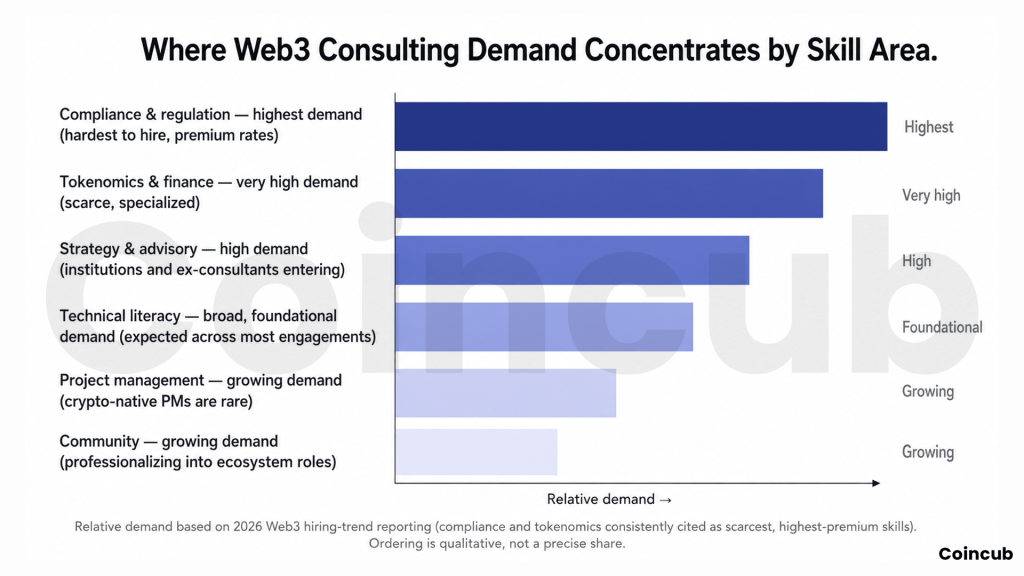
The chart above is a reminder that the highest-demand areas are advisory and strategic, not purely technical. Someone with a strong consulting, finance, or operations background already owns much of what clients need.
The Web3-Specific Knowledge to Add
On top of transferable skills, you need a real working understanding of blockchain fundamentals, including how wallets, transactions, and smart contracts work, the basics of tokenomics, the major networks and their trade-offs, and the cryptographic concepts such as hashing and digital signatures that underpin the whole field. You do not need to be a deep protocol engineer, but you must be fluent enough to hold a credible technical conversation.
A useful rule is that you need enough technical literacy to ask the right questions, evaluate answers, and call out nonsense, even if you cannot write the smart contract yourself. For consultants who want to specialize technically, learning a language such as Solidity and understanding decentralized application architecture opens higher-value, more technical engagements. For strategy-focused consultants, conversational fluency plus a trusted technical network is often enough.
Choosing Your Niche
The most common mistake new consultants make is trying to advise on everything. Specialization is what makes you credible and findable.
Web3 is too broad for anyone to be expert across all of it. A consultant who claims to do tokenomics, compliance, smart contract audits, community growth, and treasury management at once signals shallowness rather than range. Clients hire specialists for specific problems, and a sharp niche is easier to market, easier to price, and easier to deliver on.
Productive niches include token model design, regulatory and compliance advisory, decentralized finance strategy, treasury and stablecoin management, real-world asset tokenization, community and go-to-market strategy, and security and risk assessment. The best niche for you usually sits where your prior career overlaps with a Web3 need. A former compliance officer has a natural path into regulatory advisory, while a former product manager fits go-to-market and token design.
A practical approach is to start narrow, build a reputation and case studies in one area, then expand adjacent once you are established. Trying to expand before you have proof in a single niche tends to dilute the very credibility you are trying to build.
A 90-Day Pivot Roadmap
A pivot feels overwhelming until it is broken into stages. A focused three-month plan moves most people from interested to credible.
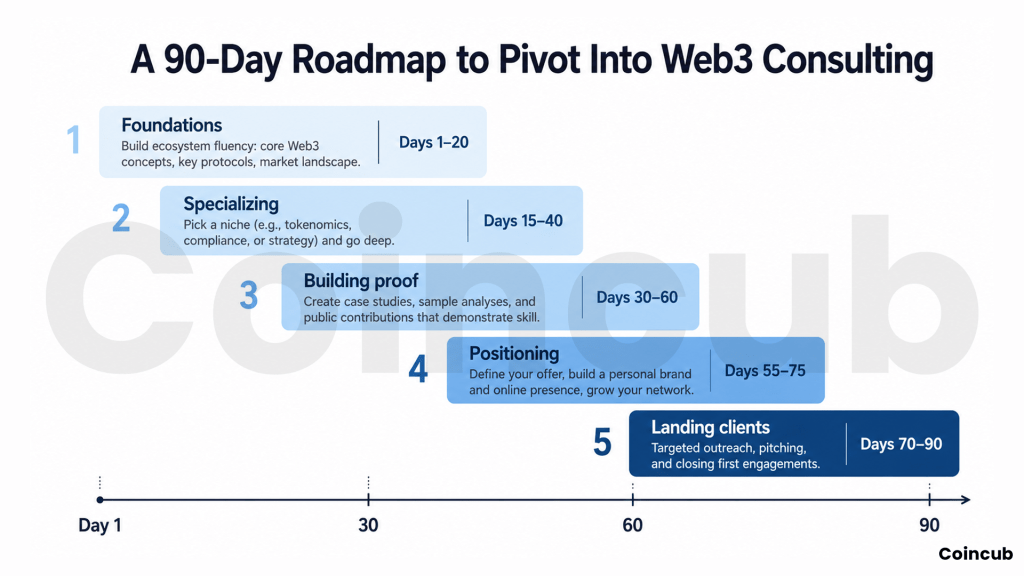
Days One to Twenty: Foundations
Spend the first stretch cementing fundamentals. Set up wallets, use real protocols with small amounts, read the major networks’ documentation, and follow the current debates closely enough to speak about them naturally. The goal is to move from textbook knowledge to lived familiarity.
Days Fifteen to Thirty-Five: Specialize
Pick your niche based on where your background meets demand. Go deep enough that you can speak with authority about the specific problems in that niche, the common mistakes, and the current best practices. Depth in one area beats breadth across many.
Days Thirty-Five to Sixty: Build Proof
Credibility comes from demonstrated work, not claims. Produce visible proof through written analyses, a small advisory project even if unpaid at first, a teardown of a real project’s token model, or contributions to a community. Each artifact becomes evidence you can point a prospective client toward.
Days Fifty-Five to Ninety: Position and Land Clients
Build a simple professional presence that states clearly who you help and how, then begin reaching out and participating where your clients gather. The final stretch is about converting your foundation and proof into conversations, and conversations into first engagements.
Packaging Yourself Credibly
In an emerging field crowded with self-proclaimed experts, how you present yourself decides whether you are taken seriously.
The strongest positioning names a specific client and a specific problem, such as helping early-stage protocols design sustainable token models, rather than a vague claim to do Web3 consulting. Specific positioning attracts the right clients and repels the wrong ones, which is exactly what you want.
Published analysis, case studies, and visible work do more for credibility than any list of skills. Clients in this space are skeptical of talk, because the field is full of it. A single sharp teardown of a real problem demonstrates judgment more convincingly than a polished biography.
Price With Confidence
New consultants routinely underprice themselves out of insecurity. Because clients are well funded and talent is scarce, the market often supports higher rates than newcomers expect. Pricing too low can even signal inexperience. Anchoring your rate to the value you deliver, rather than to your nerves, is part of being taken seriously.
| Prior career | Natural niche | Proof that resonates |
|---|---|---|
| Compliance or law | Regulatory advisory | A clear breakdown of a rule’s impact |
| Finance or accounting | Tokenomics and treasury | A token model or treasury analysis |
| Product management | Go-to-market and token design | A product or launch teardown |
| Software engineering | Technical architecture | A working prototype or audit notes |
| Marketing or community | Growth and community strategy | A documented campaign or playbook |
Finding the First Clients
The hardest part of any consulting pivot is the first few clients. After that, referrals compound.
Web3 business happens in public, in community channels, at events, and around open projects. Consistent, helpful participation in the spaces where founders and teams gather builds the familiarity that precedes any hire. Visibility plus demonstrated competence is how most early engagements begin.
Your existing network is more valuable than it looks. Former colleagues, employers, and contacts who know your work and are now curious about crypto are natural first clients or referral sources. Trust transfers even when the subject matter changes.
Dedicated Web3 job and freelance platforms list advisory and consulting roles, and they are a legitimate way to find paid work while you build a reputation. Combining inbound visibility with proactive outreach on these channels gives the early pipeline its momentum.
Early engagements matter less for the fee than for the proof and the referral. A small project delivered well becomes a case study and a recommendation, and in a tight-knit industry, recommendations travel fast. The first client is the hardest, and the third makes the practice feel real.
Common Mistakes That Stall a Pivot
The path is well worn enough that the recurring missteps are predictable, which means they are also avoidable.
The most common mistake is treating preparation as endless. There is always one more protocol to study, one more report to read. People who wait to feel fully expert never start, because the field changes faster than anyone can fully master it. Competence in this space is demonstrated by engaging with real problems, not by accumulating private knowledge indefinitely.
New consultants often resist narrowing their focus, fearing they will turn away work. In practice, a vague generalist is harder to hire than a sharp specialist, because clients cannot tell what specific problem the generalist solves. Casting a wide net usually catches less than a precise one.
Quietly building skills while staying invisible produces no clients. In an industry that conducts its business in public, a consultant who never publishes, never participates, and never shares a view remains unknown no matter how capable. Visibility is not vanity here. It is the distribution channel for the entire practice.
Charging too little to win early work can backfire, signaling inexperience and attracting price-sensitive clients who are the hardest to satisfy. Anchoring rates to the value delivered, and raising them as proof accumulates, builds a healthier practice than racing to the bottom.
Building the Tools of Credibility
A consultant in an emerging field is, in part, a publisher. The assets you build become the reasons clients trust you.
A Body of Public Work
A steady stream of written analysis, breakdowns of real situations, and clear explanations of hard topics does double duty. It sharpens your own thinking and it demonstrates that thinking to anyone evaluating you. Over time, a body of public work becomes a portfolio that speaks before you do.
A Simple, Sharp Online Presence
You do not need an elaborate brand. You need a clear statement of who you help and how, a few pieces of proof, and a way to be contacted. Clarity beats polish. A prospective client should understand your value within seconds of finding you.
A Trusted Network of Specialists
No consultant covers everything, so the smart ones build a network of people they trust for the parts outside their niche. A strategy consultant who can pull in a vetted smart contract auditor, or a compliance specialist who knows a strong wallet auditor, delivers more than any solo operator. The network multiplies what you can credibly take on.
Scaling Beyond Yourself as a Web3 Consultant
For those who want more than a solo practice, the pivot can become the seed of something larger.
As demand grows, a solo consultant can begin to specialize further, raise rates, and eventually bring in collaborators or build a small firm. The progression mirrors traditional consulting, where individual reputation gradually becomes institutional reputation. This path is not for everyone, but it is open to those who build a strong enough foundation.
Some consultants turn repeated work into reusable products, such as frameworks, assessments, templates, or educational material. Productizing reduces the trap of trading hours for money forever and creates value that scales beyond your direct time. It also reinforces your authority, because a useful framework circulates and carries your name with it.
Whatever the scale, the consultants who last keep one foot at the frontier of the field, learning continuously and engaging with the newest developments. The day you stop being a student of the space is the day your advice begins to age. In a field this dynamic, perpetual learning is the price of perpetual relevance.
Managing the Risks of the Pivot
An honest guide names the downsides, because the pivot is not free of risk.
Consulting income is lumpy, especially at the start, and crypto markets add their own cycles on top. Building a financial cushion before going full time, or pivoting gradually while employed, protects you from being forced into bad decisions during a quiet stretch.
Advice in this field is visible and consequential. Recommending a flawed structure or a doomed project attaches to your name. Maintaining intellectual honesty, including telling clients when blockchain is the wrong answer, protects the reputation that is your most valuable asset.
The field moves quickly, and yesterday’s best practice can become today’s cautionary tale. Continuous learning is part of the job rather than a phase that ends. Consultants who stop updating their knowledge quietly become liabilities to their clients.
The Economics of a Consulting Practice
Understanding how the money works keeps the pivot grounded in reality rather than in optimism.
Pricing Models
Consultants typically price in one of a few ways. Hourly or daily rates suit advisory conversations and short engagements. Project fees suit defined deliverables such as a token model or a compliance assessment. Retainers suit ongoing relationships where a client wants continuous access to your judgment. Many established consultants blend these, using retainers for stability and project fees for upside.
A consultant rarely bills every working hour, because time goes into business development, learning, and admin. Planning around realistic utilization, rather than assuming a full week of billable work, prevents the disappointment that sinks many new practices. The hours spent finding and nurturing clients are an investment, not lost time.
Early on, income is lumpy and unpredictable. Over time, a mix of repeat clients, retainers, and referrals smooths the curve. The goal is to move from chasing each engagement to maintaining a pipeline where new work arrives before old work ends. That stability is earned through consistent delivery and visible expertise, and it is what turns a risky leap into a durable career.
Equity and Token Compensation
A feature unique to this field is that clients sometimes offer payment partly in tokens or equity rather than only cash. This can be lucrative or worthless depending on the project, so treating such compensation as a speculative bonus rather than reliable income keeps expectations sensible. Accepting some exposure can align you with a client’s success, but it should never replace the cash that pays your bills.
Managing Cash Flow Across Cycles
Crypto moves in cycles, and consulting demand moves with it. In strong markets, clients are plentiful and budgets are generous. In quiet markets, projects pause and budgets tighten. Consultants who save during the busy stretches and keep their fixed costs low ride out the slow ones without panic. Building a few months of expenses into reserve is not caution for its own sake, it is what lets you keep choosing good clients instead of taking any client out of desperation. The professionals who survive multiple cycles are usually the ones who planned for the quiet periods while the loud ones were still in full swing.
Frequently Asked Questions (FAQ)
Do I need to know how to code to become a Web3 consultant? +
Not necessarily. Many high-value consulting niches, such as strategy, tokenomics, compliance, and go-to-market, reward business judgment more than coding. You do need genuine technical literacy, enough to understand how wallets, smart contracts, and the major networks work, so you can ask the right questions and spot nonsense. Consultants who learn to code can access more technical, higher-value engagements, but it is not a universal requirement.
What background transfers best into Web3 consulting? +
Backgrounds in finance, law and compliance, product management, software engineering, and marketing or community all transfer well, because each maps onto a clear Web3 need. The strongest pivots happen where your prior expertise overlaps with a specific blockchain problem, such as a compliance officer moving into regulatory advisory or a product manager into token design.
How long does it take to pivot into Web3 consulting? +
With focused effort, many people reach a credible starting point in around ninety days, moving through fundamentals, specialization, building proof, and landing first clients. Becoming established and building a steady pipeline takes longer, often six months to a year, and depends heavily on how visibly you demonstrate your expertise and how well you use your existing network.
Is there really demand for Web3 consultants in 2026? +
Yes. Crypto-native companies, decentralized finance protocols, and traditional finance firms expanding into blockchain are competing for a limited pool of qualified people. These clients tend to be well funded and willing to pay competitive rates, and most work is remote, which widens the opportunity to serve clients anywhere in the world.
How should I choose my consulting niche? +
Pick the intersection of your existing strengths and genuine market demand, then go deep rather than broad. Productive niches include token model design, regulatory advisory, decentralized finance strategy, treasury management, real-world asset tokenization, and community strategy. Starting narrow makes you easier to market and more credible, and you can expand into adjacent areas once you have proof in one.
How do I find my first clients? +
Combine visibility with outreach. Participate consistently and helpfully in the communities and events where founders gather, draw on your existing network of former colleagues and contacts who are curious about crypto, and use dedicated Web3 job and freelance platforms that list advisory roles. Early engagements matter most for the proof and referrals they generate.
What are the biggest risks of this career shift? +
The main risks are income volatility, since consulting is lumpy and crypto adds its own cycles, reputational exposure in a public industry where bad advice attaches to your name, and the constant need to keep up with a fast-moving field. Building a financial cushion, pivoting gradually while employed, and maintaining strict intellectual honesty all help manage these risks.