


 Buy a Licensed Company
  Explore VASP Data
  Talk to an Expert

 Atis Shala
Atis is a senior analyst and community lead with four years of experience in crypto. He has a bachelor from the Rochester Institute of Technology.
Atis Shala
Atis is a senior analyst and community lead with four years of experience in crypto. He has a bachelor from the Rochester Institute of Technology.
Regulating Onchain Property under MiCA and the SEC

- Putting real estate on a blockchain does not change its legal nature. Regulators look past the technical “wrapper” to the economic substance; the chain is plumbing, not a legal shield.
- On both sides of the Atlantic, any property token that promises a share of profits (rent or appreciation) from someone else’s management is treated as a regulated financial instrument, not a standard crypto asset.
- In the United States, the SEC heavily subjects property tokens to the Howey Test. Because they involve investing money in a common enterprise with an expectation of profit, they almost always require formal registration or a strict compliance exemption.
- Europe’s flagship MiCA framework explicitly excludes financial instruments. Therefore, investment-based property tokens bypass MiCA and fall under the stricter, traditional MiFID securities regime.
- While tokenization is marketed as a path to instant liquidity, the legal reality of securities law means strict resale restrictions and investor eligibility rules usually apply, limiting immediate secondary market trading.
- Successful projects are legally engineered before a single line of smart contract code is written. Choosing a compliant legal architecture, such as a Special Purpose Vehicle (SPV), and budgeting for compliance are non-negotiable for builders.
- Tokenizing property does not bypass local tax laws. Cross-border token offerings often face layers of overlapping property, corporate, and capital gains taxes that can erase technical efficiencies if not addressed early.
The Tokenization Era
Tokenizing a building sounds like a purely technical act. You take a property, divide its value into digital tokens, and let people buy fractions of it on a blockchain. The technology is the easy part. The hard part is that the moment you do this, you walk into one of the oldest and most heavily defended areas of law, the rules that govern property and securities. Those rules did not disappear because the asset is now on a chain. They apply with full force, and in 2026 two of the most influential regulatory regimes in the world, the European Union’s MiCA framework and the United States Securities and Exchange Commission, have made clear exactly how.
This article explains how onchain property is actually regulated on both sides of the Atlantic, why a tokenized building is treated so differently from a tokenized currency, what the Howey Test has to do with your real estate token, and what builders and investors need to understand before they participate. The stakes are high, because the market is growing fast, and the gap between the hype and the legal reality is where most people get hurt.
Why Onchain Property Is a Regulatory Special Case
Not all tokens are the same in the eyes of the law, and property tokens sit in the most demanding category.

Tokens as Wrappers
The first principle to internalize is that putting an asset on a blockchain does not change what the asset legally is. A token representing a share of a building is, in substance, a claim on real estate and usually on the income it produces. Regulators look through the technical wrapper to the economic reality underneath. The chain serves as plumbing rather than a legal shield.
Property Plus Profit Equals Scrutiny
Property tokens almost always combine two things regulators care deeply about. They represent ownership of a valuable real-world asset, and they typically promise the holder a share of profits such as rent or appreciation. That combination, ownership plus an expectation of profit from someone else’s management, is precisely the pattern that securities law was built to govern. This is why a tokenized property attracts far more scrutiny than a tokenized payment coin.
The urgency comes from scale. Tokenized real estate is among the fastest-growing categories of real-world asset tokenization, with projections placing the market in the trillions.
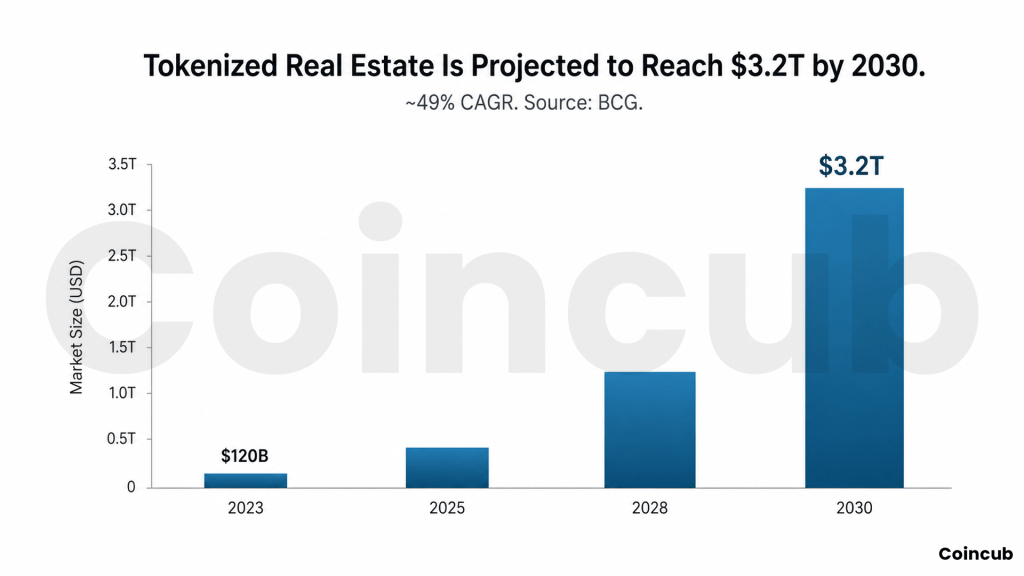
As the chart shows, the projected trajectory is steep, with estimates pointing toward roughly 3.2 trillion dollars by 2030. When a market grows that quickly, regulators move to define the rules before problems multiply, which is exactly what has happened.
How the SEC Treats Tokenized Property
In the United States, the central question for any property token is whether it is a security, and the SEC’s answer has been consistent.
The SEC’s position is that tokenized real estate offerings are still securities under existing law. Wrapping a property interest in a token does not exempt it from the rules that govern investment products. For builders, the safe assumption is that a property token is a security unless a careful legal analysis clearly shows otherwise.
The Howey Test
The tool the SEC uses is the Howey Test, a decades-old standard for identifying an investment contract. Under it, an arrangement is a security if there is an investment of money in a common enterprise with an expectation of profit derived from the efforts of others.
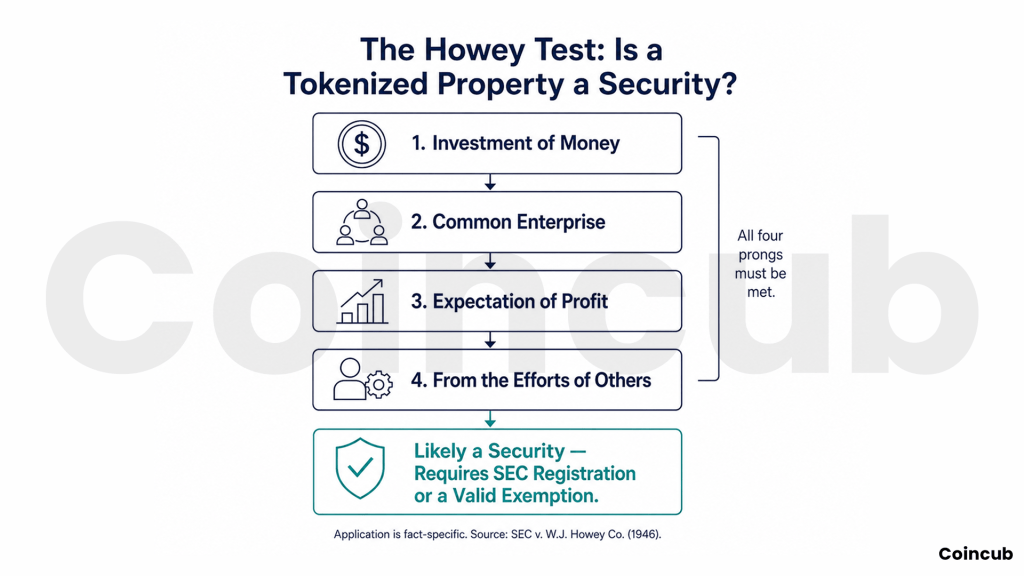
The flow above walks through the logic. A typical property token, where investors pay money into a project run by a sponsor and expect to earn rent or appreciation from that sponsor’s management, satisfies every prong. When all the boxes are checked, the token is a security, and the consequences follow automatically.
What Being a Security Requires
If a token is a security, the offering must either register with the SEC or qualify for an exemption. Registration is demanding and expensive, so most projects pursue exemptions that limit who can invest or how the token can be marketed. Either way, the obligations around disclosure, investor eligibility, and resale restrictions are real, and ignoring them invites enforcement.
There is nuance at the edges. In a joint interpretation, the SEC and the CFTC named a set of crypto assets as digital commodities rather than securities, providing a classification framework that distinguishes commodities from securities. Property tokens, with their clear profit-from-others pattern, generally fall on the securities side of that line rather than the commodity side, but the existence of the framework matters for the broader market.
How MiCA Treats Tokenized Property
The European approach reaches a similar destination by a different route, and the distinction it draws is crucial.
A common misunderstanding is that MiCA governs everything crypto in Europe. It does not. MiCA explicitly excludes financial instruments. Tokenized securities, including most tokenized property that represents an investment, remain regulated under the traditional financial framework known as MiFID rather than under MiCA itself. So a property token in Europe is usually handled as a regulated security, much as in the United States.
Where Does MiCA Apply?
MiCA governs crypto-assets that are not financial instruments, such as payment tokens and certain utility tokens. A property token engineered purely as a utility, with no profit expectation, might fall under MiCA, but most real estate tokens are designed to deliver returns, which pushes them into the securities regime instead. The design of the token determines which rulebook applies.
What MiCA has done for the broader tokenization market is build out the surrounding infrastructure. European authorities have issued a substantial body of technical standards clarifying whitepaper requirements, reserve audits, and related obligations, creating a more predictable environment for regulated tokenization of real-world assets generally. Even where property tokens sit under MiFID, they benefit from a maturing ecosystem that MiCA helped establish.
A Side-by-Side Comparison Between the US and EU
Seeing the two regimes together clarifies how a builder should think about jurisdiction.
| Aspect | United States (SEC) | European Union |
|---|---|---|
| Default classification | Security under existing law | Usually a financial instrument |
| Governing test or rule | Howey Test | MiFID financial instrument rules |
| Does MiCA apply? | Not applicable | Excludes financial instruments |
| Path to compliance | Register or use an exemption | Comply with securities and prospectus rules |
| Treatment of pure utility token | May be a commodity | May fall under MiCA |
The headline is that both regimes treat a profit-bearing property token as a regulated security. The labels and the specific rules differ, but the practical burden, real disclosure and investor protection obligations, is similar on both sides of the Atlantic.
What This Means for Builders
For anyone planning to tokenize property, the regulatory reality should shape the project from day one rather than being bolted on at the end.
The structure of the token determines its legal treatment, so legal design has to come first. Deciding what rights the token carries, what returns it promises, who can buy it, and how it can be traded all flow from the regulatory analysis. Building the technology first and asking the legal question later is how projects end up unsellable or exposed to enforcement.
Compliant tokenization carries real costs, including legal structuring, the chosen exemption or registration, qualified custody, and ongoing reporting. These are not optional extras. They are the price of operating legally, and a project that cannot bear them is not ready to launch. Treating compliance as a core line item rather than an afterthought is a mark of seriousness.
Because the rules differ across countries, jurisdiction is a strategic choice rather than a default. Where the issuer is based, where investors are located, and which exemptions are available all shape what is possible. Many serious projects take careful legal advice on structure and domicile before writing a line of contract code.
Moreover, securities rules constrain how an offering can be promoted, especially when an exemption limits the investor pool. Overpromising returns or marketing a restricted offering to the general public is a fast route to trouble. Disciplined, accurate communication is both a legal requirement and a trust builder.
What This Means for Investors
The same realities cut the other way for people buying property tokens.
Before investing, an informed buyer asks how the token is structured, whether the offering is registered or exempt, who is eligible to participate, and what rights the token actually confers. A project that cannot answer these clearly is a warning sign, because legitimate offerings are built around exactly these answers.
Tokenization is often sold as a path to instant liquidity for traditionally illiquid real estate. The legal reality is more sober. Securities rules frequently restrict who can buy and when tokens can be resold, so the promised liquidity may be limited in practice. Investors should treat liquidity claims with the same skepticism they would apply to any investment pitch.
When a property token is a regulated security, investors gain the protections that come with that status, including disclosure and eligibility rules. When a project tries to dodge those rules, investors lose those protections precisely when they are most needed. Paradoxically, the offerings that look easiest to access are often the ones offering the least protection.
Also, investors should match the investment to their profile. Property tokens carry the risks of the underlying real estate, the risks of the token structure, and the risks of an emerging market all at once. Sizing such an investment sensibly, and not mistaking a novel wrapper for a novel asset class with different fundamentals, keeps expectations grounded.
Common Structures Used to Tokenize Property
Because a raw property token usually counts as a security, projects rely on established legal structures to hold the asset and issue the tokens compliantly. Knowing the common shapes helps both builders and investors read a deal.
The Special Purpose Vehicle
The most common approach places a single property inside a dedicated legal entity, often called a special purpose vehicle, and issues tokens that represent shares in that entity. Investors do not technically own a piece of the building directly. They own a stake in the company that owns the building, and the token records that stake. This structure fits neatly within existing securities and company law, which is precisely why it is popular.
Fund and Pooled Structures
Some projects tokenize interests in a fund that holds multiple properties rather than a single asset. This spreads risk across a portfolio and can make the offering more attractive, though it also adds layers of management and fees. The token in this case represents a share of the fund, and the fund itself is subject to the rules that govern collective investment vehicles.
Debt Versus Equity Tokens
Property tokens can represent equity, a share of ownership and profit, or debt, a loan secured against the property that pays interest. The legal and risk profiles differ sharply. Equity holders share in upside and downside, while debt holders have a more fixed return and a different position if things go wrong. Reading which type a token represents is essential before investing.
Why Structure Drives Everything
Each structure carries its own regulatory obligations, tax treatment, and investor rights. A project’s choice of structure is the foundation on which everything else rests, which is why serious teams settle the legal architecture before building the technology. A clever contract cannot rescue a flawed legal structure.
Tax and Cross-Border Complications
Property is one of the most heavily taxed asset classes in the world, and tokenizing it does not lift those obligations. If anything, it adds new questions.
Layered Tax Exposure
A tokenized property can attract tax at several levels. The underlying property may owe local property and income taxes. The entity that holds it may owe corporate tax. The investor may owe tax on income distributions and on any gain when they sell the token. Tokenization can stack these layers in ways that are easy to overlook in the excitement of a novel format.
Cross-Border Friction
Tokens trade globally, but property sits in one jurisdiction and investors sit in many. A building in one country, owned through an entity in a second, with tokens held by investors in a third, creates a tangle of overlapping tax and legal claims. This cross-border friction is one of the practical reasons the promised frictionless market has been slower to arrive than the technology alone would suggest.
The Need for Professional Advice
For both builders and investors, the tax dimension is a strong argument for qualified professional advice rather than assumption. The rules vary by country and by structure, and the cost of getting them wrong can erase the efficiency that tokenization was supposed to deliver. Treating tax as a first-order design question, not an afterthought, is a mark of a serious project.
Lessons From the Early Projects
The first wave of tokenized property has already produced instructive successes and failures.
- Compliance First, Technology Second: The projects that endured tended to treat the legal structure as the foundation and the blockchain as a feature built on top. Those that led with the technology and treated compliance as a problem to solve later often found themselves unable to sell their tokens or exposed to enforcement. The pattern is consistent enough to be a rule.
- Liquidity Took Longer Than Promised: Early marketing leaned heavily on the promise of instant liquidity for illiquid real estate. The reality, shaped by securities rules on who can buy and when, has been more modest. Projects that set honest expectations about liquidity fared better with investors than those that overpromised and disappointed.
- Trust Was Built Through Transparency: The tokenized property efforts that gained traction were generally the ones most transparent about structure, rights, risks, and the people behind them. In an area where investors are committing real money to a novel format, openness has proven to be a competitive advantage rather than a burden.
What is the Future of Onchain Property Regulation?
The direction of travel is becoming clearer even as the details continue to evolve.
Convergence on Substance Over Form
Both major regimes have settled on the same core principle. The legal treatment follows the economic substance of an asset, not the technology used to represent it. A profit-bearing property interest is a security whether it lives on a deed or on a blockchain. Expect that principle to harden rather than soften as more jurisdictions weigh in.
Infrastructure Catching Up
Regulators are steadily building the technical standards, capital treatment rules, and classification frameworks that let regulated tokenization scale. The clarification that a tokenized security receives the same treatment as its non-tokenized form is an example of rules adapting to make compliant tokenization workable rather than blocking it.
A Bigger, More Regulated Market
The likely future is a tokenized property market that is much larger and much more regulated at the same time. The growth projections are real, and so is the regulatory attention. The projects that endure will be the ones that embraced the rules early, because in property, the law has always had the final word, and tokenization has not changed that.
A Practical Checklist Before You Participate
For anyone weighing a tokenized property opportunity, a short set of questions filters out most of the avoidable trouble.
For Investors
Confirm how the token is legally structured, whether the offering is registered or exempt, and who is eligible to buy. Ask what rights the token actually confers, whether equity or debt, and what returns are promised versus merely hoped for. Clarify the real resale restrictions so you understand the true liquidity, and check the tax exposure across every relevant jurisdiction. A project that answers these crisply is far more credible than one that deflects.
For Builders
Settle the legal structure and jurisdiction before writing smart contract code, and budget honestly for legal work, custody, and ongoing reporting. Decide early whether you are issuing equity or debt, and design the token’s rights to match. Market only within the limits your exemption allows, and make transparency about structure and risk a feature rather than an afterthought. The discipline shown before launch is the strongest predictor of whether a project survives contact with regulators.
| Stakeholder | The one question that matters most |
|---|---|
| Investor | Is this a registered or properly exempt security, and what can I actually do with the token? |
| Builder | Does my structure satisfy securities law in every jurisdiction I touch before I launch? |
Keeping that single question central tends to surface the answers to all the others.
Frequently Asked Questions (FAQ)
Is a tokenized real estate investment a security? +
In the United States, the SEC's position is that tokenized real estate offerings are still securities under existing law. Most property tokens satisfy the Howey Test, because investors put money into a common project and expect profit from the sponsor's efforts. In the European Union, such tokens are usually treated as financial instruments under MiFID. On both sides, a profit-bearing property token is generally a regulated security.
What is the Howey Test and why does it matter here? +
The Howey Test is the standard the SEC uses to identify a security. An arrangement qualifies if there is an investment of money in a common enterprise with an expectation of profit from the efforts of others. A typical property token, where buyers fund a project run by a sponsor and expect rent or appreciation, meets every prong, which is why such tokens are usually classified as securities requiring registration or an exemption.
Does MiCA regulate tokenized property in Europe? +
Usually not directly. MiCA explicitly excludes financial instruments, and most tokenized property that represents an investment is treated as a financial instrument under the traditional MiFID framework rather than under MiCA. MiCA governs crypto-assets that are not financial instruments, such as payment tokens, so a property token only falls under MiCA in the narrow case where it is a pure utility with no profit expectation.
How do the SEC and EU approaches differ? +
They reach a similar destination by different routes. The SEC classifies most property tokens as securities under the Howey Test and requires registration or an exemption. The EU treats them as financial instruments under MiFID, outside MiCA. The labels and specific rules differ, but both impose real disclosure and investor-protection obligations on profit-bearing property tokens.
What does a builder need to do to tokenize property legally? +
Design the token around the legal analysis from the start, deciding what rights and returns it carries and who can buy it. Budget for the real costs of compliance, including legal structuring, registration or an exemption, qualified custody, and ongoing reporting. Choose the jurisdiction deliberately, take qualified legal advice, and market the offering honestly within the constraints that securities rules impose.
Does tokenization really make real estate more liquid? +
It can improve liquidity compared to traditional real estate, but the common promise of instant liquidity is overstated. Because most property tokens are regulated securities, rules often restrict who can buy them and when they can be resold. Investors should treat strong liquidity claims with caution and verify the actual transfer restrictions before assuming they can sell freely.
What protections do investors have when buying property tokens? +
When a property token is a regulated security, investors receive the protections attached to that status, including disclosure requirements and eligibility rules. Projects that try to avoid securities regulation also strip away those protections. The safest offerings are usually the ones that take the rules seriously, even though they may be harder to access than projects that promise frictionless entry.