Buy a Licensed Company
  Explore VASP Data
  Talk to an Expert

 Atis Shala
Atis is a senior analyst and community lead with four years of experience in crypto. He has a bachelor from the Rochester Institute of Technology.
Atis Shala
Atis is a senior analyst and community lead with four years of experience in crypto. He has a bachelor from the Rochester Institute of Technology.
Where Do Crypto Billionaires Store Their Coins?

- The absolute rule governing billionaire crypto custody is ensuring that no single compromised key, device, or individual has the power to wipe out the entire fortune.
- The overwhelming majority, often 90% to 95%, of an elite holder’s wealth is kept completely offline to insulate the core capital from remote hacking, phishing, and online exploits.
- Large holders leverage multisignature setups or Multi-Party Computation (MPC) to distribute key fragments across multiple trusted parties and secure geographic locations.
- Corporations and major funds bypass DIY methods entirely, relying on heavily regulated, audited, and insured custodians like Coinbase Prime and BitGo to manage the governance of massive positions.
- Wealthy investors diversify by assigning specific roles to different tools, keeping core reserves frozen offline, active trading capital in flexible MPC systems, and only a small float in online hot wallets.
- Sophisticated market participants draw a sharp line between leaving funds on a standard exchange account and utilizing qualified, segregated custodians where assets cannot be misused during insolvency.
- Lasting asset protection comes from a continuous operational discipline, regularly testing backups, rotating keys, and mapping out legal inheritance, rather than a one-time hardware purchase.
Crypto Whales Don’t Bulk, They Cut
The richest crypto holders rarely keep their fortunes on an exchange. Here is how they actually secure billions, and what ordinary investors can copy.
Crypto billionaires almost never store the bulk of their wealth on an exchange or in a single wallet. They spread it across cold storage, multisignature setups, and institutional custodians, deliberately splitting control so that no single theft, mistake, or disaster can wipe them out. The Winklevoss twins famously cut printouts of their private keys into pieces and locked the fragments in safe deposit boxes across the country. Strategy, the company led by Michael Saylor, holds more than 650,000 bitcoin worth tens of billions of dollars through institutional-grade custody rather than a hardware wallet in a drawer.
The thread running through every approach is the same idea: eliminate single points of failure. This article breaks down the specific methods large holders use, why they layer several of them together, and which of those techniques scale down to protect an ordinary portfolio just as well.

Large holders keep the vast majority of their crypto in offline cold storage protected by multisignature or MPC schemes, often through regulated custodians like Coinbase Prime or BitGo, with keys split across people and locations. Only small, active balances sit in hot wallets. The guiding principle, removing single points of failure, works at any portfolio size.
The One Rule That Governs Everything
Before the specific methods, it helps to understand the principle they all serve. In crypto, whoever controls the private key controls the coins, and transactions cannot be reversed. There is no bank to call and no chargeback. That makes two threats equally fatal: someone stealing your key, and you losing it. A billionaire’s custody setup is engineered to defend against both at once, which usually rules out any design where a single key, device, or person can move the funds.
This is why the wealthiest holders almost never rely on one wallet, however secure. They assume any single component can fail, be stolen, or be lost, and they build so that no single failure is catastrophic. Everything that follows is a variation on that one idea.
The Custody Spectrum, From Paper to Institutions
Storage methods trade off security against convenience. The chart below plots the main options. The methods favored for large holdings cluster in the high-security zone, while the convenient hot wallet sits alone in the corner reserved for small, spendable amounts.
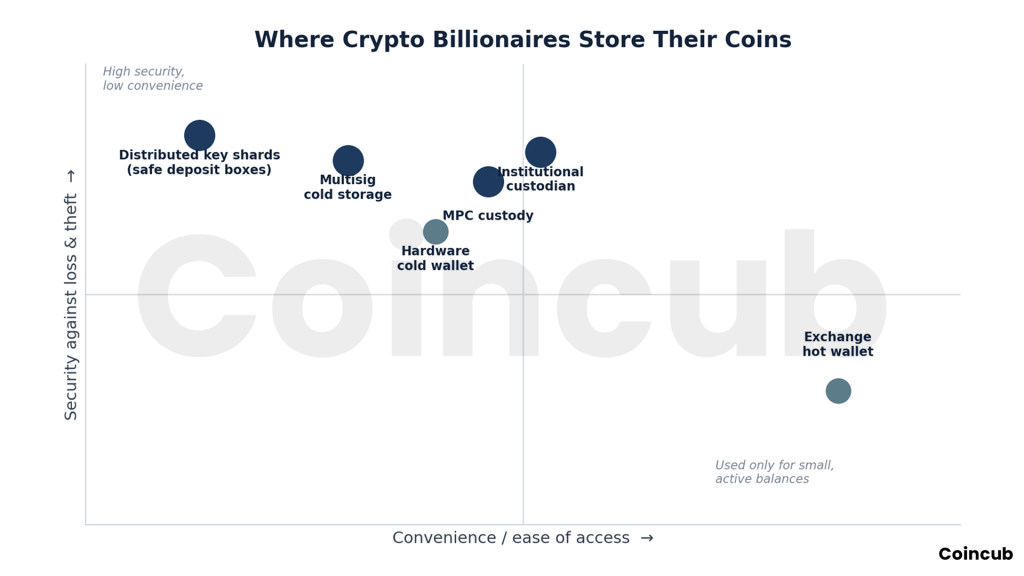
The table below summarizes the same methods with the role each one plays in a large portfolio.
| Method | How it works | Typical role for big holders |
|---|---|---|
| Cold storage | Keys generated and kept entirely offline, never exposed to the internet. | The default home for long-term holdings. |
| Multisignature | Several separate keys must approve a transaction, for example 2 of 3. | Removes single-key risk on large reserves. |
| MPC custody | One key is split into encrypted shares so no party ever holds it whole. | Flexible security for active institutional funds. |
| Institutional custodian | A regulated firm safeguards assets with insurance and audited controls. | Holds the bulk for funds and corporations. |
| Hot wallet | An online wallet for quick access and spending. | Only small, active balances. |
Table 1. The main custody methods and where each fits.
Cold Storage: Keeping Keys off the Internet
Cold storage is the foundation. A cold wallet stores the access credentials without ever connecting to the internet, which protects against the most common attack vectors, since a key that is never online cannot be phished, hacked remotely, or drained by a malicious website. For long-term holders, the rule of thumb is simple. Coins you do not plan to touch for a while belong offline. This is the layer that holds the overwhelming majority of a large holder’s wealth.
Cold storage on its own still has a weakness, though. A single offline key can be physically stolen, destroyed in a fire, or lost. That is why billionaires rarely stop at a lone hardware wallet and instead combine cold storage with the next technique.
Cold storage comes in several forms, from a dedicated hardware wallet to an air-gapped computer that has never touched the internet, to a simple paper or metal backup of a key. Serious holders often prefer metal backups over paper because metal survives fire and water. The common thread is that the secret material is generated and kept in an environment an attacker cannot reach remotely, which closes the door on the entire category of online theft.
Multisignature: No Single Key Is Enough
Multisignature, or multisig, requires approvals from several independent keys before any transaction can go through. A common arrangement is two of three, where three keys exist and any two must sign. The power of this design is that losing one key is not a disaster and stealing one key is not enough. An attacker would need to compromise multiple keys held by different people in different places at the same time.
The wealthiest holders push this further with geographic distribution. Best practice is to store the keys in separate secure locations, for instance one at home, one with a trusted family member, and one in a bank’s safe deposit box, so that a localized event like a burglary, fire, or flood cannot reach them all. This is the institutional version of the Winklevoss approach, which split key fragments into envelopes spread across regional banks so that no single break-in could assemble the whole key.
MPC: Splitting the Key With Math
Multi-party computation, or MPC, reaches a similar goal through cryptography rather than multiple full keys. It splits a single private key into encrypted fragments held by different parties or devices, and no party ever holds the complete key. Transactions are signed collaboratively without the full key ever being assembled in one place. Compared with traditional multisig, MPC tends to be more flexible and avoids some of the rigid setup and operational bottlenecks of coordinating several full keys, which is why many active funds favor it.
Institutional Custodians: Outsourcing the Vault
For corporations and large funds, much of the heavy lifting is handled by regulated custodians such as Coinbase Prime or BitGo. These firms combine cold storage, multisig or MPC, insurance, and audited controls into a professional service. BitGo, for example, supports over 1,100 digital assets and has offered insurance coverage up to $250 million for stored funds. In 2025, Coinbase Prime reported serving 13 of the 15 largest crypto hedge funds in the world. For a public company holding billions in crypto, a custodian provides the governance, reporting, and insurance that a do-it-yourself setup cannot.
Why They Layer Methods Together
The most important insight is that billionaires do not pick one method. They combine several, assigning each a job. A typical structure keeps the long-term core in multisig cold storage or with an insured custodian, runs active trading capital through an MPC platform, and leaves only a small float in a hot wallet for immediate needs. This diversification means that even a serious failure in one layer does not threaten the whole fortune.
This layered model mirrors how the traditional wealthy manage money, where assets are spread across vaults, banks, and accounts rather than concentrated in one safe. The crypto version simply swaps the instruments. The logic of not keeping everything in one place is centuries old.
How the Famous Names Actually Do It
The most cited example of paranoid self-custody is the Winklevoss twins. In Bitcoin’s early days they printed their private keys, cut each printout into pieces, and sealed the fragments in envelopes stored in safe deposit boxes in different parts of the country. Their process reportedly involved regional banks, sledgehammers, and concrete. The genius of the scheme was that stealing one envelope gave a thief nothing usable, because no single location held a complete key. It was multisig logic implemented with paper and geography before the tooling existed.
At the opposite end of the spectrum sits Strategy, the company formerly known as MicroStrategy, which under Michael Saylor became the largest corporate holder of bitcoin. As of late 2025 it held more than 650,000 bitcoin, worth roughly $60 billion. A position that large is not managed with a hardware wallet in a safe. It relies on institutional-grade custody with the kind of governance, multi-key controls, and reporting that a public company answerable to shareholders requires. The contrast with the Winklevoss approach shows the range, from artisanal self-custody to corporate custody, that the word storage can cover.
Exchanges themselves are some of the largest holders, because they safeguard coins on behalf of millions of users. Reputable ones store the overwhelming majority of customer assets in cold storage and keep only a small fraction in hot wallets to handle withdrawals, which is the same layered logic an individual billionaire uses, applied at industrial scale.
The Lesson Hidden in Custodian Failures
Handing coins to a custodian introduces a different risk, and recent history makes it concrete. When a platform holds your keys, you are trusting its solvency and honesty, not just its security. The collapse of FTX in 2022 was the hard lesson, where customer funds that people believed were safely held turned out to have been misused. The phrase not your keys, not your coins became a rallying cry precisely because a custodian failure can be as devastating as a hack.
This is why sophisticated holders distinguish sharply between regulated, audited, insured custodians and ordinary exchange accounts. A qualified custodian segregates client assets, undergoes audits, and carries insurance, which is a very different proposition from leaving coins in a trading account. The takeaway for everyone is to know exactly who controls your keys and what protections actually exist, rather than assuming that any company holding crypto is equally safe.
It is also worth noting that the split is rarely even. A common pattern keeps something like 90 to 95% of holdings in the deepest cold storage tier, a smaller slice in a custodian or MPC platform for assets that need to move, and only a token amount in a hot wallet. The exact percentages vary, but the shape is consistent: the colder and harder to reach the storage, the more money it holds.
What Ordinary Investors Can Copy
The encouraging part is that the core techniques scale down. You do not need a custodian or millions of dollars to apply the same principles, just the same discipline about removing single points of failure.
| Billionaire habit | How to apply it yourself | |
|---|---|---|
| Keep the bulk offline | Hold long-term coins on a reputable hardware wallet rather than on an exchange. | |
| Avoid single points of failure | Use a multisig setup or split backups so one lost or stolen item is not fatal. | |
| Distribute backups geographically | Store seed backups or keys in more than one secure location to survive fire or theft. | |
| Keep little in hot wallets | Leave only spending money online, and move savings to cold storage. | |
| Use insured custody when it fits | For large or inherited holdings, a regulated custodian can add insurance and governance. |
Table 2. Billionaire custody principles scaled to a normal portfolio.
One more advantage of the institutional route deserves mention: it brings crypto custody closer to the standards of traditional finance, with regulatory compliance, independent audits, and clear accountability. For a fund manager answering to investors or a company answering to auditors, those features are not optional extras. They are the reason large pools of capital can hold crypto at all. The maturing of this custody industry is a big part of why so much institutional money entered the market in recent years.
The Trade-off Nobody Escapes
Every level of this security has a cost in convenience, and even billionaires cannot avoid the tension. Keys split across safe deposit boxes are extraordinarily safe and genuinely inconvenient to use. A hot wallet is instant and comparatively exposed. The art of custody is matching the method to the money, with deep security for the reserves you rarely touch and easy access for the small amounts you use often.
There is also a human dimension that grows with the stakes: inheritance and access. A custody setup so secure that the owner alone can reach it becomes a problem if that person is incapacitated or dies. This is part of why institutional custody and well-documented multisig arrangements appeal to serious holders, since they allow trusted parties or processes to recover assets under defined conditions rather than locking wealth away forever.
Security Is a Habit, Not a Product
If there is a single lesson to draw from how the wealthiest holders operate, it is that security is a set of habits rather than a product you buy once. The hardware wallet, the custodian, and the multisig contract are tools, but the protection comes from how they are combined and maintained. Keys get rotated, backups get tested, access is documented, and the setup is reviewed as holdings grow. A billionaire treats custody as an ongoing process, not a box ticked on the day they bought in.
That mindset is the most copyable thing of all. Most people lose crypto not to sophisticated hackers but to simple, avoidable mistakes: a seed phrase photographed and synced to the cloud, a single backup destroyed in a flood, or everything left on an exchange that later froze withdrawals. Adopting even a fraction of the layered discipline described here removes the great majority of that everyday risk, regardless of how many zeros are in the balance.
In the end, the billionaire playbook is less about exotic technology than about respect for an unforgiving system. Crypto gives you complete control, and complete control means complete responsibility. The richest holders simply take that responsibility seriously, building layers so that no single bad day can undo years of accumulation.
Frequently Asked Questions (FAQ)
Do crypto billionaires keep their coins on exchanges? +
Rarely for the bulk of their holdings. Exchanges are convenient but represent a single point of failure, so large holders keep most assets in cold storage or with insured custodians and use exchanges only for active trading.
What is the safest way to store a large amount of crypto? +
A combination, rather than any single tool. The common pattern is offline cold storage protected by multisignature or MPC, with keys distributed across people and locations, and often a regulated custodian for governance and insurance.
What is the difference between multisig and MPC? +
Multisig uses several complete keys and requires a set number to approve a transaction. MPC splits one key into encrypted shares so the full key is never assembled. Both remove single-key risk, but MPC is often more flexible operationally.
Can I use these methods with a small portfolio? +
Yes. A hardware wallet, distributed backups, and keeping only spending money online apply the same single-point-of-failure logic at any size. The principles scale down even when the dollar amounts do not.
What does not your keys, not your coins mean? +
It means that if someone else holds the private keys to your crypto, such as an exchange, you are trusting them to stay solvent and honest. True ownership comes from controlling the keys yourself, which is why large holders favor self-custody or regulated custodians with strong protections.
Are hardware wallets enough on their own? +
For modest amounts, a single hardware wallet with a secure backup is reasonable. For large holdings, billionaires add multisignature or MPC and distribute keys, because a lone device can still be lost, destroyed, or physically stolen.