


 Buy a Licensed Company
  Explore VASP Data
  Talk to an Expert

 Atis Shala
Atis is a senior analyst and community lead with four years of experience in crypto. He has a bachelor from the Rochester Institute of Technology.
Atis Shala
Atis is a senior analyst and community lead with four years of experience in crypto. He has a bachelor from the Rochester Institute of Technology.
Altcoin Rotation: When to Move From BTC to Small Caps
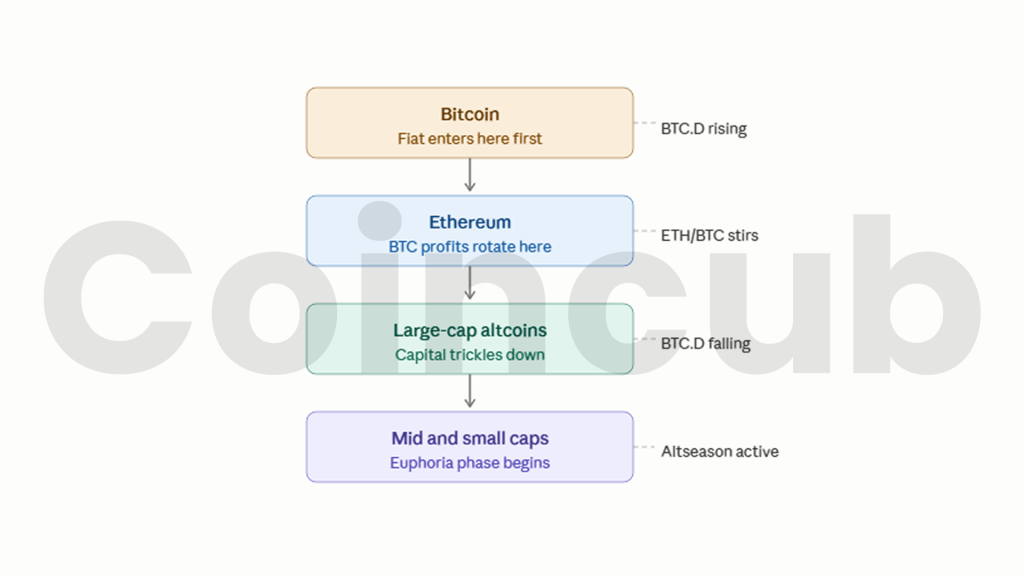
- Crypto bull markets follow a set sequence, with money moving first into Bitcoin, then Ethereum, trickling down to large-cap altcoins, and finally flooding into high-risk, high-reward small caps.
- The “Golden Zone” for altcoin rotation occurs when BTC Dominance drops while Bitcoin’s price remains stable or continues to rise, signaling that capital is expanding outward.
- Don’t rely on BTC.D alone. Verify that an altseason is genuinely underway by watching secondary metrics like TOTAL2, TOTAL3, and a rising ETH/BTC ratio.
- Outsized returns come from positioning yourself early in trending narratives before the retail crowd arrives, but you must always vet a project’s liquidity and tokenomics before buying.
- Protect your core wealth by allocating only 10-20% of your portfolio to small caps, ideally funding these high-risk bets using profits skimmed from your safer BTC or ETH positions.
- Small caps can easily erase 90% of your portfolio if you mistime the top. Use Dollar Cost Averaging (DCA) to sell on the way up, and remember the golden rule: if it’s good enough to screenshot, it’s good enough to sell.
Every cycle, a handful of traders turn modest portfolios into life-changing wealth. Rarely does that happen by holding Bitcoin alone. Bitcoin is the bedrock of the crypto market, offering relatively steady, compounding growth across market cycles. Small-cap altcoins, on the other hand, are a different beast entirely. They can deliver 10x, 50x, or even 100x returns in a matter of weeks. The catch? They can just as easily erase 90% of your portfolio if you mistime the move.
This is where altcoin rotation comes in. Altcoin rotation is the strategic process of shifting capital from safer, higher-liquidity assets like Bitcoin into smaller, higher-risk altcoins at precisely the right moment in the market cycle. A related term you will hear constantly is altseason, which refers to the period when altcoins broadly outperform Bitcoin, and the entire market feels like it is printing money.
Knowing what to buy is important. Knowing when to rotate is what separates traders who compound their wealth from those who watch 10x gains evaporate into nothing. In this guide, you will learn how the flow of money moves through the crypto market, how to decode Bitcoin dominance (BTC.D) as your primary timing indicator, which secondary metrics confirm an incoming rotation, and how to manage risk so you actually keep your profits.

Understanding the Crypto Market Cycle: The Flow of Money
To time any rotation correctly, you first need to understand the structure of a crypto bull market. Money does not flood into small caps on day one. It follows a predictable path, driven by investor psychology and the search for higher percentage returns.
The Classic Path to Altseason
Step 1: Fiat Enters Bitcoin
Every major bull cycle begins the same way. Institutional money, newly converted retail investors, and macro-driven capital all flow into Bitcoin first. Bitcoin is the gateway asset. It is the most liquid, the most regulated, and the easiest to justify buying. At this stage, BTC dominance is high and rising, and altcoins are largely ignored.
Step 2: Profits Flow From BTC to Ethereum
Once Bitcoin has made a significant move and early buyers are sitting on substantial gains, they begin looking for the next leg of growth. Ethereum is the natural first stop. It has deep liquidity, strong fundamentals, and a well-understood narrative. BTC.D begins to tick lower as ETH absorbs fresh capital.
Step 3: Capital Trickles Down to Large-Cap Altcoins
With both BTC and ETH in strong uptrends, attention shifts to the top 20 or top 50 coins by market cap. These are assets like Solana, Avalanche, or Chainlink. They offer higher upside potential than ETH while still carrying recognizable names and reasonable liquidity.
Step 4: Euphoria Hits, and Money Floods into Mid and Small Caps
This is the final and most explosive phase. Retail investors, now feeling confident and greedy after watching the market rise for months, start hunting for the next 100x. Capital pours into mid-cap and small-cap projects. Memecoins trend on Twitter. Google searches for obscure tokens spike. This is the phase most people are chasing when they talk about altseason.
Why This Happens
The psychology behind this pattern is straightforward. As large-cap assets consolidate after a big move, they offer diminishing percentage returns. A $500 billion asset cannot realistically 10x overnight. A $20 million market cap token can. Investors naturally rotate down the risk curve in search of higher percentage gains, flooding smaller assets with disproportionate capital inflows.
The Ultimate Indicator: Decoding Bitcoin Dominance (BTC.D)
If there is one chart you should have open at all times during a bull market, it is Bitcoin dominance (BTC.D). Understanding how to read it is the foundation of any serious altcoin rotation strategy.
What Is BTC.D?
Bitcoin dominance measures Bitcoin’s market capitalization as a percentage of the total crypto market cap. If the entire crypto market is worth $3 trillion and Bitcoin accounts for $1.5 trillion of that, BTC.D is 50%. It is a simple ratio, but the signals it sends are incredibly powerful.
How to Read the Chart
Rising BTC.D + Rising BTC Price = Bad for Altcoins
When Bitcoin is pumping and its dominance is increasing simultaneously, it means liquidity is being sucked out of the broader market and concentrated into BTC. Altcoins will either bleed slowly or dump outright during this phase. This is the wrong time to rotate into small caps.
Falling BTC.D + Stable or Rising BTC Price = The Golden Zone
This is the setup every altcoin trader is waiting for. When Bitcoin’s dominance begins to fall while BTC’s price holds steady or continues higher, it signals that fresh capital is flowing into altcoins. Money is expanding outward across the market rather than consolidating into Bitcoin. This is the window where small-cap rotation generates the most explosive returns.
Falling BTC.D + Falling BTC Price = Proceed With Caution
A drop in dominance alongside a BTC price decline can sometimes occur during a broad market sell-off. In this scenario, everything is losing value, and rotating into small caps would be premature. Always confirm that BTC is holding its ground before treating a dominance drop as a buy signal.
| BTC Price | BTC.D | Market Signal | What To Do |
| Rising | Rising | Liquidity is concentrating in BTC; altcoins are being ignored or bleeding | Stay in BTC, avoid altcoin exposure |
| Rising | Falling | The Golden Zone; capital is rotating outward into altcoins | Begin scouting altcoin rotation opportunities |
| Stable | Falling | Rotation is underway but BTC lacks strong momentum | Proceed cautiously; confirm with TOTAL2 and ETH/BTC |
| Falling | Falling | Broad market sell-off; everything is losing value | Risk-off; hold stablecoins or BTC, do not rotate |
Historical Context
The pattern repeats with remarkable consistency. In late 2017, Bitcoin dominance dropped from roughly 65% to below 40% in a matter of weeks. What followed was one of the most explosive altcoin markets in history, with hundreds of small-cap tokens posting quadruple-digit returns. The same dynamic played out in early 2021, when BTC.D fell from around 70% to roughly 40%, triggering the DeFi and altcoin summer that made legends out of early movers. Studying these historical BTC.D charts is one of the best ways to calibrate your timing for the next cycle.
Key Metrics and Indicators Signaling an Altcoin Rotation
Bitcoin dominance is your primary indicator, but experienced traders use a stack of secondary signals to confirm that a rotation is genuinely underway before moving capital into riskier assets.
TOTAL2 and TOTAL3 Charts
TOTAL2 is the total crypto market cap excluding Bitcoin. When TOTAL2 is trending upward while BTC.D is falling, it confirms that capital is flowing into altcoins broadly, not just sitting in stablecoins. TOTAL3 takes this one step further by excluding both Bitcoin and Ethereum, giving you a direct read on the health of small and mid-cap altcoins specifically.
When TOTAL3 begins to break out to new highs, it is one of the clearest signals that the later stages of altseason are arriving. At that point, capital has already filtered through BTC and ETH and is now actively searching for the explosive small-cap plays that define the euphoric phase of a bull market.
Ethereum as a Leading Indicator
Watch the ETH/BTC trading pair closely. When Ethereum begins outperforming Bitcoin on a relative basis, meaning the ETH/BTC ratio is rising, it is often the starting gun for broader altseason. Ethereum tends to lead the altcoin market. Historically, a sustained breakout in ETH/BTC has preceded explosive moves in small-cap altcoins by days to weeks.
Think of it as a confirmation signal. If BTC.D is falling and ETH/BTC is breaking out simultaneously, the conditions for a full-scale altcoin rotation are firmly in place.
Stablecoin Supply
A surge in the total supply of stablecoins like USDT and USDC on exchanges is a powerful bullish signal. Stablecoins sitting on exchanges represent “dry powder,” capital that has been de-risked and is waiting for the right moment to be deployed. When stablecoin reserves are high and sentiment begins to shift positive, that capital can flood into risk assets very quickly. Monitoring stablecoin supply on platforms like CryptoQuant or Glassnode gives you an edge in anticipating incoming buy pressure.
Sentiment and Social Metrics
Markets move on emotion as much as fundamentals. A few sentiment indicators worth tracking:
- Fear and Greed Index: This composite metric measures market sentiment on a scale from 0 (Extreme Fear) to 100 (Extreme Greed). A reading above 70, particularly when sustained over several days, often corresponds with retail FOMO and the late-stage euphoria that drives small-cap pumps.
- X (Twitter) Trends: When crypto tokens start trending organically on social media, especially from non-crypto accounts, it signals that retail attention has arrived. This is often a sign that a particular narrative or sector is in full pump mode.
- Google Trends: Search interest in terms like “how to buy crypto” or specific token names tends to spike near market tops. Paradoxically, this can help you identify when a small-cap trade is nearing exhaustion.
The Art of the Rotation: Moving Into Small Caps Safely
Once your indicators align, the next challenge is executing the rotation thoughtfully rather than impulsively.
Defining Small Caps
In crypto, “small cap” is a relative term that shifts with the overall market size. A common baseline is a market cap under $100 million, though some traders extend this to $500 million during larger bull cycles. The key characteristic of a small-cap token is that it has a relatively low total valuation, meaning a smaller absolute amount of capital is needed to move the price significantly in either direction.
Narrative Investing
In small-cap crypto, narrative is often more powerful than fundamentals in the short term. The market rotates through sectors in waves, and being positioned in the right narrative before the crowd arrives is how outsized returns are made.
Recent examples of market-moving narratives include:
- Artificial Intelligence (AI): Tokens tied to decentralized AI infrastructure or AI-adjacent utilities
- Real World Assets (RWA): Projects tokenizing traditional financial instruments like bonds or real estate
- Memecoins: Community-driven tokens with no utility but enormous social momentum
- GameFi: Play-to-earn and Web3 gaming ecosystems
The goal is to identify which narrative is gaining traction before it becomes mainstream, position yourself early, and exit into strength when the broader retail crowd piles in.
Vetting Small-Cap Projects
Before putting capital into any small-cap token, run through this checklist:
Tokenomics and Unlock Schedules: Check how many tokens are currently in circulation versus the total supply. A large percentage of tokens locked and scheduled to unlock soon creates persistent sell pressure. Tools like TokenUnlocks.app make this easy to verify.
Team Activity: Is the team actively shipping updates? Are there regular GitHub commits, product announcements, or community calls? A dormant team in a fast-moving market is a red flag.
Liquidity: Can you actually sell your position? Check the depth of the order book on centralized exchanges, or the liquidity pool size on DEXs. A token with a $10 million market cap but only $50,000 in liquidity will be nearly impossible to exit at scale.
Trading Volume: Consistent, organic daily volume relative to market cap is a positive sign. Volume that spikes 10,000% for one day and then collapses usually signals manipulation rather than genuine interest.
Portfolio Strategy and Risk Management
The most common reason traders fail to build lasting wealth during altseason is poor risk management. Making 20x on a small cap means nothing if you give it all back in the next phase.
The “House Money” Strategy
Rather than liquidating your core Bitcoin or Ethereum holdings to fund small-cap plays, the smarter approach is to sell a small percentage of your BTC or ETH profits and use those gains as your small-cap allocation. This preserves your base position while giving you exposure to higher-upside assets. If your small-cap bets go to zero, you still hold your core portfolio. If they 10x, you have generated meaningful gains without sacrificing the foundation of your wealth.
A common framework is to allocate between 10% and 20% of your total portfolio to small caps during altseason, keeping the remaining 80% to 90% in BTC, ETH, or stablecoins.
Scaling In and Out With DCA
Dollar Cost Averaging (DCA) applies to exits just as much as it applies to entries. Trying to sell at the absolute top of a small-cap pump is nearly impossible. Instead, scale out progressively as price increases. Sell 20% at 3x, another 20% at 5x, and so on. This approach locks in profits along the way while keeping some exposure for further upside.
The same logic applies to entries. Rather than deploying your entire allocation into a token at once, scale in over time or on price dips to reduce the impact of volatility.
Taking Profits
There is a golden rule in crypto that is simple but constantly ignored: if it is good enough to screenshot, it is good enough to sell. When your portfolio hits a number that would genuinely change your life, take money off the table. The time to rotate small-cap profits back into Bitcoin or stablecoins is while the market still feels exciting and prices are still rising. Waiting for “just a little more” is how life-changing gains turn into disappointment.
Common Pitfalls to Avoid During Altseason
Even experienced traders make costly mistakes when markets are moving fast and euphoria is running high.
Round-Tripping
Round-tripping is one of the most painful experiences in crypto. It refers to the scenario where you watch a token run from 1x to 10x, hold through the peak convinced it will go higher, and then ride it all the way back down to near zero. The correction after an altseason can be brutal and swift. Coins that 50x in a bull market regularly lose 95% of their value in the subsequent bear market. Having a plan to exit before the music stops is essential.
Liquidity Traps
Some tokens display large market cap figures that are misleading. A coin might show a $50 million market cap on paper, but if 90% of the supply is locked in wallets with no intention to sell, the actual circulating supply is tiny. This creates artificial scarcity and inflated prices. When you try to sell, you will find there are no buyers at anywhere near the current price. Always verify circulating supply and liquidity depth before entering a position.
Chasing the Pump
When a small-cap token has already surged 500%, it is already on everyone’s radar. The traders who made life-changing money bought it before the surge, and many of them are now looking for an exit. Buying into a token after a massive spike means you are likely providing liquidity for earlier investors to sell into. The psychological pull to chase a pump is strong, but disciplined traders wait for the next setup rather than buying someone else’s top.
Final Thoughts: When Does The Altcoin Rotation Happen?
Altcoin rotation is one of the highest-risk, highest-reward strategies in the crypto market. When timed correctly, it can compress years of wealth-building into a single market cycle. When executed poorly, it can wipe out everything you have built.
The framework is straightforward: watch Bitcoin dominance (BTC.D) as your primary signal, confirm with TOTAL2, TOTAL3, and the ETH/BTC pair, use stablecoin supply and sentiment data to gauge market readiness, and rotate into narrative-driven small caps only when the conditions are firmly aligned.
Above all, protect your capital. Use the house money strategy, scale out with DCA, and take profits before the crowd. The traders who survive multiple crypto cycles and grow their wealth over time are not the ones who hold on the longest. They are the ones with the patience to wait for the right setup and the discipline to walk away from the table while they are still ahead.
Frequently Asked Questions (FAQs)
How long does an altcoin season typically last?
Altseason durations vary across cycles. Historically, the most explosive phase of altseason, where small caps see parabolic moves, lasts anywhere from four to twelve weeks. The broader altcoin outperformance period relative to Bitcoin can extend for several months. However, the sharpest gains are concentrated in a very short window, which is why timing and having a pre-planned exit strategy matters so much.
What is the best platform to buy small-cap altcoins?
For tokens listed on centralized exchanges, platforms like KuCoin and MEXC tend to list smaller projects earlier than major exchanges like Coinbase or Binance. For truly early-stage or unlisted tokens, decentralized exchanges are your primary option. Uniswap dominates on Ethereum and EVM-compatible chains, while Jupiter is the leading aggregator on Solana. Always double-check contract addresses against official project sources to avoid scam tokens.
Can small-cap altcoins go to zero?
Yes. The uncomfortable truth is that the vast majority of small-cap altcoins from any given cycle eventually lose nearly all of their value. Many go completely to zero. Even tokens that deliver 50x returns during a bull market regularly trade down 95% or more after the cycle ends. This is why risk management, position sizing, and taking profits are far more important than finding the perfect entry. Assume any small-cap play can go to zero and size your positions accordingly.