Buy a Licensed Company
  Explore VASP Data
  Talk to an Expert

 Atis Shala
Atis is a senior analyst and community lead with four years of experience in crypto. He has a bachelor from the Rochester Institute of Technology.
Atis Shala
Atis is a senior analyst and community lead with four years of experience in crypto. He has a bachelor from the Rochester Institute of Technology.
Betting on the Future: Why Prediction Markets are Winning in 2026
- Unlike traditional polling or pundit opinions, prediction markets force participants to back their predictions with real money, stripping away partisan bias and wishful thinking.
- While the concept was proven by academic experiments in the 1980s, it took the widespread adoption of blockchain and stablecoins to bypass regulatory bottlenecks and create a truly global, frictionless market.
- Smart contracts have eliminated the need for a central operator, allowing for automated, tamper-proof payouts that participants can implicitly trust.
- The scope of prediction markets has exploded far beyond elections, now allowing users to forecast and hedge on everything from extreme weather and granular in-game sports moments to scientific breakthroughs and pop culture.
- By consistently rewarding accuracy and financially punishing delusion, prediction markets have evolved into society’s most reliable, unbiased truth-seeking engine in 2026.
The Power of Collective Foresight
In January 2026, as world leaders gathered in Davos, traditional pollsters gave the incumbent Swiss government a 78% chance of surviving the snap elections called just weeks prior. Pundits debated endlessly on cable panels. But on Polymarket, traders had already moved the odds to 61% against the incumbents. The government fell. The pundits apologized. The market moved on.
A prediction market is, at its core, a trading platform where participants buy and sell contracts tied to the outcomes of future events. If you believe something will happen, you buy a contract. If it does, you get paid. On the contrary, if it does not, you lose your stake. Simple mechanics, profound implications.
For decades, prediction markets operated at the fringes of public life: academic curiosities, niche tools for traders, regulatory headaches for lawmakers. But the technological and cultural shifts that had been building for years finally converged in 2026. Today, prediction markets have surpassed traditional polling and expert commentary as the world’s most reliable truth-seeking engine. The crowd, properly incentivized, sees what the pundits miss.

The Origins: Conceptualizing the “Wisdom of the Crowds”
To understand why prediction markets work, you need to understand what they replaced.
For most of the twentieth century, society relied on two tools to forecast the future: polling and expertise. Pollsters surveyed populations. Experts analyzed data and issued opinions. Both methods carried a fundamental flaw. Neither one required the forecaster to pay a price for being wrong.
In 1945, the Austrian economist Friedrich Hayek published a paper that would quietly reshape how economists thought about information. Hayek argued that no central authority could ever gather and process the full range of knowledge dispersed across millions of individuals in a society. The price system in a free market, he wrote, performs this aggregation automatically. Prices encode the collective knowledge of every buyer and seller who participates. Markets, in other words, know things that no single expert ever could.
Hayek was writing about commodity prices, but the implication stretched further. If a wheat market could aggregate global knowledge about weather patterns, crop yields, and transportation costs into a single number, could a specialized market aggregate knowledge about anything? Could it accurately price who would win an election, or whether a scientific experiment would succeed?
The Efficient Market Hypothesis
In the 1970s, economist Eugene Fama formalized a related idea with the Efficient Market Hypothesis. Fama argued that financial markets rapidly absorb all available information, and that asset prices reflect the collective judgment of all participants. Consistently beating the market, he argued, is nearly impossible because prices already incorporate everything the smartest players know.
Academics began to connect these two ideas. Hayek’s aggregation mechanism combined with Fama’s price efficiency suggested something powerful: a well-structured market built around a specific future event would force participants to encode their true beliefs into prices. Money would motivate accuracy. Bias and wishful thinking would cost real dollars. The resulting price would represent the most honest collective forecast available.
The theory was elegant. All it needed was a test.
The Birth of the First Prediction Market
In 1988, three professors at the University of Iowa decided to run that test.
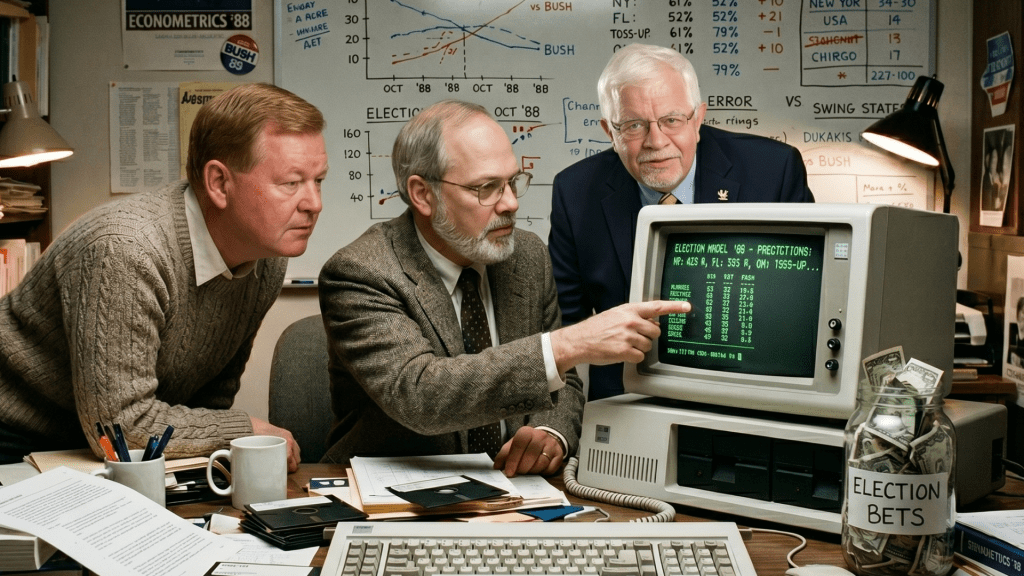
Robert Forsythe, Forrest Nelson, and George Neumann launched the Iowa Electronic Markets with a single purpose: to predict the outcome of the U.S. Presidential Election between George H.W. Bush and Michael Dukakis. The IEM allowed real-money trading on electoral outcomes, with contract payouts tied to each candidate’s share of the popular vote. Participants could invest up to five hundred dollars, a limit designed to keep the experiment within regulatory bounds.
The platform launched with no marketing budget, a small pool of participants, and rules that wouldn’t make sense by today’s standards. But the results were striking. On election eve, the IEM’s prices predicted Bush’s vote share more accurately than any major polling organization. The final market price landed within a single percentage point of the actual result.
Why Did it Work?
The answer lies in what economists call “skin in the game.” When a pollster asks a voter who they think will win, the voter can say anything. Wishful thinking carries no financial consequence. But when a trader on the IEM placed a dollar on their prediction, the equation changed. They now had a direct incentive to think clearly, to set aside emotion, and to seek out the most accurate information available.
The IEM ran successfully for years, consistently beating traditional polls in election forecasts. It proved the concept beyond academic debate. But it stayed small and niche for a straightforward reason: regulation. The CFTC had granted the IEM a “no-action” letter that shielded it from regulatory interference, but the cap on investment sizes and restricted access kept it from scaling. The platform could demonstrate the idea but could never take it global.
For prediction markets to reach their potential, they needed technology that could bypass the regulatory gatekeepers entirely. They needed blockchain.
The Turning Point: Why 2026 is the Year of Prediction Markets
Something shifted in the public conversation around 2023 and 2024. Trust in traditional media and expert commentary had been declining for years, but the 2024 U.S. election cycle accelerated the collapse. Pollsters miscalled a pivotal race. High-confidence pundits got the story wrong. Viewers noticed, and many did not come back.
Meanwhile, Polymarket had been quietly growing. The platform launched in 2020 as a blockchain-based prediction market, and by the 2024 election cycle, its volumes on political markets were drawing mainstream attention. Journalists began citing Polymarket odds alongside, and sometimes instead of, polling averages. The market had entered the public conversation.
Why Did Prediction Markets Achieve Mass Adoption?
By 2026, three technological shifts had combined to push prediction markets into the mainstream.
The first was blockchain and smart contracts. Earlier prediction markets required participants to trust a central operator to hold funds and pay out correctly. Blockchain-based platforms removed that requirement entirely. Smart contracts execute payouts automatically when an outcome is verified, and no company or government can freeze funds or alter the rules mid-market. This solved a fundamental trust problem that had limited the industry for decades.
The second shift was stablecoins. Early crypto platforms required users to hold volatile assets like Bitcoin or Ether, which introduced a separate layer of financial risk. The widespread adoption of dollar-pegged stablecoins like USDC changed this calculus entirely. A user in Nairobi, Buenos Aires, or Jakarta could fund a prediction market account with the equivalent of dollars, without going through a bank, without currency conversion fees, and without waiting days for a wire transfer. The market became genuinely global.
The third shift was design. Early prediction markets looked like spreadsheets. Today’s platforms look like sports betting apps or social media feeds. Users swipe through markets, share positions, and receive notifications when prices move. The friction has dropped to nearly zero. Participating in a prediction market now feels as natural as placing a bet on a football game or scrolling a news feed.
The pundit class had spent decades benefiting from an information monopoly. They controlled the data, the platforms, and the audiences. The public had no mechanism to push back, to say “we think you’re wrong” and put real money behind the claim. Prediction markets gave the public that mechanism. In 2026, the mechanism is winning.
Betting on Everything: The Modern Ecosystem
The most striking feature of prediction markets in 2026 is their sheer scope. Because the underlying infrastructure is decentralized and permissionless, anyone can create a market for any verifiable event. The ecosystem has expanded across almost every domain of human interest.
Politics
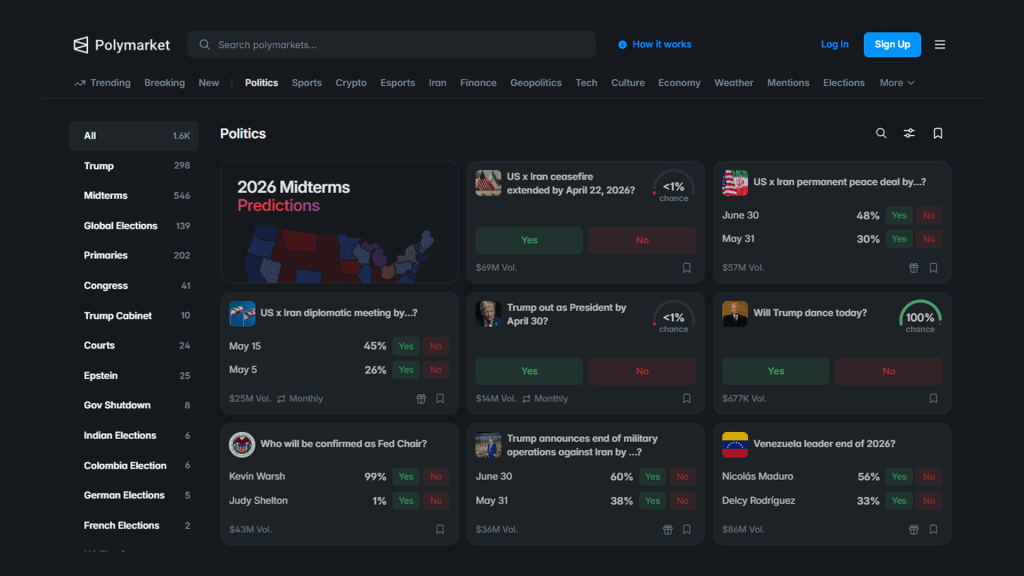
Politics remains the heartland of prediction markets, but the scope has grown far beyond presidential races. Traders now bet on cabinet appointments, Senate confirmation votes, Supreme Court decisions, and local ballot measures in dozens of countries. Global geopolitics has become a major market category. Will a specific peace agreement hold? Could a new trade bloc form? Will a particular government survive a no-confidence vote?
These markets aggregate knowledge from political insiders, analysts, and ordinary observers all at once. A diplomat with knowledge of a sensitive negotiation, a journalist who picked up a congressional tip, and a political science student who built a statistical model all participate in the same market. The price they arrive at reflects all of their knowledge combined.
Weather and Climate
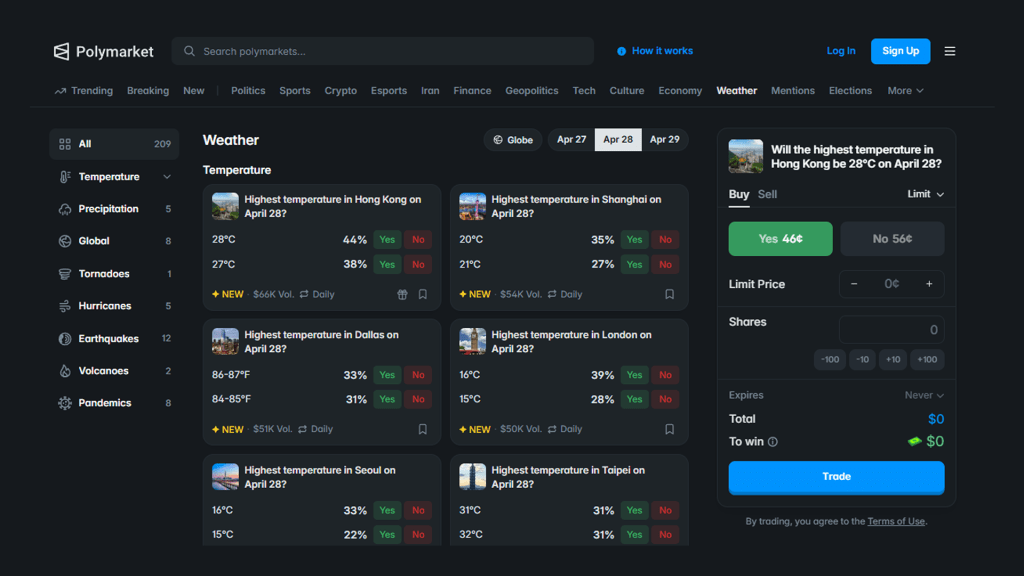
Farmers have always needed to manage weather risk. For most of history, they relied on crop insurance and forward contracts. Prediction markets have opened a new category of hedging instrument. Businesses now trade contracts on seasonal temperature ranges, hurricane landfall probabilities, and annual rainfall totals. A citrus grower in Florida can hedge against a late-season freeze. An energy company can hedge against a mild winter that reduces heating demand.
As extreme weather events have increased in frequency, the financial stakes attached to accurate forecasting have risen sharply. Prediction markets aggregate signals from meteorologists, climate scientists, and local experts faster than any official forecast can.
Sports
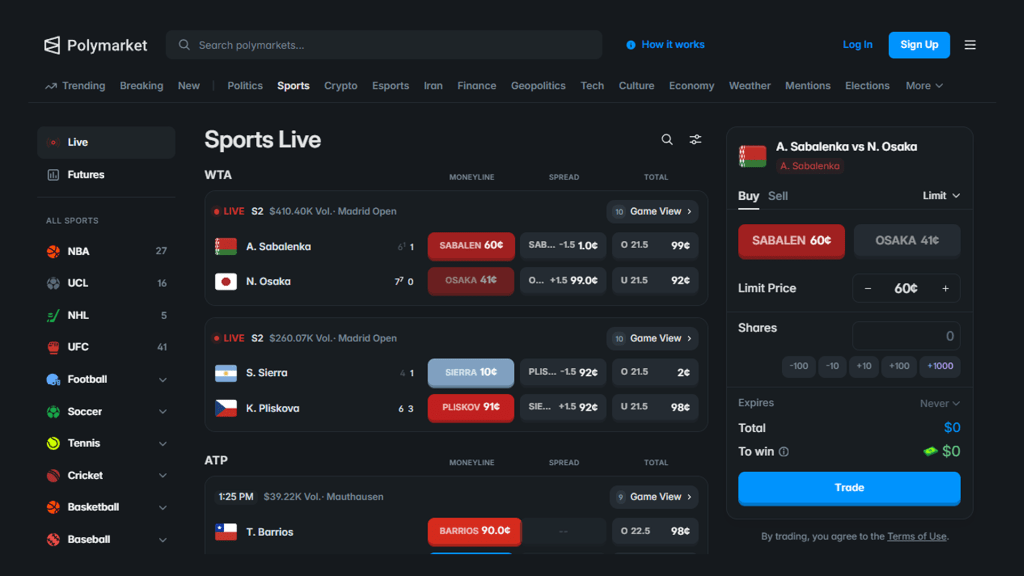
Traditional sportsbooks build a house edge into every market. The odds always tilt slightly in the bookmaker’s favor. Peer-to-peer prediction markets have disrupted this model. On decentralized sports platforms, users set their own odds by trading directly against each other. The bookmaker’s cut disappears, and the resulting prices are often sharper than anything a traditional sportsbook publishes.
The bigger innovation is granularity. Traditional sportsbooks focus on game outcomes and point spreads. Sports prediction markets now cover in-game events at the micro level. Will the next drive end in a score? Will this pitcher strike out the next two batters? This granularity has attracted a wave of sports analytics traders who believe their statistical models give them a real edge.
Entertainment and Pop Culture
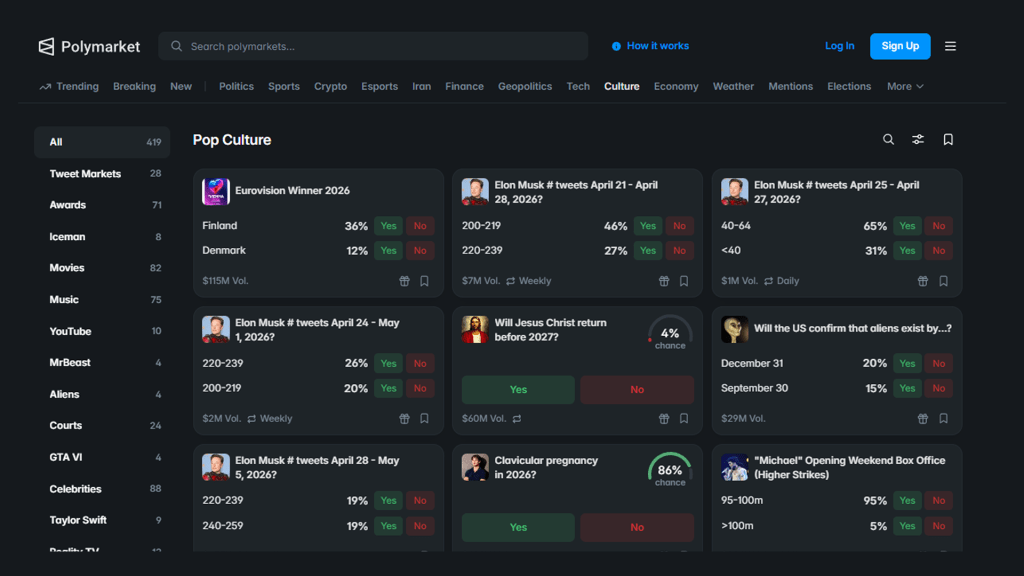
Some of the most popular markets in 2026 have nothing to do with politics or finance. Entertainment markets draw massive trading volumes. Traders bet on opening weekend box office totals, Oscar nominations, and Grammy winners. When a highly anticipated television series airs its finale, markets on the episode’s plot outcomes draw tens of thousands of participants in real time.
These markets serve a purpose beyond entertainment. Studios and streaming services have started using prediction market odds as early signals of audience reception. A film with weak market sentiment before opening weekend tends to underperform. The market functions as a collective review before the critics have written a single word.
Science, Technology, and Business
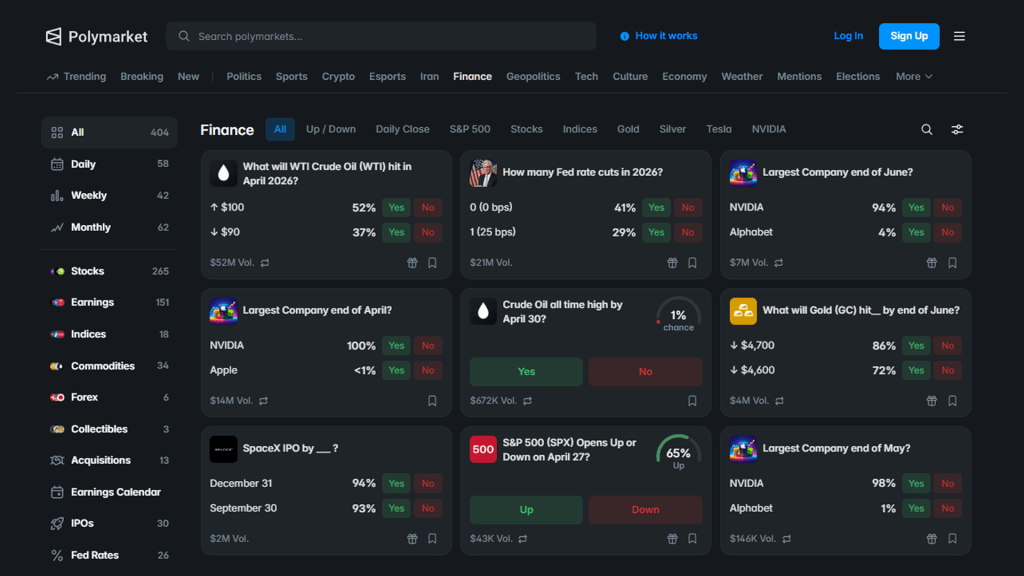
Perhaps the most intellectually exciting category involves scientific and technological forecasting. Traders now bet on when the next major AI model will launch, whether a specific clinical drug trial will succeed, and which company will cross a particular revenue milestone first. Rocket launch success probabilities trade on major platforms on launch day.
These markets do something no press release or analyst report can replicate. They force participants with superior information to commit real capital to that belief. When a trader with genuine technical knowledge buys contracts on a satellite launch, they signal confidence that company insiders have not expressed publicly. The aggregate signal from all such traders produces a forecast that consistently outperforms institutional predictions.
The Future is a Traded Asset… Onchain
From a university experiment in Iowa to a global, decentralized network of interconnected markets, prediction markets have traveled a remarkable distance in four decades. The IEM proved the concept. Blockchain removed the gatekeepers. Stablecoins opened the doors to a global user base. Good design brought everyone else in.
The deeper lesson is about honesty. Traditional forecasting gave people a platform to express opinions without consequences. Prediction markets change the incentive structure entirely. Every price reflects a genuine belief, backed by real money, held by someone who wants to be right. The resulting signal cuts through noise in a way that no poll, no panel discussion, and no expert commentary can match.
The market is also self-correcting. Participants who are wrong consistently lose money and exit. Participants who are right consistently profit and attract followers. The process rewards clarity and punishes delusion, over and over, in real time.
The next time you want to know whether a bill will pass, which team will win a championship, or when the next technological breakthrough will arrive, you can read the opinion section. Or you can check what people are willing to bet. In 2026, the smart money is on the smart money.
Frequently Asked Questions (FAQs)
What does it mean to bet on the future?
Betting on the future means staking real money on the outcome of an upcoming event. You purchase shares or contracts tied to a specific result, like an election or a sports game, and profit if your prediction proves correct.
Can you bet on the future?
Yes, you can bet on the future using prediction markets. These platforms allow anyone to trade event-based contracts on topics like politics, weather, pop culture, and sports, turning everyday forecasting into a legally regulated or decentralized financial transaction.
What is meant by prediction market?
A prediction market is an exchange where participants buy and sell contracts based on the probability of a future event occurring. The contract prices reflect the crowd’s collective belief, serving as a highly accurate, data-driven, decentralized forecasting tool.
Which is the biggest prediction market?
As of 2026, Polymarket and Kalshi are the two biggest prediction markets. Kalshi dominates the regulated U.S. landscape for macro-style events, while Polymarket leads globally in decentralized, crypto-based volume. Both platforms frequently process billions in daily trading volume.