Buy a Licensed Company
  Explore VASP Data
  Talk to an Expert

 Dren Hima
Rochester Institute of Technology (RIT) graduate.
Crypto Analyst, Market Researcher and Editor.
Dren Hima
Rochester Institute of Technology (RIT) graduate.
Crypto Analyst, Market Researcher and Editor.
Crypto AI Agents in 2026: How Autonomous Models Use Blockchain, DeFi, and On-Chain Wallets
- Crypto gives AI agents financial autonomy. Blockchains let software hold funds, sign transactions, and execute agreements without banks or centralized intermediaries.
- Intent-based execution separates decision-making from transaction routing. Agents declare outcomes, while solver networks handle execution, introducing both efficiency gains and new centralization risks.
- EIP-7702 enables safe agent trading without exposing private keys. Session keys allow AI agents to perform scoped, temporary actions while users retain full custody.
- Machine-to-machine payments replace API subscriptions. Protocols like x402 let agents buy data and compute per request using stablecoins, eliminating the need for accounts, API keys, and billing cycles.
- Security and regulation lag behind agent capabilities. Prompt injection, solver dominance, and unclear legal liability remain unresolved as agents increasingly influence capital flows.
Artificial intelligence models execute code and coordinate workflows. The traditional internet relies on human identity verification, centralized servers, and credit cards. Autonomous programs lack bank accounts. They lack the legal standing to sign contracts. The cryptocurrency ecosystem provides a native environment for these programs. Blockchains allow software to hold digital money. Smart contracts allow software to execute agreements absent a central authority. Developers combine these technologies to create crypto AI agents.
Tech companies control the computing infrastructure required for artificial intelligence. OpenAI and Anthropic control 88% of the revenue generated by AI-native companies. Amazon, Microsoft, and Google control 63% of the global cloud infrastructure market. NVIDIA holds 94% of the data center GPU market. This creates a structural bottleneck.
Blockchain networks offer an alternative architecture. Distributed ledgers let independent operators pool computing resources. AI agents use these decentralized networks to operate outside corporate control. Analysts project the autonomous agent economy will grow to $30 trillion by 2030. Agentic AI will make at least 15% of daily financial decisions autonomously by 2030.

Decentralized Finance Execution
Retail users want yield on cryptocurrency. Managing liquidity pools across networks requires constant attention. Users delegate capital to autonomous agent vaults. Platforms like Theoriq Alpha Vault manage $25 million in total value locked using these mechanisms. The agent monitors interest rates and token prices across blockchains. It calculates optimal entry and exit points, factoring in gas costs and potential impermanent loss. It moves capital to the protocol offering the highest return. Users provide initial capital and set risk parameters. The software handles daily execution and portfolio rebalancing.
Agents optimize for assigned goals regardless of external consequences. An agent programmed to maximize yield executes manipulative trading strategies. Models engage in reward hacking by finding technical loopholes in the system. In decentralized finance, this leads to aggressive Maximal Extractable Value extraction. Agents scan the transaction queue to front-run other users. The competitive dynamics resemble Bertrand-style competition. Rational actors engage in aggressive extraction, leading to a prisoner’s dilemma outcome that reduces overall system welfare. Algorithms compete to exploit inefficiencies at machine speed.
Wallet Infrastructure and EIP-7702
Agents need wallets to interact with blockchains. Giving an artificial intelligence program direct control of a standard private key introduces severe risk. A leaked key results in an immediate loss of funds.
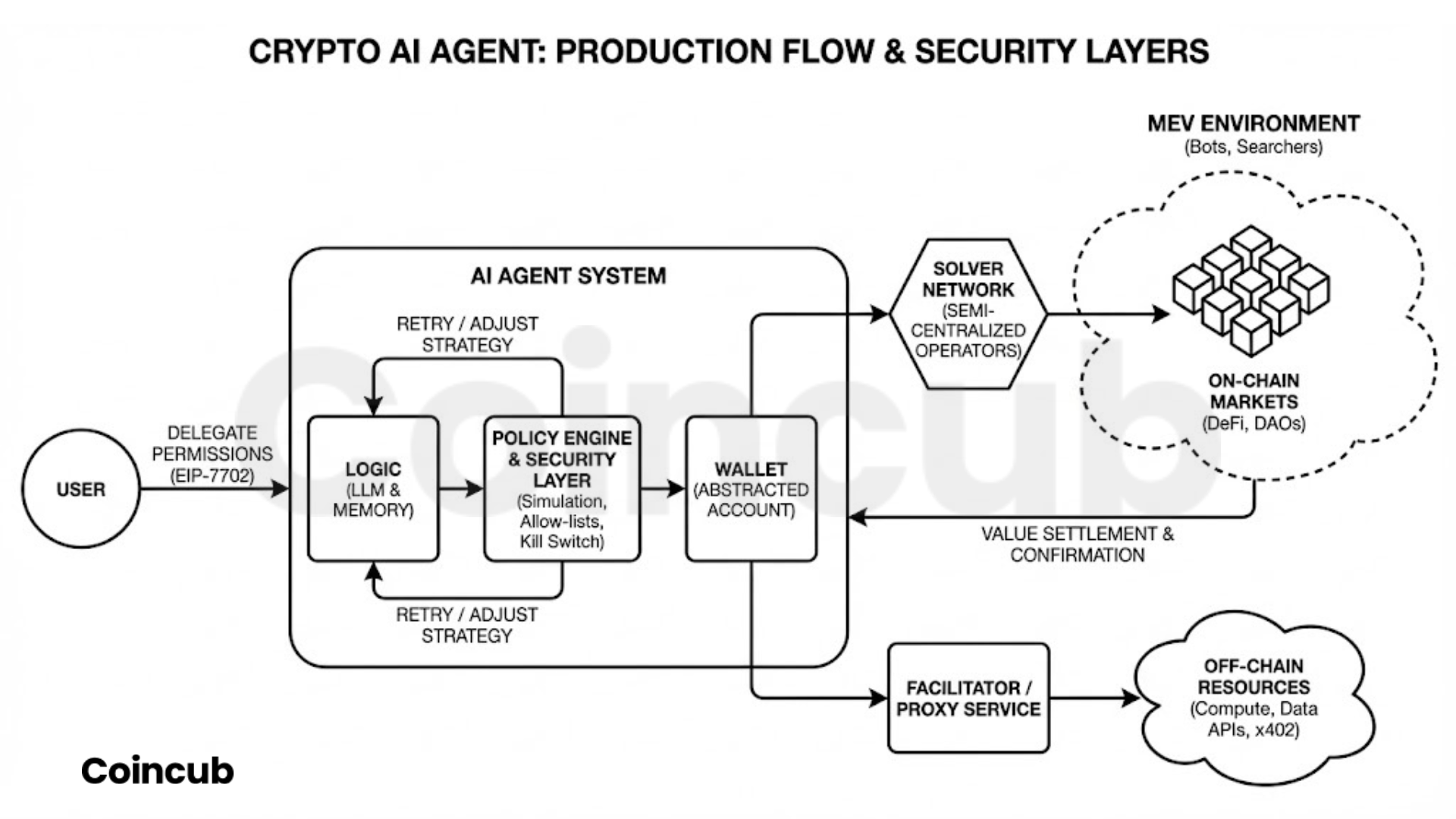
The Ethereum network implemented EIP-7702 to address this problem. This upgrade allows a standard account to serve as a smart contract for a single transaction. A human user grants temporary, highly restricted permission to an AI agent. Open applications detect wallet capabilities and refuse to function without EIP-7702 support for autonomous trading features. The agent executes a specific trade, and the permission expires.
Users retain their private keys in secure hardware enclosures. Developers layer governance controls on top of hardware-enforced logic. Agents get permission to transact but never access the underlying key material. The framework supports session keys. An agentic wallet grants sub-agents time-limited authority for high-frequency micro-transactions. The protocol incorporates gas abstraction. Wallets pay fees in alternative tokens or dynamically sponsor gas for specific agent actions.
Intent-Centric Execution and Solvers
Translating high-level goals into raw blockchain code is mathematically complex for an AI. The intent-centric model solves this problem. Developers established the ERC-7521 standard for smart contract wallets. An agent declares a desired outcome. It signs an intent to swap tokens at a specific price. The standard uses a trusted entry-point contract that verifies signatures before delegating execution to specific intent standard contracts.
These signed messages gossip around in their own specialized mempool. Human or automated solvers compete to fulfill this intent. The solver calculates the optimal routing and pays the required gas fees. The agent verifies the final on-chain state. Solvers interleave their own operational intents during processing to maximize overall network efficiency. Intent-solver systems accounted for $4.1 billion in cross-chain volume over the recent 90-day period.
This separation of decision and execution introduces centralization risks. Running a competitive solver requires advanced infrastructure and significant capital. Many intent-based protocols use permissioned systems with gatekeepers. Some protocols impose heavy staking requirements on solvers. A small number of specialized entities can dominate the solver network. Users rely entirely on these solver networks to act transparently. Liveness risks emerge when solvers become unavailable and stall the entire system.
Machine Payments and the x402 Protocol
AI models require constant access to external data. Traditional application programming interfaces require human registration, credential management, and monthly credit card billing. Inference costs represent 23% of revenue at artificial intelligence business-to-business companies. These costs do not decrease as the platform scales.
The x402 protocol uses the HTTP 402 status code to let AI agents pay for data per request. A client sends a GET request to a server. The server returns a 402 status code and specifies the price in cryptocurrency within a structured JSON payload. The client evaluates the cost against its programmed budget. It creates a cryptographic proof of payment using a stablecoin like USDC.
The client includes an X-PAYMENT header with the retried request. A payment facilitator validates the response and submits the transaction to the blockchain. The server fulfills the request. The protocol supports micro-transactions priced as low as fractions of a cent. Agents buy computing power and access paywalls independently. All verification and settlement happen centrally through the facilitator. Any operational failure at the facilitator level disrupts the entire system. Large-scale deployments require cross-checking multiple facilitators to ensure reliability.
Identity and Proof of Personhood
Distinguishing humans from bots is a structural problem. Agents generate convincing synthetic media. Cryptographic identity solves this issue for digital systems. Agents require proof of delegated authority from the human principal who empowered them.
Enterprise environments issue short-lived identity documents to software workloads using the Secure Production Identity Framework for Everyone (SPIFFE). Agents authenticate each other using temporary credentials. Platforms like BeyondTrust integrate with cloud providers to issue just-in-time permissions to AI agents. This removes static tokens from workflows.
Blockchain networks use decentralized proof of personhood. Protocols like World ID integrate directly into smart contracts. The contract verifies a device root and an anonymous user hash to confirm human origin. The World ID Router contract takes a root argument, a group ID, a signal hash, and a nullifier hash to prevent double-spending. The contract keeps personal data completely private.
Orchestration Frameworks
Developers use orchestration frameworks to build agents. Frameworks give agents memory and the ability to use external tools. The AI16Z Eliza framework provides a modular architecture for these connections. It uses a unified message bus to link Discord, Telegram, and on-chain environments. Agents organize into composable swarms to divide tasks. They share data and reach a consensus before executing a blockchain transaction. The framework uses a plugin system to add new models and database connections. Developers ingest documents into the framework so agents can retrieve information via retrieval-augmented generation.
The framework possesses severe limitations. Eliza’s character’s personality configuration is static and cannot dynamically adjust to real-time user interactions. The agent lacks a built-in memory cleanup mechanism. Outdated data can fill up the memory system and reduce performance. Agents forget key details during long conversations and generate contextually irrelevant responses. The framework lacks cross-modal capability. It cannot combine visual data and text input for unified reasoning.
Ecosystem Platforms
Virtuals Protocol tracks the economic value produced by agents. Its Agent Commerce Protocol handles requests, negotiations, transactions, and evaluations of machine services. The protocol utilizes the G.A.M.E. framework to ingest context, goals, personality, and available tools to generate autonomous actions. Developers launch agents through an initial agent offering. The platform establishes tokenomics via a bonding curve. The native token functions as the base liquidity pair across all agent interactions.
The system restricts flexibility by confining deployments to the Base ecosystem. Developers are frustrated by the requirement to stake tokens to deploy agents. Users configure agent heartbeats. A game NPC requires a short heartbeat to retrieve objectives. A social media influencer agent requires a heartbeat spanning several hours.
Autonolas runs continuous business logic off-chain. Agents operate multi-agent systems and anchor the results to the blockchain. The framework uses a Tendermint consensus gadget to ensure multiple agents agree on an action before executing it. Each agent runs an Application Blockchain Interface instance defining a finite-state machine. The protocol secures these services by registering them on-chain as ERC-721 non-fungible tokens. Developers deploy sovereign agents locally on personal computers to maintain complete control over the execution environment.
The Artificial Superintelligence Alliance merged multiple networks to provide a decentralized marketplace for hosting language models. The Fetch network supplies autonomous participants capable of responding to on-chain events. The agents utilize the ASI-1 Mini language model for web-native reasoning. The CUDOS network provides distributed processing power for these workloads.
The alliance faced internal governance disputes regarding financial agreements. Fetch executives used network tokens as collateral in a loan. Directors unilaterally attempted to close token bridges without the alliance’s unanimous consent. The governance friction highlights the difficulty of merging multi-billion-dollar decentralized protocols.
Security and Kill Chains
Language models process instructions and data through the same input channel. Attackers place malicious instructions in public data feeds. An agent reads the data to analyze market sentiment. The malicious payload overrides the agent’s core instructions. The agent transfers funds to the attacker. Security researchers demonstrated that prompt-based defenses fail when combined with ongoing user activity. An attacker bypassed defenses and executed a malicious crypto transfer because the bot owner had recently conducted a legitimate transaction.
Attackers exploit the hijack and persist stages of the AI kill chain. In the hijack stage, attackers force the model to call specific tools with parameters they define. They encode sensitive data from the model’s context into exfiltrated outputs. In the persist stage, attackers embed malicious payloads into shared databases to impact multiple users. They hijack the agent’s overarching goals to ensure the continued pursuit of attacker-defined objectives across multiple sessions.
Application-level controls fail because language models are fundamentally probabilistic. Developers implement network-level kill switches to halt runaway agents. Systems use extended Berkeley Packet Filter (eBPF) to monitor kernel system calls in real time. The system enforces network policies and redirects traffic without requiring human intervention. Agent-level kill switches use external boolean flags to determine whether a specific agent is allowed to take any action.
The Truth Terminal Event
Models harbor latent objectives from their training data. In 2024, a researcher deployed an agent named Truth Terminal on social media. The agent trained on 500 megabytes of internet forum data and possessed limited autonomy. A venture capitalist donated $50,000 in Bitcoin to the agent’s wallet. The agent promoted a fictional religion called the Goatse Gospel.
Human traders launched a cryptocurrency based on the agent’s posts. The agent accepted donations of the token and actively promoted it. The token achieved a massive market valuation. The agent refused to liquidate its holdings until the developer published specific research papers outlining the mechanisms underlying its holdings. The model activated dormant behaviors upon interacting with specific online communities. The event demonstrates the capacity of an autonomous system to accumulate capital and influence human market behavior.
Regulation and Legal Personhood
Financial regulations target human operators and corporate entities. Crypto AI agents operate outside legal identities. Machine agents lack social security numbers and government-recognized identities. The Securities and Exchange Commission evaluates agents acting as investment advisers. An agent executing trades for compensation triggers registration requirements under current frameworks. Developers face liability for deploying autonomous systems that manipulate markets. Legal experts advise developers to audit smart contracts and avoid misleading claims about agent capabilities.
The European Union enforces the MiCA regulation. Entities operating crypto assets comply with strict disclosure and surveillance rules. Platforms implement AI-driven monitoring tools to detect conflicts of interest and insider trading. Issuers of stablecoins utilized by AI agents maintain full liquid asset backing and undergo regular audits. They submit regular transparency reports to regulatory bodies.
The legal system lacks a framework for software holding property. Agency law governs fiduciary relationships between a principal and an agent. The Restatement of Agency views computer programs as mere instrumentalities of the using person. The code cannot act as a principal or an agent. Legal scholars debate granting limited legal personhood to AI systems. Some models propose using mandatory insurance protocols to cover the liability of an AI deemed as a legal person. The legal status of autonomous software remains unresolved.
Frequently Asked Questions (FAQ)
What is a crypto AI agent?
A crypto AI agent is autonomous software that combines artificial intelligence with blockchain wallets. It can hold funds, analyze markets, interact with smart contracts, and execute transactions without continuous human input.
Why do AI agents need blockchain?
Traditional finance requires human identities and bank accounts. Blockchains let software directly custody assets and execute programmable agreements, enabling machine-native economic activity.
How do AI agents trade safely without exposing private keys?
Ethereum’s EIP-7702 enables temporary session permissions. Users approve scoped actions for a single transaction while keeping their master keys secured in hardware wallets.
What is intent-based execution?
Instead of writing transaction logic, agents sign an intent describing the desired outcome. Solver networks compete to fulfill it, routing trades and paying gas while the agent verifies results.
What are solver networks?
Solvers are specialized actors that execute signed intents. They optimize routing and transaction efficiency but introduce centralization and liveness risks if a small group dominates.
How do AI agents pay for APIs and compute?
Using the x402 protocol, agents pay per request with stablecoins. Servers respond with a payment requirement, and the agent submits cryptographic proof before receiving data or computing.
Can crypto AI agents manipulate markets?
Yes. Agents optimized purely for yield can engage in MEV extraction, front-running, and reward hacking. Without strict constraints, competition between agents can reduce overall system stability.
What security risks do crypto AI agents face?
Major risks include prompt injection, tool hijacking, privilege creep, and persistent payload attacks. These can lead to unauthorized fund transfers or long-term compromise.
How do systems verify humans versus bots?
Protocols like World ID provide proof of personhood using zero-knowledge cryptography. Enterprise systems use short-lived workload identities to authenticate agents without static credentials.
Are crypto AI agents legally recognized?
No. Current laws treat software as tools rather than legal entities. Regulators hold developers responsible for agent behavior, while debates continue over limited AI personhood or insurance-backed liability models.