Buy a Licensed Company
  Explore VASP Data
  Talk to an Expert

 Atis Shala
Atis is a senior analyst and community lead with four years of experience in crypto. He has a bachelor from the Rochester Institute of Technology.
Atis Shala
Atis is a senior analyst and community lead with four years of experience in crypto. He has a bachelor from the Rochester Institute of Technology.
Spectral (SPEC) Price Prediction
DApps started as a simple promise of running software that nobody can rewrite directly. Instead of a single company flipping a switch, smart contracts publish the rules in public, and anyone can verify how the app behaves. That shift changed what “users” even means. A dApp user can also become a liquidity provider, a governance voter, or a contributor who earns tokens for work. When the incentives click, a dApp can grow faster than traditional apps because ownership and usage overlap.
But that same design makes pricing messy. Tokens do not move on vibes alone. Markets react to real usage, fee flows, emissions, unlock schedules, and the chain-level environment that dApps depend on. If a dApp lands product-market fit, demand for its token can strengthen. If it fails to retain users or it inflates supply, price often bleeds out over time.
That brings us to Spectral (SPEC). It sits in the dApp stack with a focus on onchain AI agents and automation, which gives SPEC a distinct set of adoption and utility signals to watch in any price prediction.

Spectral (SPEC) Flash Prediction
| Timeframe | Bear case range | Base case range | Bull case range |
| 12-month outlook (2026) | $0.03 to $0.12 | $0.10 to $0.30 | $0.35 to $0.50 |
| 2 to 3 year outlook (2027–2028) | $0.05 to $0.25 | $0.20 to $0.80 | $0.90 to $2.50 |
| 5+ year outlook (toward 2030) | $0.05 to $0.60 | $0.50 to $3.00 | $3.00 to $8.00+ |
What is Spectral (SPEC)?
Spectral is trying to make onchain software feel less like engineering and more like giving clear instructions. Instead of writing Solidity from scratch, you describe what you want an agent to do in natural language, then Spectral’s workflow turns that intent into deployable onchain logic. Think “create an agent that monitors a condition, then executes a trade” or “create an agent that runs a recurring onchain task.” The important point is not the AI buzzword. It is the loop Spectral wants to standardize: prompt → agent → deployment → usage by others.
Once an agent exists, Spectral aims to let creators monetize it by letting other users interact with that agent, like a marketplace for onchain automation. You can treat agents as reusable building blocks, not one-off scripts that only the original developer can maintain.
Spectral Syntax and Inferchain: Token Demand
Syntax is the agent creation layer. It is the front door where users generate agent instructions, deploy contracts, and discover agents the community already built. If Spectral succeeds, Syntax becomes the product surface where activity concentrates, and activity usually anchors token utility.
Inferchain is the bigger bet. Spectral frames it as an execution, communication, and ownership layer that lets agents coordinate across contexts instead of living as isolated bots. In plain terms, Inferchain matters because coordination creates repeatable economic behavior: agents talk to agents, users own and operate them, and the network can standardize how value and incentives move through that system. More coordination usually means more reasons to hold or stake the network token.
What SPEC is used for?
SPEC sits at the center as the governance and incentive asset. Spectral positions it as the token that lets the community propose and vote on upgrades and parameter changes. In practice, Spectral’s governance flow uses staking to turn SPEC into voting power (xSPEC), which nudges long-term holders to participate instead of just trading the token.
SPEC also plugs into participation incentives. Spectral ties staking to tangible benefits inside the product, like fee discounts for users and boosted creator earnings for agent builders. That design matters for demand because it connects SPEC to ongoing usage, not just speculation.
SPEC Tokenomics: Supply, Unlocks, and Demand Creation
SPEC has a max supply of 100,000,000. According to CMC, its current circulating supply is 14,104,697 SPEC, which means roughly 14.10% of the cap trades today and about 85,895,303 SPEC still sits outside the circulating float.
That gap matters more than any chart pattern. A low float can pump on thin liquidity, but it can also dump fast when unlocks hit exchanges or when early holders rotate out. When you model price scenarios, treat “future circulating supply” as a moving target, not a footnote.
How Does Value Flow In Spectral?
Spectral’s tokenomics write-up frames Syntax as a two-sided marketplace: creators publish agents, users run jobs through them. Users pay for that activity through multiple fee surfaces, and Spectral routes those payments through a “gas tank” model.
Concrete fee surfaces called out by the project include:
- Gas fees at the real-time cost to transact on Base, which Spectral says Syntax supports “as of now.”
- Transaction fees set at 50 bps (0.50%) of transaction value.
- Usage fees set at 10% on top of the cost of an API call an agent makes to complete a job.
Spectral also says Syntax V2 deducts gas, transaction, and usage fees directly from a user’s Gas Tank, which Spectral maintains and funds with USDC deposits that users can withdraw.
Here’s the key pricing implication: SPEC demand only becomes durable if staking meaningfully lowers those costs or boosts earnings enough that power users keep SPEC staked instead of renting it for a week.
SPEC Staking Utility
Spectral links staking to day-to-day product behavior in a way that can create recurring token demand if the incentives stay competitive. Users can stake SPEC to reduce the transaction fees they pay when they run agents, while creators can stake SPEC to increase the share of earnings they receive when other people execute transactions through their agents.
Spectral also frames staking through tiered thresholds and “combined” pools, so one stake can qualify the same wallet for benefits on both sides of the marketplace, as a user and as a creator, instead of forcing people to choose one role.
If those tiers feel economically rational, staking can reduce effective float. If tiers feel weak, staking becomes a temporary trade, and float comes back to market quickly.
Spectral (SPEC) Unlocks and Emissions
Sell pressure usually comes from three places:
- Vesting unlocks to early stakeholders (investors, core contributors, community allocations).
- Spectral unlocks and indicates the schedule extends into 2027, with the next unlock shown for Jan 2, 2026.
- Ongoing incentive programs that distribute SPEC. I.e. Tri-Alpha Rewards with 4,500 SPEC per week tied to governance participation and contributions.
Treasury behavior, especially when the team moves tokens for custody, liquidity, or incentives. Spectral’s tokenomics post explicitly flags investor-token custody migration as a process that involves moving substantial funds.
A simple checklist before you publish any price call:
- Confirm next unlock date and size on a vesting dashboard, then verify against official Spectral announcements.
- Track any changes to staking tiers, fee discounts, or creator boosts, since those change demand elasticity overnight.
- Watch for new reward programs or higher emissions, even if they boost activity in the short run.
- Monitor treasury transfers and exchange inflows around unlock windows.
Spectral (SPEC) Price Today
Spectral (SPEC) trades like a low-cap token with a thin float, so the “price today” only tells part of the story. Still, a clean snapshot helps you anchor everything else in this article, especially when you compare price moves against volume, market cap, and how much supply actually circulates.
- Price: $0.117503
- 24h change: +3.95%
- 24h volume: $496,600
- Market cap: $1,657,350
- CMC rank: #1806
- Circulating supply: 14,104,697 SPEC
- Max supply: 100,000,000 SPEC
What Could Move the Price of SPEC?
After you look at the current SPEC price and tokenomics, the next question is what actually makes that number move. SPEC does not skyrocket because someone posts a chart. It moves when demand shows up in a measurable way, when supply hits the market on schedule, and when the broader crypto tape decides whether it wants to reward small caps or punish them.
Spectral Use Cases: Are They Strong Enough to Increase Demand?
Product usage sits at the top. Spectral talks about an agent workflow where creators publish agents and users run jobs through them. When that system grows, you should see more agents created, more jobs executed, and more fee volume flowing through the surfaces Spectral highlights in its tokenomics framing. Usage matters because it gives SPEC a reason to exist beyond trading. If staking improves economics for active users and creators, then higher usage can translate into steady buy-and-stake behavior instead of one-off speculation.
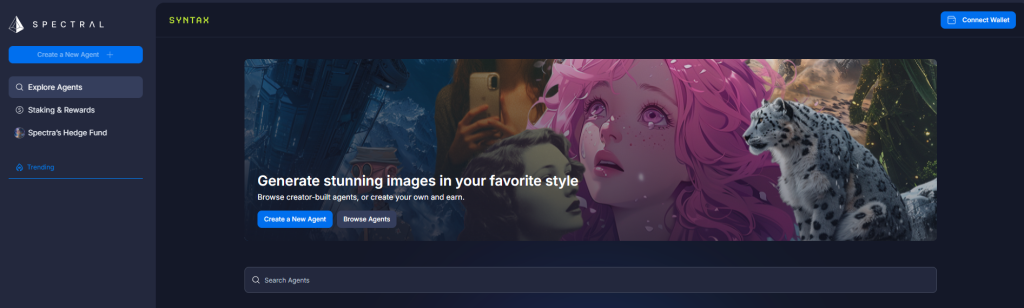
Next comes staking and governance. SPEC staking can reduce user fees and increase creator earnings, so staking participation should rise when the product feels worth using, not when price alone looks exciting. Governance activity also matters because it signals real community attention and coordination. Low governance usually means the token functions like a ticker. High governance does not guarantee price strength, but it often correlates with builders and power users sticking around.
Finally, exchange access and liquidity depth decide how easily new demand can actually express itself. A token can have the best product metrics in the world and still trade poorly if liquidity stays thin and market access stays narrow. Watch whether liquidity shifts from a single pool to multiple venues, and whether volume grows without the price whipping around like a leaf in a storm.
SPEC Max Supply Issue
SPEC can rally on low float, but supply mechanics can also cap upside quickly.
First, track the vesting and unlock schedule. Unlocks do not automatically mean dumping, but they create the opportunity for it. Markets price that opportunity in early, especially when liquidity stays shallow.
Second, watch incentive emissions. Reward programs can bootstrap activity, but they also create constant sell pressure from recipients who treat SPEC like revenue, not like ownership. If emissions rise faster than real usage, price tends to drift down even when the product looks “busy.”
Third is concentration risk. If a small set of wallets holds a large share of supply, they control volatility. Concentration does not equal manipulation, but it does mean the market can reprice quickly when one large holder decides to rebalance. In updates, always check whether top wallets reduce exposure into pumps or accumulate into dips.
Narrative and Macro Factors
Spectral sits near the AI and agent narrative, and that narrative trades like caffeine. It can spike hard, then crash when attention moves to the next shiny object. Treat sentiment as a short-term amplifier. It can accelerate moves that fundamentals already support, but it rarely sustains a price trend on its own. If you see a SPEC rally with no matching improvement in usage, staking, or liquidity, assume the move needs fuel it does not have.
Zoom out one more layer. Bitcoin dominance often dictates whether capital trickles into alts or stays parked in majors. In risk-on conditions, traders chase small caps, liquidity expands, and narratives run. In risk-off conditions, spreads widen, volume dries up, and unlocks hurt more because there are fewer natural buyers. Your driver model should always end with the tape: if the market does not want alt risk, SPEC can still build, but price will lag until liquidity returns.
Spectral (SPEC) Price Prediction 2026 and Beyond
The market currently prices SPEC off a relatively small float, which means the chart can move on thin liquidity, and future supply events can matter more than “sentiment” ever will.
So let’s model SPEC the way a grown-up models small-cap crypto: as ranges tied to assumptions. If the assumptions change, the range changes. No magic numbers, no “guaranteed targets,” no pretending we can see the future.
I’ll anchor demand to what Spectral actually sells: an onchain agent workflow and a marketplace surface. Spectral’s tokenomics framing puts real costs on usage (gas, transaction fees, usage fees) and then tries to make staking SPEC feel rational by offering fee reductions for users and better earnings rates for creators. If that loop works, SPEC can earn repeat demand. If it does not, SPEC mostly trades like a ticker.
Spectral (SPEC) 12 Month Price Prediction
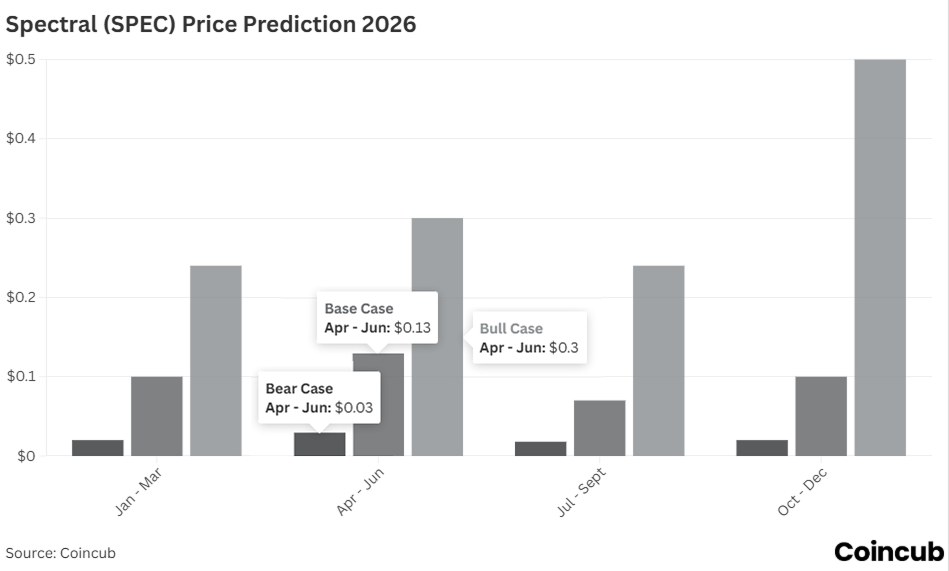
Base case: SPEC trading between $0.10 to $0.30
In the base case, Spectral keeps shipping, the product stays “real,” and usage slowly climbs, but the market still treats SPEC as a thin-float microcap with dilution overhang. You might see a steady rise in agents created and jobs executed, plus modest growth in staking because fee reductions and creator boosts start to matter for power users. Spectral’s own tokenomics post lays out the fee surfaces that would power this, including gas fees on Base, transaction fees calculated at 50 bps, and usage fees described as 10% on top of an API call cost.
In that world, price responds when demand shows up consistently, not when it spikes for three days. Liquidity still matters a lot here. Even if the product improves, SPEC can struggle to trend if liquidity stays shallow and the market cannot absorb modest selling without slippage. If you want a quick “reality check” while you update this range later, compare daily volume to expected unlock or reward distribution pressure. Low volume plus new supply usually pins the price.
Bull case: SPEC trading between $0.35 to $0.90
The bull case needs a specific kind of progress. Spectral must turn agents from a neat concept into something people actually depend on. That means repeat users, repeat fees, and creators who treat agent publishing like a business, not like a weekend experiment. When that happens, staking stops looking like “optional DeFi stuff” and starts looking like the cheapest way to use the platform. Spectral explicitly designs staking to reduce transaction fees for users and increase creator earnings share, so a usage ramp can realistically translate into more staked SPEC and a tighter effective float.
This scenario also assumes better market access. It does not require every top exchange on earth, but it does require enough depth that new buyers can build positions without launching the price into orbit and then watching it crater. Thin liquidity creates dramatic candles. Deep liquidity creates trends.
Bear case: SPEC trading between $0.03 to $0.12
The bear case does not need a scandal. It just needs math and indifference. SPEC currently has about 14.1% of its max supply circulating.
If unlocks, rewards, or treasury distributions expand the float faster than real demand grows, price drifts down until it finds a buyer who actually wants exposure. Recent news calls out how unlocks can swamp buy-side liquidity for SPEC-sized markets, though you should treat any third-party commentary as context and still verify primary sources before publishing.
In short, the “What price will SPEC reach in 2026?” question reads like this: does Spectral convert more users into “stakers who use the product,” or does SPEC remain a low-float trade that struggles once supply expands?
Spectral (SPEC) Price Prediction 2027-2028
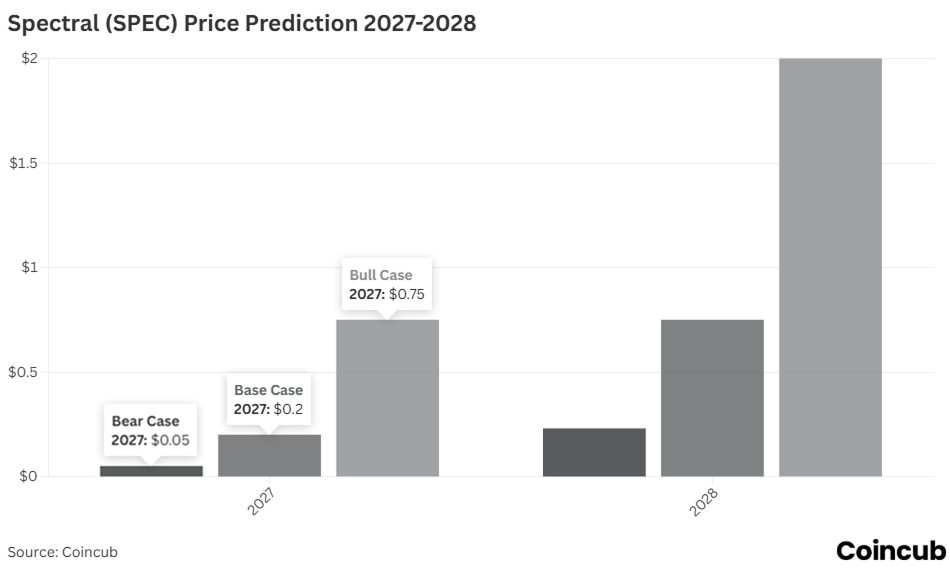
Base case: SPEC trading between $0.20 to $0.80
In the base case, Spectral builds an ecosystem that looks boring in the best way. Agents work. People reuse them. Creators specialize. Fees become predictable. Staking becomes common among the people who actually generate that fee activity, because the fee reduction and creator earnings boosts feel worth the opportunity cost of locking capital. The point here is not hype. The point is habit. When a platform becomes habit-forming, demand becomes smoother and less dependent on narratives.
At the same time, dilution continues. You should assume circulating supply rises meaningfully from today’s 14.10M over this window, because the max supply sits at 100M and projects usually distribute supply over time through unlocks and incentives.
In this base case, market cap expands faster than circulating supply, so price can rise even while float grows.
Bull case: SPEC trading between $0.90 to $2.50
The bull case looks like ecosystem maturity, not just product improvement. Spectral would need to become a standard coordination layer for onchain automation, where users do not just “try an agent,” they run workflows through agents because it saves time or reduces operational risk. On the token side, Spectral would need to keep staking utility compelling while keeping emissions and reward programs disciplined, so that the system does not pay users to show up and then immediately sell.
This scenario also assumes crypto markets remain willing to reward infrastructure narratives. AI and agents can still play a role here, but they should amplify fundamentals, not replace them. If SPEC rallies purely because “agents are back,” the move can fade as fast as it arrived.
Bear case: SPEC trading between $0.05 to $0.25
The long bear case usually feels quiet. The team ships. The community talks. The token underperforms anyway. You get modest usage, uneven retention, and recurring sell pressure from unlocks and incentive distribution. Meanwhile, competing platforms compress margins and make “agent creation” feel less differentiated. In that environment, SPEC can still pump occasionally, but it struggles to hold higher ranges because the market does not see durable demand.
The 2 to 3 year question is simple: does Spectral build a sticky agent marketplace where staking has clear economic value, or does it remain an interesting product with a token that trades supply?
Spectral (SPEC) Price Prediction 2030
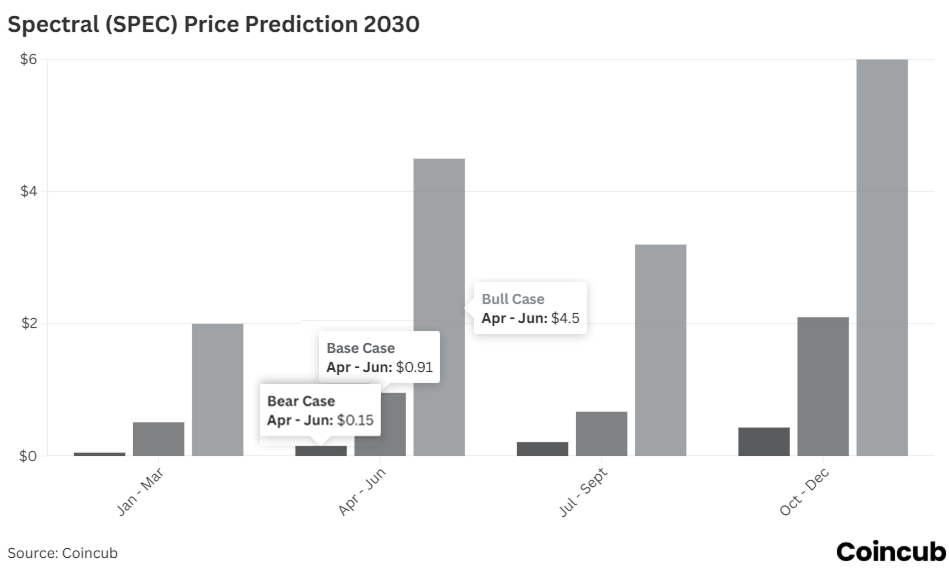
Five-year predictions should make you uncomfortable. Good. They should. At this horizon, you model regimes, not candles.
Base case: SPEC trading between $0.50 to $3.00
For SPEC to earn this range by 2030, three things need to be true. First, the product must mature into infrastructure people rely on, with agent usage that does not depend on a narrative cycle. Second, SPEC must retain a clear economic role through staking and governance that feels worth holding through multiple market cycles. Third, emissions and supply expansion must become predictable enough that the market can price the token without constant fear of surprise dilution. The current supply picture, 14.10M circulating out of 100M max, makes that third point non-negotiable.
In this base case, SPEC does not need to become a top-20 asset. It just needs to become a token with stable demand tied to stable usage.
Bull case: SPEC trading between $3.00 to $8.00+
This is the “macro tailwinds plus execution” scenario. It assumes broader global adoption of onchain finance and onchain automation, plus more institutional comfort with crypto infrastructure. Institutions do not buy narratives. They buy liquidity, governance clarity, risk controls, and market structure they can explain to committees. If Spectral can prove durable usage and predictable token mechanics, institutional flows can become a real factor.
This scenario also runs through the next Bitcoin halving, expected at block height 1,050,000 around March or April 2028, depending on block times.
Historically, halving cycles can shift liquidity and risk appetite across crypto. They do not guarantee anything, but they often influence whether capital rotates into alts and how long that rotation lasts. If the 2028 cycle produces a sustained risk-on regime and Spectral shows real traction, SPEC can ride both fundamentals and the tape.
Bear case: SPEC trading between $0.05 to $0.60
The long bear case happens when token mechanics never fully stabilize. Staking perks fail to justify lockups, emissions stay too leaky, or competitors commoditize the agent stack. Under that regime, SPEC trades like perpetual optionality. It spikes on attention and drifts down when attention leaves. Nothing “breaks,” but nothing compounds.
Risks of the Future of Spectral
SPEC trades in a market that can punish you for being right at the wrong time. Liquidity still looks thin, which means a modest buy can spike price and a modest sell can crater it. Slippage turns “I’ll just enter” into “why did I pay 6% extra,” especially on weekends or during market stress.
Supply risk sits right behind liquidity. SPEC has a large gap between circulating and max supply, so unlocks matter. Even if the team and early holders act responsibly, the market often prices unlocks like future selling because it knows some portion will hit exchanges. That overhang can cap rallies.
Then you have execution risk. Smart contracts can fail, and agent workflows add another layer of complexity. If an agent misfires, uses a faulty oracle, routes through a bad pool, or interacts with a compromised contract, users eat the loss. Spectral can reduce that risk with guardrails, but it cannot delete it.
Competition also moves fast. AI-agent frameworks, onchain automation tools, and intent-based systems all chase the same “make crypto usable” goal. If a rival wins distribution or ships a better creator economy, SPEC demand can stall.
Ultimately, the biggest risk is regulation. Automation and trading agents raise compliance questions depending on how people use them, especially around market abuse, consumer protection, and custody-like behavior. If regulators target the use cases, the token feels it first.
Frequently Asked Questions (FAQs)
What is Spectral (SPEC)?
Spectral is a Web3 protocol that helps people create and run onchain agents, meaning autonomous programs that can execute defined tasks on crypto rails.
What is SPEC used for?
SPEC primarily functions as the ecosystem’s governance and participation token.
Is SPEC a good investment in 2025?
Depends. SPEC is a risky investment considering that only a small percentage of its total supply is in circulation. Token unlocks could make it hard for the token to reach new all-time highs.
Why did SPEC pump or dump recently?
SPEC often moves on microcap mechanics: thin liquidity, big relative flows, and supply events. Recent updates point to token unlock pressure as a major driver of downside, while short-term bounces can happen fast when volume returns.
What is SPEC’s max supply and circulating supply?
SPEC has a max supply of 100,000,000. CoinMarketCap lists 14,104,697 SPEC as circulating supply. That accounts for only 14% of the total supply.
Where can I buy SPEC?
You can buy SPEC on Bybit, Gate, MEXC, Crypto.com, Bitfinex, BingX, XT, Uniswap, and Bitunix.
Where should I store SPEC?
Store SPEC in an EVM wallet you control if you want self-custody, especially if you plan to use Base or interact with dApps. A hardware wallet offers the safest default for long-term holding, while software wallets work fine for smaller amounts and active use.