Buy a Licensed Company
  Explore VASP Data
  Talk to an Expert

 Atis Shala
Atis is a senior analyst and community lead with four years of experience in crypto. He has a bachelor from the Rochester Institute of Technology.
Atis Shala
Atis is a senior analyst and community lead with four years of experience in crypto. He has a bachelor from the Rochester Institute of Technology.
Polkadot (DOT) Price Prediction 2026: Forecasts, JAM Upgrade & Tokenomics

Our industry has officially entered a bear market, but that does not mean the end of the world like many newcomers believe. As a matter of fact, this bear market is likely going to be the easiest compared to previous cycles, mainly because of how stable the foundation of the industry is at this point. Institutional money keeps flowing. Pair that up with the big corporations and normies onboarded through consumer apps, and you get a very active ecosystem.
We believe Polkadot (DOT) in 2026 is structurally and fundamentally bullish given the circumstances that the market is in right now. This bullishness is driven by the most radical economic and architectural transformations in the protocol’s history. Based on aggregate algorithmic modeling, institutional capital flows, and critical development milestones, DOT is positioned for a fundamental pricing that targets an average trading channel of $5.50 to $7.90, provided macroeconomic liquidity remains stable.
The Verdict: The overarching sentiment for 2026 leans strongly positive. While intense competition from alternative Layer-1 networks and Layer-2 rollups continues to command retail attention, Polkadot’s transition to an absolute scarcity model and a revenue-generating utility framework fundamentally alters its valuation thesis from an inflationary staking asset to a deflationary core infrastructure token.

DOT Price Forecasts: 2026 Outlook
| Market Scenario | Projected Price Target | Defining Market Conditions |
| Minimum Price Forecast | $1.00 – $2.00 | Bearish Support: Macroeconomic downturn, delayed institutional ETF approvals, or technical execution failures during network upgrades. |
| Average Price Forecast | $5.50 – $7.90 | Baseline Adoption: Post-upgrade stabilization, successful Coretime sales generation, and steady Substrate developer activity. |
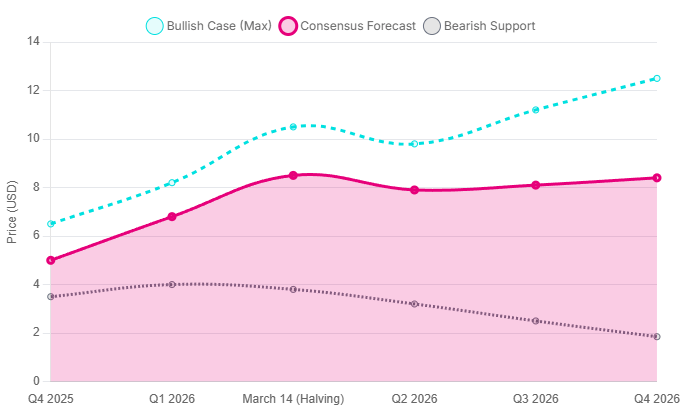
| Maximum Price Forecast | $10.50 – $15.00 | Bullish Breakout: Favorable U.S. Federal Reserve rate policies, massive institutional accumulation via 21Shares PDOT ETF, and flawless JAM testing. |
The primary macroeconomic driver for DOT’s 2026 valuation is the impending March 14, 2026 Issuance Cut (widely referred to within the ecosystem as the Polkadot Halving or Pi Day Hard Cap). This watershed event permanently caps the DOT supply at 2.1 billion tokens, severing the protocol from its legacy model of infinite inflation.
Based on current analyst consensus, algorithmic forecasting, and impending supply-side shocks, Polkadot is widely categorized as a strategic buy and long-term hold for 2026. The asset presents a highly asymmetric risk-to-reward ratio for investors willing to weather short-term volatility in exchange for exposure to the forthcoming JAM (Join-Accumulate Machine) protocol and the expanding integration of Real World Assets (RWA).
Polkadot Price Prediction 2026
The 2026 trajectory anticipates intense Q1 volatility peaking around the March 14 issuance cut, followed by a Q2 stabilization period ranging between $4.50 and $6.00. Assuming the successful execution of Polkadot 2.0 mechanisms, Q3 and Q4 are projected to push toward the $7.90 average, with bullish models targeting decile breakouts above $10.50 by year-end.
The temporal distribution of Polkadot’s price action in 2026 is inextricably linked to its technical roadmap and the scheduled execution of OpenGov referendums. By segmenting the year into quarters, a clear narrative emerges regarding how the market will price in fundamental scarcity alongside technological maturation.
Q1 2026 DOT Price Prediction
Projected DOT Price for Q1: $1.30 – $4.80
The first quarter of 2026 will be entirely dominated by the narrative surrounding the historic March 14 issuance reduction. Much like Bitcoin’s halving cycles, the broader cryptocurrency market operates heavily on “buy the rumor, sell the news” dynamics. Leading into the “Pi Day” cut, DOT is expected to experience heightened volatility as both retail and institutional actors attempt to front-run the supply shock.
Under the previous tokenomics model, DOT inflation hovered around 10%, generating roughly 120 million new tokens annually. In Q1, the market will aggressively price in the reality of the new 2.1 billion Hard Cap enacted by Referendums 1710 and 1828. The scheduled activation on March 14, 2026, will execute a 52.6% reduction in annual issuance, dropping the newly minted supply to approximately 56.88 million coins for the subsequent year.
Algorithmic predictions for Q1 reflect this tension. Binance consensus models forecast severe fluctuations between absolute lows and $3.77 in early March, anticipating massive speculative positioning. Accumulation by institutional entities anticipating the scarcity premium is likely to form a solid support floor, heavily mitigating downside risk below the $1.00 to $2.00 threshold. During this phase, DOT will repeatedly test critical psychological resistances around the $3.00 and $4.00 levels as short-term traders exit positions leading into the event itself.
DOT Price Prediction for Q2 2026
Projected DOT Price for Q2: $4.50 – $6.00
Following the March 14 implementation of the issuance cut, Q2 will serve as a fundamental stabilization phase. The network’s inflation rate will instantly drop, forcing market participants to adjust to a mathematically constrained supply environment. Furthermore, Q2 will witness the maturing of the Polkadot Hub, which launched its core components in late 2025 as the unified portal for staking, governance, and cross-chain asset management.
During this quarter, the economic effectiveness of Agile Coretime will be heavily scrutinized. As blockspace is sold dynamically rather than via legacy parachain slot auctions, the revenue generated from Coretime sales will become a vital metric for network health. The legacy model forced parachains into massive DOT lockups, creating artificial scarcity but severely limiting ecosystem participation. If Q2 data demonstrates that developer adoption of on-demand Coretime is robust, proving the network can sustain itself on utility-driven revenue rather than inflationary block rewards, DOT will likely consolidate comfortably in the mid-range.
Furthermore, Q2 will fully realize the impact of the Asset Hub migration that occurred in late 2025, which stripped the Relay Chain of basic balances and staking logic to drastically increase systemic efficiency. As these modular efficiencies become apparent in latency reductions, developer confidence is expected to stabilize the token’s price floor.
Polkadot Price Prediction Q3 & Q4 2026
Projected DOT Price for Q3 & Q4: $6.00 – $10.50
The latter half of 2026 will shift investor focus from supply-side tokenomics toward raw technological capability. Q3 and Q4 are slated for critical milestones in the testing and early deployment phases of the JAM (Join-Accumulate Machine) upgrade, the architecture heralded as Polkadot 3.0. As the 43 independent implementation teams competing for the 10 million DOT prize pool begin demonstrating conformance to the Polkadot Gray Paper specifications, the narrative of Polkadot as a decentralized “Global Supercomputer” will gain significant mainstream traction.
If the broader cryptocurrency market enters a macroeconomic bull phase, spurred by anticipated U.S. Federal Reserve rate adjustments, a weakening Dollar Index (DXY), and increased global liquidity, DOT’s fixed supply mechanics will heavily amplify upward price action. A successful alignment of macro-liquidity and the JAM technological rollout provides the necessary momentum to breach the $8.00 resistance. Bullish models from Blockchain Reporter and Investing Haven indicate that sustained ecosystem growth during this period could push DOT toward $11.48, with maximum Q4 extensions testing the $13.00 to $15.00 zones.
Fundamental Analysis: The “Why” Behind the Price of DOT
DOT’s long-term valuation in 2026 is fundamentally underwritten by three transformative pillars: a radical shift from unlimited inflation to absolute scarcity (the 2.1B Hard Cap), the democratization of network access via Agile Coretime, and the transition toward the JAM protocol, which completely redefines the network’s throughput and computational utility.
To accurately forecast Polkadot’s long-term value proposition and rank its validity as a premier Layer-0 infrastructure, an exhaustive examination of its underlying fundamental architecture is required. The network is undergoing a metamorphosis that touches every aspect of its economics, governance, and code base, rendering historical price models obsolete.
The Tokenomics Overhaul (March 2026)
For years, Polkadot’s primary fundamental critique from institutional investors was its aggressive inflationary model. Designed to bootstrap network security by incentivizing high staking participation in its Nominated Proof-of-Stake (NPoS) system, the protocol historically minted roughly 120 million DOT annually with absolutely no maximum supply cap. While effective for early-stage development, this constant printing structurally diluted the purchasing power of long-term holders. Under the legacy model, projections indicated the DOT supply would balloon to over 3.4 billion tokens by the year 2040.
This paradigm was permanently shattered by the passing of OpenGov Referendums 1710 and 1828, collectively known as the “Hard Pressure” proposals. Championed by the decentralized community, these referendums established a strict 2.1 Billion DOT Hard Cap.
The mechanics of this overhaul execute precisely on March 14, 2026 (“Pi Day”). Unlike Bitcoin’s abrupt 50% block subsidy halving every four years, Polkadot utilizes a mathematically smoothed, stepped disinflationary formula. Issuance is reduced every two years by exactly 13.14% (a numerical homage to the value of Pi) of the remaining issuance required to reach the hard cap.
Immediately following this inaugural cut in 2026, the annual inflation rate will plummet from ~10% to approximately 3.11%, dropping structurally below 1% by the early 2030s.6 This creates immense deflationary pressure. By replacing reliance on infinite token printing with a self-sustaining Treasury Proposal system funded by actual network usage, the DOT token transitions from a highly inflationary utility asset to a demonstrably scarce store of value. The maximum circulating supply will plateau near 1.91 billion by 2040, entirely ceasing emission around the year 2160.
Polkadot 2.0 & Agile Coretime
Polkadot 1.0 relied entirely on “Parachain Auctions,” a model where developers had to lock up massive amounts of DOT for up to two years to secure a dedicated core (a parachain slot) on the Relay Chain. This created an artificially high barrier to entry, locking out small-to-medium development teams, draining secondary market liquidity, and stifling organic ecosystem growth. Furthermore, it led to horrific resource allocation inefficiencies; a parachain produced blocks at a fixed 12-second interval regardless of whether it was processing zero transactions or experiencing severe network congestion.
Agile Coretime fundamentally resolves these bottlenecks, marking the true dawn of Polkadot 2.0. Parachain auctions have been completely phased out in favor of dynamic “Coretime Sales.” Computing power is now treated as a fluid, commoditized resource. Developers can purchase “Bulk Coretime” for predictable, continuous operation (up to 28 days), or utilize “On-Demand Coretime” via a flexible pay-as-you-go model.
Coupled with Elastic Scaling, which allows a single decentralized application (dApp) to temporarily utilize multiple cores simultaneously to handle traffic spikes, Polkadot 2.0 operates with cloud-like AWS efficiency. This scaling upgrade compresses block times from 6 seconds down to sub-2 seconds, drastically improving the User Experience (UX). Crucially for investors, the DOT used to purchase Coretime generates intrinsic revenue for the network, providing an organic demand sink that directly offsets the reduced staking yields caused by the new Hard Cap.
The JAM Chain (Join-Accumulate Machine)
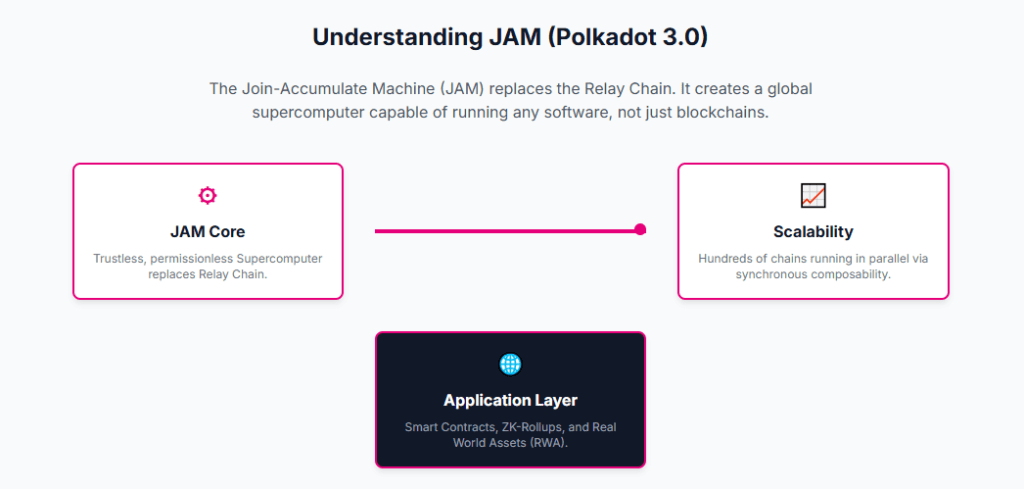
If Agile Coretime defines Polkadot 2.0, the JAM Protocol represents the visionary leap to Polkadot 3.0. Conceptualized by founder Dr. Gavin Wood in the comprehensive Polkadot Gray Paper, JAM is a monumental architectural upgrade designed to completely replace the existing Relay Chain.
For your information, JAM (Join-Accumulate Machine) is a permissionless, trustless supercomputer framework. It strips away the specific blockchain logic of the legacy Relay Chain and replaces it with a minimalistic, generalized computational environment powered by the RISC-V Polkadot Virtual Machine (PVM).
Through a novel computational paradigm called CoreJAM (Collect, Refine, Join, Accumulate), execution is heavily parallelized across 350+ cores. The “Collect” and “Refine” stages occur off-chain to maximize efficiency, while the “Join” and “Accumulate” stages happen on-chain to ensure coherent state integration.
The performance metrics targeted by the Gray Paper are staggering. JAM targets a theoretical capacity of 1 million transactions per second (TPS), 850 MB/s of bandwidth, and 2 Petabytes of data availability. By comparison, current iterations of Solana process roughly 125 MB/s, while Ethereum 2.0 processes a mere 1.3 MB/s.
This transitions Polkadot’s narrative away from merely being an “interoperability hub” connecting separate parachains, toward becoming a “Decentralized Global Supercomputer.” In 2026, as the JAM “Toaster” and “Tart” (Testing, Analysis and Research Telemetry) testnets mature, and the 43 implementation teams vie for the 10 million DOT conformance prize, this narrative shift will act as a massive fundamental tailwind. It provides tangible proof that DOT can rival the monolithic execution speeds of centralized competitors without sacrificing its industry-leading shared security.
Institutional Adoption & ETF Narratives
Beyond raw technological capability, DOT’s 2026 valuation relies heavily on institutional capital pipelines. The successful approval of Bitcoin and Ethereum spot ETFs established a regulatory blueprint that major altcoins are actively pursuing.
Asset management giants like 21Shares have filed to launch a Polkadot Trust ETF, utilizing the CME CF Polkadot Index as a standardized pricing benchmark. The proposed 21Shares structure features a highly innovative twist specifically designed for institutional yield generation: the intent to stake 40% to 70% of the underlying DOT. This allows traditional equity investors to capture native blockchain yield without directly managing cryptographic keys.
While the U.S. Securities and Exchange Commission (SEC) has historically delayed these filings, pushing the 21Shares verdict deep into extended review periods under Section 19(b)(2) of the Securities Exchange Act, the eventual integration of DOT into traditional finance (TradFi) rails remains a critical adoption catalyst for 2026. Furthermore, macroeconomic research from Messari indicates that institutional conviction in tokenized assets and DePIN (Decentralized Physical Infrastructure Networks) heavily favors robust, scalable frameworks. With projects like Peaq natively building DePIN on Substrate, the fundamental demand for underlying DOT blockspace is projected to scale proportionally with institutional interest.
Expert Opinions & Analyst Consensus on DOT
The aggregate consensus of algorithmic models and market analysts predicts a wide average trading channel of $5.50 to $11.48 for DOT in 2026. Bullish institutional models forecast peaks near $36.00 relying on tech adoption, while bearish models warn of sub-$2.00 capitulations if Layer-2 competition continues to siphon retail liquidity.
Aggregating expert opinions provides a holistic view of market sentiment, balancing hyper-optimistic technological forecasts with grounded, data-driven risk assessments. Evaluating the Electric Capital and Messari reports provides crucial context regarding developer health, which acts as a leading indicator for future price action.
However, before assessing price, analysts look to developer retention. According to the highly respected Electric Capital Developer Report, Polkadot consistently ranks in the top tiers of the entire cryptocurrency industry. Going into 2026, the Polkadot ecosystem boasts over 8,900 active developers and processed roughly 684,000 code commits in the preceding year. Despite periods of depressed price action, the network recorded a massive 15,000 code updates directly to its core protocol, signaling intense, uninterrupted development momentum. This high retention rate provides analysts with the confidence that Polkadot is not a “dead chain,” but rather an undervalued infrastructure layer.
The Bullish Case for DOT: $15.00 to $36.00+
Bullish analysts focus primarily on the maturation of Polkadot 2.0 and the tokenomics overhaul. Forecasting models from Investing Haven project that DOT could surge to $27.20 in 2026, with a maximum potential of $36.25 if the asset decisively breaks critical Fibonacci resistance levels. Similarly, Blockchain Reporter algorithms target an average of $11.48 and a high of $13.01 for 2026. These optimistic scenarios hinge entirely on the successful adoption of Agile Coretime by enterprise developers and a smooth rollout of JAM testnets, establishing DOT as the premier Web3 computational layer. The bullish thesis assumes that as the 2.1B hard cap chokes the liquid supply, even modest increases in demand will trigger violent upward price discovery.
The Bearish Case for DOT: Under $1.00
Conversely, bearish analysts warn that superior technology does not guarantee market share. Short-term algorithmic models from Changelly and CoinCodex have frequently flagged heavy bearish sentiment, pointing to periods where DOT could dip to under $1.00 or even test the absolute $1.40 support floor during severe macro downturns. The primary bearish argument is centered on “attention economics.” Analysts fear that Ethereum Layer-2 rollups (e.g., Arbitrum, Base) and high-performance monolithic chains (Solana) will continue to monopolize retail liquidity and developer attention, rendering Polkadot an impressive but underutilized ghost town.
Technical Analysis of DOT: Chart Patterns to Watch
DOT’s technical posture in 2026 is defined by absolute critical support at $2.28-$3.00, formidable macro resistance at $14.04 (the 50% Fibonacci level), and the interplay between the 50-week and 200-week moving averages, which will indicate the confirmation of a long-term macro reversal.
While fundamental factors and protocol upgrades dictate DOT’s long-term intrinsic value, algorithmic trading bots and retail speculation are governed strictly by Technical Analysis (TA). Navigating the 2026 price action requires monitoring distinct chart patterns, moving averages, and historical price floors.
Support and Resistance Levels for DOT
- Support Zones: The absolute critical psychological and historical support zones rest at $3.00 and $4.00. During the depths of the 2024-2025 bear markets, institutional accumulation heavily defended these floors. In the event of an unexpected macroeconomic crash, such as hawkish Fed rate hikes or a spike in the DXY, algorithmic trading desks will look to the $2.28 to $2.30 range as the last line of technical defense before absolute capitulation.
- Resistance & Fibonacci Retracements: DOT’s all-time high (ATH) was established in November 2021 at roughly $55.00. Applying macroeconomic Fibonacci retracement levels from this ATH down to the cycle lows, the most critical battleground for 2026 is the $14.04 level (the 50% Fibonacci retracement). A confirmed weekly candle close above this specific resistance would technically invalidate the multi-year bearish market structure. This breakout would confirm a definitive macro-bull trend, exposing the $20.00 to $27.00 zones for price discovery.
Moving Averages (SMA) & Market Momentum
A comprehensive view of the Simple Moving Averages (SMA) across various timeframes reveals the ongoing tug-of-war between short-term market noise and long-term trend establishment.
- The 50-Week and 200-Week SMA: On the macro weekly timeframe, the 200-week SMA acts as a formidable ceiling, often sloping downward during prolonged consolidations. However, the 50-week SMA serves as a dynamic tracker of medium-term recovery. Traders in 2026 will closely monitor the potential for a Golden Cross, a heavily bullish technical event where the 50-week SMA crosses above the 200-week SMA. Should this occur in mid-to-late 2026 alongside the JAM protocol developments, it would serve as an aggressive “buy” signal for automated trend-following funds.
- Oscillators (RSI & MACD): The Relative Strength Index (RSI) on the weekly timeframe remains a vital indicator of momentum exhaustion. Extended periods below the 30 threshold (indicating oversold conditions) historically precede violent upside mean-reversions. Conversely, the Moving Average Convergence Divergence (MACD) histogram on the weekly charts will be utilized to confirm trend strength; a bullish crossover above the zero line in Q1 2026 will be required to sustain momentum into the Pi Day halving event.
Polkadot vs. Competitors in 2026
In 2026, Polkadot differentiates itself from Ethereum L2s, Cosmos, and Solana through its “Shared Security” model and the unparalleled parallelized throughput of the JAM supercomputer architecture. However, it faces intense, ongoing competition regarding developer mindshare and retail liquidity.
To accurately contextualize Polkadot’s value proposition and viability as an investment, it must be benchmarked against the broader Layer-1 (L1) and Layer-2 (L2) landscape. The blockchain industry has fragmented into distinct architectural philosophies: monolithic execution, modular rollups, and interoperable networks.
Comparison Table: Polkadot vs. Major Competitors
| Architectural Feature | Polkadot (with JAM & Agile Coretime) | Ethereum (L1 + L2 Rollups) | Cosmos (Interchain) | Solana (L1) |
| Throughput / Speed | ~1 Million TPS (JAM capacity); 850 MB/s bandwidth; sub-2s block times. | ~15-30 TPS (Base L1); Thousands via L2s, prioritizing base decentralization. | High throughput per sovereign zone, bottlenecked by IBC relayers. | ~3,000-65,000 TPS (Monolithic, parallel smart contracts); 400ms block times. |
| Security Model | Shared Security: All parachains inherit Relay Chain/JAM security instantly, lowering builder risk. | Inherited L2 Security: Rollups inherit L1 security, but bridging carries severe smart contract risks. | Sovereign Security: Each chain must bootstrap and incentivize its own validator set. | Monolithic Security: Global state consensus; high hardware requirements for validators. |
| Interoperability & Liquidity | Native, synchronous composability via XCM; unified liquidity across the Asset Hub. | Fragmented Liquidity: Capital isolated across separate L2s (Arbitrum, Optimism) requiring external bridges. | Opt-in interoperability via IBC; smooth but asynchronous coordination. | Single-layer composability; highly unified liquidity, excellent for trading. |
| Primary Developer Focus | Enterprise, DePIN, heavy computational tasks, protocol-level customizability (Substrate). | Institutional DeFi, Blue-chip NFTs, standard EVM applications, high baseline trust. | App-chains requiring absolute sovereign governance and custom slashing rules. | Consumer apps, gaming, meme-coins, low-latency perpetual trading. |
Polkadot’s primary architectural advantage over Cosmos is shared security, which completely alleviates the massive financial burden of bootstrapping a validator set for new projects. Against Ethereum L2s, Polkadot prevents the horrific User Experience (UX) of fragmented liquidity and the constant threat of multi-million dollar bridge hacks.
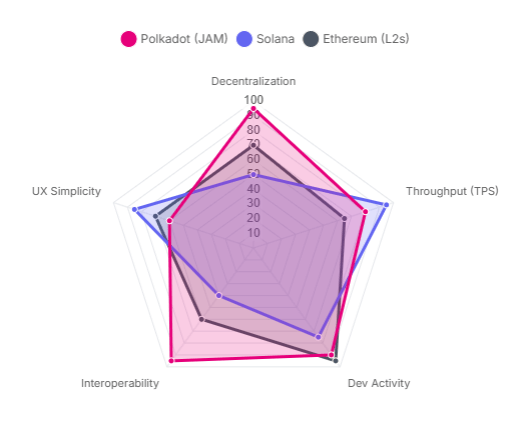
Against Solana, Polkadot sacrifices some immediate retail convenience for robust, distributed decentralization and significantly higher data availability capabilities via the upcoming JAM architecture. If Polkadot can successfully market the JAM Grid, it will position itself not just as a blockchain, but as a Web3 equivalent to Amazon Web Services (AWS).
What Factors Could Crash the Price of DOT?
Polkadot’s 2026 outlook is continuously threatened by severe execution risks surrounding the complex JAM codebase, chronic User Experience (UX) friction driving away retail adoption, and the looming macro threat of SEC regulatory classification.
Execution Risk & The Complexity Trap: Polkadot’s Architecture is Complex
Founder Dr. Gavin Wood has publicly acknowledged the sheer difficulty of maintaining the codebase, with community members frequently raising concerns about “spaghetti code” and performance degradation during critical network upgrades. The transition from the legacy Relay Chain to the Asset Hub, and ultimately to the JAM supercomputer, represents an unprecedented engineering hurdle. A catastrophic bug during this migration, or repeated delays in the JAM conformance timeline, would severely damage institutional confidence and crash the asset’s price. Data inconsistencies, such as conflicting core sales data between marketplace platforms like Lastic and RegionX, further undermine trust in the ecosystem’s reliability.
User Experience (UX) Friction: Raw Developer Activity Rarely Translates to Retail Usability
The native dot-apps interface and Substrate wallet architecture are frequently cited by users as convoluted compared to the seamless experience of Solana’s Phantom wallet or Ethereum’s MetaMask. Nightmare scenarios involving token migrations, such as the complex unvesting and cross-chain teleportation required for basic bridging, frustrate average users and stifle adoption. If Polkadot cannot abstract away its complexity via intuitive front-ends, it will fail to capture the retail liquidity necessary to sustain price appreciation.
Regulatory Status & SEC Overreach: Regulation-by-Enforcement
While the Web3 Foundation has aggressively argued that DOT has “morphed” from a security into software over its lifespan, a formal SEC classification of DOT as an unregistered security remains a tail risk. Such a classification would effectively kill U.S. exchange listings, decimate liquidity, and permanently block the approval of the highly anticipated 21Shares Polkadot ETF.
Frequently Asked Questions (FAQ)
Will Polkadot reach $100 in 2026?
Highly unlikely. Reaching $100 requires DOT to hit a market capitalization exceeding $150 billion.47 While the protocol is fundamentally strong and the tokenomics are improving, 2026 projections cap realistic bullish targets around $10.50 to $15.00 based on macroeconomic liquidity parameters and the current circulating supply.
Is Polkadot dead?
No. According to comprehensive data from Messari and Electric Capital reports, Polkadot consistently ranks in the top tier of blockchain ecosystems for developer activity. The network supports over 8,900 active builders, generated 684,000 code commits in the past year, and manages a massive OpenGov treasury, proving it is a highly active and evolving infrastructure layer.
When is the Polkadot Halving?
The first major Polkadot issuance cut will be executed on March 14, 2026 (mathematically stylized as Pi Day). Following the community approval of OpenGov referendums 1710 and 1828, this event enacts a strict 2.1 billion DOT Hard Cap, reducing the annual inflation rate by 13.14% every two years until issuance ceases entirely.
What is Polkadot JAM?
JAM (Join-Accumulate Machine) represents the Polkadot 3.0 architectural upgrade. Detailed in the Polkadot Gray Paper, JAM is designed to replace the legacy Relay Chain with a decentralized, trustless supercomputer. It has a theoretical throughput of 1 million TPS, 850 MB/s of bandwidth, and 2 Petabytes of data availability.