


 Buy a Licensed Company
  Explore VASP Data
  Talk to an Expert

 Atis Shala
Atis is a senior analyst and community lead with four years of experience in crypto. He has a bachelor from the Rochester Institute of Technology.
Atis Shala
Atis is a senior analyst and community lead with four years of experience in crypto. He has a bachelor from the Rochester Institute of Technology.
Algorand (ALGO) Price Prediction 2026-2030
Algorand (ALGO) trades at about $0.111 as of 22 September 2026, giving it a market capitalisation of roughly $1.0 billion. That is about 47% above the all-time low of $0.0757 set on 29 July 2026, yet more than 96% below the token’s 2019 peak. Any Algorand price prediction therefore starts from an uncomfortable fact: the network has kept shipping technology while the token has kept losing value.
What will decide ALGO’s future price is whether rising network utility turns into lasting demand for the token. Stablecoin volume, real-world asset (RWA) tokenisation, staking economics after January 2027 and the release of the remaining 960 million ALGO carry most of the weight. Because these can move in very different directions, every ALGO price forecast below is a bear, base or bull scenario, and none of them is a guaranteed outcome.
Algorand Price Prediction at a Glance
Before looking at each year, it helps to see where ALGO stands today (September 2026).

| Metric | Value |
|---|---|
| Current price (22 September 2026) | About $0.111 |
| Market capitalisation | About $1.0 billion |
| Circulating supply (end of August 2026) | 9.04 billion ALGO (90.4% of max) |
| Maximum supply | 10 billion ALGO |
| 30-day performance | Up about 21.6% |
| All-time low | $0.0757 (29 July 2026) |
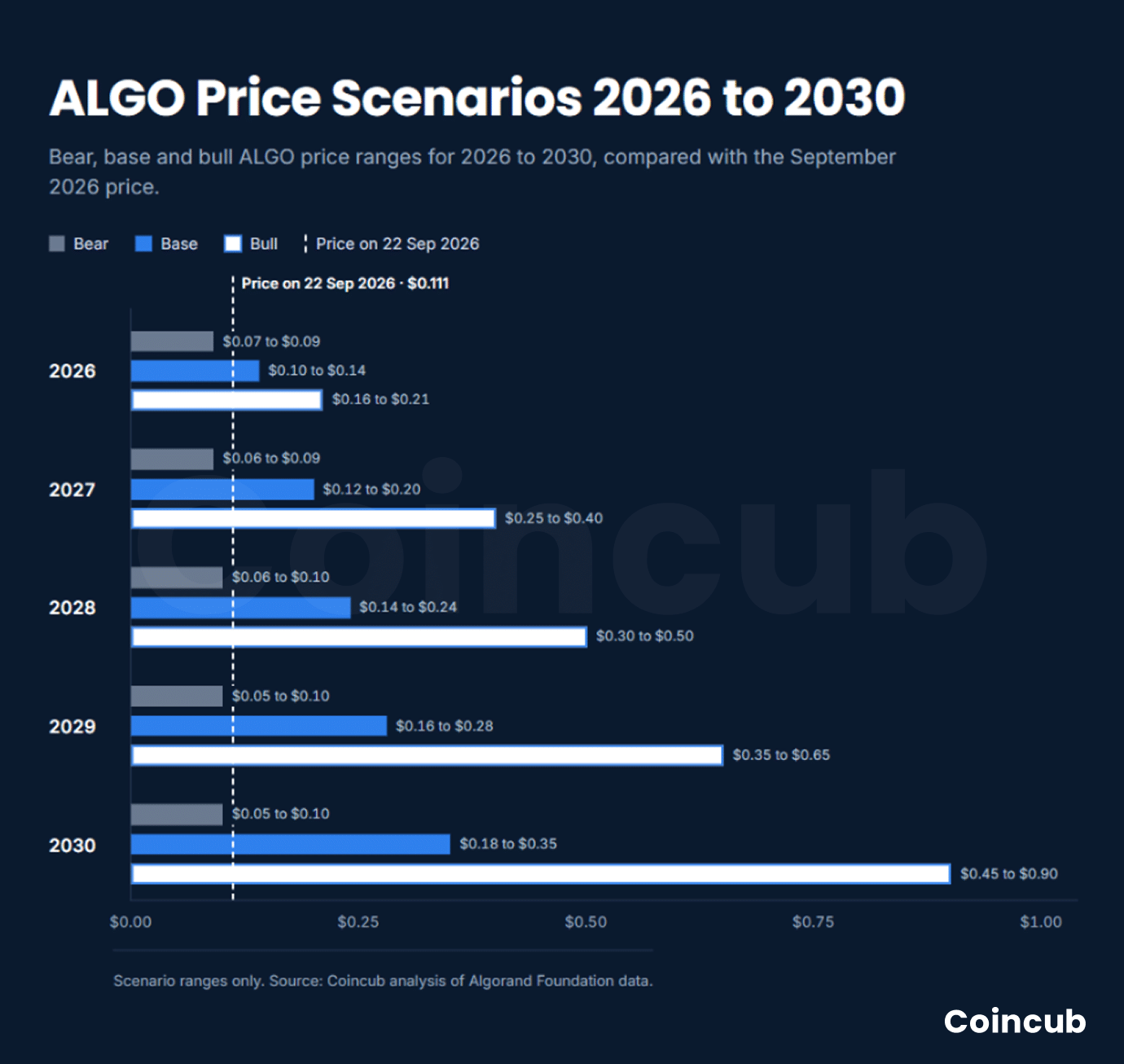
Those figures describe a token rebounding from a very depressed base. Building on them, the table below sets out our scenario ranges, with an assumed supply column because every extra ALGO in circulation lowers the price a given market cap can support.
| Year | Assumed supply | Bear case | Base case | Bull case |
|---|---|---|---|---|
| 2026 (year end) | 9.1B ALGO | $0.07 to $0.09 | $0.10 to $0.14 | $0.16 to $0.21 |
| 2027 | 9.4B ALGO | $0.06 to $0.09 | $0.12 to $0.20 | $0.25 to $0.40 |
| 2028 | 9.7B ALGO | $0.06 to $0.10 | $0.14 to $0.24 | $0.30 to $0.50 |
| 2029 | 9.9B ALGO | $0.05 to $0.10 | $0.16 to $0.28 | $0.35 to $0.65 |
| 2030 | 10B ALGO | $0.05 to $0.10 | $0.18 to $0.35 | $0.45 to $0.90 |
On balance, the bullish factors are strong payment activity, native post-quantum accounts and a new CEO focused on institutional finance. The bearish factors are falling dollar-denominated DeFi value, the end of Foundation staking bonuses in January 2027 and continued token dilution.
Algorand (ALGO) Price Prediction for 2026
With only about three months of 2026 left, the Algorand price in 2026 depends mostly on whether the recent rebound can hold. ALGO bottomed at $0.0757 on 29 July and has since risen about 16.8% in a week and 21.6% in 30 days, a move that coincided with the v5.0.0 upgrade in late August.
Network Activity, Staking and Supply
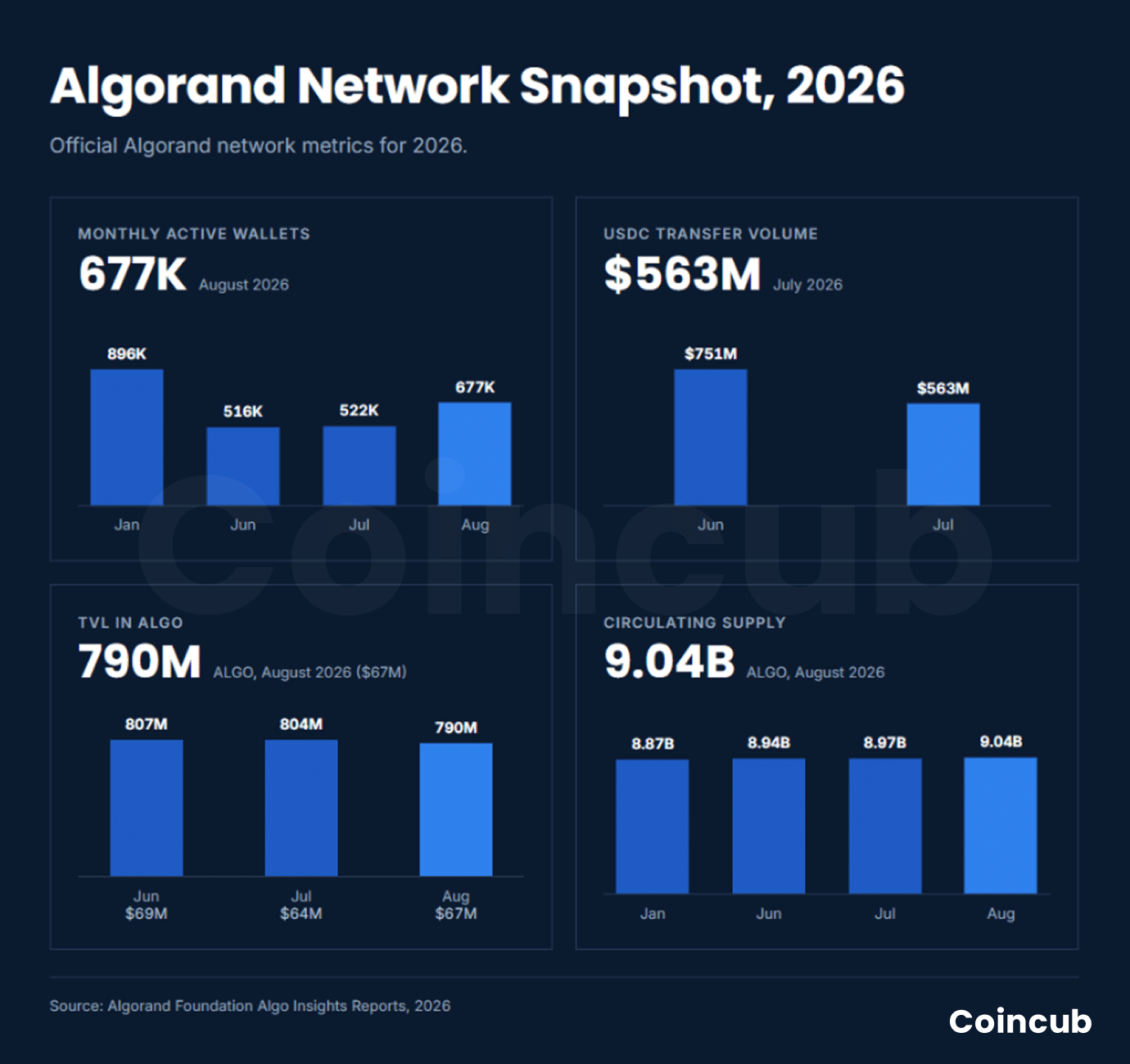
Beneath the price, the network is busier than the chart suggests. The Algorand Foundation’s June 2026 Algo Insights Report recorded $751 million in USDC transfer volume, 807 million ALGO locked in DeFi and a circulating supply of 8.94 billion ALGO. By August, monthly active wallets had climbed 29.6% to 677,000, according to the August 2026 Algo Insights Report. However, total value locked (TVL) stood at only $67 million, so much of the value moving across Algorand does not stay there.
At the same time, more than 2.02 billion ALGO was staked, and stakers earned 6.74 million ALGO in August, or roughly 4% a year at that pace. Supply keeps rising too, by about 24 million ALGO a month in 2026. Readers new to the mechanics can start with how crypto staking rewards are earned.
2026 Scenarios
Taking these factors together, the near-term catalysts are post-quantum account adoption and clarity on staking rewards after January 2027. In the bear case, ALGO retests its summer low at $0.07 to $0.09. The base case sees it consolidating between $0.10 and $0.14, and the bull case lifts it to $0.16 to $0.21 on a strong market.
ALGO Price Prediction for 2027
Looking further out, 2027 tests Algorand’s economics most directly. According to the Algorand staking rewards FAQ, rewards come from 50% of transaction fees plus a Foundation bonus lasting roughly 24 months from January 2025, so fees must carry more of the load from 2027. The v5.0.0 upgrade prepared for this by introducing usage-based fees, which charge more for resource-heavy transactions.
Adoption and developer trends are mixed. Stablecoin supply on Algorand was only $43 million in August, small for a $1 billion network, although stablecoins’ growing role in payments gives Algorand room to grow. New asset creation reached 305,000 in August, while deployed smart contracts fell from 808,000 in January to 603,000.
Accordingly, our 2027 bear case of $0.06 to $0.09 reflects a reward cliff and a weak market. The base case of $0.12 to $0.20 assumes a smooth shift to fee-funded staking, and the bull case of $0.25 to $0.40 requires a broad rally plus clear stablecoin and RWA growth.
Algorand Price Prediction 2030
By 2030, the question becomes whether Algorand has secured a durable role in on-chain finance. On supply, the remaining 960 million ALGO would be close to fully circulating by 2029 or 2030 at the current pace, and the Foundation’s page on the ALGO token confirms the 10 billion cap. After that, dilution stops.
Demand could come from tokenisation and payments. VersaBank’s US tokenised deposit pilot, announced in August 2025, runs on Algorand, Ethereum and Stellar. Meanwhile, x402 agent payments on Algorand settled $174,000 across 615,000 transfers in August 2026.
With about 10 billion ALGO circulating, each $1 billion of market cap equals roughly $0.10 per token. That gives an ALGO price in 2030 of $0.05 to $0.10 in the bear case, $0.18 to $0.35 in the base case and $0.45 to $0.90 in the bull case.
What Could Drive ALGO Higher?
Those upper ranges depend on a handful of drivers. The first is network usage, because heavier activity generates more fees for stakers under the new fee model. Stablecoins and payments come next, where June’s $751 million in USDC volume shows real settlement demand. RWA tokenisation, such as bank deposit pilots moving into production, would add further fee demand, while v5.0.0’s larger smart contracts help developers build more complex applications.
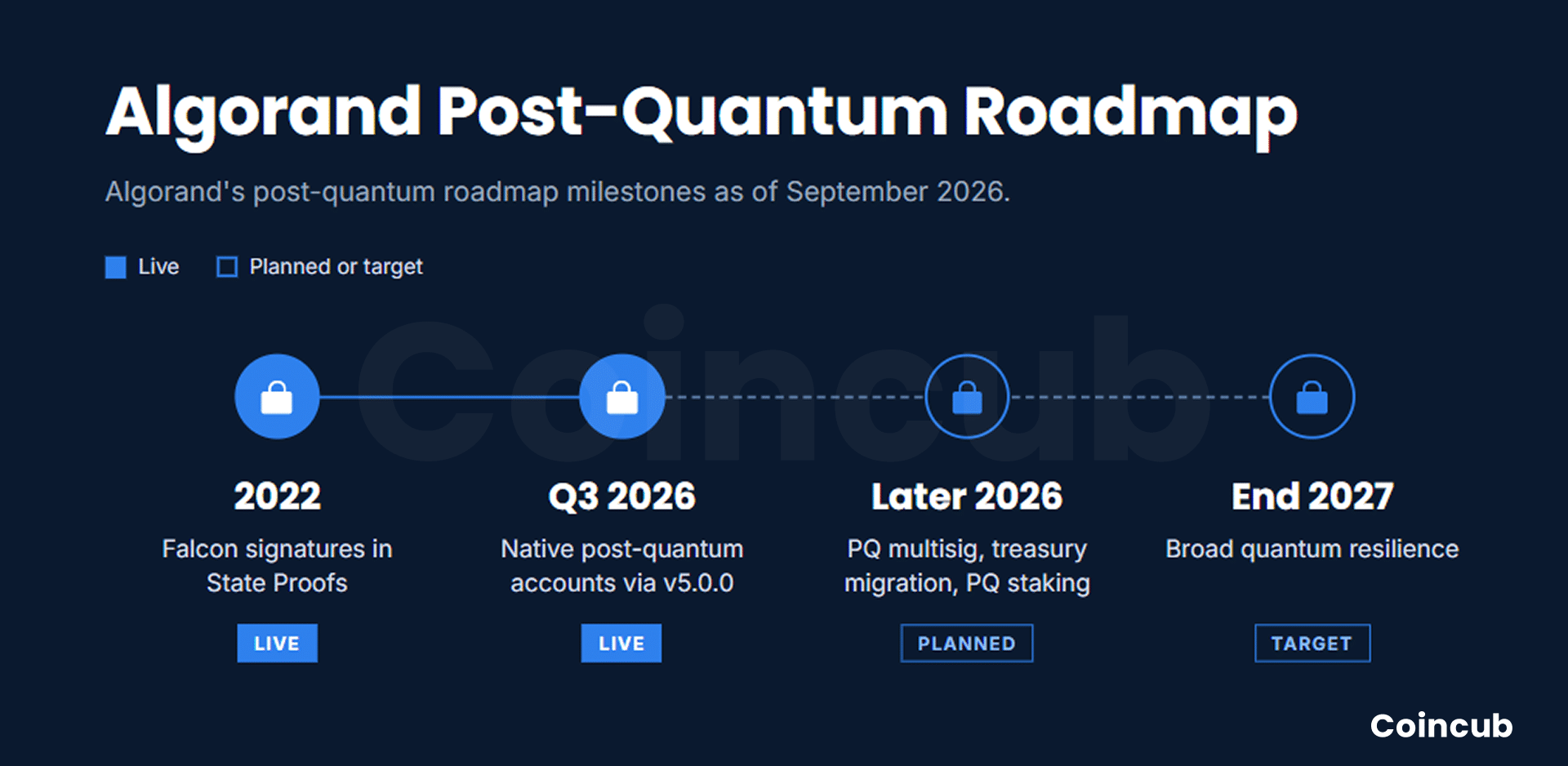
The most distinctive driver, though, is quantum security. The Algorand Foundation’s post-quantum security roadmap, published on 18 June 2026, targets broad quantum resilience by the end of 2027, with milestones beginning in Q3 2026. The first arrived on schedule when native Falcon-1024 accounts launched with the v5.0.0 protocol upgrade. Institutions worried about how quantum computing threatens crypto wallets may favour chains that finish this work early.
What Could Push ALGO Lower?
Every driver has a counterweight. Weak crypto markets hit mid-cap altcoins hardest, as July’s all-time low showed, and larger ecosystems such as Ethereum and Solana, covered in the Solana price prediction, compete for the same issuers and developers. Activity can also fade, as when monthly active wallets fell from 896,000 in January to 516,000 in June.
Beyond that, supply and value capture pose deeper risks. Another 960 million ALGO must still enter circulation just as Foundation staking bonuses end. Above all, Algorand fees are tiny by design, so the network can move billions in USDC while generating very little demand for ALGO.
Algorand Price Prediction Methodology
Given how easily usage and token value drift apart, our Algorand forecast uses a market-cap model. We estimate a plausible market cap for each scenario from today’s $1.0 billion valuation and the network activity assumed, then divide it by expected circulating supply. Supply extends the 2026 release pace of about 24 million ALGO a month toward the 10 billion cap.
To judge which scenario is unfolding, we track the monthly Algo Insights metrics: stablecoin volume and float, TVL in ALGO and dollars, active wallets and staking. Historical price extrapolation alone is insufficient, because ALGO fell more than 96% from its 2019 high while circulating supply grew to over 90% of the cap.
Is ALGO a Good Investment?
Whether ALGO fits a portfolio depends on each reader’s goals and risk tolerance, so this article gives no buy or sell verdict. Instead, investors would need to assess whether fees can fund staking after January 2027, whether stablecoin and RWA value grows in dollar terms, and whether the post-quantum roadmap wins institutional users.
On the reward side, ALGO offers a capped supply, roughly 4% staking returns and a price near its all-time low. On the risk side, it faces dilution until about 2030, a subsidy cliff and weak value capture. Readers comparing options can review the best crypto to buy in 2026 or compare other crypto price predictions.
Frequently Asked Questions (FAQ)
Can ALGO reach $1? +
ALGO reaching $1 would require a market cap of roughly $10 billion once all 10 billion tokens circulate, about ten times its September 2026 value. Our 2030 scenarios top out at $0.90, so $1 would need adoption well beyond the bull case.
Can ALGO reach $5? +
A $5 ALGO would imply a market cap of about $50 billion, which would place Algorand among the largest cryptocurrencies. Nothing in current network data supports that level before 2030, so we treat it as highly unlikely within this forecast period.
What will ALGO be worth in 2030? +
Our 2030 base case places ALGO between $0.18 and $0.35, with a bear case of $0.05 to $0.10 and a bull case of $0.45 to $0.90. These are scenarios based on supply and adoption assumptions, and actual prices may differ widely.
Is ALGO inflationary? +
ALGO has a fixed maximum supply of 10 billion tokens, so no new coins are minted. However, circulating supply keeps growing as the Algorand Foundation releases its remaining holdings, reaching 9.04 billion in August 2026. That release dilutes holders until the cap is reached.
What affects ALGO's price? +
ALGO's price depends on broader crypto sentiment, network usage, stablecoin and RWA activity, staking economics and new supply entering circulation. Protocol news, such as the August 2026 v5.0.0 upgrade and changes to staking rewards in 2027, can also move the price sharply.