


 Buy a Licensed Company
  Explore VASP Data
  Talk to an Expert

 Bonniey Josef
Bonniey is a Psychologist and Crypto Copywriter with extensive experience in writing content that educates and entertains.
Bonniey Josef
Bonniey is a Psychologist and Crypto Copywriter with extensive experience in writing content that educates and entertains.
Ethereum Online Payments in 2026 and Where ETH Is Used
Ethereum in 2026 is increasingly used as a practical payment rail for digital services, entertainment, and online platforms. This article explains how ETH payments work, where Ethereum is used, and why usability, fees, and trust matter most.

Ethereum is easiest to misread when it is treated only as a token people hold, trade, or stake. However, its ordinary online use appears at a smaller moment: a person selects ETH, confirms a wallet transaction, and waits for that value to become usable inside a service. That is where Ethereum stops being an abstract network and starts behaving like a payment rail.
A 2024 open-access study on cryptocurrency awareness, acceptance, and adoption found that awareness, perceived ease of use, usefulness, and trust all shape whether people adopt crypto in financial behavior. That is a useful lens for Ethereum online payments because most users do not begin with protocol design. They begin with a practical question: will this coin work for the thing I want to do online?

The Point Where ETH Becomes a Payment
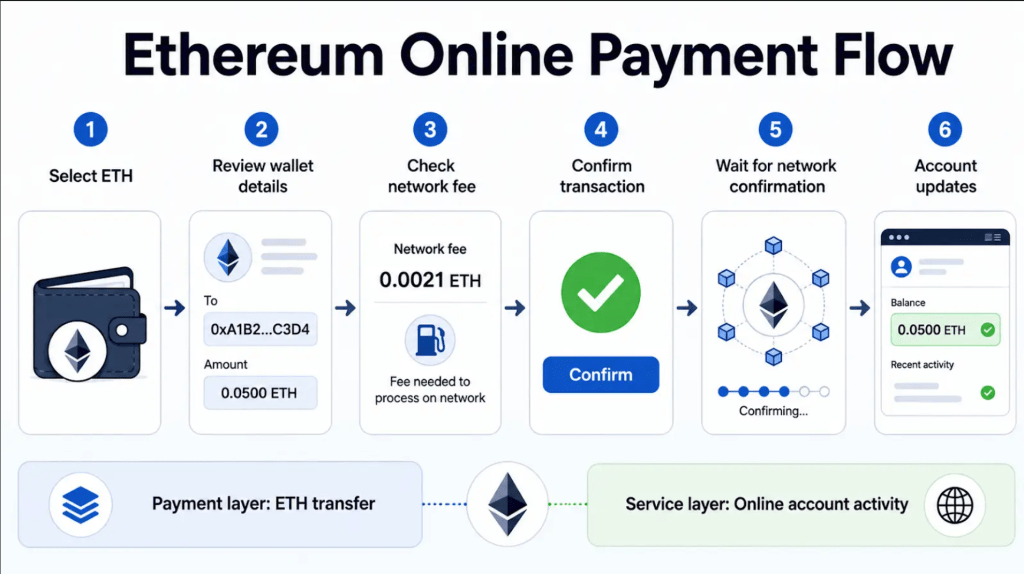
Online entertainment gives that question a clean setting because the payment step is visible, trackable, and separate from the activity that follows. Once a reader understands ETH as a wallet-based payment rail, it can help to look at a service where Ethereum is accepted alongside other crypto options and then credited into an account balance. Online casinos offer this kind of setup, and do so in a low-stakes way.
This high-quality Ethereum casino in Australia works as a concrete reference point because it shows ETH listed alongside Bitcoin, USDT, Litecoin, Bitcoin Cash, Bitcoin SV, and Bitcoin Lightning, then places that payment choice beside entertainment categories such as pokies, live casino, table games, jackpots, specialty games, and crypto. The useful detail is the sequence. A user chooses a coin, sends funds from a wallet, waits for network confirmation, and sees the value handled inside the account, often through a local balance, such as AUD.
Ethereum handles the payment movement. The account balance becomes the usable layer. The entertainment formats remain separate from the coin used to fund the account. Keeping those layers apart explains why ETH can be part of online spending, without turning every Ethereum payment example into a discussion about the service itself.
Payments, Not Price Charts
Ethereum’s public identity is still tied to market charts, smart contracts, NFTs, and decentralized finance. Those topics matter, but they can hide the quieter use case: paying for something online. In a payment setting, the most important facts are not whether ETH moved 3% this week. The useful questions are simpler. Does the site accept ETH? Does the wallet show the address clearly? Is the network fee visible before confirmation? Does the account show the credited amount?
That is why online payment examples are more helpful than broad claims about adoption. They reveal what the user actually handles. The wallet asks for a destination, an amount, and a fee. The sender checks the details. The network confirms the transaction. The receiving platform reflects the value according to its own account system. None of that requires the reader to become a blockchain engineer, but it does require them to pay attention to the difference between the Ethereum network and the service receiving the payment.
Ethereum transactions carry network costs that can change with demand. For users, the amount shown before confirmation is part of the decision, not a technical footnote. A card payment often hides processing complexity behind a familiar checkout screen. An ETH payment brings part of that infrastructure into view: the address, the estimated fee, and the confirmation status.
Why ETH Feels Different from Bitcoin Online
Bitcoin is still the first crypto payment reference. Ethereum has a different online personality. It belongs to a larger application environment, where wallets, tokens, smart contracts, and Ethereum-compatible networks often sit close together. That does not make every ETH payment complex. It means the user may encounter Ethereum through a wallet already used for other crypto activity.
For ordinary online payments, the difference is less about ideology and more about behavior. Bitcoin often carries the mental image of a store of value that can also be spent. Ethereum carries the image of a network token moving through app-based settings. In practice, both can appear beside other coins as payment options. The reader’s job is to understand what each payment rail asks the user to check.
A practical ETH payment has a few non-negotiable reading points: the correct network, the receiving address, the fee, the confirmation status, and the account outcome after the transaction. These are not advanced trading ideas. They are the basic literacy of paying with crypto online.
What Counts as Real Ethereum Use
Real Ethereum use does not require a grand promise. It appears when ETH solves a specific online payment task for someone who already understands the wallet step. The setting may be entertainment, software, creator access, cloud tools, or digital goods. What matters is that the user can connect the transaction to a clear account result.
That is why Ethereum’s payment story in 2026 is narrower and more believable than the old claim that crypto would replace every checkout. ETH works best where the service is already digital, the user is already comfortable with a wallet, and the receiving platform presents the credited value clearly. The strongest signal is not noise around adoption. It is the ordinary moment when a confirmed transaction becomes usable inside an account, which is exactly where trust, fees, and platform reputation meet in consumer trust in cryptocurrency payments.