


 Buy a Licensed Company
  Explore VASP Data
  Talk to an Expert

 Atis Shala
Atis is a senior analyst and community lead with four years of experience in crypto. He has a bachelor from the Rochester Institute of Technology.
Atis Shala
Atis is a senior analyst and community lead with four years of experience in crypto. He has a bachelor from the Rochester Institute of Technology.
How to Mine Dash: Complete Beginner-to-Advanced Guide
Dash remains a cornerstone of the decentralized payment sector in 2026. As a privacy-centric digital currency, Dash utilizes a unique two-tier network to facilitate instant transactions and community governance. Mining Dash involves participating in the first tier of this network: the Proof of Work (PoW) layer. Miners use specialized hardware to solve complex mathematical puzzles, securing the blockchain and validating transactions.
People continue to mine Dash in 2026 because of its established market presence and the consistent block rewards it offers. While the landscape has become highly competitive, the network’s maturity provides a level of predictability that newer projects lack. This guide provides a comprehensive roadmap for anyone looking to enter the Dash mining space. We cover everything from basic definitions to advanced hardware configurations, ensuring you have the technical clarity needed to start your mining operation.
What Is Dash?
Dash, short for “Digital Cash,” launched in 2014 with a clear mission: to improve upon the limitations of Bitcoin. It focuses on speed, privacy, and ease of use for everyday transactions. While many cryptocurrencies act as speculative assets, Dash functions as a practical medium of exchange.

What Problem Does Dash Solve?
Dash addresses the slow confirmation times and high fees often associated with older blockchains. Through its InstantSend feature, the network confirms transactions in seconds. It also offers PrivateSend, an optional privacy feature that obscures the origin of funds. These tools make Dash a viable competitor to traditional electronic payment systems.
How the Dash Network Works
Dash employs a distinct two-tier architecture. The first tier consists of miners who secure the network and create new blocks. The second tier consists of Masternodes. These powerful servers handle specialized functions like InstantSend and governance voting. The network also features a self-funding treasury system, where a portion of block rewards goes directly toward development and marketing projects. This structure ensures the Dash ecosystem remains self-sustaining and innovative.
How Dash Mining Works (X11 Proof of Work Explained)
Dash mining relies on a specific consensus mechanism to maintain its ledger. Unlike Bitcoin, which uses the SHA-256 algorithm, Dash utilizes a more complex sequence known as X11.
Dash Mining Algorithm: X11
X11 is a chained hashing algorithm that incorporates 11 different scientific hashing functions. Dash creator Evan Duffield designed it to increase network security and prevent the early dominance of Application-Specific Integrated Circuits (ASICs). However, as the industry matured, manufacturers developed powerful X11 ASICs. Today, mining Dash with anything other than an ASIC is practically impossible.
Dash Block Rewards and Block Time
The Dash network generates a new block approximately every 2.6 minutes. Each block produces a reward that the network distributes among three groups:
- Miners (20%): Those providing the computational power.
- Masternodes (70%): Those providing advanced network services.
- Treasury (10%): Funds for ecosystem growth.
Note that the reward distribution shifted significantly in recent years to favor the Masternode tier, reflecting the network’s emphasis on service-oriented stability.
Role of Miners in Dash Security
Miners act as the fundamental security layer. By dedicating hashrate to the X11 algorithm, they make it prohibitively expensive for a malicious actor to reorganize the blockchain. Every miner contributes to the overall decentralization of the network.
Is Dash Mining Profitable in 2026?
Profitability in 2026 depends on a delicate balance of technical efficiency and operational costs. It is no longer a “set and forget” venture; it requires active management and strategic planning.
Factors That Affect Dash Mining Profitability
- Hashrate: The total computational power your hardware provides.
- Electricity Cost: This is your primary ongoing expense. Success often requires access to industrial power rates below $0.06 per kWh.
- Hardware Efficiency: Newer ASICs produce more hashes per watt of electricity consumed.
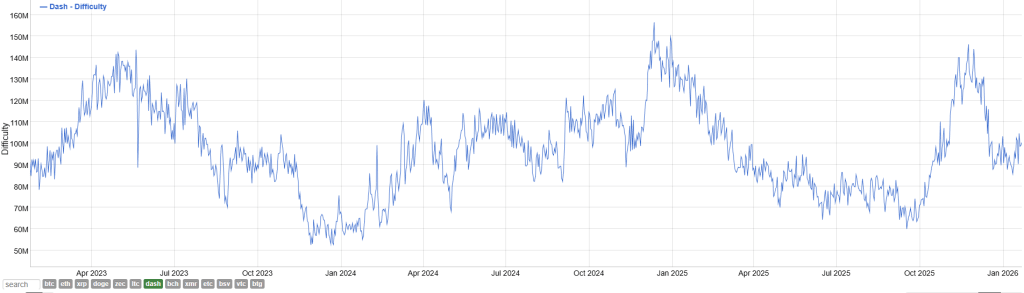
- Network Difficulty: As more miners join the network, the difficulty of finding a block increases, reducing individual shares.
Dash Mining Profitability Calculator
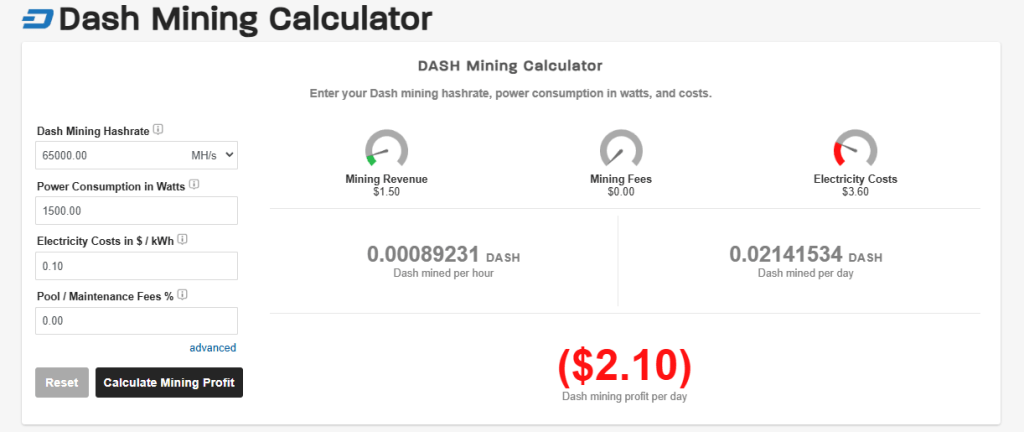
To determine if mining is viable, you must use a specialized calculator. You enter your hardware’s hashrate (expressed in Gigahashes or Terahashes), power consumption, and your local electricity rate. These tools compare your expected DASH earnings against your power bill. In 2026, daily returns are often modest; the real value lies in long-term accumulation and the potential appreciation of the DASH token.
Risks, ROI Timelines, and Market Volatility
The Return on Investment (ROI) timeline for a new Dash miner typically ranges from 12 to 24 months. Risks include sudden drops in the price of DASH or the release of a significantly more efficient miner by companies like Bitmain, which can make older gear obsolete overnight.
Hardware Requirements for Mining Dash
The days of mining Dash on a home computer are over. To participate effectively, you must invest in professional-grade equipment.
Can You Mine Dash with a GPU or CPU?
No. While it was technically possible in the early years, the X11 network difficulty has reached a point where CPUs and GPUs cannot generate enough hashes to earn rewards. The electricity cost of running a GPU would vastly exceed the value of the DASH produced.
Best ASIC Miners for Dash (X11)
The following table highlights the top-tier hardware options available in 2026:
| Miner Model | Hashrate | Power Consumption | Efficiency |
| Bitmain Antminer D9 (2025/26 Ed.) | 1.8 TH/s | 2800W | 1.55 J/G |
| StrongU Hornbill H8 | 900 GH/s | 1900W | 2.11 J/G |
| Innosilicon A11 successor | 1.2 TH/s | 2400W | 2.00 J/G |
Electricity, Cooling, and Noise Considerations
ASIC miners are industrial machines. They generate significant heat and noise, often exceeding 75 decibels. You cannot run these in a standard living room. They require dedicated cooling systems, high-voltage outlets (220V-240V), and proper ventilation to prevent hardware failure.
Software Requirements: Dash Mining Software
While the hardware does the heavy lifting, the software connects your machine to the Dash network and manages your earnings.
Official Dash Core Wallet
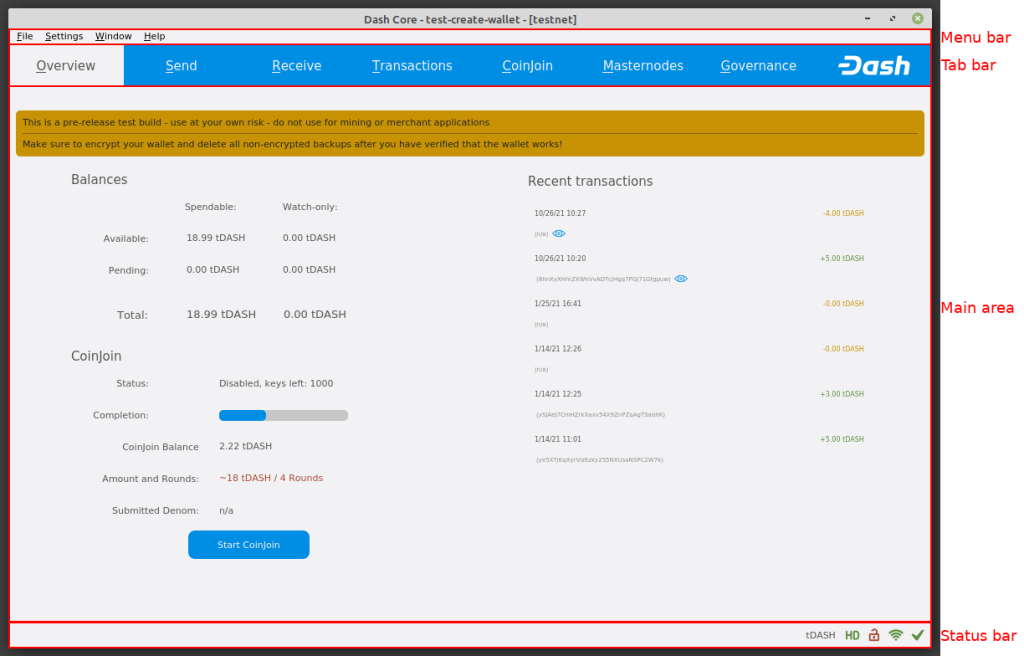
Before you start, download the Dash Core Wallet. This is the official “full node” wallet. While you can use hardware wallets for storage, the Dash Core Wallet provides the most direct interaction with the network and is essential for those who eventually want to transition into running a Masternode.
Mining Software and Firmware
Most modern ASICs come with pre-installed firmware. You simply access the miner’s IP address through a web browser to configure your settings. Advanced users may use custom firmware to “undervolt” their machines, which reduces power consumption and heat at the cost of some hashrate.
Supported Operating Systems
The configuration interface for most ASICs is OS-agnostic because it runs in a browser. Whether you use Windows, Linux, or macOS, you can manage your Dash miner as long as you are on the same local network.
Solo Mining vs. Pool Mining Dash
Choosing a mining strategy is a critical decision for any newcomer.
Solo Mining Dash: Pros and Cons
Solo mining means you compete against the entire network alone. If you find a block, you keep the entire reward. However, the probability of finding a block with a single machine is extremely low. You might go months or years without a payout, making this a high-risk strategy.
Pool Mining Dash: How It Works
Mining pools combine the hashrate of thousands of individual miners. When the pool finds a block, the reward is split among participants based on their contribution. This results in smaller, more frequent payouts. Most pools charge a fee of 1% to 3%.
Best Dash Mining Pools (Updated 2026)
| Pool Name | Fees | Payout Scheme | Min. Payout |
| ViaBTC | 1% – 4% | PPS+ / PPLNS | 0.01 DASH |
| Antpool | 0% – 2.5% | PPLNS | 0.05 DASH |
| F2Pool | 3% | PPS | 0.1 DASH |
Step-by-Step Guide: How to Mine Dash
Step 1: Set Up a Dash Wallet
Download and install the Dash Core wallet from the official website. Encrypt your wallet and back up your seed phrase. Generate a receiving address; this is where your mining rewards will land.
Step 2: Choose and Buy Hardware
Purchase an X11 ASIC miner. Ensure your electrical setup can handle the load. Use a heavy-duty PDU (Power Distribution Unit) rather than standard power strips.
Step 3: Configure Mining Software
Connect your ASIC to your router via Ethernet. Find the miner’s IP address using your router’s admin panel. Log into the miner’s web interface (usually with “admin” as the username and password).
Step 4: Join a Mining Pool
Select a pool from the list above. Enter the pool’s URL and your worker name (usually your Dash wallet address) into the miner’s configuration page. Save the settings.
Step 5: Monitor Performance
The miner will begin hashing within minutes. Check the pool’s dashboard to see your hashrate and pending rewards. Monitor the temperature of your ASIC regularly to ensure it stays within the manufacturer’s recommended range.
Dash Mining Costs, Taxes, and Common Challenges
Mining is a business, and you must treat it as one.
- Operational Costs: Factor in electricity, replacement fans, and periodic cleaning supplies.
- Tax Implications: In many jurisdictions, the IRS and other tax authorities view mined cryptocurrency as taxable income at the moment of receipt. Keep meticulous records of the USD (or local currency) value of every payout.
- Legal Status: Cryptocurrency mining is legal in most countries, but some regions have banned it due to energy concerns. Always verify your local regulations before investing in hardware.
Mining is no easy task. There are multiple challenges that must be addressed, especially for people new to it. Some of the most common challenges for Dash miners include:
- ASIC Not Hashing: Check your power cables and Ethernet connection. Ensure your pool URL is entered correctly.
- High Reject Rates: This usually indicates a poor internet connection or a pool server that is too far away geographically.
- Overheating: If the miner reaches 80°C or higher, it may throttle itself. Improve airflow or lower the ambient room temperature.
Future of Dash Mining: Is It Worth It Long-Term?
The future of Dash mining is tied to the network’s adoption as a payment rail. As the block reward decreases over time, miners must rely on transaction fees and the appreciation of the DASH token. While the competition is fierce, Dash’s unique DAO structure provides a level of development funding that few other PoW coins possess. If you have access to cheap energy, Dash mining remains a solid entry point into the world of industrial-scale crypto operations.
Final Thoughts: Should You Mine Dash?
Dash mining is best suited for individuals or businesses with access to low-cost electricity and a dedicated space for loud, hot hardware. It offers a way to support a robust payment network while earning consistent rewards. However, if you lack the infrastructure for ASICs, you may find it more profitable to simply purchase DASH on an exchange. For the technically inclined, mining offers a unique, hands-on way to participate in the decentralized economy of 2026.
Frequently Asked Questions (FAQs)
Can I mine Dash on my laptop?
No. A laptop lacks the necessary computational power and would likely overheat and break within hours. Specialized rigs or powerful PCs are the best way to mine Dash.
How long does it take to mine 1 Dash?
This depends entirely on your hashrate. With a modern Bitmain D9, it may take several days or weeks depending on the current network difficulty.
What is the minimum payout for Dash mining?
Most pools set a minimum payout of 0.01 to 0.1 DASH. However, the overall payout for Dash mining depends on how much of the hash rate your device is accountable for on a specific pool.
Is Dash mining legal?
Yes, in most countries, though you should check specific local energy and crypto regulations. Mining is still a complicated topic when it comes to regulations, especially taxation.