


 Buy a Licensed Company
  Explore VASP Data
  Talk to an Expert

 Atis Shala
Atis is a senior analyst and community lead with four years of experience in crypto. He has a bachelor from the Rochester Institute of Technology.
Atis Shala
Atis is a senior analyst and community lead with four years of experience in crypto. He has a bachelor from the Rochester Institute of Technology.
HBAR Price Prediction 2026-2030: Enterprise Adoption Meets Supply Maths
- HBAR traded at about $0.0813 on 20 September 2026, with a market capitalisation near $3.56 billion and roughly 43.83 billion of the 50 billion maximum supply in circulation. The token sits about 86 percent below its record of $0.5701, set on 16 September 2021.
- Our 2026 base case is $0.080 to $0.12, and the bull case of $0.14 to $0.19 requires a broad market upturn plus faster inflows into the HBAR ETF.
- Institutional access is now real rather than prospective. The Canary HBAR ETF trades on Nasdaq under the ticker HBR at a 0.95 percent fee and held approximately $59.8 million in assets when checked on 20 September 2026.
- Hedera shipped the upgrade developers had been asking for. Full Ethereum Virtual Machine compatibility for smart contracts arrived on 21 July 2026, letting Solidity developers deploy with familiar tooling such as Hardhat, and mainnet v0.76.3 followed on 30 August 2026.
- The enterprise story gained a name and a policy seat. Accenture joined the Hedera Governing Council in April 2026, and Hedera’s VP of Global Policy took part in European Central Bank digital euro pilot discussions on 16 September 2026.
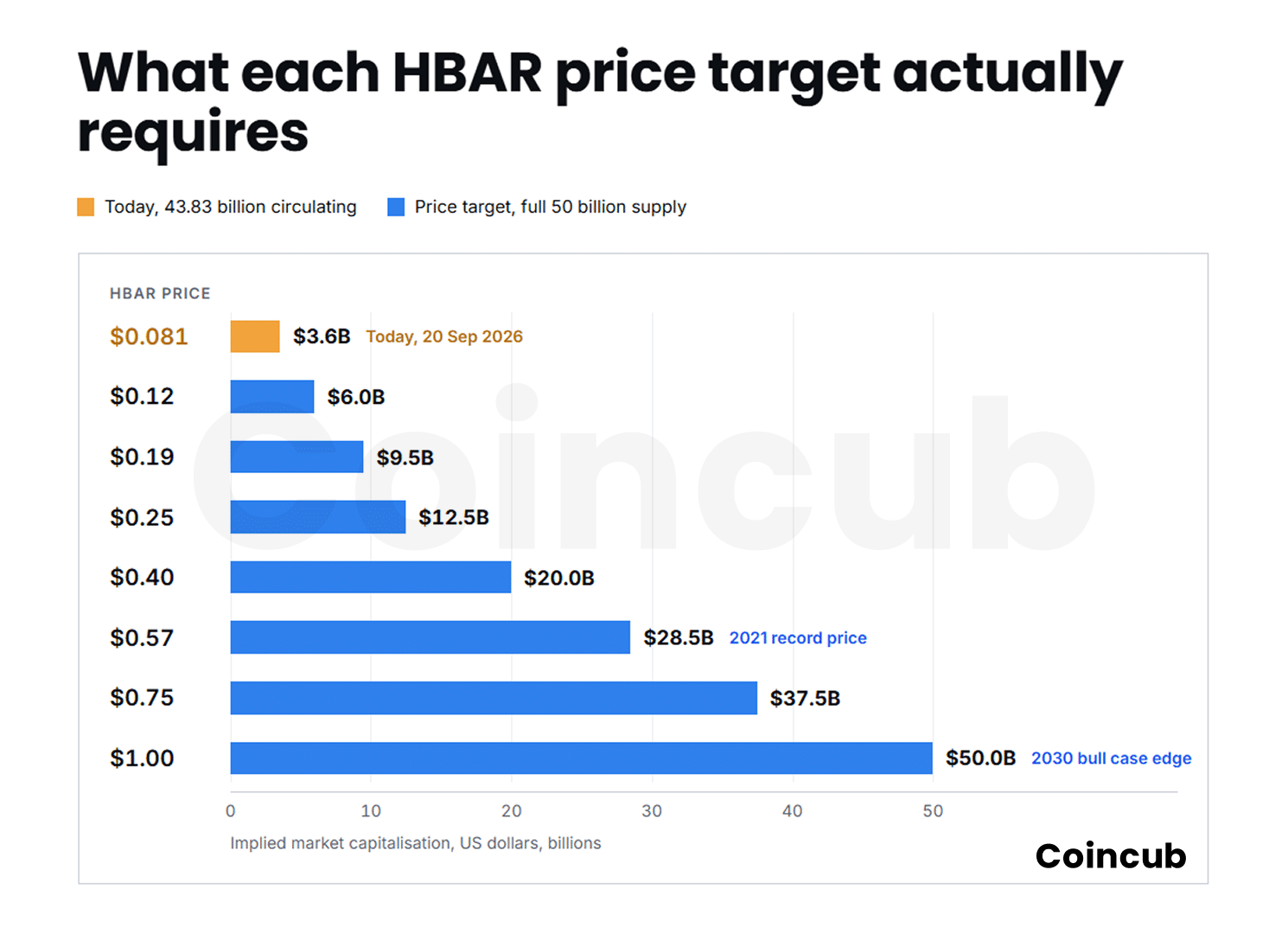
- The supply arithmetic still governs every long-term target. Reaching $0.57 again requires roughly $28.5 billion of market capitalisation at full 50 billion supply, against $3.56 billion today, which is why we treat $1 as a bull-case edge for 2030 rather than as a base case.
Where HBAR stands in 2026
Hedera’s token traded at $0.08110 on CoinGecko and $0.08132 on CoinMarketCap on 20 September 2026, a tight spread that reflects reasonably deep aggregation across roughly 70 exchanges. Market capitalisation came to about $3.56 billion, ranking HBAR between 27th and 31st depending on the service. Circulating supply stood at approximately 43.83 billion tokens, which is 87.66 percent of the fixed 50 billion maximum, giving a fully diluted valuation near $4.06 billion.
Recent performance has been positive without being dramatic. HBAR gained roughly 7 percent over both the trailing week and the trailing month, and about 67 percent over twelve months. Twenty-four hour volume ranged between $99 million and $144 million across aggregators, which is modest against a $3.56 billion capitalisation and reflects a holder base that trades less actively than comparable networks.
The distance from the record matters because it drives the maths in every section below. HBAR reached $0.5701 on 16 September 2021 according to CoinMarketCap, and $0.5692 on 15 September 2021 according to CoinGecko. The one-day and one-hundredth-of-a-cent discrepancy is an artefact of exchange coverage rather than a dispute about events. Either way the token is roughly 86 percent below that level, and the circulating supply has expanded substantially since, which means the market capitalisation required to revisit it has expanded too.

The Governing Council and HBAR supply
Hedera is governed by a council of large enterprises. Hedera’s own council site does not publish a headline number, so this we name verified members rather than asserting a total. Confirmed participants include IBM, Boeing, Deutsche Telekom, LG, Ubisoft, BitGo and Accenture, which joined in April 2026. Readers who want the current roster should check hederacouncil.org directly.
HBAR’s supply is capped at 50 billion tokens, and a fixed maximum supply makes a token disinflationary. New tokens still enter circulation until the cap is reached, and no mechanism burns them afterwards. Roughly 6.17 billion HBAR remain to enter circulation, which is about 12 percent of the maximum, and that represents a modest but real headwind until the cap is reached.
What changed for Hedera in 2026
The most consequential change is that Hedera stopped asking developers to learn something new. Full EVM compatibility for smart contracts shipped on 21 July 2026, which means Solidity contracts deploy with standard tooling such as Hardhat rather than requiring Hedera-specific approaches. For a network whose technical case has always been strong and whose developer adoption has always lagged that case, this addresses the gap directly. Mainnet v0.76.3 followed on 30 August 2026, increasing message capacity between nodes and deprecating the legacy AccountBalanceQuery method.
Institutional access moved from announcement to measurable flow. The Canary HBAR ETF trades on Nasdaq as HBR with a 0.95 percent expense ratio and held approximately $59.8 million in assets when checked on 20 September 2026, with the fund reported to hold more than 700 million HBAR in August 2026. That is a meaningful vehicle for advisers and allocators who cannot hold tokens directly, and it is a small fraction of a $3.56 billion market. Both things are true and readers should hold them together.
Enterprise and policy engagement with Hedera
Enterprise and policy engagement continued along the lines Hedera has always emphasised. Accenture joined the Governing Council in April 2026, adding a systems integrator with direct access to enterprise blockchain budgets. Archax enabled real-time USDC interest payments on Hedera in August 2026, which is a concrete regulated-finance use rather than a pilot. On 16 September 2026 Hedera’s VP of Global Policy participated in European Central Bank digital euro pilot discussions, placing the network inside the conversation about Europe’s retail CBDC infrastructure.
The regulatory backdrop also shifted in a direction that suits Hedera’s tokenisation focus. On 16 September 2026 SEC Commissioner Mark T. Uyeda announced a temporary innovation exemption for tokenised NMS stocks on selected blockchain venues. Hedera is not named in that exemption, and the broader effect of making tokenised equities easier to trade favours networks built around regulated asset issuance.
How these forecasts are built
Many HBAR forecasts derive a price from where the four-year market cycle says the market should be. That approach treats a historical rhythm as a forecasting tool for a single asset, when the pattern describes aggregate market behaviour and individual tokens diverge from it routinely. HBAR spent the middle of 2026 near $0.08 with a capitalisation near $3.5 billion, a reminder that the cycle and the token can move apart.
The scenarios below take a different route. They start from current capitalisation, ask what capitalisation each price implies at the relevant supply, and then judge whether the stated drivers could plausibly produce that change. That method produces wider ranges and fewer confident numbers, which is the appropriate trade for a token whose price has diverged from cycle-based expectations.
Hedera’s technical position in 2026
Hedera’s differentiator remains its consensus design rather than its throughput headline. The network uses hashgraph consensus, in which nodes gossip transaction information and reach agreement through virtual voting, rather than proposing and confirming sequential blocks. This achieves asynchronous Byzantine Fault Tolerance, the strongest security guarantee available in distributed systems, and it removes the 51 percent attack surface that proof-of-work and many proof-of-stake designs carry.
Performance follows from that structure. Hedera reaches finality in a few seconds and handles high transaction volumes without the congestion behaviour of linear chains, because transactions do not compete for space in a single sequential block. Fees are low and, importantly for enterprise budgeting, predictable, which matters more to a corporate treasurer than a low average fee with occasional spikes.
HBAR itself serves three functions within that system. It pays for transaction processing, smart contract execution and data storage and carries governance weight on network proposals. Moreover, it is staked in the proof-of-stake mechanism that secures consensus and earns rewards.
The persistent criticism concerns governance rather than technology. Council-based governance by large enterprises delivers reliability and accountability that a purely token-weighted system struggles to match, and it concentrates decision-making in organisations rather than holders. Readers who value permissionless governance will find that trade-off unattractive, and readers who are evaluating Hedera as enterprise infrastructure will find it reassuring. The honest framing is that it is a deliberate design choice with costs on both sides.
Real-world use of the network
Supply chain traceability remains the most developed category, and Hedera’s council membership is its route to market rather than an add-on. Corporations already running distributed ledger pilots for provenance have an existing commercial relationship with the network, which lowers the barrier to moving from pilot to production.
Tokenisation of real-world assets is the category where the 2026 developments compound. The Hedera Token Service allows assets to be issued with native controls rather than through custom contracts, which matters when an issuer needs to demonstrate to a regulator that transfer restrictions are enforced at the ledger level. Archax enabling real-time USDC interest payments in August 2026 is a working example of the pattern.
Decentralised identity and micropayments round out the set. Hedera’s Consensus Service and file storage support verifiable credentials that preserve privacy, and the network’s low and predictable fees make per-transaction charges of fractions of a cent economically coherent in a way that they are not on chains with variable gas.
HBAR price prediction 2026-2030
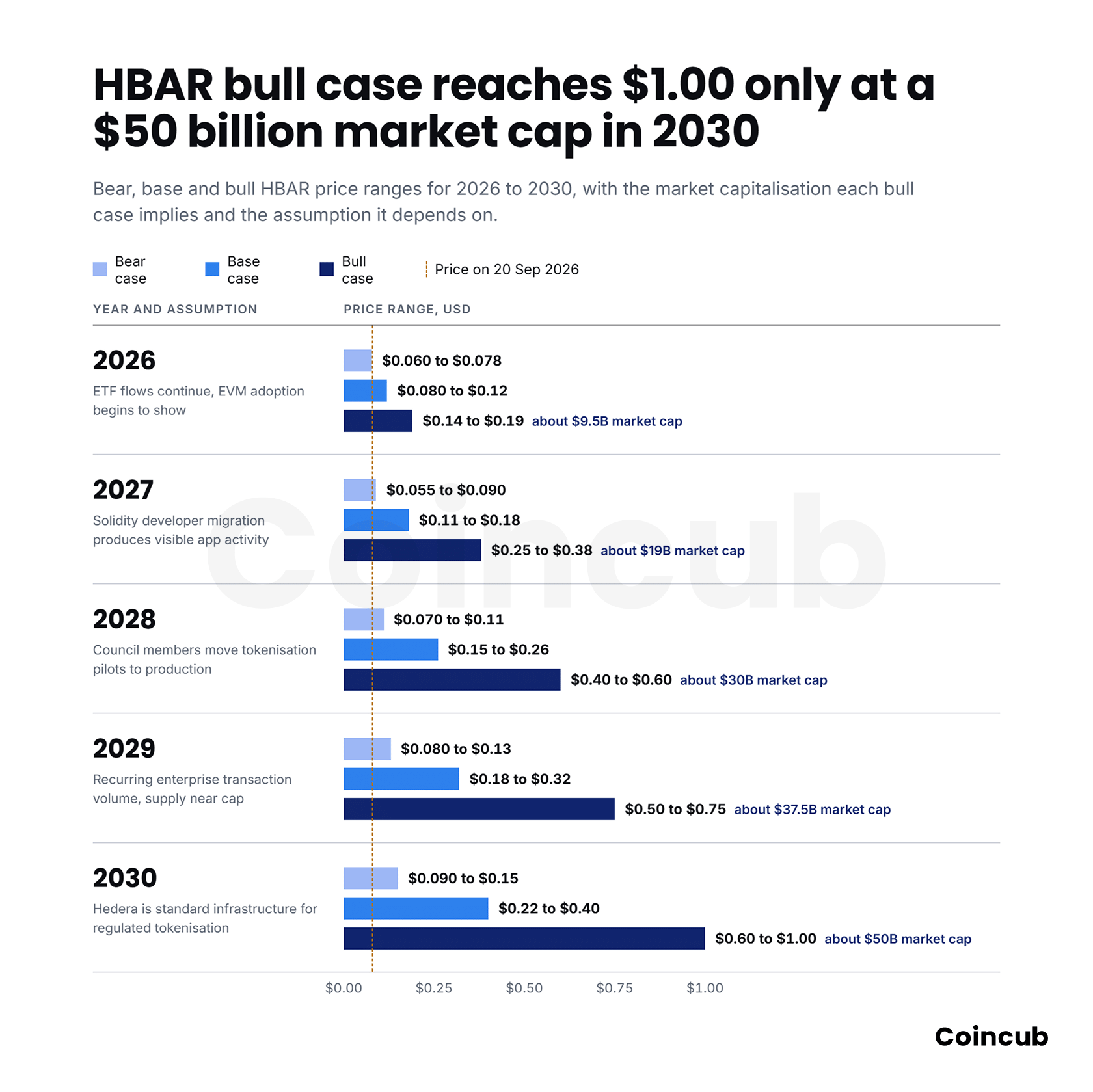
These ranges were built on September 2026 from a spot price of about $0.081, a circulating supply of roughly 43.83 billion, a fixed maximum of 50 billion, and the ETF, upgrade and council developments described above. Crypto prices are volatile and forecasts of this kind are frequently wrong, so every row states the assumption behind it and the market capitalisation the bull case implies.
| Year | Bear case | Base case | Bull case | Bull case implied market cap | Governing assumption |
|---|---|---|---|---|---|
| 2026 | $0.060 to $0.078 | $0.080 to $0.12 | $0.14 to $0.19 | roughly $9.5 billion | ETF flows continue, EVM adoption begins to show |
| 2027 | $0.055 to $0.090 | $0.11 to $0.18 | $0.25 to $0.38 | roughly $19 billion | Solidity developer migration produces visible app activity |
| 2028 | $0.070 to $0.11 | $0.15 to $0.26 | $0.40 to $0.60 | roughly $30 billion | Council members move tokenisation pilots to production |
| 2029 | $0.080 to $0.13 | $0.18 to $0.32 | $0.50 to $0.75 | roughly $37.5 billion | Recurring enterprise transaction volume, supply near cap |
| 2030 | $0.090 to $0.15 | $0.22 to $0.40 | $0.60 to $1.00 | roughly $50 billion | Hedera is standard infrastructure for regulated tokenisation |
HBAR in 2026
Three months remain in 2026, and the realistic range around them is narrow. Our base case of $0.080 to $0.12 assumes the current pattern continues, with ETF flows adding a steady bid and EVM compatibility producing early developer interest that has yet to translate into transaction volume. The bull case of $0.14 to $0.19 requires a broad market upturn plus a visible acceleration in HBR’s assets under management. The bear case of $0.060 to $0.078 assumes the wider market cools and HBAR gives back the modest gains of recent weeks.
HBAR in 2027 and 2028
The middle years are where EVM compatibility either produces results or does not. Developer migrations take time, typically twelve to eighteen months between a compatibility layer shipping and applications with real users appearing on it. A base case of $0.11 to $0.18 for 2027 assumes that migration proceeds at a normal pace and that ETF assets continue to grow gradually. The bull case of $0.25 to $0.38 assumes visible application activity combined with a strong market, and at roughly $19 billion of capitalisation it would place Hedera among the larger networks.
Extending into 2028, the base case of $0.15 to $0.26 assumes council members convert tokenisation pilots into production systems that consume HBAR for fees at scale. This is the specific mechanism on which Hedera’s long-term case depends, since council relationships create demand only when those organisations actually transact. The bull case of $0.40 to $0.60 per HBAR token assumes several do so simultaneously.
HBAR in 2029 and 2030
By 2030 circulating supply should be at or near the 50 billion cap, which simplifies the arithmetic and removes dilution from the discussion. A base case of $0.22 to $0.40 implies a market capitalisation between roughly $11 billion and $20 billion, which is a reasonable valuation for a network with steady enterprise transaction revenue and a settled institutional access route. The bull case of $0.60 to $1.00 implies $30 billion to $50 billion and requires Hedera to be a standard layer for regulated tokenisation rather than one option among several.
We place $1.00 at the upper edge of the 2030 bull case, because the path to $50 billion of capitalisation runs through adoption milestones that have not yet happened. The bear case of $0.090 to $0.15 assumes enterprise adoption stalls at the pilot stage and HBAR trades as a well-built network without a demand engine.
Frequently Asked Questions (FAQ)
What is the HBAR price today? +
HBAR traded at approximately $0.0813 on 20 September 2026, with a market capitalisation near $3.56 billion and roughly 43.83 billion tokens in circulation out of a fixed 50 billion maximum.
Is there an HBAR ETF? +
Yes. The Canary HBAR ETF trades on Nasdaq under the ticker HBR with a 0.95 percent expense ratio, and it held approximately $59.8 million in assets when checked on 20 September 2026. It gives regulated exposure to HBAR without direct token custody.
Can HBAR reach $1? +
Reaching $1 would imply a market capitalisation of roughly $50 billion at the full 50 billion supply, against $3.56 billion today. This article places $1.00 at the upper edge of its 2030 bull case, which requires Hedera to become standard infrastructure for regulated tokenisation. It is possible over that horizon and it should not be treated as a base expectation.
Does Hedera now support Ethereum smart contracts? +
Yes. Full EVM compatibility for smart contracts shipped on 21 July 2026, allowing Solidity developers to deploy using familiar tooling such as Hardhat. This removes a long-standing barrier to developer adoption, and the resulting application activity will take time to appear.
How many members are on the Hedera Governing Council? +
Hedera does not publish a headline count on its council site. Verified members include IBM, Boeing, Deutsche Telekom, LG, Ubisoft and BitGo, with Accenture joining in April 2026. Readers wanting the current roster should check hederacouncil.org directly.
Is HBAR deflationary? +
No. HBAR has a fixed maximum supply of 50 billion tokens, of which roughly 43.83 billion were circulating in September 2026. A fixed cap makes the token disinflationary, since the remaining 12 percent still enters circulation over time and no mechanism burns tokens afterwards.
Where can I buy HBAR? +
HBAR trades on Binance, Coinbase, Bybit, OKX, Upbit, HTX, Gate.io, KuCoin, MEXC, Crypto.com and a number of smaller venues, with aggregate twenty-four hour volume between $99 million and $144 million on 20 September 2026. US investors who prefer a regulated wrapper can access the Canary HBAR ETF on Nasdaq.