


 Buy a Licensed Company
  Explore VASP Data
  Talk to an Expert

 Atis Shala
Atis is a senior analyst and community lead with four years of experience in crypto. He has a bachelor from the Rochester Institute of Technology.
Atis Shala
Atis is a senior analyst and community lead with four years of experience in crypto. He has a bachelor from the Rochester Institute of Technology.
DCA Strategy: Why It Beats ‘Buying the Dip’
Every crypto investor knows the temptation. Prices crash, social media shouts “buy the dip,” and excitement builds. It feels like the perfect moment to act, a quick way to turn panic into profit. In reality, “buying the dip” often turns into gambling fueled by emotion. Trying to time the market in an industry as volatile as crypto usually ends in frustration… because the crypto market is extremely volatile.
The DCA strategy, or dollar-cost averaging, takes a different path. Instead of waiting for the “right” time, investors using DCA commit to investing a fixed amount at regular intervals, no matter what the market is doing. This steady approach reduces the impact of volatility, smooths out price fluctuations, and keeps emotion out of the equation.
In a market that can rise or fall by 20% in a single day, discipline matters more than intuition. DCA rewards patience and consistency, while emotional dip-buying often punishes both.

What Is Dollar-Cost Averaging (DCA)?
Dollar-cost averaging, or DCA, is an investment strategy based on one simple principle: consistency beats timing. Instead of predicting when prices will rise or fall, investors set aside a fixed amount of money at regular intervals, such as $100 every week or month, regardless of market conditions. Over time, this method averages out the cost of each purchase and reduces the emotional stress of trying to enter the market at the perfect moment.
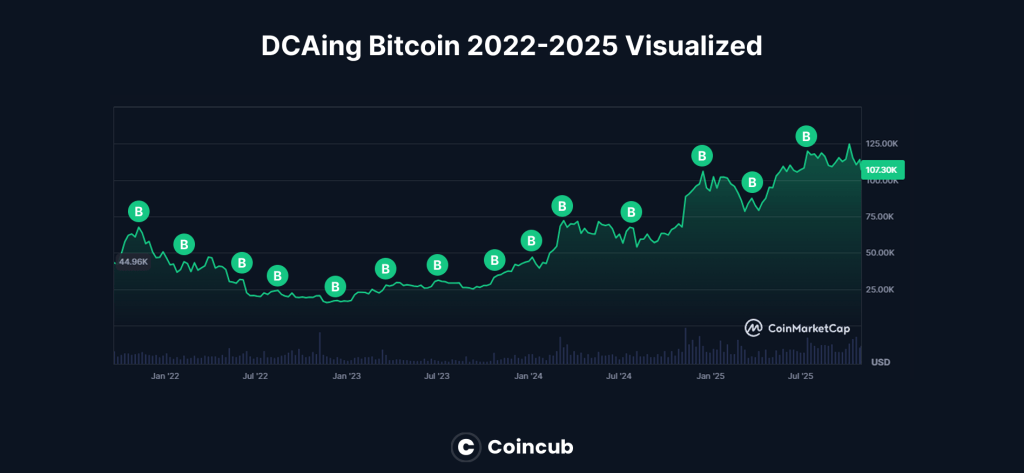
Consider a simple example. An investor decides to invest $100 in Bitcoin each week. During some weeks, Bitcoin trades at $100,000. Other weeks, it falls to $80,000. When prices are higher, that $100 buys a smaller fraction of Bitcoin. When prices drop, it buys more. After several months, the investor’s average purchase price reflects a balanced mix of all entries, often lower than if they had invested a big sum at once.
This strategy has long existed in traditional markets, where investors regularly contribute to index funds or retirement accounts. In crypto, DCA offers the same benefit but within a market that moves faster and with sharper volatility. Regular investing smooths out price swings and keeps emotions out of decision-making.
The ideal DCA frequency depends on personal goals, income stability, and transaction costs. Most investors prefer weekly or monthly contributions to stay consistent without overpaying on fees.
DCA helps investors focus on discipline rather than luck. It transforms volatility from an obstacle into an ally by using price swings to accumulate more over time.
The Myth of “Buying the Dip”
“Buying the dip” is one of the most repeated mantras in crypto investing. The logic sounds simple: wait for prices to fall, then buy at a discount before the next rally. In theory, it seems like a path to easy profits. In practice, it rarely works as expected.
The problem begins with human psychology. When prices drop, fear sets in. Many investors hesitate, waiting for the market to fall even lower. When it finally rebounds, they rush in late, often buying near the next short-term peak. Others jump in too early, catching what traders call a “falling knife,” only to see their portfolio sink further. This emotional cycle of hesitation and FOMO keeps investors trapped between greed and fear, making timing the market nearly impossible.
Crypto markets make this even harder. Bitcoin, for instance, fell from around $69,000 in November 2021 to under $20,000 by mid-2022. Many who “bought the dip” at $50,000 or $40,000 quickly learned that what looked like a bottom was only the start of a deeper decline. Predicting those levels in real time is nearly impossible because every dip feels like the last one until another follows.
Unlike disciplined strategies such as dollar-cost averaging, dip-buying relies entirely on short-term prediction and emotional confidence. It turns investing into speculation, forcing constant reaction to volatility rather than long-term planning.
Markets do not reward perfect timing. Instead, they reward consistency. The idea of buying the dip sounds smart in hindsight because we only remember the dips that bounced. The rest are forgotten, buried under losses and missed opportunities.
How DCA Outperforms in Volatile Markets
Volatility is often seen as a threat in crypto investing, but for investors using the DCA strategy, it becomes an advantage. Dollar-cost averaging turns unpredictable price swings into opportunities to buy more when prices are low and less when they are high, automatically smoothing the average purchase cost over time.
The 2026 Drawdown Made the Case for DCA in Real Time
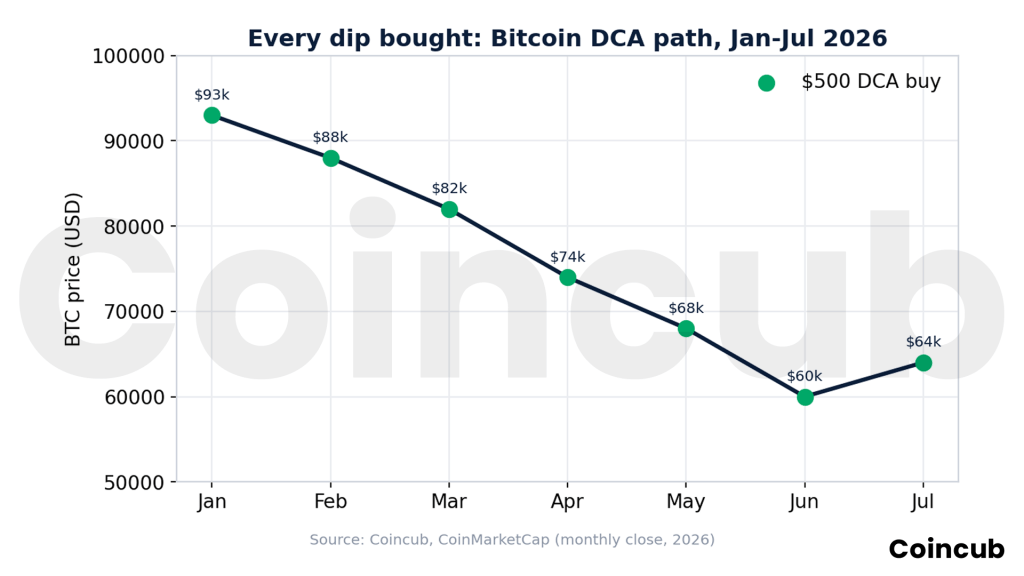
The first half of 2026 gave dollar cost averaging its clearest test in years. Bitcoin opened the year above $93,000, then slid through every month of the first half, hitting a fresh 21 month low near $60,000 at the end of June before steadying around $64,000 by 20 July. The Crypto Fear and Greed Index fell to 29, firmly in fear territory, and Bitcoin traded below its 50 month moving average for the first time in this cycle. Money leaving the spot Bitcoin ETFs and uncertainty over Federal Reserve rate decisions did most of the damage.
This is precisely the environment where “buying the dip” breaks down. Every level in the first half looked like a bottom and then gave way to a lower one. An investor who tried to time the perfect entry in February at $88,000 watched it fall another 30 percent. DCA sidesteps that guessing game by buying on a fixed schedule, which in a falling market means each purchase lands at a lower price and quietly drags down your average cost.
Consider an investor who put $500 into Bitcoin at the start of each month from January to July 2026, using the approximate monthly prices above. The steady buyer accumulated more coins exactly when prices were weakest, in May and June.
Theoretical Portfolios of Both Investors (DCA & Dip Buyer)
| Month | Bitcoin Price | DCA Investment | BTC Bought | Cumulative BTC |
| Jan | $93,000 | $500 | ₿0.00538 | ₿0.00538 |
| Feb | $88,000 | $500 | ₿0.00568 | ₿0.01106 |
| Mar | $82,000 | $500 | ₿0.00610 | ₿0.01716 |
| Apr | $74,000 | $500 | ₿0.00676 | ₿0.02391 |
| May | $68,000 | $500 | ₿0.00735 | ₿0.03127 |
| Jun | $60,000 | $500 | ₿0.00833 | ₿0.03960 |
| Jul | $64,000 | $500 | ₿0.00781 | ₿0.04741 |
Comparing Profits of Both Investors
Now compare that steady buyer against someone who deployed the whole $3,500 in January, convinced that $93,000 was a dip worth catching.
| Metric | DCA Investor | Dip Buyer |
| Total Invested | $3,500 | $3,500 |
| Total BTC Acquired | ₿0.0474 | ₿0.0376 |
| Average Cost per BTC | $73,821 | $93,000 |
| BTC Value at $64,000 | $3,034 | $2,408 |
| Result | -13.3% | -31.2% |
Both investors are underwater in July, because the market itself is down. That is the honest picture. What separates them is the size of the hole. The DCA investor sits at an average cost of about $73,800 and is down roughly 13 percent, while the lump sum buyer paid $93,000 and is down more than 31 percent. Just as important, the DCA investor holds 26 percent more Bitcoin for the same money. When the market recovers, that larger stack and lower average cost turn into a far quicker return to profit.
This smoothing effect is the core strength of DCA. In a volatile market like crypto, where prices can swing 10 to 20 percent in a day, consistency builds resilience. Investors remove emotion from the equation, following a rule instead of reacting to fear or greed. That detachment prevents costly mistakes such as panic selling during corrections or chasing rallies after a breakout.
Compounding also strengthens DCA’s edge. Each periodic investment adds to a growing base that benefits from every future rally. The investor’s returns expand not from perfect timing but from the simple act of staying invested.
Why the Falling Market Rewards the Boring Approach
DCA does not promise gains in a downtrend, and the 2026 example shows it will not shield you from unrealized losses. What it does is convert volatility into a lower entry price and remove the emotional trigger that makes people freeze near the bottom. In June, with the index at fear and headlines calling for further downside, the scheduled buyer simply bought more Bitcoin than in any other month. No conviction required, no market call to get right.
The behavioural edge is the real prize. Across the first half of 2026, dip buyers faced six separate moments where the price looked cheap and then fell further. Each one demanded a fresh decision under stress. The DCA investor made that decision once, in advance, and let the calendar carry it out. In a market where the Fear and Greed Index swings from euphoria to panic within weeks, replacing dozens of anxious choices with one rule is what keeps people invested long enough to see the recovery.
When Does DCA Work, and When it Doesn’t
No strategy works perfectly, and DCA is no exception. During long bear markets or extended periods of flat prices, dollar-cost averaging can feel unrewarding. Investors keep buying as prices drift sideways or decline for months, which can lead to temporary unrealized losses. In those moments, it may seem like patience achieves little progress.
However, the purpose of DCA is not short-term profit. It is preparation for recovery. By consistently building a position during downturns, investors accumulate crypto at lower average prices. When markets eventually recover, those early disciplined purchases deliver stronger returns than sporadic buying during hype-driven rallies.
There are also times when dip buying performs better, particularly in short, sharp corrections that recover quickly. An investor who buys aggressively during a brief pullback and sees an immediate rebound may outperform a steady DCA schedule in the short run. Yet, this requires perfect timing and emotional control, qualities most investors struggle to maintain over multiple cycles.
DCA shines because it removes the need for timing altogether. It turns market uncertainty into a structured routine and rewards long-term conviction rather than short-term prediction. Even in bear markets, the investor who stays consistent ends up positioned for the next wave while others are still waiting for confidence to return.
The Behavioral Edge: Discipline Over Emotion
Crypto investing is more of a psychological game than a numbers one. The market punishes emotion more than bad luck. Prices surge, greed takes over, and investors chase gains. Then prices crash, fear dominates, and those same investors sell at a loss. This emotional loop repeats across every cycle and every chart.
Behavioral finance explains why. Human minds crave control and certainty, even in unpredictable environments. “Buying the dip” feels empowering because it gives the illusion of control. But in truth, it exposes investors to emotional bias and market noise. Dollar-cost averaging offers the opposite experience. It replaces reaction with repetition. Instead of making hundreds of emotional decisions, investors make one rational decision, and that’s to stay consistent.
DCA breaks the fear-and-greed cycle by turning volatility into routine. Each recurring buy happens automatically, whether the market looks euphoric or hopeless. Over time, that removes the emotional pressure that ruins performance. Investors no longer need to ask, “Is now the right time?” because the schedule answers that question for them. Now that stablecoins are more accessible than ever, we can even throw them into the mix.
The best investors often win by doing less. They stick to their process, stay detached from daily headlines, and allow time to do the heavy lifting. DCA builds that same muscle of patience and detachment.
In crypto, discipline means survival. The market rewards consistency far more than conviction. By eliminating emotion and trusting a proven process, DCA investors let data, not dopamine, guide their results.
How to Set Up a DCA Strategy in Crypto
Building a DCA strategy in crypto is simple but requires discipline and structure. The goal is to make consistent investing automatic, not emotional.
Step 1: Choose a trusted exchange.
Start with a regulated platform such as Binance, Coinbase, Bitpanda, or Kraken. Make sure it supports recurring buys and offers strong security features like two-factor authentication.
Step 2: Automate recurring purchases.
Set a fixed amount to invest at regular intervals: for example, $100 every week or month. Automating this process removes the temptation to time the market and ensures you keep investing through both highs and lows.
Step 3: Diversify your portfolio.
Allocate across leading coins such as Bitcoin and Ethereum, while keeping a portion in stablecoins. This approach balances exposure to growth with protection against volatility.
Step 4: Use smart tools.
Platforms like Binance Auto-Invest can execute DCA automatically. These tools track your schedule, rebalance portfolios, and provide analytics to keep you on target.
Step 5: Manage risk responsibly.
Only invest amounts you are comfortable holding for at least three to five years. Crypto cycles move quickly, but sustainable growth comes from patience.
A well-structured DCA strategy lets you focus on consistency rather than prediction. Once automated, the hardest part is simply staying committed.
Final Thoughts on Dollar-Cost Averaging (DCA)
Dollar-cost averaging is not a trick to beat the market. It is a framework for surviving it. In a space defined by volatility, speculation, and emotion, DCA gives structure and control back to the investor. It replaces guesswork with habit and transforms chaos into opportunity.
Over time, consistency proves more powerful than prediction. Investors who follow a disciplined DCA plan avoid the emotional swings that derail short-term traders. They build positions gradually, weather downturns, and stay exposed to the upside that follows every correction. The process is simple, but its power lies in patience.
DCA does not guarantee profits, and it does not protect against long bear markets. What it does offer is resilience, a way to stay in the game when others burn out or lose conviction. The investors who win in crypto are rarely the ones who timed every dip perfectly. They are the ones who kept showing up.
In a market that rewards conviction and endurance, DCA remains one of the most effective and realistic strategies for long-term success. Build steadily, ignore the noise, and let time compound your consistency.
Frequently Asked Questions (FAQ)
Is DCA good for crypto in 2026? +
Yes. The 2026 downtrend is a textbook case. Regular buying through the first half of the year produced a lower average cost and a smaller loss than a single early entry, while keeping the investor calm and consistent through a fear driven market.
Did DCA make money in the 2026 dip? +
Not yet, because Bitcoin is still below where it started the year. But a DCA investor is down far less than a lump sum buyer and holds more Bitcoin, which positions them better for any rebound.
How often should I buy BTC to DCA? +
Weekly or monthly remains the practical range. Automated recurring buys on a regulated exchange keep fees low and remove the temptation to skip a scheduled purchase when the news feels frightening.
What DCA means? +
DCA, or Dollar-Cost Averaging, is an investing strategy where you invest fixed amounts at regular intervals regardless of price, reducing risk from market volatility and smoothing your average purchase cost over time.
What’s the best platform for DCA investing? +
The best platforms for DCA investing include Coinbase, Binance, Bitpanda, and Kraken, which offer automated recurring buys, low fees, and user-friendly tools for consistent crypto accumulation over time.
Is “buying the dip” ever better than DCA? +
Buying the dip can outperform DCA during strong bull markets if timing is perfect, but most investors fail to predict bottoms consistently. DCA reduces emotional bias, smooths volatility, and performs better over long-term market cycles.
Does DCA work in bear markets? +
Yes, DCA works effectively in bear markets because regular investing lowers your average purchase price as prices fall, allowing you to accumulate more crypto and benefit more when the market eventually recovers.
Is DCA good for crypto in 2025? +
Yes, DCA remains one of the best crypto strategies in 2025. It helps investors manage volatility, avoid emotional trading, and steadily build positions in coins like Bitcoin and Ethereum regardless of short-term market swings.