Buy a Licensed Company
  Explore VASP Data
  Talk to an Expert

 Atis Shala
Atis is a senior analyst and community lead with four years of experience in crypto. He has a bachelor from the Rochester Institute of Technology.
Atis Shala
Atis is a senior analyst and community lead with four years of experience in crypto. He has a bachelor from the Rochester Institute of Technology.
Predicting Altcoin Season: 5 Signs to Watch For
Every few years, the crypto market enters a phase where Bitcoin slows down and other cryptocurrencies, known as altcoins, begin to outperform it across several key metrics. Crypto natives call this phenomenon an altcoin season. It is a period marked by rapid growth, aggressive speculation, and rotating capital that fuels sharp rallies in tokens outside of Bitcoin and Ethereum.
The reason altcoin season captures so much attention is simple: potential. During these cycles, the right altcoin can outperform Bitcoin by several multiples, creating waves of new narratives and short-lived bull runs across DeFi, gaming, and meme sectors. But while the upside looks obvious in hindsight, timing it is far from easy. Predicting when capital will shift from Bitcoin into altcoins requires more than luck. It demands awareness of changing liquidity patterns, market sentiment, and onchain behavior.
History has shown two defining altcoin seasons: 2017 and 2021. In 2017, Ethereum, Ripple, and Litecoin dominated, while in 2021, Solana, Avalanche, and random DeFi tokens took center stage. Each wave reflected the market’s evolution, from pure speculation to experimentation with real-world use cases.

Identifying the next one is not about guessing which coins will pump. It is about recognizing the conditions that make such rallies possible. While the fundamentals remain the same, each cycle is different, and the cycle we find ourselves in right now proved that. Over 10 million tokens onchain, decreased retail inflow, and concentrated liquidity are all factors which we must take into account when talking about a potential altcoin season. Even if we have a major altcoin season, it will likely be totally different from what we experienced back in 2021.
Sign 1: Bitcoin Dominance Weakens
Every altcoin season begins with a shift in power. Bitcoin, the market leader, starts to lose its dominance as traders rotate capital into smaller, higher-risk crypto. This transition is not immediate. It follows a familiar rhythm: Bitcoin rallies first, captures global attention, then slows down while liquidity begins to flow into altcoins. Understanding this rotation is one of the most reliable early signals of an upcoming altcoin season.
What Bitcoin Dominance Measures
Bitcoin dominance represents the percentage of the total cryptocurrency market capitalization held by Bitcoin. In simple terms, it measures how much of the total crypto value belongs to Bitcoin compared to all other coins combined. When dominance is high, it means investors prefer the safety and stability of Bitcoin. When dominance falls, it signals growing risk appetite and interest in alternative coins.
This ratio is a reflection of market psychology. During uncertain or bearish periods, traders seek security, and Bitcoin benefits from that flight to safety. In contrast, during optimistic or speculative phases, investors chase higher returns in smaller coins, leading to a drop in Bitcoin’s share of the total market.
Historical Patterns
History shows clear cycles where Bitcoin dominance falls just before altcoins rally. In 2017, Bitcoin’s dominance dropped from around 85 percent to 37 percent within a year. That collapse coincided with one of the strongest altcoin surges ever recorded. Ethereum, Ripple, and Litecoin each gained several hundred percent in a few months.
The same structure repeated in 2021. Bitcoin’s dominance fell from 70 percent to roughly 40 percent as capital shifted toward DeFi tokens and emerging Layer 1 blockchains like Solana, Cardano, and Avalanche. Each of these moments followed a strong Bitcoin rally that drew in new liquidity, later distributed across the rest of the market once BTC momentum cooled.
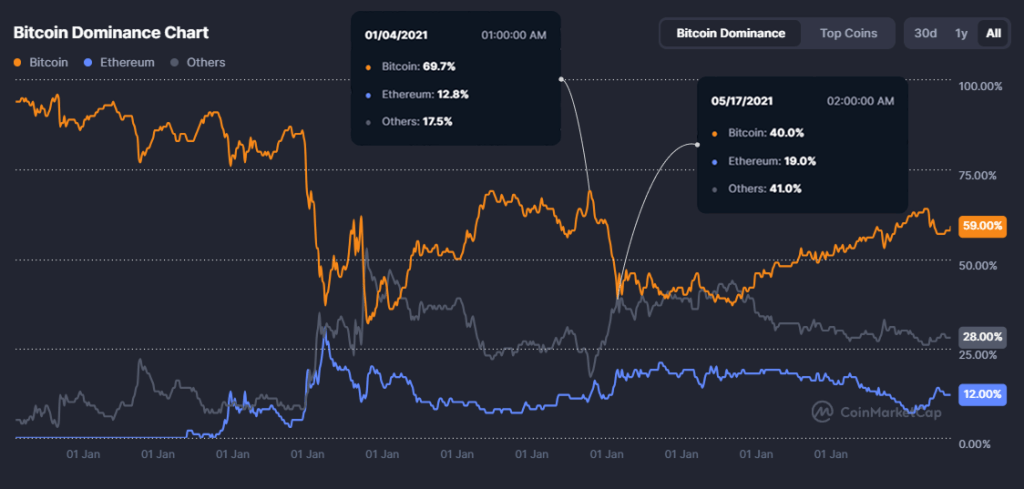
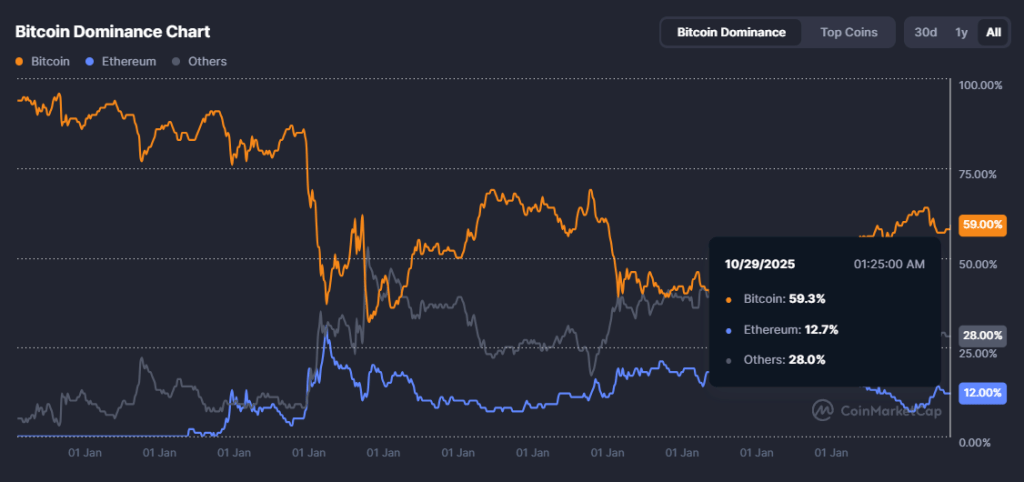
In 2025 however, BTC.D remains high, hovering around 58-60%, indicating the market hasn’t yet rotated broadly into altcoins despite improving metrics elsewhere. The contrast shows why analysts emphasise the dominance metric: only when BTC’s share retreats significantly does altcoin-season probability rise.
Technical Thresholds
Traders often monitor Bitcoin dominance charts to anticipate this transition. A drop below 50 to 45 percent is commonly viewed as a trigger zone for altcoin momentum. While the exact threshold can vary by cycle, these levels tend to signal that liquidity is rotating more aggressively into altcoins.
From a charting perspective, dominance breakdowns often appear as descending triangle patterns or moving average crossovers on daily and weekly timeframes.
It is important to note that traders use these setups as confirmation tools rather than entry triggers. The fall in dominance confirms that capital is flowing into altcoins, but it does not indicate which tokens will benefit most or how long the rotation will last.
Falling Bitcoin dominance reflects a structural shift in market behavior. It shows that investors are taking on more risk, chasing returns in smaller caps and emerging narratives. While dominance alone cannot predict which coins will outperform, it serves as a valuable confirmation that the capital cycle is in motion. By watching Bitcoin’s dominance chart closely, traders can position themselves to recognize when the market begins to favor innovation and growth over security and stability.
Sign 2: Rising Market Liquidity and Exchange Inflows
Price alone does not ignite an altcoin season. What truly fuels it is liquidity, so the flow of money that enables markets to move efficiently. Liquidity determines how easily traders can enter or exit positions without major slippage. When liquidity expands, it becomes the foundation that supports large-scale rallies across multiple cryptocurrencies. Without it, even strong narratives or technical setups struggle to gain momentum.
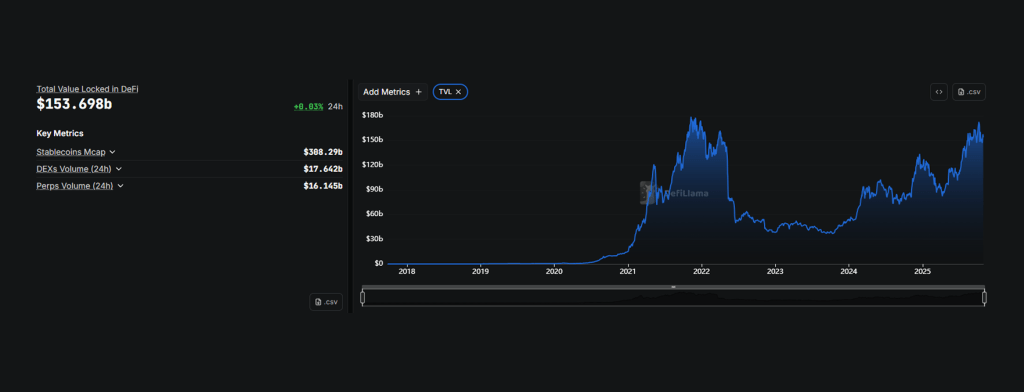
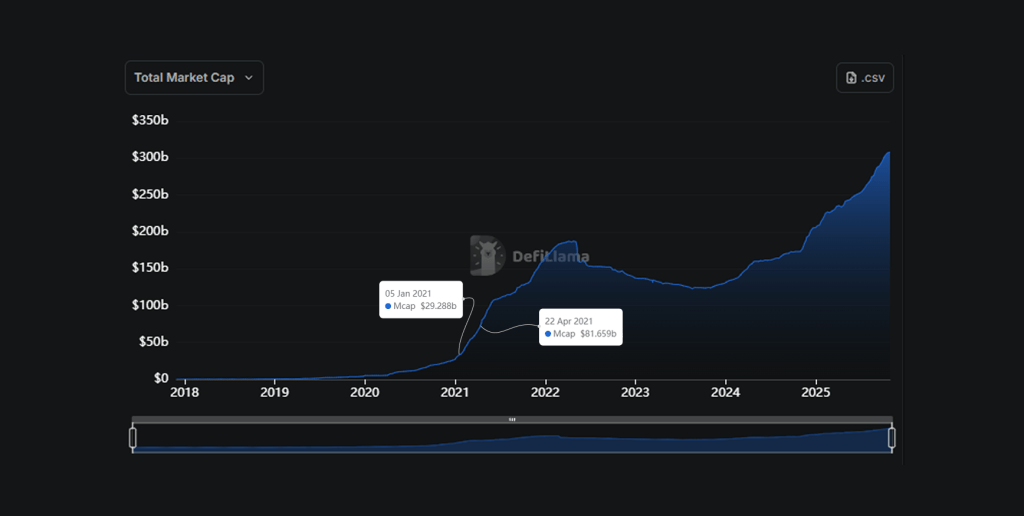
In 2021, the rise in market liquidity preceded the altcoin season as DeFi TVL peaked around $255 billion in November, signaling broad capital deployment into alt ecosystems. Current data shows liquidity improving, stablecoin supply exceeds $300 billion and TVL sits near $160 billion, yet the breadth of rotation remains narrower and many indicators are still trailing their 2021 highs. Although liquidity exists, the complete mass movement into altcoins that defined 2021 has not yet materialized, and nothing could guarantee the mass movement will even happen this cycle.
The Role of Liquidity in Altcoin Season
Liquidity acts as the bloodstream of the crypto market. When trading volume and market depth increase across several exchanges, it signals renewed market participation. In simple terms, more liquidity means more active buyers and sellers. This creates smoother price discovery and allows capital to move faster between crypto.
Altcoin seasons tend to begin when liquidity starts to rise broadly, not just in Bitcoin. Higher spot and derivative volumes on exchanges often align with early phases of capital rotation. The increased activity shows that traders are deploying fresh capital instead of recycling existing positions. When market makers and large holders add depth to order books, smaller tokens benefit the most because they rely heavily on external liquidity to move.
Technical Data Sources
Liquidity growth is measurable. Several reliable platforms track this activity across chains and exchanges. DefiLlama provides insights into total value locked (TVL), a strong indicator of capital flowing into decentralized ecosystems. When TVL begins to rise on multiple blockchains, it suggests that participants are deploying capital beyond Ethereum, often a sign that speculative appetite is returning.
Data providers like CoinGlass monitor exchange inflows, open interest, and perpetual funding rates, metrics that show how leveraged and liquid markets are becoming. Rising open interest with neutral or slightly positive funding rates indicates healthy speculative engagement. Meanwhile, onchain analytics tools such as Token Terminal track stablecoin movement toward exchanges, signaling that traders are preparing to buy.
Stablecoin Supply Expansion
Stablecoins are the clearest representation of dry powder entering the market. When supplies of USDT, USDC, and DAI increase, it means new liquidity is ready to enter altcoins. Historically, sharp growth in stablecoin issuance has preceded major altcoin rallies.
For instance, in the first quarter of 2021, the circulating supply of USDT expanded by roughly 42 percent just weeks before a surge across DeFi and Layer 1 tokens. The logic is straightforward: stablecoins act as on-ramps for traders. When their supply grows, it reflects rising confidence and readiness to deploy capital into altcoins.
Market Health Indicators
A healthy liquidity environment also shows up through balanced market metrics. Low funding rates combined with high spot volume signal sustainable participation rather than overleveraged speculation. Extended periods of low volatility often precede strong breakouts. When that volatility finally expands, altcoins tend to react faster than Bitcoin because of their lower liquidity thresholds.
Liquidity rotation occurs in waves. It usually begins with Bitcoin absorbing inflows, then moves to large-cap altcoins like Ethereum or Solana, before spreading to mid and low caps. Recognizing this sequence helps traders anticipate where capital is headed next.
In short, expanding liquidity marks the true beginning of altcoin season. When money starts flowing freely through exchanges, DeFi platforms, and stablecoin channels, it signals that the market is ready for its next phase of growth, one where altcoins often take the lead.
Sign 3: Onchain Activity and Developer Growth
Altcoin seasons are not random bursts of speculation. Beneath every major rally lies a foundation of growth that happens quietly before prices move. Onchain data and developer engagement often reveal these shifts early. When builders are active and networks attract real users, capital eventually follows. This is where fundamentals begin to outpace narratives.
Why Fundamentals Still Matter When Predicting an Altcoin Season
Price may drive attention, but fundamentals sustain momentum. Market cycles exaggerate stories, yet the projects that survive beyond the hype are those showing genuine onchain progress. Metrics such as active wallet addresses, smart contract deployments, and GitHub commits give a clearer picture of long-term health than short-term price charts.
Institutional and experienced traders often track these metrics long before retail sentiment turns bullish. They understand that rising developer activity usually means new products, better infrastructure, and more use cases. The smartest money moves in when the data improves but before social media notices.
Developer and Network Activity
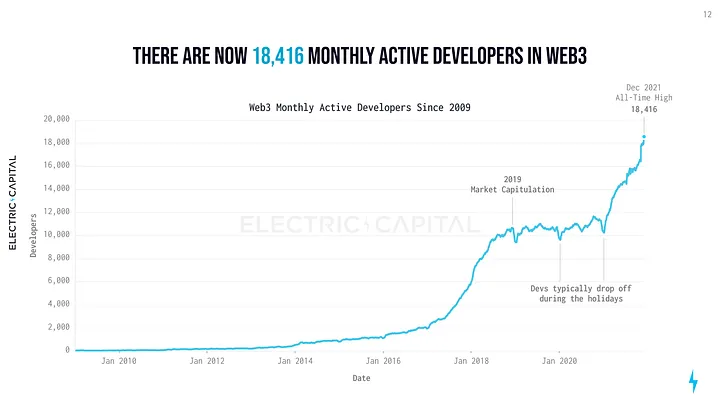
Developer growth remains one of the strongest leading indicators of an altcoin’s potential. Platforms like Token Terminal, Electric Capital’s Developer Report, and Artemis compile data on active contributors and code commits across ecosystems. When developer participation accelerates, it shows conviction and innovation within that network.
Examples from past cycles reinforce this point. Before Solana’s massive rally in 2021, its developer base tripled over the course of a year. A similar buildup occurred on Ethereum during 2020, when the number of active smart contracts surged right before DeFi summer. More recently, Base has seen early spikes in developer engagement and app launches even during broader market stagnation, signaling quiet but steady growth.
In 2021, onchain and developer metrics surged ahead of the altcoin wave: monthly active developers in Web3 exceeded 18,000 with Ethereum’s dev base growing ~42% in 2021. In contrast, by 2025 Ethereum alone has added over 16,000 new developers and maintains more than 31,000 active contributors. While developer engagement remains strong in 2025, rotation into altcoins still awaits broader breadth across ecosystems.
Onchain Metrics
Healthy onchain activity separates sustainable ecosystems from speculative ones. Indicators like active addresses, daily transactions, and TVL show whether users are interacting with the network or simply holding tokens. Yet, not all activity is organic. Periods dominated by airdrop farming or bot traffic can inflate these numbers temporarily.
To spot genuine growth, look at transaction fees, staking participation, and wallet retention. Rising network fees often indicate increasing demand for block space. Growing staking participation reflects user confidence in the protocol. Expansion in unique wallet count signals new adoption rather than recycled liquidity.
In 2021, for example, Ethereum’s fee revenue and daily transactions both rose sharply months before its price peak, suggesting real usage was driving the move.
Identifying Narrative Formation
Every altcoin cycle forms around a few dominant themes, DeFi, NFTs, Layer 2 scaling, AI tokens, or real-world assets. The challenge is recognizing these narratives early, when data looks uneventful but growth is quietly compounding. Analysts who monitor network metrics and developer trends often identify these inflection points before mainstream coverage begins.
Catching a narrative before the crowd requires focusing on fundamentals, not noise. When onchain data and developer activity both rise together, it signals a market preparing for expansion. This alignment between innovation and participation often marks the earliest stage of a true altcoin season.
Sign 4: Shifts in Retail and Social Sentiment
Once liquidity expands and fundamentals strengthen, the final spark that fuels an altcoin season often comes from the crowd. Retail investors and social sentiment act as emotional accelerants. They do not start cycles, but they confirm them. As more people talk about tokens, post charts, and share “next 100x” predictions, capital floods in. Monitoring how and when sentiment changes helps traders gauge where the cycle truly stands.
Tracking Sentiment Data
Sentiment is measurable. Platforms such as LunarCrush, Google Trends, and X Analytics offer data that tracks engagement, keyword volume, and overall social activity across crypto networks. When mentions of altcoin-related terms begin to rise sharply, it often signals growing awareness. Historically, spikes in social volume have preceded rallies by one to two weeks.
The pattern usually starts with small communities discussing new projects or narratives. Soon after, influencers begin to coordinate content around those same topics. As their reach amplifies exposure, YouTube searches, Reddit discussions, and trending terms follow. This compounding attention creates short-term demand as newcomers rush in, pushing prices higher in a feedback loop of hype and validation.
Retail vs Institutional Phases and How They Translate to Altcoin Season Indicators
Institutional and professional traders typically move first. They accumulate Bitcoin and Ethereum early, positioning for broad market recovery. Retail investors enter later, once confidence has returned and mainstream media begins covering crypto again. This influx often marks the midpoint of an altcoin cycle, when gains accelerate but volatility also increases.
Retail participation can be spotted through visible cultural trends. Memecoins begin to pump, terms like Solana Summer dominate social platforms, and speculative projects suddenly attract outsized interest. While these indicators can confirm rising momentum, they also suggest that much of the easy accumulation phase has already passed.
Fear and Greed Index
The Crypto Fear and Greed Index captures this emotional transition. During early recovery phases, sentiment usually remains neutral or fearful even as prices rise. As retail investors gain confidence, the index moves toward “greedy.” This shift reflects renewed optimism and risk-taking behavior.
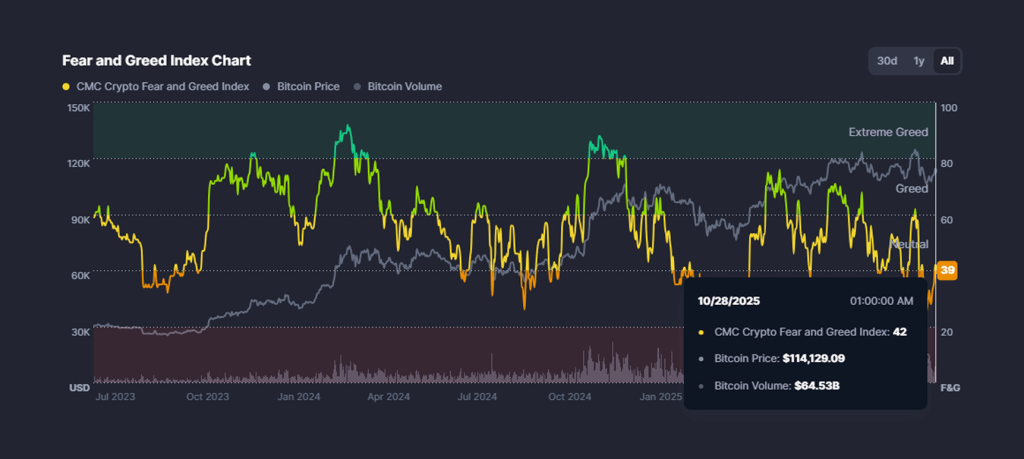
In 2021, retail sentiment surged as altcoins entered the spotlight; social-volume metrics and trending memes aligned with a broad market rotation, signaling peak participation. However, 2025 data shows heightened sentiment, with the Crypto Fear & Greed Index reaching ~79 in mid-2025, while dominance remains with Bitcoin and altcoins have not yet filled the “retail flood.” Retail engagement confirms cycles, and in 2025 that confirmation remains partial.
Not every rise in social chatter is bullish. When social metrics grow while prices stagnate or decline, it signals sentiment divergence. This condition shows that the market is running on narrative alone, not on liquidity or participation. It often precedes sharp corrections as speculative attention fades.
The key is distinguishing hype from real momentum. Sustainable altcoin seasons depend on both participation and liquidity, not just trending memes or influencer campaigns. True confirmation comes when sentiment strengthens alongside rising trading volume, onchain activity, and developer engagement.
Sign 5: Macroeconomic and Regulatory Tailwinds
Altcoin seasons do not exist in isolation. They unfold within a larger global environment where economic conditions, interest rates, and government policies dictate how freely capital moves. When the broader financial climate supports risk-taking, crypto markets thrive. Understanding these macro and regulatory dynamics provides critical context for spotting when large-scale capital rotation into altcoins becomes possible.
Macro Drivers
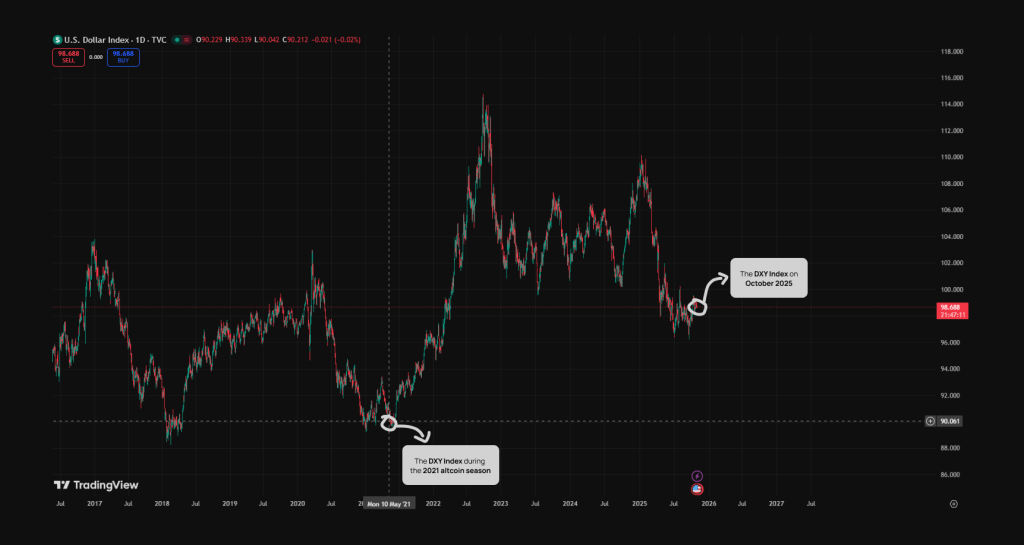
The global economy sets the tone for every asset class, and crypto is no exception. Interest rates, inflation trends, and the strength of the U.S. dollar directly shape investor behavior. When rates are high and liquidity tightens, speculative coins like altcoins tend to suffer as capital moves toward safer returns. When rates fall, liquidity increases, and traders are more willing to take invest in altcoins.
This relationship became clear during the 2020-2021 bull run. Global central banks injected unprecedented liquidity through quantitative easing and near-zero interest rates. The resulting flood of capital lifted all speculative assets, and crypto benefited the most. Bitcoin led the rally, but altcoins multiplied in value as investors sought higher yield within the expanding ecosystem.
Watching indicators such as the DXY Index (which tracks dollar strength) and central bank rate policies helps predict when macro conditions turn favorable for altcoins. A weaker dollar, cooling inflation, and lower borrowing costs all support speculative growth phases.
Regulatory Climate
The regulatory environment also shapes capital flow. When governments provide clarity, institutional investors gain confidence to participate. The European Union’s MiCA framework is a strong example, offering a clear licensing structure for exchanges and stablecoin issuers. Similarly, approvals of Bitcoin and Ethereum ETFs in major markets have signaled growing legitimacy.
In the United States, political shifts and enforcement attitudes often dictate sentiment. A pro-innovation stance from lawmakers or regulators can open floodgates of institutional participation, while uncertainty or aggressive crackdowns can pause momentum. Predicting how regulatory developments evolve helps gauge the sustainability of an altcoin season rather than its short-term volatility.
Institutional Products and On-Ramps
The next wave of crypto growth depends heavily on bridges between traditional finance and blockchain. Spot ETFs, tokenized treasuries, and real-world asset (RWA) protocols create direct channels for institutional capital to flow into digital markets. Once inside the ecosystem, that liquidity rarely stays concentrated in Bitcoin. It trickles down into altcoins, where investors chase higher returns through innovation and yield opportunities.
These financial on-ramps expand the total addressable market for crypto, turning isolated speculative cryptocurrencies into integrated components of the broader financial system.
Global Narrative Shifts
Narratives shape perception, and perception moves capital. When institutions, corporations, or policymakers begin discussing blockchain utility instead of speculation, the groundwork for a new cycle is being laid. Adoption themes like Web3 gaming, tokenized assets, and AI integrations turn curiosity into conviction.
Looking back at 2021, macro factors and regulatory shifts aligned tightly: ultra-low interest rates, global quantitative easing, and the absence of major regulatory clarity helped fuel the broad altcoin surge. In 2025, policy conditions remain strong, central banks are cutting rates, institutional adoption grows, and major laws such as the GENIUS Act are advancing, yet capital still concentrates in Bitcoin and Ethereum. While macro and regulatory tailwinds are present, the broad-based rotation into altcoins lags what was seen in 2021, mainly because regulations are focused on Bitcoin, Ethereum, and Solana, including ETF approvals.
Altcoin seasons are strongest when macro stability, regulatory clarity, and technological progress align. These forces create a climate where capital feels both safe and ambitious. Recognizing that alignment early helps investors position ahead of the crowd, before optimism turns into euphoria.
Timing the Altcoin Season
Recognizing the beginning of an altcoin season is not about catching the exact top or bottom. The signs discussed in this guide rarely align perfectly. Real prediction is about probability. Each indicator provides a piece of the puzzle, and when several of them move in the same direction, the odds of a broad market rotation increase. Successful traders focus on stacking confirmations rather than chasing predictions.
The strongest signal emerges when multiple indicators synchronize. A typical sequence might include Bitcoin dominance dropping, stablecoin inflows rising, and social engagement beginning to surge. When these conditions overlap, they signal that liquidity is expanding and attention is shifting toward riskier tokens. Add visible developer growth or rising total value locked, and the probability of an upcoming altcoin season strengthens even further.
This process is not instantaneous. The market often needs time to digest liquidity shifts and narrative formation. Recognizing that cycles build in stages helps prevent emotional trading and premature entries.
Avoiding False Starts
Crypto markets frequently produce false signals that resemble previous early altcoin seasons. Short-lived rallies, often concentrated in memecoins or speculative narratives, can lure traders before Bitcoin reclaims dominance. The key is to wait for confirmation through sustained strength across several sectors, not just isolated spikes. Consistent performance over a few weeks, supported by rising volume and organic user activity, provides stronger validation than any single metric.
Traders can track these dynamics using data-driven dashboards. Platforms like CoinMarketCap, TradingView, DefiLlama, and Token Terminal offer real-time metrics that combine both macro and micro perspectives. The goal is to build conviction through data rather than raw emotion. By blending technical, onchain, and sentiment indicators, traders can approach altcoin cycles with structure, patience, and confidence rather than guesswork.
Final Thoughts on How to Predict the Altcoin Season
Altcoin seasons are born from rotation, not luck. They happen when capital, confidence, and innovation align, not when traders simply wish for them. The five signs discussed in this guide reveal the framework behind every genuine cycle: a drop in Bitcoin dominance, rising liquidity, growing onchain activity, surging retail sentiment, and favorable macro or regulatory conditions. Together, these signals form the pulse of market rotation.
But today’s environment is different. The market no longer enjoys a constant inflow of new users or fresh capital. Liquidity is fragmented, and competition among tokens has exploded. There are now thousands of projects competing for the same pool of attention and money, compared to just a few hundred in 2021. With supply so heavily diluted, true altcoin seasons have become harder to ignite and even harder to sustain.
The best investors understand this. They do not chase short-lived rallies or viral narratives. Instead, they monitor metrics, follow data, and prepare for shifts before they become visible to everyone else. Prediction is an illusion, but preparation is a discipline.
Crypto still moves in cycles, but each one matures differently. If Bitcoin is the tide, altcoins are the boats, and the smart trader learns to read the current before it turns… but at the end of the day, tides can be unpredictable.
Frequently Asked Questions (FAQs)
What is altcoins season?
Altcoin season is when cryptocurrencies other than Bitcoin outperform it in price and trading volume. It usually follows a Bitcoin rally, as investors shift liquidity into smaller tokens like DeFi, gaming, and Layer 1 coins seeking higher returns.
How long will Alt season last?
Altcoin season typically lasts a few weeks to several months, depending on market liquidity and investor sentiment. It continues as long as capital keeps rotating from Bitcoin into smaller tokens, but usually ends once hype peaks and profits flow back into Bitcoin or stablecoins.
When was the last altcoin season?
The last major altcoin season occurred in early to mid-2021. During that period, Bitcoin’s dominance dropped sharply while projects like Cardano, Solana, Avalanche, and numerous DeFi tokens saw massive gains. It marked the peak of the bull market before liquidity tightened and capital rotated back into Bitcoin and stablecoins.
Which coin will give 1000x?
No one can predict which coin will deliver a 1000x return. Such gains are extremely rare and usually occur early in a project’s lifecycle, before it gains mainstream attention. Investors looking for high potential should focus on fundamentals like strong teams, real utility, active development, and growing onchain metrics.
How to predict altcoin season?
You can predict an upcoming altcoin season by tracking key market signals. Watch for Bitcoin dominance dropping below 50%, rising trading volumes, increasing stablecoin inflows to exchanges, and growth in onchain activity across multiple networks. Also monitor retail sentiment, social media engagement, and positive macro or regulatory trends.
What will trigger altcoin season?
Altcoin season is usually triggered by a combination of factors. Bitcoin stabilizing after a strong rally, rising liquidity in the market, and growing investor confidence. Expanding stablecoin supply, increased trading volume, and positive regulatory or macroeconomic conditions also play key roles. When these forces align, capital starts rotating from Bitcoin into altcoins, sparking broad market gains.
How to check altcoin season?
You can check altcoin season by observing Bitcoin stabilizing after a rally, liquidity rising, and investors shifting capital into smaller tokens. Growing stablecoin supply, decreasing Bitcoin dominance, and positive market sentiment usually trigger this rotation.