Buy a Licensed Company
  Explore VASP Data
  Talk to an Expert

 Atis Shala
Atis is a senior analyst and community lead with four years of experience in crypto. He has a bachelor from the Rochester Institute of Technology.
Atis Shala
Atis is a senior analyst and community lead with four years of experience in crypto. He has a bachelor from the Rochester Institute of Technology.
The Swiss Wealth Tax: Is Your Bitcoin Really Tax-Free?
- Private investors can enjoy tax-free capital gains on their Bitcoin and crypto holdings, provided they adhere to strict “Safe Harbour” rules (such as holding periods and turnover limits) to avoid being reclassified as professional traders.
- “Tax-free” does not mean entirely untaxed. Cryptocurrencies are classified as declarable assets, meaning all residents must pay an annual cantonal and municipal wealth tax based on the exact value of their portfolio on December 31st.
- Because the wealth tax is decentralized, the financial impact varies drastically by region. Choosing to reside in a low-tax canton like Zug or Glarus offers a massive compounding advantage over higher-tax cantons like Geneva.
- While passively holding crypto triggers only the wealth tax, actively earning yield through staking, lending, or mining is classified as regular income and is taxed at the asset’s market value at the exact moment of receipt.
- The upcoming implementation of the Crypto Asset Reporting Framework (CARF) means international exchanges and crypto service providers will soon automatically share user data with Swiss authorities, effectively ending the viability of hidden offshore wealth.
- Total compliance requires a strict end-of-year snapshot. Taxpayers must declare all assets across hot wallets, cold storage, and exchanges using the official year-end price list published by the Swiss Federal Tax Administration.
The Crypto Valley of Switzerland: Zug
Switzerland has built a formidable reputation as one of the most welcoming jurisdictions for digital asset holders. From the innovation-friendly “Crypto Valley” in Zug to the presence of globally recognised blockchain enterprises, the country has actively courted the crypto industry for over a decade. For many investors around the world, Switzerland represents a strategic destination for managing significant digital wealth, and that reputation has only grown as regulatory environments in other countries have become more restrictive.
A narrative has taken hold in crypto circles that holding or trading Bitcoin in Switzerland is essentially a tax-free affair. The story goes that Switzerland does not tax capital gains for private individuals, making it an ideal place to accumulate and eventually realise substantial crypto profits without the taxman taking a meaningful cut. This idea has attracted high-net-worth individuals, Bitcoin maximalists, and digital entrepreneurs to establish residency there.
The reality is more layered. Capital gains on Bitcoin and other cryptocurrencies are indeed largely exempt from tax for private investors under Swiss law, and this represents a genuine and significant advantage. However, the Swiss Federal Tax Administration views crypto assets as declarable wealth, and every resident holding digital assets faces an annual cantonal and municipal wealth tax on those holdings. The size of that annual bill depends heavily on which canton you call home, and beginning in 2027, international reporting frameworks will make undeclared crypto holdings far harder to sustain than they once were.

A Primer on the Swiss Tax System
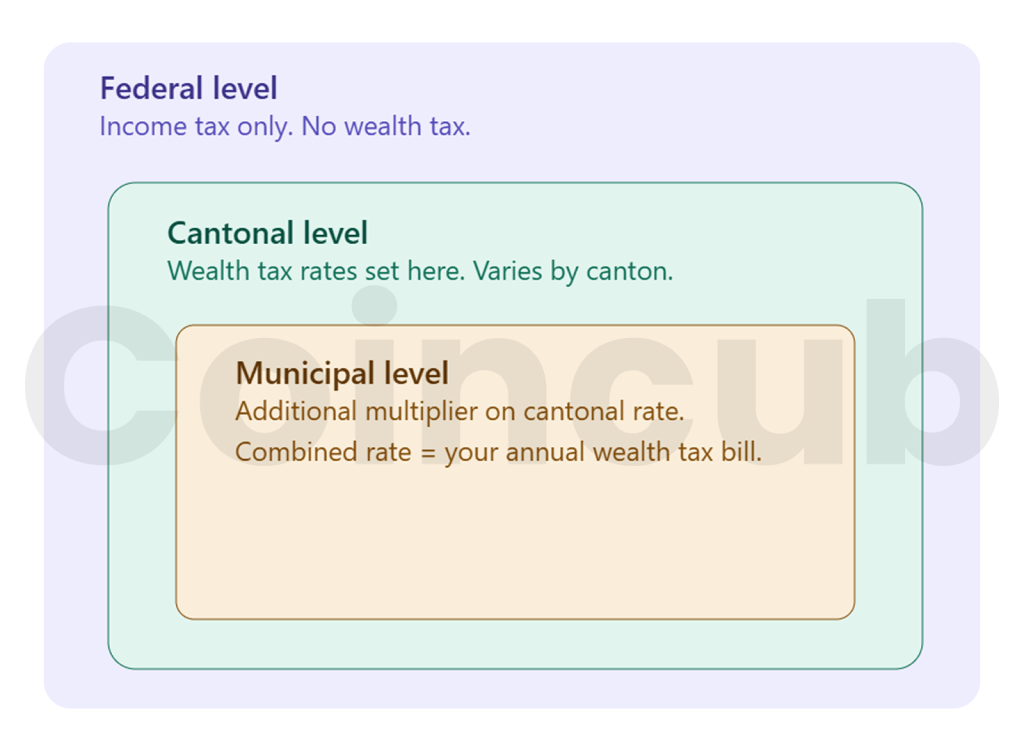
Switzerland operates a three-tiered tax structure, with levies imposed at the federal, cantonal, and municipal levels simultaneously. Federal taxes apply uniformly across the country and are administered centrally. Cantonal taxes are set by each of the 26 cantons and can vary dramatically from one region to the next. Municipal taxes are then layered on top of cantonal rates and are determined by individual towns and cities within each canton. The result is a patchwork of rates that makes Switzerland one of the most regionally diverse tax environments in the world.
For crypto investors, two categories of tax are relevant: income tax and wealth tax. Federal income tax applies to earnings, employment income, and in some circumstances, profits from financial activities. The federal government does not, however, levy a wealth tax on private assets. Wealth tax is exclusively a cantonal and municipal mechanism, meaning the federal government plays no role in taxing what you own as opposed to what you earn.
The wealth tax works through an annual snapshot approach. Each year, residents must declare their total global assets as they stood on the 31st of December. Every bank account, investment portfolio, real estate holding, and crucially, every crypto wallet, is included in this declaration. The aggregate value of those assets, minus applicable allowances and liabilities, forms the taxable wealth base. The cantonal authority then applies its rate to that base to arrive at the annual wealth tax liability.
Understanding this snapshot mechanism is fundamental to managing crypto tax exposure in Switzerland. A portfolio worth CHF 2 million on the 31st of December is taxed on that CHF 2 million figure, regardless of what it was worth in January or how much it fluctuated throughout the year.
The Tax-Free Capital Gains Myth vs. Reality
The foundation of Switzerland’s appeal to crypto investors is the capital gains exemption for private individuals. Under Swiss tax law, gains realised from selling or exchanging assets are generally not subject to income tax when the holder qualifies as a private investor. For a Bitcoin holder who bought at CHF 5,000 and sold at CHF 80,000, this exemption represents an enormous financial advantage that most jurisdictions simply cannot match.
The Swiss Federal Tax Administration formalised the criteria for this classification in Circular No. 36. To maintain private investor status and keep capital gains tax-free, a holder must satisfy several conditions. The holding period for each asset should be at least six months. Trading turnover across a calendar year should remain below five times the total value of the securities portfolio at the start of that year. Gains from securities trading should account for less than 50 percent of the individual’s net income. The investor must not use debt financing to fund asset purchases, and derivative instruments such as options should not be used to hedge positions.
Meeting all of these conditions keeps capital gains firmly in the exempt category. Failing to meet them, particularly the turnover threshold or the debt financing rule, can trigger reclassification as a self-employed securities dealer. At that point, capital gains are treated as professional income and become subject to both income tax and social security contributions, fundamentally altering the tax profile of the activity.
The Misunderstood Tax Category
There is also an often-misunderstood category of tax-neutral events. Purchasing Bitcoin with Swiss francs does not constitute a taxable event. Swapping Bitcoin for Ethereum, or moving assets between wallets, is similarly treated as tax-neutral for private individuals. The taxable moment arrives only when crypto is exchanged for fiat currency or used to purchase goods and services. For long-term holders who rarely realise gains, the Swiss framework delivers genuinely on its promise of a low-friction environment.
The Main Event: The Swiss Wealth Tax on Crypto
While capital gains tend to dominate the conversation around crypto taxation in Switzerland, the wealth tax is the mechanism that touches every single resident holding digital assets, regardless of whether they ever sell.
The Swiss Federal Tax Administration classifies cryptocurrencies as movable intangible assets, referred to in German as Kryptobasierte Vermögenswerte. This classification places Bitcoin, Ethereum, and other digital assets in the same declarable category as stocks, bonds, and cash held in foreign accounts. They are assets, and assets must be reported.
The valuation process follows the December 31st snapshot rule. For major cryptocurrencies with sufficient market liquidity, the SFTA publishes an official year-end price list each January. Taxpayers are required to use these official rates when declaring their holdings. If a particular token does not appear on the published list, the taxpayer must use the closing price from a recognised exchange on December 31st and document the source clearly. Unofficial or self-selected valuations are not acceptable to the tax authorities.
The declaration itself covers every form of crypto storage. Hot wallets connected to the internet, cold storage hardware wallets kept in a safe at home, assets held on centralised exchanges, and even assets held in decentralised protocol smart contracts must all be included in the annual securities schedule. There is no threshold below which crypto holdings become exempt from declaration, and the obligation applies to all residents regardless of where the assets are technically stored or which country the exchange is based in.
The Crypto Asset Reporting Framework (CARF)
A significant development on the horizon will change how enforceable these obligations are. The Crypto Asset Reporting Framework, known as CARF, is an international standard developed by the OECD and being adopted across major jurisdictions. Under the Swiss implementation timeline, crypto asset service providers operating both in Switzerland and abroad will be required to automatically share account and transaction data on Swiss residents with the SFTA starting in 2027. This is roughly analogous to the Common Reporting Standard that already applies to bank accounts and financial institutions globally.
The practical consequence is straightforward: the window for undeclared crypto wealth is closing. Once CARF goes live, Swiss tax authorities will receive detailed information about holdings, trades, and transfers from platforms across participating jurisdictions. The era of plausible deniability about offshore exchange balances will effectively be over, and residents who have not been reporting their holdings accurately will face significant exposure.
A Canton-by-Canton Comparison
One of the most consequential decisions a Swiss crypto resident can make is choosing which canton to live in. Because the wealth tax is entirely decentralised, the financial impact of holding a large Bitcoin position varies enormously depending on residency. Two investors holding identical portfolios, one in Zug and one in Geneva, will face meaningfully different annual tax bills simply because of their address.
The Each to Their Own Rule
Every canton sets its own tax rate and its own personal allowance threshold, which is the amount of net wealth exempt from the wealth tax before any liability begins. These allowances vary by canton and also by marital status and family situation. A single individual in one canton might have an allowance of CHF 100,000, while a married couple in another canton could be exempt on the first CHF 300,000 of combined wealth.
| Canton | Approx. Wealth Tax Rate | Notable Characteristic |
| Glarus | ~0.03% | Lowest effective rate in the country |
| Zug | ~0.17% | Home to Crypto Valley, popular with blockchain firms |
| Schwyz | ~0.19% | Widely favoured by high-net-worth relocators |
| Nidwalden | ~0.20% | Low-rate inner canton |
| Zurich | ~0.22% | Higher rate, offset by financial infrastructure |
| Bern | ~0.32% | Moderate-to-high cantonal burden |
| Vaud | ~0.34% | Includes Lausanne, relatively high total rate |
| Geneva | ~0.45% | Among the highest effective rates in Switzerland |
For a Bitcoin investor holding CHF 1 million in digital assets as of December 31st, the difference between residing in Glarus and Geneva is the difference between a wealth tax liability of roughly CHF 300 and one approaching CHF 4,500, on exactly the same assets, in exactly the same country. Multiply that across a larger portfolio and across many years of compounding, and the canton choice becomes a meaningful long-term financial variable.
This is why a significant cluster of crypto-wealthy individuals has chosen to establish residency in Zug and the surrounding low-tax cantons in central Switzerland. The advantage is structural and repeating: it reduces the annual drag on a portfolio without requiring any change to the underlying investment strategy.
Taxes on Yield, Staking, and Mining in Switzerland
Passively holding Bitcoin in cold storage limits a Swiss resident’s crypto tax exposure to the wealth tax described above. The moment a holder begins generating yield from those assets, however, a second tax dimension enters the picture.
Staking rewards, lending income from crypto lending platforms, and returns from providing liquidity to decentralised protocols all constitute taxable income under Swiss law. These are treated as investment income, similar in principle to dividends received from equity holdings or interest earned on a savings account.
The valuation of this income follows a specific rule. Rewards received through staking or lending must be converted to CHF at the market rate at the precise moment of receipt. If a holder receives 0.05 ETH in staking rewards on a Tuesday in April when Ethereum is trading at CHF 3,200, the taxable income from that event is CHF 160. These amounts accumulate throughout the year and must be reported on the income tax return.
There is a compounding effect worth noting. The same staking rewards that generate an income tax liability in the year they are received also increase the total wallet balance. When December 31st arrives, that larger balance feeds into the wealth tax calculation. A successful staking strategy therefore creates both an income tax obligation in the current year and a modestly higher wealth tax base going forward.
Mining income follows the same logic. Bitcoin mined by a private individual is treated as income at the fair market value of the coins at the time of receipt. For individuals running operations of meaningful scale, the activity may cross the threshold into self-employed professional territory, at which point social security contributions apply alongside income tax.
Final Thoughts on the Swiss Wealth Tax
Switzerland offers a genuinely competitive tax environment for Bitcoin and crypto holders. The capital gains exemption for private investors is real, well-defined under Circular No. 36, and represents a structural advantage that most jurisdictions do not offer. For long-term holders who stay within the private investor criteria, the framework is predictable and relatively light-touch by international standards.
What the “tax-free Switzerland” narrative consistently leaves out is the wealth tax. Every resident holding crypto assets on December 31st owes an annual declaration and a cantonal wealth tax on those holdings. The rate depends heavily on the canton of residence, making that choice a meaningful financial decision for anyone managing a substantial portfolio. The arrival of CARF in 2027 will further close any remaining ambiguity about the reach of Swiss tax obligations to assets held on offshore platforms.
For crypto holders in Switzerland, this translates into two practical priorities. First, meticulous end-of-year documentation is essential: wallet statements, hardware wallet records, and exchange export reports should be preserved and reconciled against the official SFTA valuation list each December. Second, cantonal residency deserves careful attention when making long-term life and financial planning decisions, as the difference between a low-rate and a high-rate canton compounds into a material sum over time. The framework is favourable. Working within it correctly is where the advantage is actually realised.
Frequently Asked Questions (FAQs)
Which Swiss canton has the lowest wealth tax?
Nidwalden currently offers the lowest wealth tax in Switzerland, featuring a top flat rate of roughly 0.1% to 0.25%. Other central cantons like Zug, Glarus, and Schwyz also offer highly competitive wealth tax rates generally below 0.2%.
Why is Switzerland considered a tax haven?
Switzerland is considered a tax haven due to its decentralized tax competition, complete lack of a federal wealth tax, and a general exemption on private capital gains. This creates a highly favorable financial environment for high-net-worth individuals globally.
Why is Zug a tax haven?
Zug is favored as a tax haven because it offers some of Switzerland’s lowest corporate and personal wealth tax rates. Its pro-business regulations and exceptionally pragmatic tax authorities actively attract international enterprises, especially within the blockchain sector.
What is the crypto tax in Zug?
In Zug, private investors pay 0% capital gains tax on cryptocurrency sales. However, crypto assets are subject to an annual cantonal wealth tax of approximately 0.17%, and any passive yield like staking is taxed as regular income.
How many crypto companies are in Zug?
As of 2025 and 2026 data, the Canton of Zug is home to over 700 crypto companies. This represents roughly 40% of the entire Crypto Valley ecosystem, which now hosts nearly 1,760 blockchain and digital asset firms nationwide.