


 Buy a Licensed Company
 Explore VASP Data
 Talk to an Expert


 Atis Shala
Atis is a senior analyst and community lead with four years of experience in crypto. He has a bachelor from the Rochester Institute of Technology.
Crypto Exchange Spreads vs Trading Fees: How to Calculate the Real Cost of a Crypto Trade

- A trading fee is an explicit charge, usually a percentage of the order value, that a platform lists in its fee schedule and itemises on the receipt.
- A spread is the gap between the buy price and the sell price. On an order book it reflects market liquidity, while on a simple “buy” screen it can also contain a markup that the platform keeps.
- On the most liquid pairs, order book spreads are tiny. Kaiko data from January 2026 put average BTC and ETH spreads at roughly 0.12 and 0.11 basis points, which is about one cent on a $1,000 trade.
- On instant-buy and “zero-fee” convert products, the spread is usually the largest cost. Coinbase, Kraken and Binance.US all state that their simple products include a spread in the quoted price.
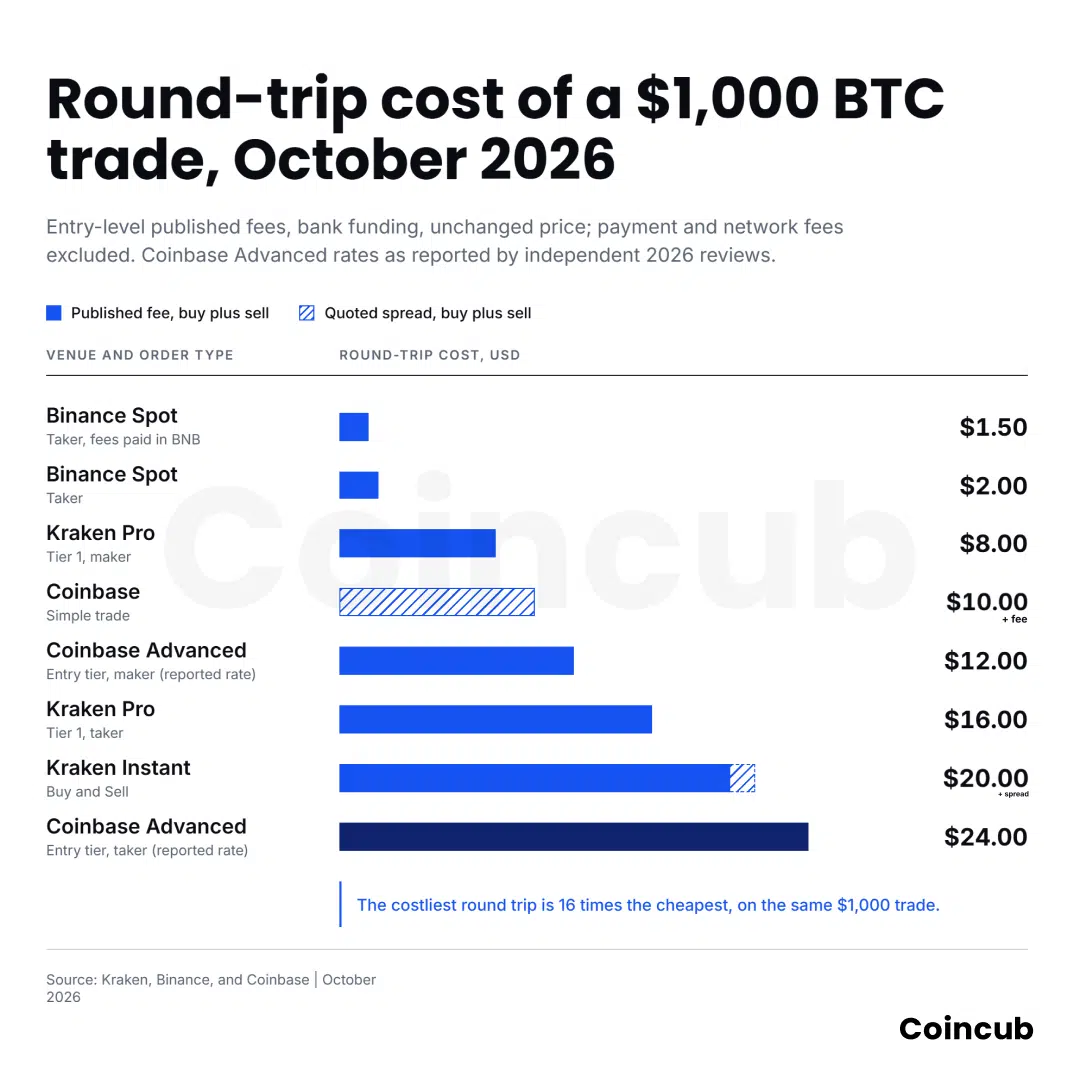
- Using published entry-level schedules, a $1,000 bitcoin round trip in October 2026 costs between about $1.50 on Binance spot and $24 at Coinbase Advanced’s reported entry taker rate, before any spread markup, payment fee or network fee.
- In the European Union, MiCA requires crypto-asset service providers to publish their pricing, cost and fee policies and, for exchange services, a firm price or a method for determining the price.
Hidden Crypto Trading Fees
Every crypto trade carries two separate costs, and most platforms put only one of them on the price list. The trading fee is the visible charge, quoted as a percentage and printed on the receipt. The spread is the difference between the price at which you can buy and the price at which you can sell, and it sits inside the quote itself. Comparing crypto exchange spreads vs trading fees matters because the cheapest-looking platform on a fee table can turn out to be the most expensive once the spread is counted, and a platform with a higher headline fee can be cheaper in practice.
What Is a Trading Fee in Crypto?
A trading fee is an explicit charge that an exchange applies to each executed order, usually calculated as a percentage of the order’s value. It appears in the platform’s published fee schedule and on the trade confirmation, which makes it the easiest cost to see and compare.
Most order book exchanges split trading fees into maker and taker rates. A taker order is one that fills immediately against orders already waiting in the book, such as a market order. A maker order is one that rests on the book until someone else trades against it, such as a buy limit order placed below the current price. Coinbase’s own definition follows this pattern and adds that a partially matched order pays the taker rate on the portion that fills immediately and the maker rate on the rest. Makers usually pay less because they add liquidity that other traders can use.

Fee levels then fall as a customer moves up volume tiers. Binance lists 0.100% maker and 0.100% taker for regular users with less than $1 million of 30-day volume, falling to 0.075% on both sides when fees are paid in BNB, its exchange token. Kraken Pro’s Tier 1 rate, which applies from the first dollar, is 0.40% maker and 0.80% taker under the cross-platform fee tiers it introduced on 9 July 2026. Coinbase shows exact Coinbase Advanced rates only inside a logged-in account, and independent reviews published in 2026 report an entry tier of 0.60% maker and 1.20% taker for accounts with less than $1,000 of monthly volume.
Trading Fee Tiers
The way tiers are earned has also started to change. Kraken now places each customer in the best tier achieved by either 30-day spot volume or assets held on the platform, so a customer with $20,000 on deposit qualifies for Tier 3 rates of 0.22% maker and 0.38% taker without trading heavily. Kraken also states that volume generated through Instant Buy does not count towards those tiers.
What Is a Spread in Crypto Trading?
The spread is the difference between the best price a buyer is willing to pay, called the bid, and the best price a seller is willing to accept, called the ask. If the best bid for bitcoin is $100,000 and the best ask is $100,050, the spread is $50, or 0.05% of the price.
Traders usually express the spread as a percentage of the mid price, which is the average of the bid and the ask. The calculation is simple: take the ask minus the bid and divide the result by the mid price. On very liquid markets the result is quoted in basis points, where one basis point equals 0.01%, so a 10 basis point spread is the same as 0.10%.
The spread becomes a cost the moment you trade against it. A market buy fills at the ask, which sits half a spread above the mid price, and a market sell fills at the bid, which sits half a spread below it. Buying and then immediately selling therefore costs one full spread even when the price has not moved at all.
Market spreads and platform markups are two different mechanisms
The word “spread” covers two separate things in crypto, and mixing them up is the main reason fee comparisons go wrong.
The first is the market spread on an order book. It is created by the competing limit orders of market makers and other traders, and no single party sets it. Nobody bills you for it, and the value captured from it goes to whoever provided the liquidity on the other side of your trade. Its size depends on how much trading activity and how many competing quotes a market attracts.
The second is a quote spread, sometimes called a markup, which appears on simple buy, sell and convert screens. Here the platform shows you a single price that already includes a margin over the market price, locks that price for a short time, and executes the trade for you. Coinbase states in its pricing and fees disclosures that it includes a spread in the quoted price for simple buy and sell orders and for conversions, that the spread may vary for similar transactions, and that it may retain any excess spread. Kraken’s fee schedule uses almost identical language for its Instant Buy and Sell services, and Binance.US says its Convert feature carries no trading fee but collects a small spread margin between the buy and sell price.
Coinbase also draws the line between the two mechanisms explicitly. It states that no spread is included for Coinbase Advanced, because trades there interact directly with the order book. Customers on the advanced screen still face the market spread, but they pay no platform markup on top of it.
How Big Are Spreads Compared With Trading Fees?
Market spreads on major cryptocurrencies are now far smaller than any published trading fee. A weekly market snapshot published on Kaiko’s data blog in January 2026, originally produced by Amberdata before Kaiko acquired it, measured average order book spreads of about 0.12 basis points for BTC and 0.11 basis points for ETH across the venues it tracked, with SOL wider at about 0.92 basis points. At 0.12 basis points, crossing the spread on a $1,000 bitcoin trade costs roughly one cent.
Liquidity was not always this deep, and it remains uneven. Earlier Kaiko research recorded bitcoin spreads on major US exchanges narrowing to about 0.3 basis points on Coinbase and 0.1 basis points on Kraken, and found that meme token spreads stayed above 2 basis points on most centralised exchanges even as their market depth grew. Smaller tokens on smaller venues can trade far wider than that, which is why the spread matters much more for altcoins than for bitcoin.
Platform markups sit on a different scale. Coinbase does not publish a fixed figure, but independent reviews in 2026 consistently report a simple-trade spread of about 0.50%. That equals 50 basis points, which is more than 400 times the January 2026 average order book spread for BTC. For a casual buyer of a major coin, the markup is therefore the cost that matters, while the market spread is close to irrelevant.
Those two scales explain the comparison problem. A platform that advertises a low trading fee but routes customers through a quoted price can end up more expensive than a platform that charges a visible fee on a tight order book.
How Major Platforms Price a Crypto Trade in October 2026
The table below sets out how the main retail products from three large exchanges and one decentralised exchange charge for a spot trade, based on each platform’s published documentation as of 26 October 2026.
| Platform and product | Explicit trading fee | Spread | Notable conditions
|
|---|---|---|---|
| Coinbase, simple buy and sell | Coinbase fee that varies with payment method, order size, asset and location | Included in the quoted price; reported at about 0.50% | Separate 1% fee on simple limit orders; spread visible in the order preview |
| Coinbase Advanced | Maker and taker rates by tier; reported entry tier 0.60% maker and 1.20% taker | No platform spread; market spread only | Exact tier shown only after login |
| Kraken Instant Buy and Sell | 1% on instant and recurring trades; 1.5% on custom orders | Included in the quoted price; Kraken may retain excess spread | Kraken+ waives the trading fee on up to $10,000 a month, while spreads and card fees still apply |
| Kraken Pro | Tier 1: 0.40% maker and 0.80% taker; Tier 3: 0.22% maker and 0.38% taker | No platform spread; market spread only | Tier set by best of 30-day volume or assets on platform |
| Binance Spot | 0.100% maker and taker for regular users; 0.075% when paid in BNB | No platform spread; market spread only | VIP tiers begin at $1 million of 30-day volume |
| Binance.US Convert | No trading fee | Small spread margin collected by Binance.US | Binance.US notes that its spot market avoids the Convert spread |
| Uniswap v3 (DEX) | Pool fee of 0.01%, 0.05%, 0.30% or 1% | No order book; price impact plays the same role | Uniswap Labs set its interface fees to zero under the UNIfication proposal approved in December 2025; network gas fees apply |
Worked Example: The Cost of a $1,000 Bitcoin Round Trip
A round trip is the simplest way to compare the two kinds of cost, because it captures both the buy side and the sell side of a position. The example below assumes a customer buys $1,000 of bitcoin and sells it straight back at an unchanged market price, using an entry-level account funded by bank transfer. Fees are applied to $1,000 on each leg and rounded, and the market spread of about 0.12 basis points adds roughly one cent in every row. Payment, withdrawal and network fees are excluded.
| Venue and order type | Fee on buy | Fee on sell | Round-trip cost | Share of $1,000
|
|---|---|---|---|---|
| Binance Spot, taker, fees paid in BNB | $0.75 | $0.75 | $1.50 | 0.15% |
| Binance Spot, taker | $1.00 | $1.00 | $2.00 | 0.20% |
| Kraken Pro Tier 1, maker | $4.00 | $4.00 | $8.00 | 0.80% |
| Coinbase Advanced entry tier, maker (reported rate) | $6.00 | $6.00 | $12.00 | 1.20% |
| Kraken Pro Tier 1, taker | $8.00 | $8.00 | $16.00 | 1.60% |
| Kraken Instant Buy and Sell | $10.00 | $10.00 | $20.00 plus the quoted spread | 2.00% plus spread |
| Coinbase Advanced entry tier, taker (reported rate) | $12.00 | $12.00 | $24.00 | 2.40% |
| Coinbase simple trade | Quoted spread of about $5.00 | Quoted spread of about $5.00 | About $10.00 plus the Coinbase fee shown at preview | About 1.00% plus fee |
The Cost of Roundtripping on Kraken
The ranking surprises many traders. A new Kraken customer who uses market orders on Kraken Pro pays 1.60% for the round trip, which is cheaper than the 2.00% fee plus spread on Instant Buy, but only by a modest margin. The same customer can cut the Pro cost in half by posting limit orders as a maker, and by qualifying for Tier 3 through $10,000 of monthly volume or $20,000 of assets, the taker cost of a round trip falls to 0.76%.
The Cost of Roundtripping on Coinbase
Coinbase Advanced shows the same lesson more sharply. At the reported entry taker rate, a small round trip on the advanced screen can cost more in explicit fees than the roughly 1% of spread on a simple trade, so the “advanced is always cheaper” rule of thumb fails for very small, infrequent accounts that cross the book. The order preview, which shows both the fee and the spread before you confirm, is the only reliable way to compare the two routes for a given trade.
The Cost of Roundtripping on Binance
Binance’s regular spot rate is the lowest explicit fee in the table by a wide margin, which shows how much pricing varies between venues of similar scale. Product availability, licensing and local regulation also differ between Binance entities and jurisdictions, so the cheapest schedule on paper is only useful if the venue is authorised to serve customers where you live.
Why “Zero-Fee” Crypto Trading Still Costs Money
Zero-fee offers remove the visible charge and leave the spread in place, so the cost moves inside the quote. Binance.US describes its Convert feature as fee-free while collecting a spread margin, and its own help pages note that spot trading avoids the spread costs associated with Convert.
Subscription programmes work the same way. Coinbase One offers zero trading fees with limitations, and Coinbase states that members may still have a spread included in their quoted prices. Kraken+ waives trading fees on up to $10,000 of monthly volume through the buy, sell and convert features, and Kraken notes that spreads and card processing fees still apply. US brokerage apps that advertise commission-free crypto, Robinhood among them, also price trades with a spread included in the execution price.
The spread does buy something real. Coinbase says its spread allows it to lock a quoted price temporarily while an order is processed, and Kraken says its spread ensures price certainty at the time of execution. A customer who values a guaranteed price and a single tap is paying for that convenience, and the useful question is whether the price of convenience is acceptable for the size and frequency of the trade.
Costs That Sit Outside Both the Fee and the Spread
- Price impact and slippage. A large market order consumes the best prices in the book and keeps filling at progressively worse levels. Kaiko’s January 2026 snapshot put BTC order book depth within 1% of the mid price at about $631 million across the venues it tracked, which is ample for retail sizes, while thinly traded tokens can move several percent on a modest order. Traders moving very large size often use the OTC desks and block trades that sit outside the public order book.
- Order type surcharges. Coinbase charges a separate limit order execution fee equal to 1% of the amount traded on each simple limit buy and sell, and Coinbase says it may also charge a 1.875% Coinbase fee on those orders, varying by payment method.
- Payment method fees. Card purchases carry higher charges than bank transfers on most platforms, and Kraken charges a fixed 3% to convert small balances below the minimum order size.
- Network and withdrawal fees. Moving coins off an exchange incurs a blockchain fee, and some platforms add processing charges. Coinbase charges 0.2% for bitcoin sent over the Lightning Network and 0.01% on USDT withdrawals, capped at 20 USDT, plus the network fee.
- On-chain costs on decentralised exchanges. A swap on a DEX pays a pool fee plus gas, and price impact replaces the bid-ask spread because there is no order book. The trade-offs between these models are covered in our DEX vs CEX comparison, and the economics on the other side of the pool are explained in the cost of being a liquidity provider.
- Funding costs on derivatives. Perpetual futures often carry lower trading fees than spot, and positions held over time pay or receive periodic funding, which is explained in our guide to perpetual futures funding rates.
What Regulators Require Platforms to Disclose About Spreads and Fees
Disclosure rules matter here because a spread is only a fair price if the customer can see it before committing. The European Union has gone furthest in writing that principle into law.
Under Article 66(4) of the Markets in Crypto-Assets Regulation (MiCA), crypto-asset service providers must make their policies on pricing, costs and fees publicly available in a prominent place on their website. Article 77 then adds specific rules for providers that exchange crypto-assets for funds or for other crypto-assets, which covers most buy, sell and convert products. Those providers must publish a firm price, or a method for determining the price, along with any limit on the amount to be exchanged. They must execute client orders at the price displayed when the order becomes final, and they must publish information about the transactions they conclude, such as volumes and prices.
ESMA’s Stance
ESMA, the EU’s securities markets regulator, clarified how this works in practice in a Q&A answered on 17 May 2024. It said the information should sit in a publicly available location, such as the provider’s website, that anyone can access without registering. It also said the published quotations should include all the elements needed for a party to anticipate with certainty the price at which an exchange would be made. In practical terms, an embedded spread is allowed, but an EU customer should be able to work out the all-in price before trading. Platforms serving EU users have had to adapt their disclosures as the MiCA transition deadlines have passed.
Outside the EU, disclosure depends largely on local rules and each platform’s own terms.
Coinbase, for example, shows the spread and fees in its order preview and transaction history, states that trades from customers’ primary balances are executed through Coinbase Exchange’s central limit order book or competitive auctions, and says it has no payment for order flow relationships with market makers.
How to Lower the All-In Cost of a Crypto Trade
Once the two costs are separated, a handful of habits removes most of the avoidable expense.
- Read the order preview before confirming: Coinbase, Kraken and Binance.US all show the applied spread and fees at the preview stage, and comparing the final “you receive” figure across two platforms is more reliable than comparing fee tables.
- Use the order book screen for repeat trades: Coinbase Advanced, Kraken Pro and Binance Spot add no platform markup, so regular buyers of major coins usually save money by moving there once they understand order types.
- Post limit orders as a maker where possible: On Kraken Pro, the Tier 1 maker rate is half the taker rate, and resting orders also avoid crossing the spread.
- Check how your tier is calculated: Kraken now credits assets held on the platform as well as volume, and Binance discounts fees by 25% when they are paid in BNB, so the effective rate can be well below the headline entry tier.
- Match the trade size to the cost structure: Flat and percentage fees dominate small orders, while price impact dominates large ones, so very small, frequent purchases can be cheaper when batched into a regular schedule such as a dollar-cost averaging plan.
- Compare the all-in price for altcoins: Spreads on smaller tokens vary widely between venues, so checking two or three order books before trading a mid-cap coin is worth the extra minute.
- Fund by bank transfer: Card and instant payment methods add a separate charge on most platforms, and that charge often exceeds the trading fee itself.
Frequently Asked Questions (FAQ)
Is the spread a fee? +
The spread is a trading cost that is built into the price you pay or receive. On an order book it is a market cost earned by liquidity providers. On a simple buy or convert screen it can include a markup that the platform keeps, which works economically like a fee even though it does not appear as a separate line.
Why is the buy price on my app higher than the sell price? +
The gap between the two prices is the spread. On instant-buy screens it combines the market spread with any margin the platform adds to lock your price, and the platform's order preview usually shows how much of the quote is spread.
Is a 0.50% spread cheaper than a 0.50% trading fee? +
A 0.50% markup on each trade costs the same as a 0.50% fee on each trade. The difference is visibility, because the fee appears on the receipt while the spread is contained in the price.
Do decentralised exchanges have spreads? +
Automated market maker DEXs such as Uniswap have no order book, so they have no bid-ask spread in the traditional sense. Traders instead pay a pool fee, network gas and price impact, which grows with the size of the trade relative to the pool.
How do I calculate the real cost of a crypto trade? +
Add the trading fee on each leg, any platform markup on each leg and the market spread, then add payment, withdrawal and network fees. For a quick comparison, a round trip at an unchanged price captures the full trading cost of opening and closing a position.
Does MiCA ban spread-based pricing? +
MiCA permits spread-based pricing for exchange services. It requires providers to publish their pricing and fee policies, to publish a firm price or pricing method, and to execute orders at the price displayed when the order becomes final.
Are fees lower on the advanced screen of every exchange? +
Advanced screens remove the platform markup, which usually makes them cheaper. Entry-tier taker fees can still be high, however, so very small accounts should compare the preview on both screens or use maker orders to secure the lower rate.