


 Buy a Licensed Company
 Explore VASP Data
 Talk to an Expert

 Atis Shala
Atis is a senior analyst and community lead with four years of experience in crypto. He has a bachelor from the Rochester Institute of Technology.
Lost or Stolen Crypto: Can You Claim Tax Relief?

- United States: Theft losses on personal property stay non-deductible after the One Big Beautiful Bill Act made the restriction permanent, but scam and hack victims who acquired crypto to make a profit can still claim a theft loss under section 165(c)(2), as IRS Chief Counsel Advice 202511015 confirmed in 2025.
- United Kingdom: HMRC does not treat theft as a disposal, so stolen crypto creates no capital loss on its own. A negligible value claim is the main route to relief for lost keys, and it can be backdated up to two years before the start of the tax year of the claim.
- Canada: Crypto held as capital property that is stolen can produce a capital loss, but losses on personal-use property are generally deemed to be nil.
- Australia: The ATO allows a capital loss for lost or stolen crypto if the owner can prove ownership, loss and loss of access, and it publishes a list of the evidence it expects.
- Germany: Theft, hacks and lost keys are generally not treated as a sale under section 23 of the Income Tax Act, so no deductible loss arises.
- Everywhere: The deductible amount is normally the cost basis, the market value at the time of the loss plays no part, and any later recovery or compensation reduces the claim or becomes taxable.
Tax relief on lost or stolen crypto
Tax relief for lost or stolen crypto exists in most major tax systems, but it rarely arrives automatically. The economic loss is real the moment a wallet is drained or a seed phrase disappears, yet tax law usually needs a disposal, a closed transaction or a formal claim before it will recognise that loss. Whether a victim gets anything back from the tax office depends on three things: how the crypto went missing, where the victim is tax resident, and how well the loss can be documented.
Five tax systems are compared here, those of the United States, the United Kingdom, Canada, Australia and Germany, across the four usual ways crypto goes missing: lost keys, hacks, scams and exchange failures. The guidance cited reflects the position as of November 2026.
Why losing crypto rarely creates a tax loss automatically
Most tax systems treat crypto as property, and property losses are usually recognised only when the owner disposes of the asset or a specific loss rule applies. That framing creates the central problem for victims. A thief who drains a wallet has taken possession of the tokens, but in legal terms the victim may still own them, and an owner who forgets a seed phrase still holds tokens that sit on the blockchain untouched.
The disposal problem
Tax authorities have built their guidance around that gap. HMRC’s manual states that misplacing a private key is not a disposal for Capital Gains Tax because the tokens still exist on the distributed ledger. Germany’s tax office applies the same logic to sales: without a sale or exchange, there is no private sale transaction and no loss to offset. The United States reaches a similar result by a different path, because a deduction under section 165 requires a loss fixed by an identifiable event and actually sustained in the tax year.
The practical consequence is that each victim has to fit the loss into a category the tax code already recognises, such as a theft loss, a negligible value claim or a capital loss on loss of an asset. Each country offers a different set of categories, and the same incident can qualify in one jurisdiction and fail in the next.
How large the losses are
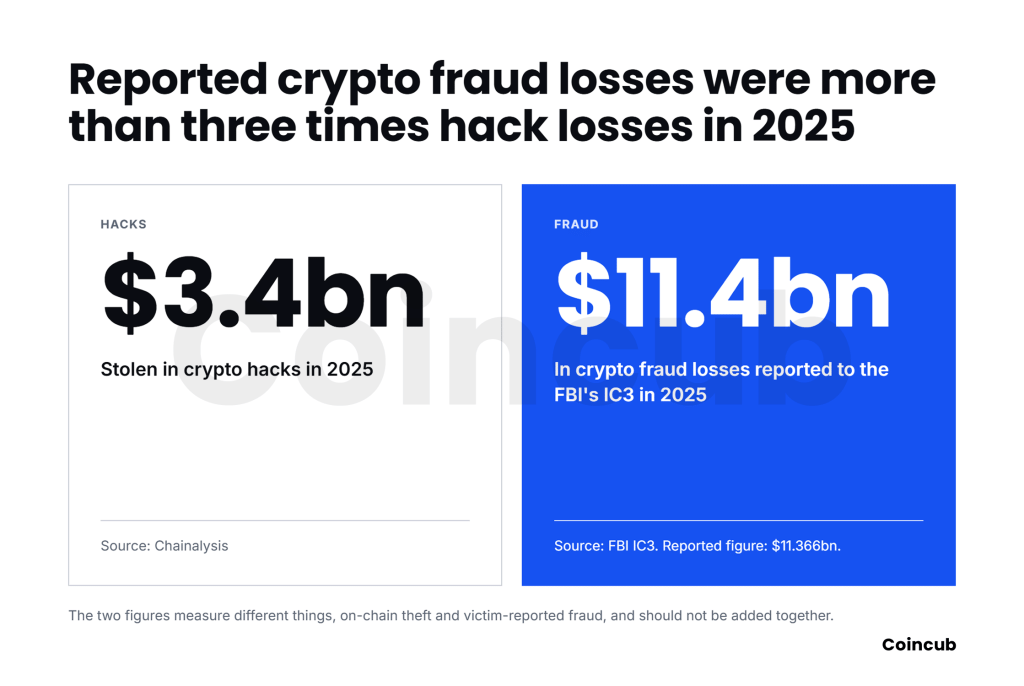
The number of people facing the question is large. Chainalysis counted more than $3.4 billion stolen in crypto hacks in 2025, and it recorded 158,000 personal wallet compromises affecting at least 80,000 unique victims. Fraud is larger still: the FBI’s Internet Crime Complaint Center logged 181,565 cryptocurrency-related complaints in 2025 with reported losses of $11.366 billion, of which crypto investment fraud accounted for $7.2 billion.
Four ways crypto goes missing
The category a loss falls into usually decides the outcome, so it helps to separate the four common scenarios before looking at any one country.
Lost private keys and inaccessible wallets
A lost seed phrase, a destroyed hardware wallet or crypto sent to a wrong address leaves the tokens on chain but out of reach. Nobody else gained them, which is why tax authorities often refuse to call it theft. Relief, where it exists, comes through a claim that the holding has become worthless to its owner.
Hacks and wallet drains
A hack moves the tokens to someone else’s address without consent. Malicious transaction approvals, compromised browser extensions and signing interface attacks that drain wallets all fall here. Hacks are the scenario most likely to count as theft under criminal law, which matters in jurisdictions that grant relief for theft.
Scams and investment fraud
In a scam the victim moves the funds voluntarily, usually after being persuaded that a platform, a romantic partner or an official needs them. Investment fraud is the largest category by reported losses, and pig butchering is a common form of it, in which a scammer builds trust over weeks and then steers the victim to a fake trading platform. Because the victim authorised the transfer, the tax question turns on why the money moved: to earn a profit, or for a personal reason.
Exchange collapses and frozen accounts
When a custodial exchange fails, the customer usually becomes an unsecured creditor in an insolvency process. The crypto may be partly recoverable through distributions, sometimes years later. Most tax systems will not recognise a loss while a reasonable prospect of recovery remains, so exchange failures typically produce relief only once the insolvency outcome is clear.
United States: theft losses after the One Big Beautiful Bill Act
The United States is where the rules changed most recently and where the distinction between personal and profit-seeking losses matters most.
The personal theft loss ban is now permanent
The Tax Cuts and Jobs Act of 2017 restricted personal casualty and theft losses to those attributable to a federally declared disaster for 2018 to 2025. The One Big Beautiful Bill Act, signed on 4 July 2025, made that restriction permanent, and from 2026 it extends the disaster exception to certain state-declared disasters. A stolen wallet is neither, so a theft of crypto held for personal reasons remains non-deductible.
The same law permanently eliminated miscellaneous itemized deductions subject to the 2% floor. That matters for lost keys, as explained below, because some loss claims that might otherwise have been available fell into that category.
The profit-motive route after CCA 202511015
The restriction applies only to personal losses under section 165(c)(3). Losses incurred in a transaction entered into for profit fall under section 165(c)(2), which the restriction does not touch. IRS Chief Counsel Advice 202511015, released in March 2025, applied that distinction to five scam scenarios from 2024.
The memo concluded that victims of a compromised account scam, a pig butchering scam and a phishing scam could claim theft losses, because each had transferred or held funds with a profit motive. Victims of a romance scam and a fake kidnapping scam could not, because their transfers were personal. Chief Counsel Advice is not binding precedent, but it shows how the IRS reads the law.
The memo did not remove the need to prove theft. Commentators note that a victim must still show that a theft occurred under the law of the relevant state, which can be difficult when no one has been charged.
Timing, amount and reporting
Three rules shape a US theft loss claim. A theft loss is treated as sustained in the year it is discovered, but not while a reasonable prospect of recovery remains at the end of that year. The deductible amount is limited to the taxpayer’s adjusted basis in the stolen crypto, so unrealised gains are not deductible. Theft losses from profit-seeking transactions are reported on Form 4684 and claimed as an itemized deduction, which means a victim who takes the standard deduction gets no benefit unless the loss is large enough to make itemizing worthwhile.
Victims of a Ponzi-style fraud where the lead figure has been criminally charged can also look at the safe harbor in Revenue Procedure 2009-20, which sets a fixed percentage of the qualified investment as the deductible loss.
Lost keys and worthless tokens
Lost keys sit in a weaker position. In CCA 202302011, the IRS said that a fall in value alone does not create a deductible loss and that a loss for worthless or abandoned crypto requires an identifiable event. The memo added that even a valid loss of that kind would have been a miscellaneous itemized deduction, which the 2025 law has now eliminated permanently. A lost seed phrase therefore rarely produces a usable deduction, and selling or otherwise disposing of a token remains the clearest way to realise a capital loss.
United Kingdom: theft is not a disposal
The UK gives a narrower answer for theft and a clearer one for lost keys.
Why stolen crypto produces no capital loss
HMRC’s Cryptoassets Manual states that theft is not a disposal, because the victim still owns the stolen tokens and can try to recover them. Victims of theft therefore cannot claim a Capital Gains Tax loss on that basis alone. The same page says that someone who paid for tokens but never received them may not be able to claim a capital loss either.
HMRC’s Capital Gains Manual, which the crypto guidance cross-refers to, adds an important qualification. It explains that where there is no likelihood that a stolen asset will be recovered, a negligible value claim would be competent, unless the loss has been covered by insurance. Tax advisers read that passage as leaving a route open for theft victims whose tokens are realistically gone.
Negligible value claims
A negligible value claim treats the owner as having disposed of the tokens and immediately reacquired them at a stated value, which can be nil, so that the loss is crystallised. HMRC accepts claims for lost private keys where there is no prospect of recovering the key or accessing the tokens. Because tokens are pooled, the claim must cover the whole section 104 pool for that token, which complicates matters for anyone who lost only one wallet among several holding the same asset. Pooling interacts with other UK crypto tax rules, including the 30-day matching rule, so the pool balance should be checked before a claim is filed.
The claim must state the asset, the amount of the deemed disposal and the date. Under HMRC’s helpsheet HS286, that date can be up to two years before the start of the tax year in which the claim is made, as long as the owner held the asset and it was already of negligible value at that earlier time. The resulting loss can be reported to HMRC at the same time as the claim.
Scams where tokens were received
A victim who receives tokens that then become worthless, as in a rug pull, may be able to make a negligible value claim. HMRC will not allow the claim if the tokens were already worthless when acquired, which shuts out many fraudulent token sales from the start.
Canada: capital property and the personal-use trap
Canada has no crypto-specific guidance on theft, so the general rules for capital property apply.
Theft of capital property
The Canada Revenue Agency’s position on losses from crime sits in Income Tax Folio S3-F9-C1. The CRA says that the nature of a fraud or theft loss has to be established first, and where capital property is stolen, the loss is computed under the ordinary capital gains rules, with any compensation treated as proceeds of disposition. A 2023 CRA technical interpretation on personal scams cites a case in which stolen capital was treated as a capital loss in the year the theft was discovered. Only half of a capital loss is allowable, and it can offset only taxable capital gains.
Personal-use property and business losses
Two classifications can change the result. Funds lost in personal scams can be treated as personal-use property, and losses on personal-use property are generally deemed to be nil. At the other end, an active trader whose crypto is inventory of a trading business may be able to deduct a theft loss as a business loss, which is fully deductible against other income. Intent at the time of acquisition is the main factor the CRA and the Tax Court of Canada use to decide which side of that line a holding falls on.
Australia: evidence decides the claim
Australia has some of the most explicit official guidance of the five countries. The ATO says that a capital loss can be claimed if the owner can show that the crypto is lost, that they owned it and that they have lost access to it. Something that can be recovered does not count as lost: the ATO gives extracting data from a hard drive as a recoverable case, while a lost private key cannot be recovered.
The evidence the ATO lists
The ATO’s page, last updated on 22 June 2026, lists the records it expects for a lost private key:
- the public key, the digital wallet address and the dates the private key was acquired and lost
- what the crypto in the wallet cost and what it was worth when the key was lost
- proof the wallet was under the claimant’s control, such as transactions linked to their identity
- possession of the hardware that stored the wallet, and verified exchange records
The ATO’s worked example shows an investor who bought 2 ETH for $2,672 in January 2025 and lost the private key in May 2026. If the investor can prove ownership and the loss, they can claim a $2,672 capital loss in the 2025 to 2026 return. The loss equals the reduced cost base, so the ETH’s market value at the time it was lost plays no part.
Compensation and insurance
Any compensation or insurance payment reduces the capital loss, and a payment above the cost base produces a capital gain. The ATO allows a rollover to defer that gain if the owner acquires another crypto asset within a year after the end of the income year. Holders who carry crypto insurance should factor that netting into any claim.
Germany: no sale, no loss
Germany taxes private crypto gains under section 23 of the Income Tax Act when tokens are sold within a year of purchase, and the one-year holding rule is the main planning tool for German holders. Losses under section 23 can be offset only against gains in the same category of private sale transactions.
The section 23 framework requires a sale or exchange, and theft does not supply one. Practitioner guides reviewed by tax advisers state that theft, the loss of a private key and hacks are not a sale for section 23 purposes, so no deductible loss arises. The Federal Ministry of Finance’s guidance letter of 6 March 2025 did not settle the point, and a practitioner briefing by the law firm P+P lists the treatment of a sale upon loss among the questions the letter left open. German victims are therefore in the weakest position of the five countries covered here, unless a court or a future ministry letter takes a different view.
How the five countries compare
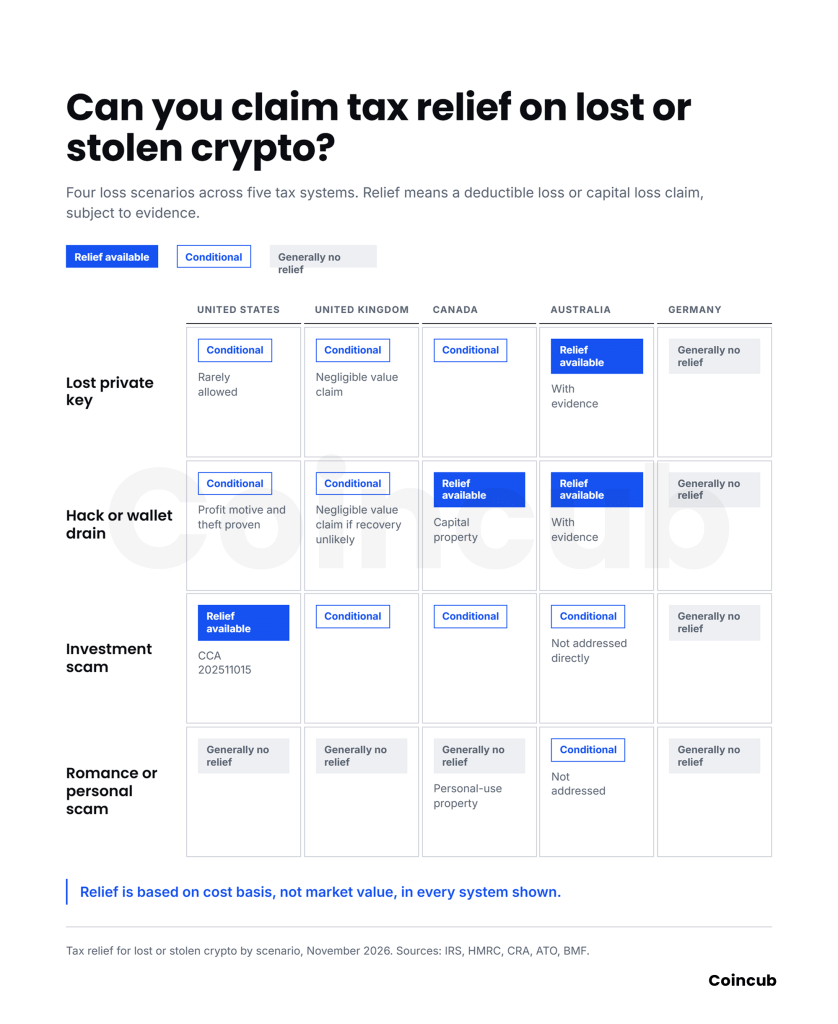
| Scenario | United States | United Kingdom | Canada | Australia | Germany
|
|---|---|---|---|---|---|
| Lost private key | Rarely deductible; no theft, and abandonment losses fall into eliminated miscellaneous deductions | Negligible value claim if no prospect of recovery | Capital loss arguable on general principles; no specific guidance | Capital loss with evidence of ownership, loss and loss of access | Generally no deductible loss |
| Hack or wallet drain | Theft loss if crypto was held for profit and theft is proven under state law | Not a disposal; negligible value claim possible where recovery is unlikely | Capital loss on stolen capital property; business loss for traders | Capital loss with evidence | Generally no deductible loss |
| Investment scam | Theft loss under section 165(c)(2), per CCA 202511015 | No loss if tokens never received; negligible value claim if worthless tokens were received later | Depends on capital, business or personal-use classification | Not addressed directly on the ATO page | Generally no deductible loss |
| Romance or personal scam | Not deductible | No capital loss | Likely personal-use property, so deemed nil | Not addressed directly | No deductible loss |
| Amount of relief | Adjusted basis | Cost less deemed disposal value | Half of the capital loss is allowable | Reduced cost base | None |
Two patterns stand out in the table. Relief almost always tracks what the victim paid for the crypto, whatever it was worth when it vanished. And profit-seeking holders do better than personal users in every system that draws the distinction.
Building the evidence file
Every claim in every country depends on records, and the work starts on the day of the loss. Tax authorities and courts look for the same core documents:
- Purchase records: Exchange statements or invoices showing what was paid for each token and when.
- Wallet evidence: Public addresses, transaction hashes and anything that links the wallet to the claimant’s identity.
- Incident records: A police report or a complaint to the national fraud reporting service, such as the FBI’s IC3 in the US, plus screenshots of scam messages or platforms.
- Recovery attempts: Correspondence with exchanges, insolvency administrators or insurers, which shows whether a reasonable prospect of recovery remains.
- Valuation at the date of loss: Useful for context and for some claims, even though most systems give relief on cost.
Professional tracing firms can follow stolen funds through the blockchain, and the methods investigators use to turn public ledgers into evidence also produce documentation a tax adviser can use. Victims should be wary of anyone promising to retrieve stolen funds for an upfront fee, because crypto recovery scams target people who have already been defrauded once. The broader warning signs of pig butchering and investment scams are worth knowing before any of this becomes necessary.
Country rules differ widely on gains as well as losses, a pattern the Global Crypto Tax Report 2025 maps across jurisdictions. For a victim, the decisive fact is usually the earliest one: whether the crypto was bought as an investment, and whether the records prove it.
Frequently Asked Questions (FAQ)
Can I deduct stolen crypto on my US taxes? +
Possibly, if you acquired the crypto in a transaction entered into for profit and can show a theft occurred under state law. IRS Chief Counsel Advice 202511015 allowed theft losses for victims of pig butchering, phishing and compromised account scams, but not for romance or fake kidnapping scams. The deduction is limited to your basis and requires itemizing.
Is losing my private key a capital loss in the UK? +
Not on its own. HMRC does not treat losing a key as a disposal, but you can make a negligible value claim if there is no prospect of recovering the key or accessing the tokens. The claim must cover the whole pool of that token.
Can I claim a loss if my crypto was stolen in the UK? +
HMRC does not treat theft as a disposal, so no capital loss arises automatically. Its Capital Gains Manual indicates that a negligible value claim may be possible where there is no likelihood of recovery and the loss is not covered by insurance.
What evidence does the ATO want for lost crypto? +
The ATO lists the public key, wallet address, dates the key was acquired and lost, the cost and value of the crypto, proof of control over the wallet, possession of the hardware and verified exchange records.
Do I claim the market value or what I paid? +
In the US, UK, Canada and Australia, relief is based on cost or adjusted basis, and the market value at the time of the loss is irrelevant to the amount.
What happens if I recover the crypto later? +
Recovery or compensation generally reduces the loss or becomes taxable. In Australia, compensation reduces the capital loss and can create a gain if it exceeds the cost base. In the US, a theft loss is not sustained while a reasonable prospect of recovery remains.
Is stolen crypto tax deductible in Germany? +
Generally not. Theft, hacks and lost keys are not treated as a sale under section 23 of the Income Tax Act, so no deductible loss arises, although the ministry's 2025 guidance did not address the point directly.