


 Buy a Licensed Company
  Explore VASP Data
  Talk to an Expert

 Atis Shala
Atis is a senior analyst and community lead with four years of experience in crypto. He has a bachelor from the Rochester Institute of Technology.
Atis Shala
Atis is a senior analyst and community lead with four years of experience in crypto. He has a bachelor from the Rochester Institute of Technology.
Bitcoin vs. USD: Key Levels for the 2026 Bull Cycle

It is 2026. The easy money of the early post-halving phase has vanished, and Bitcoin (BTC) now faces a definitive test against the US Dollar (USD). After a choppy 2025 that frustrated momentum traders and liquidated over-leveraged longs, the market structure has shifted. We are no longer speculating on institutional entry. They are here. The question for 2026 is not if Bitcoin will survive high interest rates, but how it will perform as global liquidity conditions pivot once again.
The 2026 cycle differs fundamentally from 2017 or 2021. This year represents the maturity phase of the asset class. The volatility that once defined Bitcoin is compressing into a structural uptrend, driven by sovereign adoption rumors and established ETF inflows. However, the USD remains a formidable counter-weight. Federal Reserve policy has plateaued, but the dollar’s resilience continues to cap upside breakouts.
The thesis for 2026 is simple: 2026 will punish impatient capital and reward those who understand the liquidity cycle. We are looking at a potential breakout year where Bitcoin finally decouples from traditional risk assets to behave as a true monetary hedge.

The 2026 bull cycle will be defined by a breakout above the $100,000 psychological barrier, driven by a resurgence in global M2 money supply and the final capitulation of the “higher for longer” narrative. Will Bitcoin break above that level once again remains to be seen.
Critical Bitcoin Price Levels to Watch in 2026
For traders and investors scanning for actionable data, these are the levels that matter right now. The market respects these zones due to high volumes of historical interaction and institutional order book density.
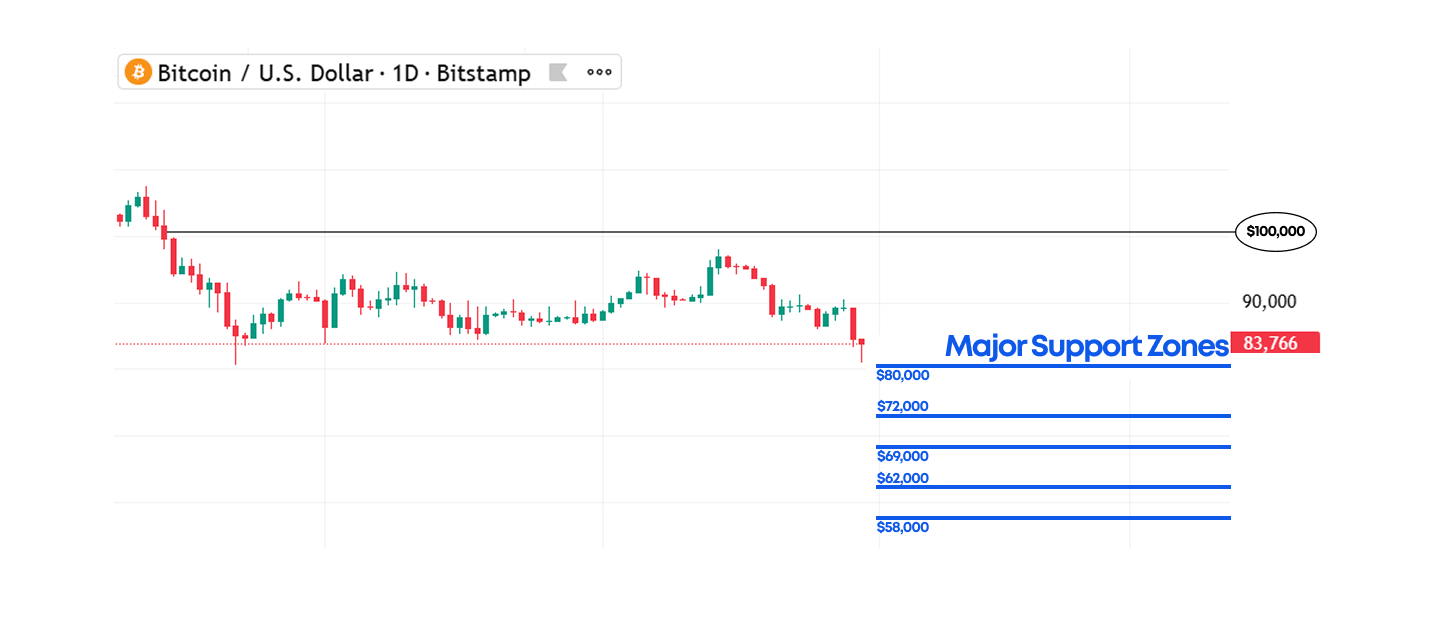
Major Support Zones (Buy Zones):
- $69,000 – $72,000: The previous cycle high (2021) has flipped into a critical structural floor. Defending this level keeps the bullish macro structure intact.
- $58,000 – $62,000: This serves as the Generational Buy zone. If a liquidity shock occurs, this region represents the 200-week moving average confluence and likely the absolute floor for the year.
- $80,000: The immediate psychological support. Bulls must reclaim and hold this level to signal the end of the early 2026 correction.
Key Resistance and Breakout Levels (Sell/Take Profit Zones):
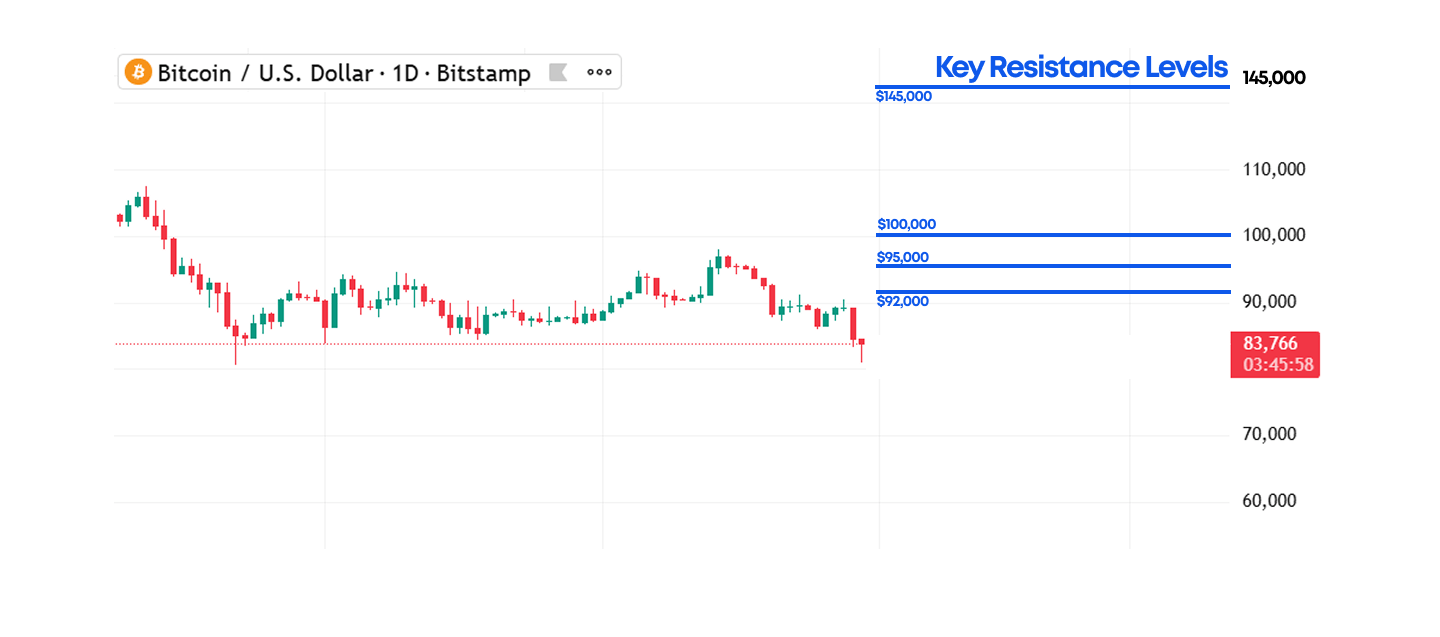
- $92,000 – $95,000: The Bull Trap zone. Heavy supply overhang exists here from late 2025 bag holders. Expect rejection on the first attempt.
- $100,000: The ultimate psychological barrier. A clean monthly close above this level triggers price discovery and likely induces a retail FOMO (Fear Of Missing Out) wave.
- $145,000 – $155,000: The technical cycle extension target. Based on Fibonacci extensions (1.618) from the 2024 low, this is the primary profit-taking zone for the 2026 bull run.
Bull vs. Bear Threshold:
- $78,500: Trading above this level favors the bulls. Sustained trading below this level opens the door to a deeper correction toward the mid-$60ks.
Why 2026 Matters: Positioning Bitcoin in the Market Cycle
Timing is the most expensive variable in crypto. Investors often mistake a mid-cycle pause for a bear market. History suggests 2026 is positioned to be a continuation year rather than a bear market initiation.
The Four-Year Cycle Context
The 2024 halving reduced daily issuance significantly, but the supply shock takes roughly 12 to 18 months to fully manifest in price. We are currently in month 21 post-halving. Historically, this window aligns with the parabolic second wind seen in previous cycles. For example, the 2017 bull run saw its most aggressive expansion in the final year of the cycle. If this rhythm holds, 2026 corresponds to the explosive tail-end of the expansion phase.
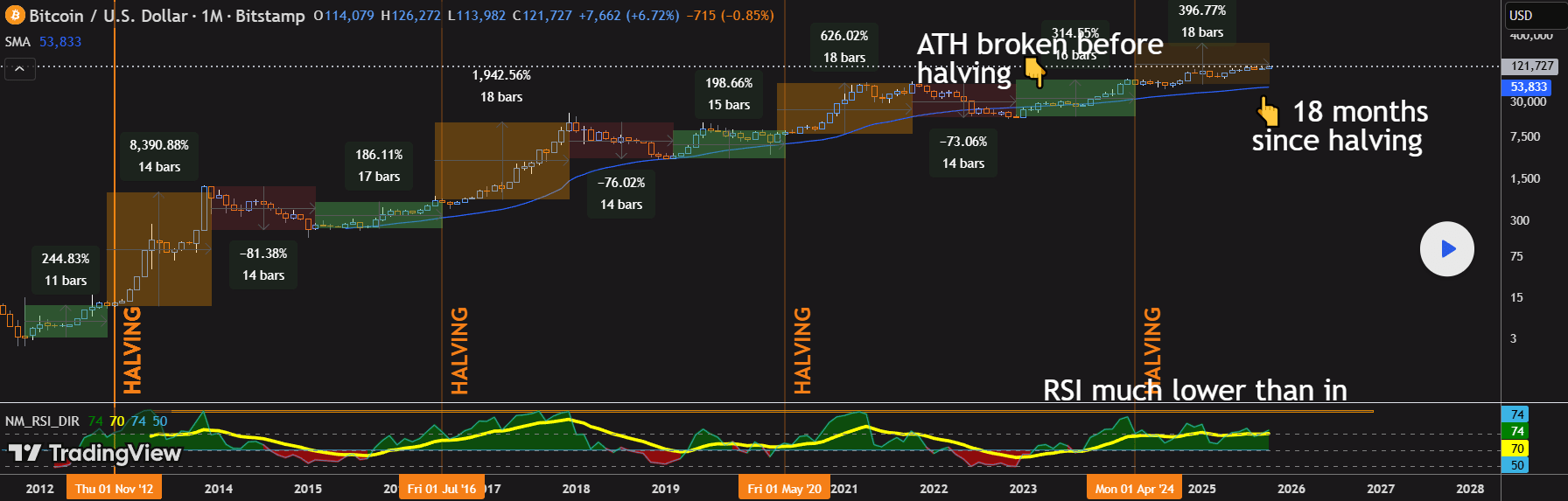
Global liquidity typically moves in 4-to-5-year waves. Central banks tightened aggressively in 2022 and 2023, paused in 2024, and maintained a restrictive plateau in 2025. The year 2026 aligns with the necessary refinancing of massive sovereign debt piles. Central banks, including the Fed and the ECB, will likely be forced to inject liquidity to manage debt servicing costs. Bitcoin correlates more tightly with Global M2 money supply than any other asset. As liquidity expands to suppress yields, Bitcoin acts as the primary valve for excess capital.
Institutional Maturation of the Crypto Industry
In previous cycles, retail traders drove price action. In 2026, the driver is the asset allocator. Pension funds and insurance giants are moving from pilot programs to strategic allocations. The good thing is, they often buy volatility-induced dips. This structural demand creates a higher floor price, dampening downside volatility and making the 2026 bull cycle slower but more sustainable than its predecessors.
Bitcoin vs. USD: The Macro Backdrop
Bitcoin trades as a direct pair against the US Dollar (BTC/USD). Therefore, the fate of the dollar dictates the fate of Bitcoin.
USD Liquidity, Debt, and Monetary Policy
The Federal Reserve finds itself in a bind. The soft landing narrative of 2025 has morphed into a stagnation reality. Interest rates remain elevated relative to the last decade, but the sheer weight of US federal debt, now exceeding $36 trillion, makes sustaining these rates mathematically impossible in the long run.
We are watching the Interest Expense line item on the US Treasury’s balance sheet. It has surpassed defense spending. This forces the Treasury to issue more short-term bills, which drains reverse repo markets and paradoxically adds liquidity to the system. For Bitcoin, this is rocket fuel. The dollar may show strength against the Euro or Yen, but it is weakening against scarce assets. We expect the Fed to officially end its Quantitative Tightening (QT) program in Q2 2026, signaling a return to balance sheet expansion.
Bitcoin as a Monetary Hedge
Investors often misunderstand Bitcoin as a tech stock. In 2026, it is behaving as digital gold with high beta. When real yields (interest rates minus inflation) fall, non-yielding assets like Gold and Bitcoin rise.
The market is currently pricing in a debasement premium. Investors realize that the purchasing power of the USD is being diluted to pay for fiscal deficits. Bitcoin’s absolute scarcity, fixed at 21 million units, stands in stark contrast to the infinite supply of fiat currency. In 2026, the trade is not just Long Bitcoin. It is Short the Dollar. Every dip in BTC/USD is effectively the market recalibrating the exchange rate between a hardening digital money and a softening sovereign currency.
Long-Term Bitcoin Technical Structure
To navigate the noise of daily volatility, we must zoom out. High-timeframe analysis strips away the emotion of the 15-minute chart and reveals the true trajectory of the asset. The structural integrity of Bitcoin’s trend remains bullish, defined by logarithmic growth curves and historical market memory.
Logarithmic Growth and Long-Term Trend Channels
Bitcoin does not move in a straight line; it moves in a curve. When analyzed on a logarithmic scale, the price action adheres to a well-defined growth channel that has contained every cycle since 2011. Currently, the lower bound of this logarithmic regression channel sits near $55,000, rising roughly $2,000 every month.
This rising floor is the fair value baseline. As long as price action remains above this logarithmic midpoint, the macro trend is healthy. In 2026, we are seeing price compress against the upper median of this channel. A breakout above the median, currently projected around $110,000, typically signals the transition from sustainable growth to mania phase.
Previous Cycle Highs as Structural Support
Markets have memory. The most critical technical development for the 2026 cycle is the conversion of the 2021 double-top ($64,000 and $69,000) into support. In technical analysis, resistance turned support is the strongest validation of a bull market.
Throughout late 2024 and 2025, Bitcoin tested this $69,000 zone multiple times. The ability of buyers to defend this level signals that the market has accepted a new valuation baseline. We are no longer debating if Bitcoin is worth $20,000 but whether it is worth above $100,000. Despite surpassing this milestone a few times, BTC has failed to stay above $100,000 for more than a few months at a time. This price acceptance above all-time highs provides the launchpad for the next leg up.
Moving Averages That Define Bull Markets
The 200-Week Moving Average (WMA) is the ultimate line in the sand. Bitcoin has historically bottomed at or near this moving average during bear markets. Conversely, maintaining distance above it confirms a strong bull trend.
For 2026, the 20-Week Moving Average is the more immediate bull market support band. In strong trending markets, price rarely closes below the 20-Week MA. Traders should watch this dynamic line carefully; a weekly close below it often serves as an early warning of a multi-month correction, while bouncing off it acts as a buy the dip confirmation.
Key Bitcoin Support Levels vs. USD for the 2026 Cycle
Support levels are not just lines on a chart; they are zones where institutional demand overwhelms supply. For 2026, our downside risk management focuses on three specific structural tiers.
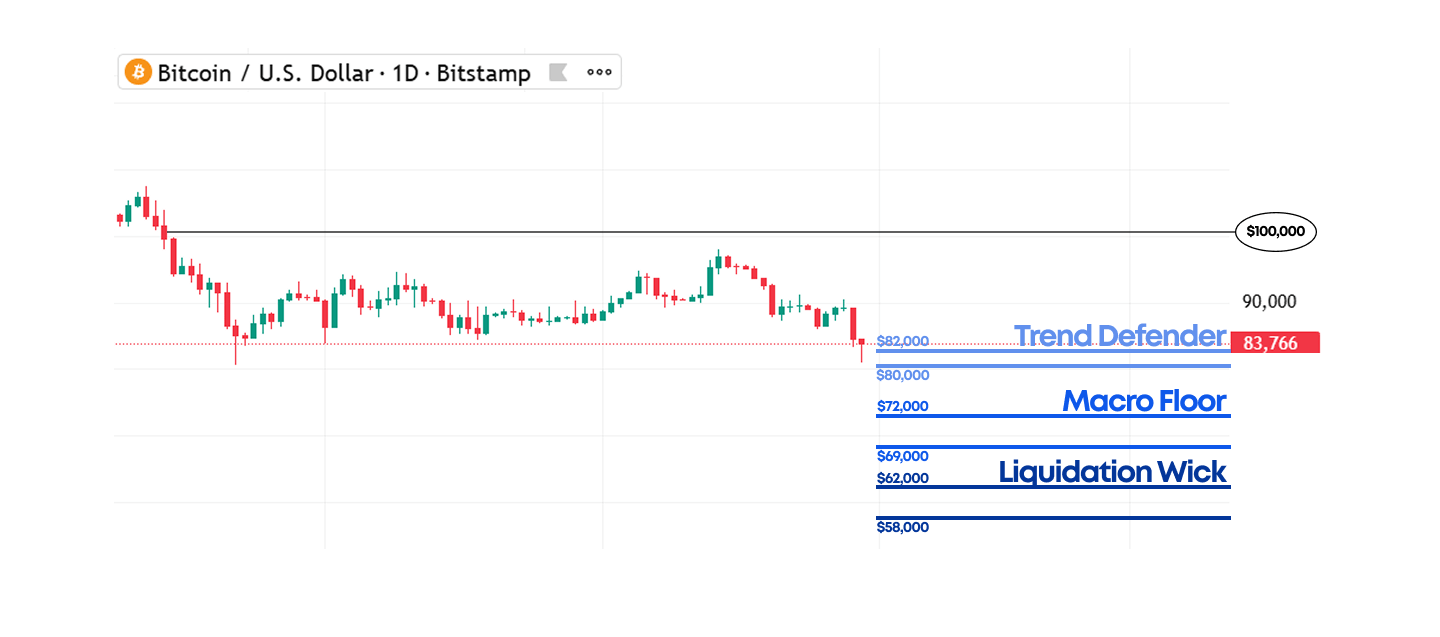
The Trend Defender ($80,000 – $82,000)
- Significance: This zone represents the high-volume node established during the Q4 2025 consolidation.
- Historical Behavior: High-frequency trading algorithms often front-run this level, creating wicks where price dips briefly before snapping back up.
- Implications: Holding this level keeps the aggressive bull case alive. Losing it implies a cooling-off period of 3-6 weeks.
The Macro Floor ($69,000 – $72,000)
- Significance: As noted, this is the 2021 cycle high. It is the psychological line between a bull market correction and a potential trend reversal.
- Historical Behavior: This level aligns with heavy limit buy orders from passive funds.
- Implications: This is a high-probability accumulation zone. If price revisits this area, it is likely the final opportunity for late entrants to position themselves before the cycle peak.
The Liquidation Wick ($58,000 – $62,000)
- Significance: This level exists only for black swan scenarios, a regulatory shock or a global liquidity crunch.
- Historical Behavior: Similar to the March 2020 crash, visits here are violent and short-lived.
- Implications: Losing $58,000 would invalidate the immediate 2026 bullish thesis, forcing a reassessment of the entire cycle structure.
Major Resistance and Breakout Levels of Bitcoin
Upside targets are defined by supply overhangs and psychological milestones. The path to new highs in 2026 must clear specific hurdles.
Before six figures, the market must digest the supply from traders who bought the local tops of 2025. This area is termed a bull trap zone because breakouts here often fail on the first attempt. We look for volume to confirm a breakout. A move past $95,000 on low volume is suspect; a move on high volume confirms the seller’s exhaustion. (Bears don’t get tired in this industry apparently.)
Humans love round numbers. The $100,000 level is the single most anticipated price point in Bitcoin history, despite being broken a few times last year, and is often considered the psychological barrier for BTC.
- Sell Walls: Expect massive sell orders from long-term holders looking to cash out at this milestone.
- Media Frenzy: Crossing this level triggers mainstream media coverage, which paradoxically brings in new retail liquidity (the wild money) to absorb the selling pressure from the smart money.
Once $100,000 clears, there is no historical resistance. We rely on Fibonacci extensions to find the next target. The 1.618 extension of the current cycle structure points to the $150,000 region. This is where the risk-reward ratio shifts unfavorably, and smart money typically begins aggressive distribution (selling) into strength.
Onchain Metrics Supporting the 2026 Bull Cycle Thesis
Price charts show what is happening; onchain analysis explains why. The underlying network data suggests that despite price volatility, the supply dynamics for 2026 are incredibly bullish.
Long-Term Holder Supply Shock
The percentage of Bitcoin that has not moved in over a year is near historic highs. This metric, known as HODL Waves, indicates that the investor base has transitioned from speculators to believers. Investors are treating Bitcoin as a savings technology, locking supply away in cold storage. With less available supply on the market (the Free Float), even marginal increases in demand cause outsized price appreciation.
Exchange Balances
Bitcoin balances on centralized exchanges (Coinbase, Binance) have been in a structural downtrend for four years. We are witnessing a supply crunch. In 2026, if an ETF or sovereign entity wants to buy $1 billion worth of Bitcoin, the liquidity on the order books is thinner than ever. This thin liquidity exacerbates upside volatility.
MVRV Z-Score
The MVRV (Market Value to Realized Value) Z-Score identifies if Bitcoin is overvalued or undervalued relative to its fair value (the average price people paid for their coins). Currently, the MVRV score sits in the sustainable bull territory (score 2.0 – 3.0). It has not yet reached the euphoria zone (score > 7.0) seen at previous cycle tops. This suggests that the 2026 rally has significant room to run before the asset becomes fundamentally overheated.
What Could Invalidate the Bitcoin Bull Cycle in 2026?
While the structural setup for 2026 remains bullish, professional participants do not trade on hope. Identifying the bear case is essential for protecting capital. Four primary risks could derail the 2026 expansion.
The inverse correlation between the US Dollar Index (DXY) and Bitcoin remains a dominant market force. If the Federal Reserve surprises the market by returning to a hawkish stance, perhaps due to a re-acceleration of inflation, the USD will rally. A DXY climbing back toward 106.00 would likely force Bitcoin to break below the $69,000 macro support, delaying the bull cycle indefinitely.
In 2026, the regulatory conversation has shifted from banning to supervising. However, aggressive enforcement of the GENIUS Act or new, restrictive reporting requirements for self-custody wallets could trigger a flight to liquidity. Any policy that hinders the bridge between traditional banking and digital assets remains a systemic risk.
Bitcoin thrives on excess money. If global central banks are forced to maintain Quantitative Tightening (QT) longer than the market expects to fight sticky inflation, the liquidity tap stays dry. Without new M2 money supply growth, Bitcoin struggles to overcome the massive sell walls at the $100,000 level.
The 2026 thesis relies heavily on sustained ETF inflows. If institutional interest plateaus and we see a multi-month trend of net outflows, the buy the dip mechanism that supported Bitcoin in 2025 will vanish.
Strategic Takeaways for Investors and Traders
Navigating the 2026 cycle requires a move away from retail-style moon chasing and toward institutional-grade risk management.
For those with a multi-year horizon, the buy and hold strategy has evolved into Systematic Accumulation. Using a Dollar-Cost Averaging (DCA) approach remains the most effective way to mitigate the volatility of the $80,000-$95,000 range.
Note: Long-term holders should focus on the 200-week moving average as their ultimate value indicator. Buying when the price is within 20% of this average has historically provided the highest ROI.
Swing traders, on the other hand, should focus on Range Play. Until Bitcoin decisively clears $100,000 on high volume, the market is likely to oscillate between the $72,000 floor and the $95,000 ceiling.
- Entry: Near Tier 2 support ($69k-$72k).
- Exit: Scaling out in the Supply Wall ($92k-$95k).
Risk Management Frameworks
- Position Sizing: No single entry should represent more than 5-10% of total liquid capital.
- Stop-Loss Placement: Professional traders are placing stops below the $68,500 mark to protect against a structural breakdown.
- Profit Taking: Establishing a sell ladder starting at $98,000 ensures you capture gains before the psychological volatility of the $100,000 level.
Final Thoughts on Bitcoin vs. USD
As we move through 2026, the battle between Bitcoin and the US Dollar has reached its most sophisticated stage. We are no longer looking at a speculative experiment but at a global contest for the future of money. Bitcoin has successfully transitioned from a niche digital asset to a core macro trade, standing alongside gold and the dollar as a primary pillar of the modern financial system.
The key levels identified, $69,000 as the floor and $100,000 as the gateway, will dictate the narrative for the remainder of the year. While risks like USD strength and regulatory shifts persist, the underlying supply-demand mechanics, bolstered by the 2024 halving and institutional adoption, favor the bulls.
Beyond 2026, the focus will likely shift from price discovery to Bitcoin as infrastructure. As the asset matures, the explosive 100x gains of the past will give way to steady, structural appreciation. For those who understand the macro backdrop, the trade remains clear: Bitcoin is the premier hedge against a softening dollar and an increasingly indebted global economy.
Frequently Asked Questions (FAQs)
Is it too late to buy Bitcoin in 2026?
While the early adopter phase has ended, the institutional phase is just beginning. Historically, buying during consolidation periods above previous cycle highs ($69,000) has been a winning strategy.
Will Bitcoin hit $100,000 this year?
The technical and macro data suggest a high probability, provided the Fed begins easing liquidity. However, expect significant volatility and fake-outs around this psychological milestone.
What happens if Bitcoin falls below $60,000?
A drop below $60,000 would signal a significant structural failure and likely mark the end of the current bull cycle thesis, shifting the market into a crypto winter phase.
Is this cycle different from 2021?
The 2026 cycle is driven by institutional spot demand (ETFs) and sovereign-level interest, whereas 2021 was fueled by retail speculation and low-interest-rate stimulus checks.