Buy a Licensed Company
  Explore VASP Data
  Talk to an Expert

 Atis Shala
Atis is a senior analyst and community lead with four years of experience in crypto. He has a bachelor from the Rochester Institute of Technology.
Atis Shala
Atis is a senior analyst and community lead with four years of experience in crypto. He has a bachelor from the Rochester Institute of Technology.
5 Best Crypto-Friendly Banks in Canada

- In Canada, a bank’s “crypto-friendliness” is defined by its willingness to route fiat transactions to registered platforms without holds, declines, or account closures.
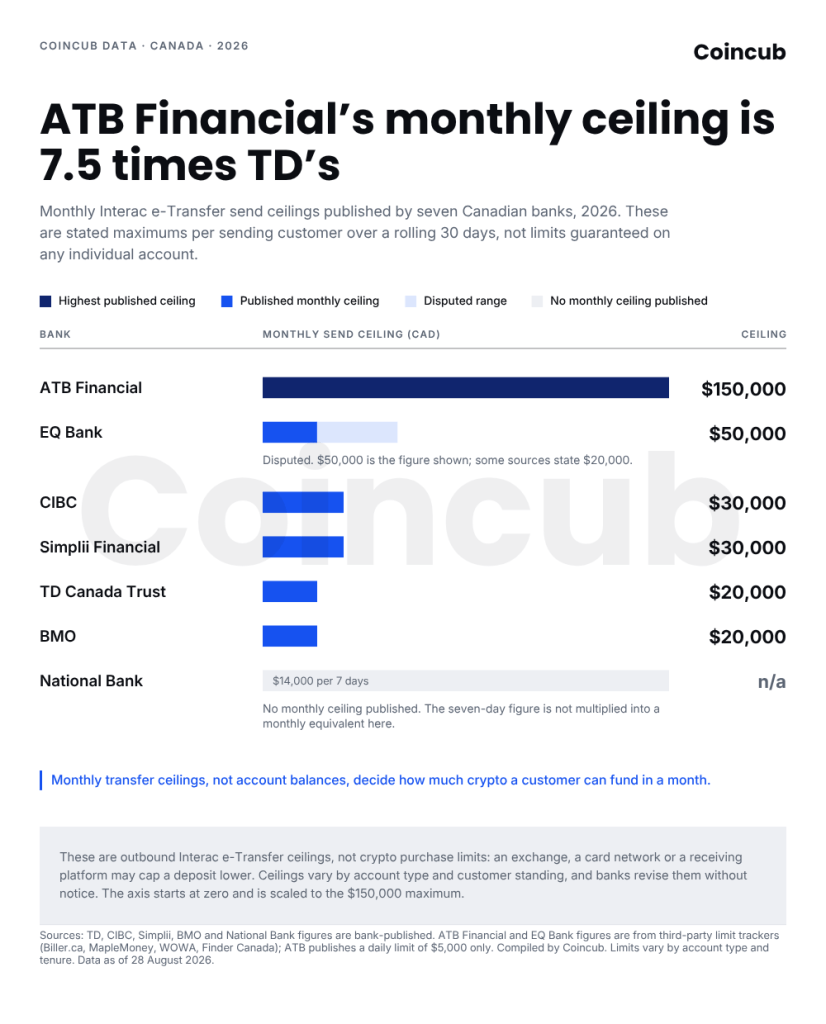
- Transaction headroom varies drastically across institutions, with monthly Interac e-Transfer limits ranging from $20,000 at major banks to $150,000 at specialized regional institutions.
- Banks with documented institutional involvement in digital assets—such as stablecoin reserve custody, ETF holdings, or infrastructure backing—demonstrate lower friction for retail crypto transfers.
- Provincial registration under regulators like the OSC, FCNB, or NSSC serves as the core benchmark for legally operating Virtual Asset Service Providers (VASPs) in Canada.
- Account friction is primarily a compliance issue driven by strict AML frameworks; users prevent account flags by avoiding credit card purchases, peer-to-peer markets, and transaction structuring.
Canadians who buy crypto rarely lose money to a hack. They lose time to a bank that holds a $2,000 Interac e-Transfer for review, declines a wire to a registered trading platform, or closes an account after three transfers to the same exchange in a week. Choosing the right bank is a question about payment rails.
One piece of context frames everything that follows. Registration data for Canada shows that crypto trading platforms serving Canadians are authorised province by province rather than nationally, with the same firms appearing separately under Ontario’s OSC, the Nova Scotia Securities Commission, and New Brunswick’s FCNB, and every one of those registrations reading as active on 30 August 2026. In Canada, a crypto-friendly bank is one that reliably moves your Canadian dollars to a registered platform and back, and treats the transaction as ordinary retail payment activity.
Quick Summary: The Top Crypto-Friendly Canadian Banks
Measured on those terms, National Bank of Canada offers the strongest combination of transfer headroom and institutional comfort with digital assets among nationally available banks, ATB Financial pairs the highest published Interac ceilings in Canada with the longest track record of banking crypto companies directly, and EQ Bank is the best no-fee digital option for Canadians outside Alberta.

| Rank | Bank | Best for | Interac e-Transfer send limits | Institutional crypto activity | Monthly fee |
|---|---|---|---|---|---|
| 1 | National Bank of Canada | Best overall | $4,000 per 25 hours, $14,000 per 7 days | Backer and network participant in CADD, Canada’s first bank-issued CAD stablecoin; holds crypto ETF positions | Varies by plan |
| 2 | ATB Financial | Crypto businesses and Alberta residents | $5,000 daily, $35,000 weekly, $150,000 monthly | Banking crypto firms since roughly 2019; holds CADC reserves; Tetra Digital Group investor | $0 on several accounts |
| 3 | TD Bank Group | Big Five retail investors | $3,000 daily, $10,000 per 7 days, $20,000 monthly | Custodian for Stablecorp’s stablecoin reserves since July 2026; Bank of Canada tokenized bond trial | $3.95 to $29.95 |
| 4 | EQ Bank | No-fee digital banking nationwide | $3,000 to $5,000 daily depending on source; confirm in app | None disclosed | $0 |
| 5 | CIBC | Highest Big Five monthly throughput | $3,000 daily, $10,000 per 7 days, $30,000 monthly | None disclosed | $4.95 to $16.95 |
Three patterns run through that table. Banks that engage with digital assets at the institutional level tend to be calmer about retail crypto transfers, because their compliance teams have already built the internal language for the risk. Published monthly Interac ceilings vary by more than seven times between the tightest and the most generous, which matters a great deal if you dollar-cost average in size. And no Canadian bank sells crypto directly to retail customers, so every option here is a route to a regulated platform.
What Makes a Canadian Bank “Crypto-Friendly”?
Those rankings rest on criteria worth stating plainly. A crypto-friendly Canadian bank is one that lets money move to and from registered trading platforms without friction, and four measurable factors decide it. They also let you evaluate any bank absent from this list.
- Interac e-Transfer headroom. An Interac e-Transfer is Canada’s domestic instant payment method for moving funds between accounts at different financial institutions, and it is how most Canadians fund a crypto account. A bank with a $20,000 monthly ceiling caps your buying at $20,000 a month regardless of your balance, while a $150,000 ceiling leaves the decision to you.
- Block and manual review rates. Every Canadian bank screens outbound payments for fraud and money laundering, and some route crypto-related transfers into manual review far more often than others. Repeat holds are the most common reason Canadians switch banks.
- Wire transfer tolerance. Wires are the standard method for funding larger positions. Several Canadian banks reportedly permit wires to domestic platforms while declining them to offshore venues, so the destination matters as much as the amount.
- Institutional posture toward digital assets. A bank that already custodies stablecoin reserves or holds crypto exchange-traded fund positions has an internal risk framework for the asset class, and that posture shows up in how its monitoring treats a retail customer sending money to a registered exchange.
VASPs in Canada
Two terms recur here and deserve a plain definition. A Virtual Asset Service Provider, usually shortened to VASP, is a business that exchanges, transfers, or custodies crypto assets for customers, and in Canada it registers with FINTRAC as a money services business.
Securities registration sits separately and runs through provincial regulators, in two tiers. Restricted dealer is the transitional category covering platforms such as Coinbase, Kraken, Netcoins, Newton, VirgoCX and Crypto.com, while investment dealer is the higher tier held by Shakepay, Ndax, Webull and Coinsquare, and it carries membership in the Canadian Investment Regulatory Organization. The tier can differ by province for the same firm, so Wealthsimple registers as an investment dealer in New Brunswick and a restricted dealer in Nova Scotia.
The 5 Best Crypto-Friendly Banks in Canada
Applying those four criteria produces a list that looks different from the usual Big Five ranking, because institutional posture and published limits separate these banks more sharply than brand size does.
National Bank of Canada: Best Overall for Transfers and Institutional Comfort
National Bank of Canada is the strongest all-round choice for Canadians who move meaningful sums to crypto platforms, because it combines the highest firmly published Interac limits among the Big Six with the deepest documented involvement in Canadian digital asset infrastructure.
The transfer limits are the first practical advantage. National Bank’s help centre states that customers can send up to $4,000 per 25-hour period and $14,000 per 7-day period by Interac e-Transfer, a third more per day and 40 percent more per week than the $3,000 and $10,000 defaults published by TD, BMO, and CIBC. RBC and Scotiabank tie their ceilings to your debit card’s access limit and publish no fixed figure, so National Bank is the only Big Six bank stating a higher number outright.
The institutional record separates National Bank further. On 4 May 2026, a consortium including Shopify, Wealthsimple, Purpose Unlimited, Shakepay, ATB Financial, National Bank, and Urbana Corporation launched CADD, described as the first Canadian dollar stablecoin issued by a regulated financial institution in Canada, with Calgary-based Tetra Trust Company issuing the token under approval from Alberta Treasury Board and Finance. National Bank acts as both backer and network participant, and in December 2025 it settled testnet transactions with Wealthsimple in what was reported as the first movement of a Canadian stablecoin between two financial institutions.
The bank has also put its own balance sheet behind crypto exposure. Its 13F filing with the United States Securities and Exchange Commission for 30 June 2026 positions disclosed roughly US$3.07 million in the Fidelity Wise Origin Bitcoin Fund, plus smaller positions in ProShares Bitcoin Strategy ETF, Grayscale Bitcoin Trust, Grayscale Bitcoin Mini Trust, and a Bitwise XRP product.
ATB Financial: Best for Crypto Businesses and Alberta Residents
ATB Financial combines the highest published Interac e-Transfer ceilings in Canada with the longest continuous track record of any Canadian institution in serving crypto companies directly, and only its Alberta-only footprint keeps it out of first place in a national guide.
The transfer limits are exceptional by Canadian standards. ATB’s own support documentation confirms a daily Interac e-Transfer maximum of $5,000, and independent limit trackers including Biller.ca and MapleMoney put the weekly ceiling at $35,000 and the monthly ceiling at $150,000. That monthly figure is five times CIBC’s and seven and a half times TD’s, and Interac e-Transfers are free on most ATB personal chequing accounts, several of which carry no monthly fee.
ATB is a provincial Crown corporation owned by the Government of Alberta, and that structure has given it room to move earlier than federally regulated peers. Brian Ford, ATB’s vice-president of business solutions, has said publicly that the bank has banked crypto companies for roughly six and a half years, dating the relationship to around 2019, when most Canadian banks declined the sector outright. ATB serves platforms, miners, and custodians, and applies blockchain analytics to verify customer assets. Ford’s framing of the selection process is blunt: “We say no a lot more than we ever say yes.”
Canadian Stablecoin Reserves
The bank’s stablecoin work is equally concrete. ATB already holds reserves backing CADC, a Canadian dollar stablecoin, and it joined National Bank, Shopify, Wealthsimple, Shakepay, Purpose Unlimited, and Urbana Corporation in a $10 million all-equity round into Tetra Digital Group that closed in the week before 8 September 2025. ATB is also slated to bank the CADD stablecoin, and Ford has said it intends to add Bitcoin-backed lending and digital asset investment advice.
Retail customers in Alberta benefit from that institutional familiarity on ordinary personal accounts. The limitation is geography, because ATB serves Alberta residents and Alberta-based businesses only.
TD Bank Group: Best Big Five Option for Retail Investors
TD Bank Group is the most practical choice for a Canadian who wants a full-service Big Five bank with branches everywhere and a demonstrated institutional willingness to touch digital assets.
TD’s institutional record moved sharply in 2026. On 27 July 2026, TD agreed to serve as custodian for the fiat-backed stablecoin reserves of Stablecorp Digital Currencies Inc., one of the first cases of a major Canadian bank taking custody of digital currency reserves inside a regulated Canadian banking framework. On 6 March 2026, TD Securities took part alongside RBC Dominion Securities, RBC Investor Services Trust, and Export Development Canada in the Bank of Canada’s first tokenized bond trial, a C$100 million issuance where bidding, coupon payments, redemption, and secondary trading all ran on one distributed ledger.
On the retail side, TD’s published Interac e-Transfer limits are $3,000 per transfer, $3,000 per day, $10,000 per seven days, and $20,000 per month, at the Big Five standard. Canadian trading platforms consistently describe TD as the major bank least likely to interfere with e-Transfers to registered exchanges, and Visa Debit purchases generally clear.
One historical caveat belongs on the record. TD said on 23 February 2018 that it was pausing credit card cryptocurrency purchases while it reviewed the market, and card funding of crypto remains restricted across essentially every Canadian issuer today. Fund with e-Transfer or debit instead, which is cheaper once cash advance fees and interest are counted.
EQ Bank: Best No-Fee Digital Alternative Available Nationwide
EQ Bank is the strongest digital-only option for Canadians outside Alberta, because it charges no monthly fee, pays interest on everyday balances, and asks for none of the minimum balances that Big Five customers keep to avoid a $16.95 or $29.95 package fee.
EQ Bank is the digital arm of Equitable Bank, Canada’s seventh largest bank by assets and a Schedule I bank since 2013, with deposits covered by Canada Deposit Insurance Corporation protection. Its e-Transfer ceilings are worth checking personally, because published figures conflict. Finder Canada and Biller.ca list $5,000 per day, $20,000 per week, and $50,000 per month, while WOWA and MapleMoney list $3,000, $10,000, and $20,000. EQ sets limits by account type and tenure, so confirm your own ceilings in the app before planning a large transfer.
Even on the conservative figures, the economics work. You pay nothing to hold the account, you earn interest on cash waiting between purchases, and you fund registered platforms without a package fee.
The bank has disclosed no institutional crypto activity, so its inclusion rests on rails and cost. It has no branch network and a narrower product range than a Big Five bank, so most users pair it with a primary bank.
CIBC: Best Big Five Option for High Monthly Throughput
CIBC earns the final position because it publishes the most generous monthly Interac e-Transfer ceiling among the Big Five, which is the constraint that binds most active retail buyers.
CIBC’s published limits are $3,000 per transfer, $3,000 per day, and $10,000 per seven days, matching its peers, but its monthly ceiling is $30,000, against $20,000 at TD and BMO. Simplii Financial, CIBC’s no-fee direct brand, publishes the same $30,000 monthly figure, which makes the pair a sensible combination for someone who wants a branch network and a free account under one relationship.
Canadian trading platforms report that CIBC e-Transfers to registered exchanges settle quickly and that the bank has a reasonable record on flagging payments to FINTRAC-registered entities. Treat that as practitioner observation, because no Canadian bank publishes its monitoring thresholds. CIBC has disclosed no institutional digital asset activity comparable to National Bank’s or TD’s, and like every Canadian issuer it blocks crypto purchases on credit cards.
The Canadian Banks That Cause the Most Friction
Knowing which banks cause trouble is as useful as knowing which to choose, and the pattern below comes from user reports and platform guidance.
- BMO: Canadian trading platforms describe BMO as classifying crypto as a high-risk asset class and running a higher rate of manual security reviews on large transfers, with a firm block on card purchases.
- Scotiabank: Reporting suggests Scotiabank permits e-Transfers and debit payments to domestic platforms while blocking wires to many non-Canadian venues. Its e-Transfer limits are account-specific and unpublished.
- RBC: RBC’s daily e-Transfer ceiling of $10,000 is tied to your client card’s access limit and is genuinely high, but the bank bans credit card crypto purchases and is widely reported to decline wires to exchanges. Its retail posture lags its institutional one, given that RBC ran the ledger platform for the Bank of Canada bond trial.
- Tangerine and Laurentian Bank: Both appear repeatedly in user reports as institutions that decline crypto-related funding across every method.
How to Avoid Having Your Canadian Bank Account Flagged
Choosing a tolerant bank solves half the problem, and your own transaction behaviour solves the other half. Bank friction in Canada is mostly a compliance outcome, and the environment tightened sharply in 2026. FINTRAC revoked roughly fifty money services business registrations over a recent quarter, including twenty-three on a single day, with many of the revoked entities linked to crypto. Grounds included failing to answer a FINTRAC information request within thirty days and failing to keep registration details current. Banks watch that record closely and price your counterparty’s risk accordingly.
The Main Habits to Stay Safe
Six habits keep your account out of that risk pricing:
- Send money only to registered platforms, and prefer investment dealers. The Canadian Securities Administrators list held nineteen authorised platforms at the time of writing, among them Coinbase Canada, Payward Canada (Kraken), Shakepay, Netcoins, Ndax Canada, Newton, VirgoCX, Coinsquare Capital Markets, Wealthsimple Investments, and Foris DAX CAN (Crypto.com).
- Avoid peer-to-peer trading for anything meaningful. Sending an Interac e-Transfer to someone you met on a peer-to-peer marketplace produces exactly the pattern fraud and money laundering models are built to catch, because the counterparty is unidentifiable and the funds often move again immediately.
- Fund with e-Transfer or debit. Every major Canadian issuer restricts crypto purchases on credit cards, and the attempts themselves generate declines that sit in your file. Where a card transaction does clear, it usually posts as a cash advance carrying a fee plus interest from day one.
- Keep your transfer pattern boring and consistent. Regular transfers of similar size to the same platform read as investment behaviour, while sudden changes in size, frequency, or destination trigger review. A large one-off amount usually goes more smoothly after a call to your branch.
- Never split a large purchase to stay under a reporting threshold. Canadian platforms must file a Large Virtual Currency Transaction Report with FINTRAC at CAD $10,000 and above, and breaking a $12,000 buy into smaller pieces to stay below that line is structuring, which FINTRAC treats as a money laundering indicator warranting its own suspicious transaction report.
- Keep records for the Canada Revenue Agency. The CRA treats crypto as a commodity, so disposals generate either capital gains or business income depending on the pattern of your activity, and your bank records form part of that evidence trail.
What Canada’s New Rules Change for Bank Access
The banking picture described above is moving, because two regulatory changes are reshaping what Canadian banks can do with digital assets.
Capital Treatment
The first is capital treatment. OSFI’s guideline on the capital and liquidity treatment of crypto-asset exposures took effect in fiscal Q1 2026, on 1 November 2025 for institutions with an October year-end and 1 January 2026 for those with a December year-end. It sorts crypto assets into four groups, from tokenized traditional assets through stablecoins to unbacked crypto assets, and caps total gross exposure to the riskier Group 2 assets at 5 percent of Net Tier 1 capital, with any breach forcing every Group 2 exposure into the most conservative treatment. The practical effect is a defined lane, giving Canadian banks explicit permission to hold measured crypto exposure along with a hard ceiling on it.
Stablecoin Legislation
The second is stablecoin legislation. The federal government introduced a proposed Stablecoin Act through the Budget 2025 Implementation Act, No. 1, released in December 2025, placing fiat-backed stablecoins under Bank of Canada supervision with a public registry of approved issuers. Issuers would have to hold reserves in high-quality liquid assets with qualified custodians in bankruptcy-remote arrangements, guarantee redemption at par, run risk and data security programs, and refrain from paying yield. Regulations remain unpublished, so the timeline for full effect is open.
Payments Infrastructure
Payments infrastructure is shifting alongside the rules. Shakepay became the first crypto company granted Payments Canada membership on 5 May 2025, on the strength of the CIRO investment dealer status it obtained earlier that year. The membership covers Canadian dollar products only, and it lets a crypto-native firm apply for direct access to core payment systems including the forthcoming Real-Time Rail. That access reduces how far a platform depends on any single bank’s tolerance, which is the structural fix for the friction described here.
Frequently Asked Questions (FAQ)
Which Canadian bank is best for buying crypto in 2026? +
National Bank of Canada is the strongest overall choice, because it publishes the highest fixed Interac e-Transfer limits among the Big Six at $4,000 per 25 hours and $14,000 per week, and because it backs and participates in the CADD stablecoin network while holding Bitcoin ETF positions on its own books.
Can a Canadian bank close my account for buying Bitcoin? +
Canadian banks can close accounts at their discretion, and they occasionally do so where transaction patterns raise anti-money-laundering concerns. Buying through a CSA-authorised platform with consistent, documented transfers makes that outcome unlikely.
Do any Canadian banks let you buy crypto directly? +
No Canadian bank sells crypto to retail customers. Canadian banks can now hold measured crypto exposure under OSFI's 2026 guideline, and some custody stablecoin reserves, but retail purchases still go through a registered trading platform.
Why do Canadian banks block crypto credit card purchases? +
Major Canadian issuers stopped allowing crypto purchases on credit cards starting with TD in February 2018, citing volatility and the credit risk of customers borrowing to buy a falling asset.
What is the highest Interac e-Transfer limit in Canada? +
ATB Financial has the highest widely reported retail ceilings at $5,000 per day, $35,000 per week, and $150,000 per month, though it serves Alberta only. Among the Big Six, National Bank leads on published figures at $4,000 per 25 hours and $14,000 per week.
Are crypto exchanges in Canada regulated? +
Yes. Platforms serving Canadians register with FINTRAC as money services businesses and hold provincial securities registrations, granted separately by regulators including the OSC, the Nova Scotia Securities Commission and New Brunswick's FCNB, either as restricted dealers or as investment dealers. The CSA list held nineteen authorised platforms at the time of writing.