Buy a Licensed Company
  Explore VASP Data
  Talk to an Expert

 Sergiu Hamza
Sergiu is a thought leader with a background in mathematics, authentification, identification, and a passion for Bitcoin.
Sergiu Hamza
Sergiu is a thought leader with a background in mathematics, authentification, identification, and a passion for Bitcoin.
Deutsche Bank secures MiCA authorization
Deutsche Bank has secured authorization under the EU’s MiCA framework in Germany to provide crypto-asset custody and transfer services. The move comes as the bank prepares to launch digital-asset custody for institutional and corporate clients, initially supporting Bitcoin, Ether, USDC, EURC and EURAU. Deutsche Bank expects its first clients to go live in 2026, subject to completion of the applicable regulatory process.
Deutsche Bank has secured authorization under the European Union’s Markets in Crypto-Assets framework to provide crypto-asset custody and transfer services in Germany, as the lender prepares to launch a digital-asset custody business for institutional clients.
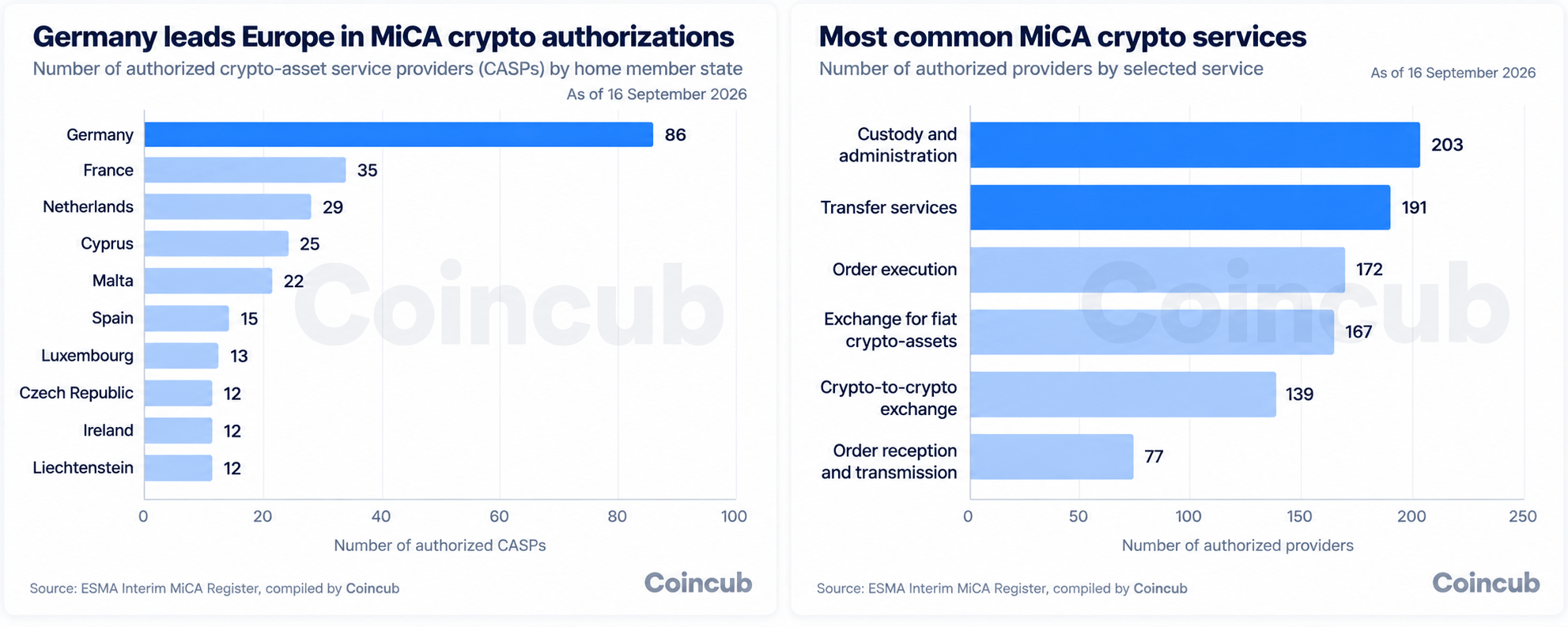
The regulatory entry covers two activities: the custody and administration of crypto-assets on behalf of clients and transfer services for crypto-assets on behalf of clients.
Deutsche Bank announced plans to launch a digital-asset custody service for institutional and corporate clients in Europe. The bank said on 16 September that it expects its first clients to go live this year.

Deutsche Bank’s authorization places the Frankfurt-based lender within the EU’s MiCA framework for crypto-asset service providers. The authorization is tied to Germany, where BaFin is the national competent authority, while ESMA maintains the EU’s central MiCA register.
But Deutsche Bank’s arrival in crypto is interesting for another reason. Look beyond the bank’s announcement and something much larger has happened to the European industry it is entering.
Europe has spent the past few years replacing a loose collection of national crypto regimes with MiCA, its single regulatory framework for digital assets. The transition was supposed to turn a fragmented market into one regulated European industry.
Deutsche Bank is arriving at the end of a regulatory transition that has stripped thousands of legacy crypto registrations out of Europe. MiCA created a much smaller crypto industry and has greatly favoured traditional banks and especially the German banks.
Founded in 1870, Deutsche Bank was involved in the financial machinery of the years preceding the 2008 crash. Bitcoin appeared in January 2009, weeks after governments had been forced to rescue a banking system buckling under its own leverage. Its first block carried a newspaper headline about another bank bailout. The ability to own and transfer money without asking a bank to keep the ledger was the point.
In 2017, the bank agreed to pay $7.2 billion to settle a US Department of Justice case concerning its sale of residential mortgage-backed securities between 2006 and 2007. The Justice Department said Deutsche Bank had misled investors about the characteristics of loans being packaged into securities and that the conduct contributed to the financial crisis.
Deutsche Bank did not cause the crash. It wasn’t Lehman Brothers. It wasn’t rescued by the German state in the manner of several other European institutions.
But it belonged unmistakably to the financial system against which Bitcoin’s earliest adherents defined themselves.
That history makes what Deutsche Bank is proposing today unusually interesting. The bank isn’t buying bitcoin. It wants to charge other people for keeping it safe.
Will they?