



 Buy a Licensed Company
  Explore VASP Data
  Talk to an Expert


Crypto taxation is shifting from ambiguous rates to mandatory reporting via OECD’s CARF (75 jurisdictions committed) and EU’s DAC8 (starting 2026), with tax hubs like UAE and Singapore now 0% but fully visible to foreign tax authorities.
Foreword

Crypto taxation has entered a new phase. For much of its history, the crypto ecosystem operated in a space where legal classification was unclear, enforcement uneven, and reporting largely absent. That ambiguity is now disappearing. In 2025, the defining change is not a sudden global convergence of tax rates, but the steady construction of reporting infrastructure that allows tax authorities, for the first time, to reliably link crypto activity to identifiable individuals across borders.
This report examines crypto taxation through a global lens at a moment when regulators, though often slow to act, are becoming inevitable enforcers. While tax treatment continues to vary widely, from genuine zero-tax regimes to progressive income models exceeding 50%, low reporting rates have been the global common denominator.
Upcoming frameworks such as the OECD’s Crypto-Asset Reporting Framework (CARF) and domestic regimes like the U.S. 1099-DA fundamentally alter the balance between users, platforms, and authorities. CARF in particular represents a structural turning point: it enables systematic insight into crypto holdings and transactions of identified users, something that did not previously exist at scale. As these frameworks come online, the historic assumption that crypto activity remains largely invisible to tax authorities no longer holds. For crypto-asset service providers, tax reporting will no longer be a peripheral legal concern but core infrastructure.
The purpose of this report is not just to rank countries by friendliness or hostility, but to map how crypto is actually taxed and how jurisdictions are preparing for the impending wave of data. By focusing on real regimes and behavioral incentives, it aims to provide a clear reference point for users reassessing their compliance posture and for service providers adapting their reporting frameworks. As crypto becomes part of the mainstream financial system, transparency – rather than tax rates alone – will define the compliance landscape ahead.
Key Takeaways
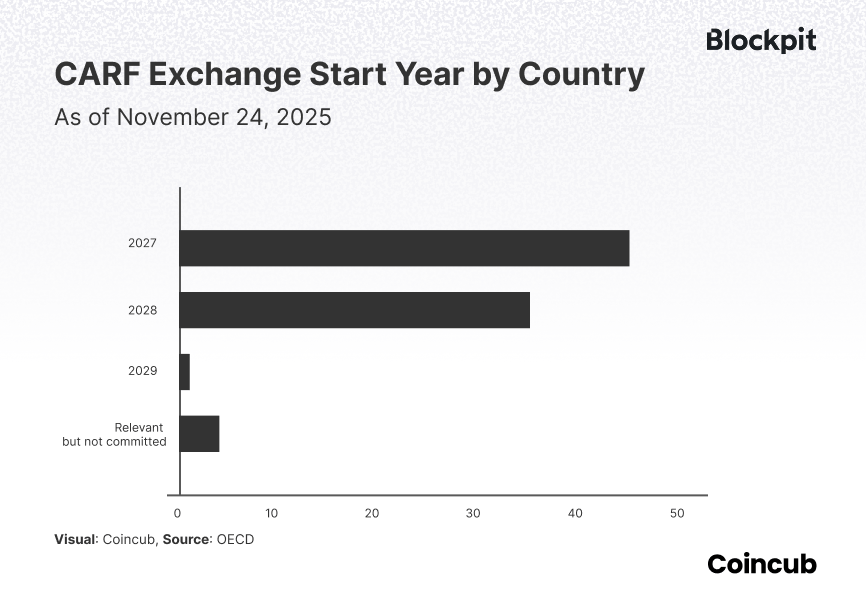
- Reporting is now the leading disruptor. Seventy-five jurisdictions have committed to CARF, 48 starting exchanges by 2027, 27 by 2028, and the US in 2029.
- The EU’s DAC8 mandates crypto-asset reporting across all 27 member states from 1 January 2026.
- The window for being invisible is closing globally. Finland is seeing every crypto transaction, and the U.S. is pushing full CARF-style reporting out toward 2029.
- For platforms and intermediaries, tax is infrastructure. If you sit between users and fiat, or hold transaction history, you are being hard‑wired into CARF‑grade reporting, and building for the strictest regime you touch is now the only defensible default.
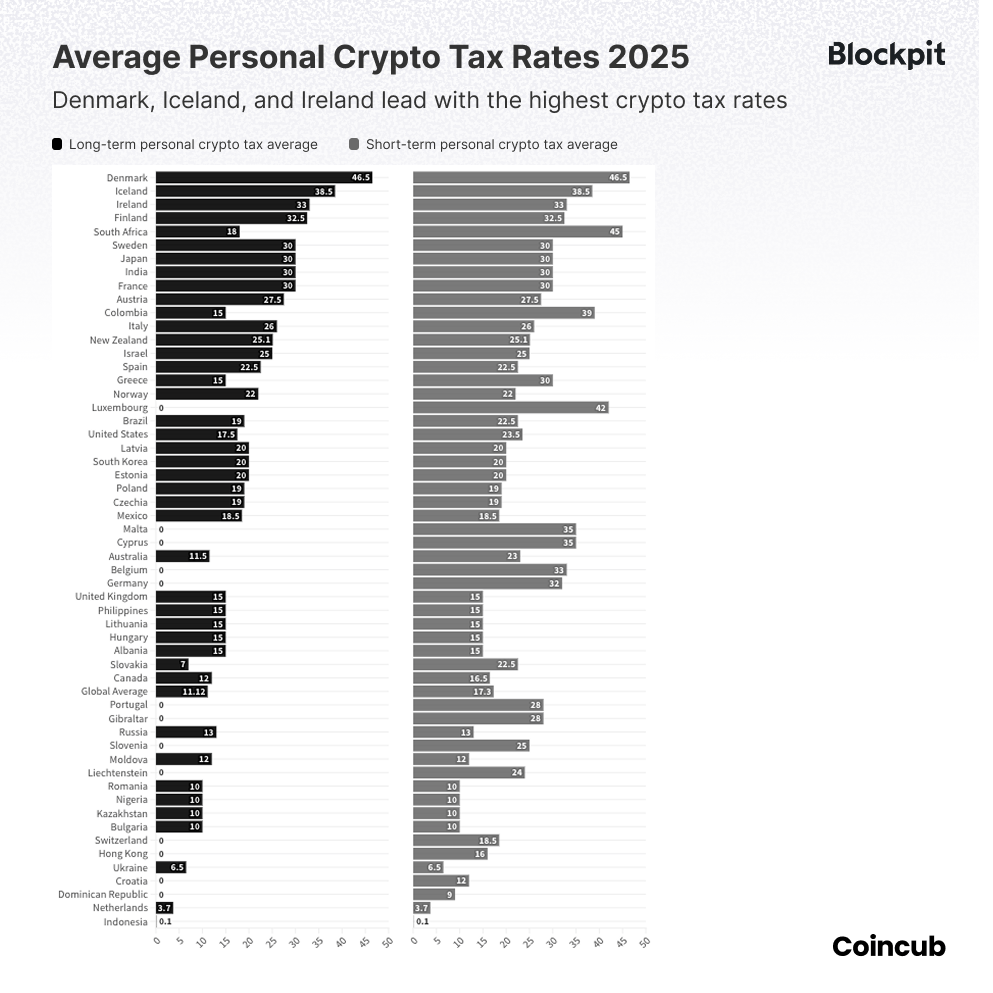
- Most long-term rates sit in three brackets: 0%, 10-15%, or 19-30%, with the global benchmark still near 11% for long-term and 17% for short-term gains.
- Flat mid-band regimes dominate, with Poland at 19%, Italy at 26%, Austria at 27.5%, France at 30%, Sweden at 30%, and Spain’s top band at 30%.
- Progressive income systems produce the highest burdens, with Japan, Denmark, Australia, and Canada routinely pushing crypto taxes into the 40-55% range.
- Long-term relief is still a substantial structural advantage in 2025. Germany and Portugal go to 0% after one year, Croatia after two, Luxembourg after six months, and Slovakia drops to 7% after one year.
- Zero-tax hubs still exist – El Salvador, UAE, Singapore, Switzerland, Puerto Rico, Panama, Bahrain, Bermuda, Cayman Islands – but most now sit inside CRS/CARF-style information exchange, so 0% no longer means invisible.
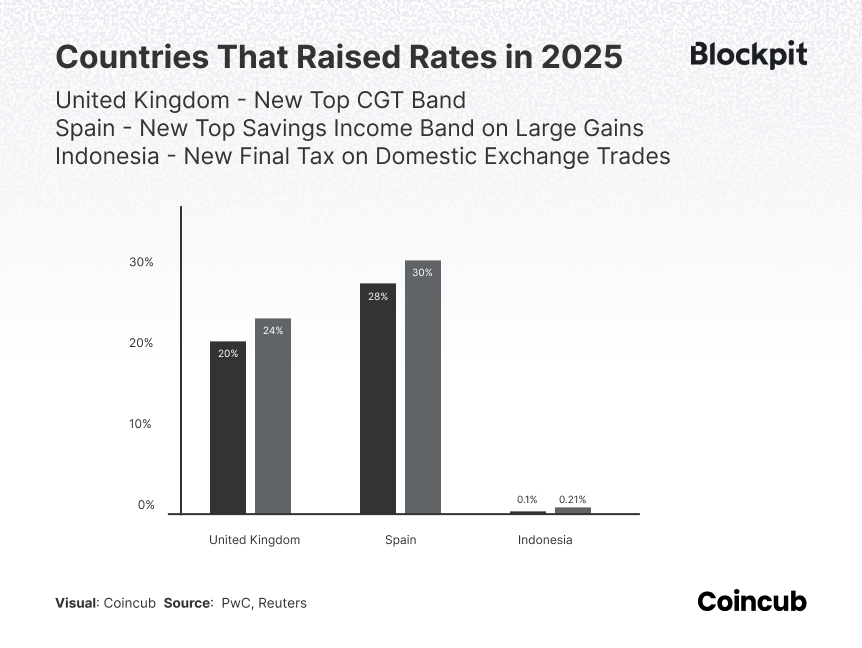
- 2024-2025 saw real tightening: the UK raised CGT to 18% and 24%, Spain added a 30% top band, Brazil normalised a ~15% crypto tax, and Indonesia lifted its trade levy from 0.1% to 0.21%.
- Several emerging markets formalised crypto tax rules: Nigeria moved to a 10% CGT, Albania to a 15% CGT, and the Philippines to a 15% CGT, plus VAT and income tax on related activity.
- Bans don’t remove activity. Algeria, China, Bangladesh, and Vietnam still generate offshore flows, shifting tax liability to other jurisdictions once reporting goes live.
Methodology
This report focuses on individual taxation of crypto assets in 2025. Corporate tax, VAT on exchange services, payroll tax, and accounting rules sit in the background but are not the main object.
Sources and Scope
- Blockpit crypto tax data and PwC individual capital gains data for 2025 across more than 100 territories, including headline CGT rates, treatment of shares and financial instruments, and personal tax bands.
- Official laws and government releases that include crypto-specific rules (India, Brazil, Portugal, Slovakia, Philippines, UK, Spain, Nigeria, El Salvador, etc.).
- Specialist tax analysis and crypto-focused resources for interpretation and cross-checks.
- Blockpit’s 2025 Germany Crypto Tax Report is a detailed case study on how a mature European country actually applies its regime to real user behaviour.
- CARF and MCAA primary documents, plus the OECD’s Crypto-Asset Reporting Framework XML guidance, for the reporting layer.
- This year’s report builds on the previous editions from 2024, 2023, and 2022.
Classification Approach
Each jurisdiction goes into one primary regime bucket:
- True zero tax on individual crypto gains (or de facto zero for normal investors).
- Low flat tax around 10-15%.
- Flat mid to high rates (roughly 19-30% and above).
- Progressive income models that add crypto gains to your salary in the same bands.
- Long-term relief regimes in which the holding period affects the tax outcome.
- Wealth or deemed-return systems that tax annual value rather than realised gains.
- Bans and effectively illegal markets.
If a country fits more than one pattern, we place it where the marginal decision of a typical crypto user changes the most. For example, Germany fits into the long-term relief regime because the one-year rule is the primary behavioural driver, even though the short-term rate sits within a standard progressive income system.
Report Caveats and Disclaimer
This report does not serve as comprehensive tax advice. Furthermore, it does not function as an exhaustive, statute-by-statute regulatory handbook. It is important to note that specific thresholds, local surcharges, and unique regulatory exceptions exist across nearly all jurisdictions. For portfolio-level financial decisions, consulting local professional advice remains both relevant and necessary. The objective of this document is to identify and illustrate prevailing trends, the direction of regulatory evolution, and the key areas of focus for the year 2025.
1.0 Introduction
Crypto taxes used to sit in the background. If you stayed under the radar and kept your trades spread across a few exchanges, you convinced yourself that nobody would care. That window is closing faster than most crypto users realise. In 2025, most governments need to decide who reports first, how far data sharing goes, and which part of the system they rely on: the exchange, the bank, or the user.
Crypto is now part of the mainstream tax system, even in countries that sell a “crypto-friendly” story. Tax-free hubs push the boundaries of residency rules and substance. High-tax countries now have frameworks such as CARF, DAC8, MiCA, CRS, and local reporting requirements for crypto exchanges. Some places reward long-term holding and claim the title of ‘crypto haven’. Others treat every trade like consultancy income.
The goal of this report is to map how countries actually tax crypto in 2025, identify the pressure points, and simplify complex descriptions to increase awareness and positively influence tax compliance. That means grouping regimes by behaviour, rather than vague labels like “pro-crypto” or “hostile”. It means calling out the difference between a genuine 0% environment and a place that has no explicit law but plenty of ways to reclassify you after the fact. It also means looking at reporting, because a low rate with heavy data flows can feel more aggressive than a higher rate with weak enforcement.
In the past, this report was for people who actually moved large amounts of crypto. But those days are gone, and crypto taxes affect everyone in the ecosystem. This may include retail users who trade on their phones, traders who churn volume every week, teams that raise in tokens and need to pay staff in something other than “promises,” and compliance and tax people who now have to plug CARF, DAC8, MiCA, and 1099-DA into a messy on-chain user reality.
1.1 The Global Picture
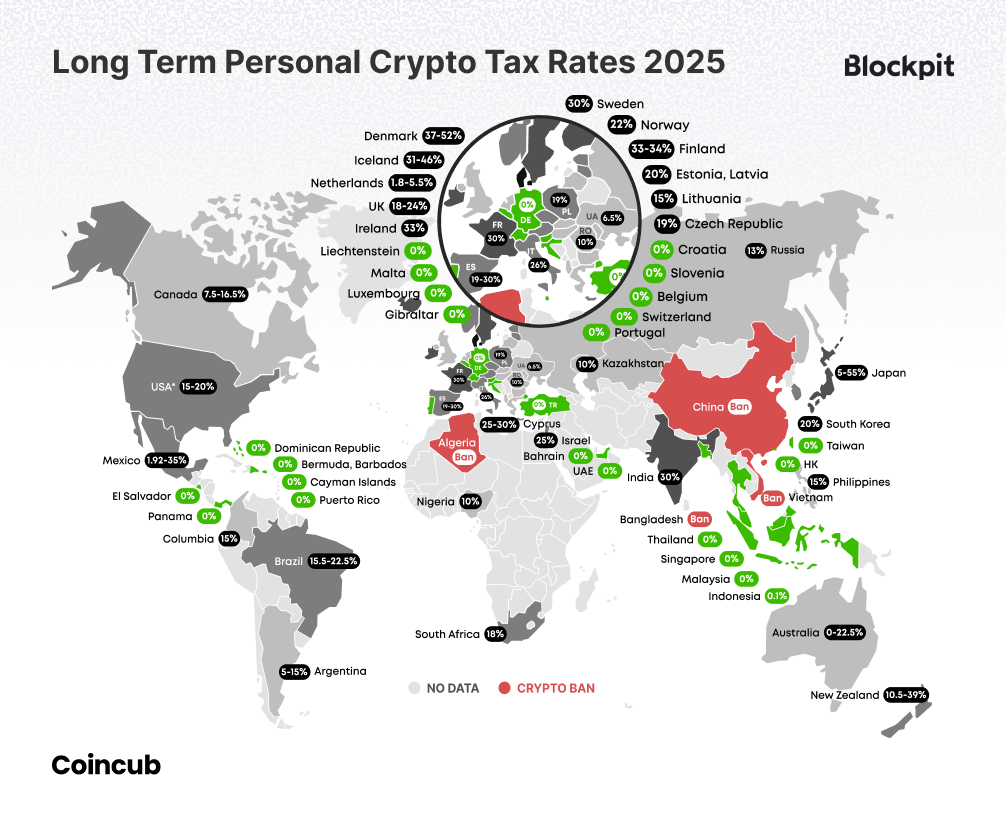
The map tracks how different countries tax personal crypto gains in the long term. As the countries are being pulled into the CARF reporting web, the report ranks jurisdictions from high to low average tax rates, showing some countries above 40%, a cluster around 15–25%, and a group of zero- or near-zero-tax, highlighting how patience and long holding periods can dramatically reduce effective tax.
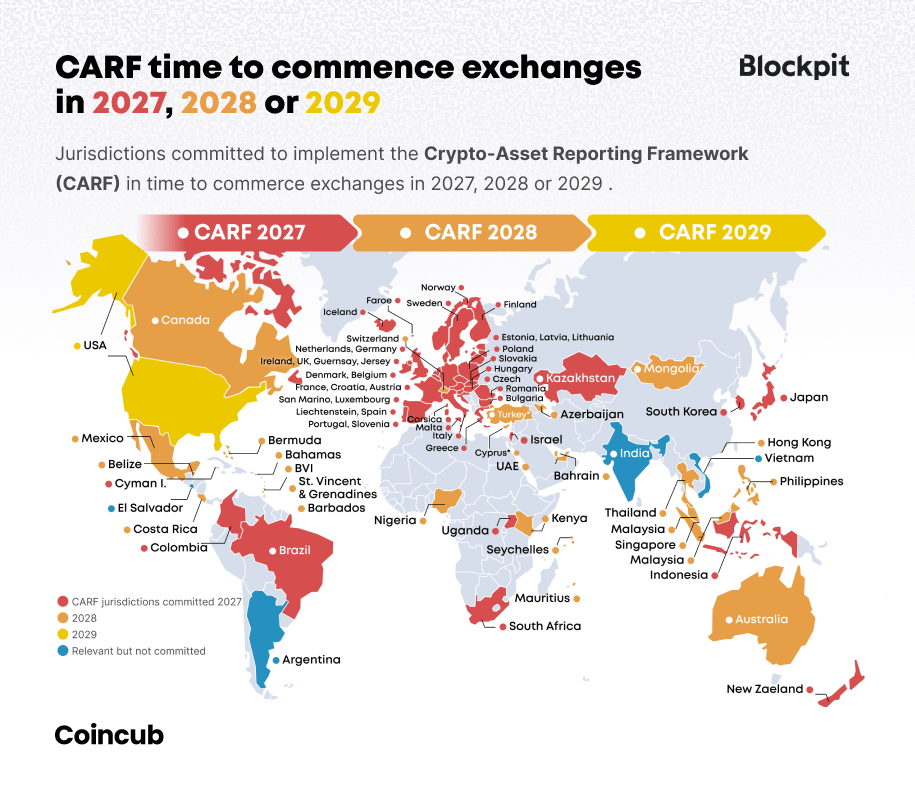
The middle section of this report shows which countries have committed to implementing CARF (by 2027, 2028, 2029, or beyond), illustrating that many traditional “zero-tax” jurisdictions are now part of a global network for sharing crypto transaction data. Seventy-one countries have signed or committed to the Crypto-Asset Reporting Framework and plan to start exchanging data between tax authorities. Some aim for 2027, some “by 2028”, and some sit outside the network entirely.
At the end, a short-term average crypto tax overview mirrors the first part. It focuses on short-term gains (usually within a year), emphasizing that speculative trading is taxed much more heavily, with many countries in the 30–40% range and only a few still offering 0% on short-term profits.
Crypto taxation is not converging on a single global standard but instead into three main blocks.
- There is a zero (or near-zero) tax cluster that stretches from the Gulf to parts of Latin America, the Caribbean, and a slice of Europe.
- Another, broader cluster of countries treats crypto like any other financial asset, charging flat rates of 19-30%.
- And, just like in real life, there is a high-tax band where most crypto profit ends up under full progressive income tax, sometimes above 50%.
On top of this, a separate layer of bans and grey zones still covers countries like Algeria, China, Bangladesh, and Vietnam.
In 2025, a 0% tax regime within a dense CARF network looks very different from one in which no bank or exchange reports anything to foreign authorities. From this point, the report walks through regimes in a straight line, and only then returns to CARF, perception, and user-level implications. To give a broader view, the report tries at times to shed light on how governments answer three questions:
- Is crypto an asset, a currency, or something else?
- Does the tax office care about the holding period or only about the moment of cashing out?
- Does the country rely on self-reporting or on data flows from exchanges and banks?
2.0 Reporting Reality: CARF, DAC8, 1099-DA
Tax rates answer “how much,” but reporting answers “who shows up”.
2.1 CARF, CRS, FATCA in One View
The OECD’s Crypto-Asset Reporting Framework plugs into an ecosystem that already includes the Common Reporting Standard (CRS) for financial accounts and
Foreign Account Tax Compliance Act (FATCA) for US persons. CARF asks VASPs, exchanges, brokers, and even some DeFi front ends to report detailed information about user balances and transactions to local tax authorities, who then share it across borders. Obviously, DeFi remains the regulatory blind spot. While recent guidance attempts to stretch this to some governance token holders or admins, pure non-custodial front-ends often lack the legal “control” required to enforce collection similar to centralized exchanges
This map shows the first waves of CARF signatories, including most of the EU, North America, and several zero-tax hubs. Some early adopters aim to exchange information by 2027. Others pushed the adoption to 2028 but committed in principle.
Once CARF is live, the most significant difference will not depend on whether local law classifies crypto as an asset or a currency. Instead, it will boil down to whether a provider falls under the CARF definitions and has to hand over structured XML reports of user activity.
2.2 Europe – DAC8, MiCA, and Local Rules
Within Europe, the Directive on Administrative Cooperation (DAC8, tax transparency for crypto-assets) is the central piece that brings crypto into the EU’s administrative cooperation framework. It forces EU-based platforms and non-EU platforms with EU users to report transactions to tax authorities in a harmonised format.
MiCA does not set tax rules, but it helps tax offices by clarifying who counts as a crypto asset service provider and what records they must keep. Combined, DAC8 and MiCA make it far harder for EU residents to “forget” heavy trading activity on large centralised exchanges.
Germany and Portugal represent one end of the spectrum in this EU context. Germany runs a generous long-term relief program, and it will still receive rich data on short-term trading once CARF and DAC8 are fully implemented. Portugal offers 0% for long-term holdings and also implements clear 28% taxation and Travel Rule enforcement for active trading. The likes of France, however, flagged already that MiCA’s passporting mechanisms might require ‘strengthening’, and are even exploring making crypto taxation similar to “unproductive wealth,” where crypto would be taxed the same way a yacht would be.
Nevertheless, despite local EU rules and regulations, the CARF framework is emerging as a unifying front, and citizens across countries should expect a relatively compact and consistent approach to crypto tax.
2.3 United States – 1099-DA
The US delayed multilateral exchange to 2029, as of 24th November 2025, but will still enforce its domestic framework. From 2025 onward, brokers must issue Form 1099-DA for digital asset transactions, with detailed basis and proceeds information sent to both the taxpayer and the IRS. This covers centralised exchanges, some custodial platforms, and other intermediaries that fit the broker definition.
US residents still face the same CGT rates as before. Long-term gains fall within the familiar 0/15/20% brackets; short-term gains are treated as ordinary income at 10-37%. The difference now is that hiding significant activity gets much harder once brokers start sending clean data automatically.
2.4 Zero-Tax Hubs Inside Reporting Networks
Many countries with 0% tax or low tax rates now sit inside these information networks. A UAE resident may pay 0% locally, but if that person remains tax resident elsewhere, CARF and DAC8-style exchanges will expose the discrepancy.
Caribbean and European 0% hubs already face pressure on banking relationships when they host large volumes of high-risk activity without convincing substance. CARF will not immediately close that gap, but it adds another channel through which larger positions appear on foreign tax screens. The era of “no tax and no reporting” is quickly coming to an end.
3.0 CARF Country-Level Insights
3.1 Finland
In September 2025, the Tax Administration set out CARF-style rules for crypto-asset service providers, with the law meant to pass by 31 December 2025 and take effect on 1 January 2026. Starting in 2026, licensed CASPs must collect detailed crypto transaction data for all clients, domestic and foreign. First annual reports, detailing transaction amounts and enabling gain/loss calculation, are due in 2027 for the 2026 tax year.
Domestic reporting exceeds international minimums, as authorities mandate detailed transaction data for matching, FIFO methods, and pre-calculating tax outcomes. Finland’s tax authority has flagged a large gap between the number of people trading crypto and those correctly reporting their income, which seems to be a key political driver behind the adoption of a stricter-than-minimum regime.
The Finnish rules define a “reporting crypto asset service provider” as a provider that offers crypto‑asset services or carries out exchange transactions (for example, crypto against euros) and has authorisation from the Finnish Financial Supervisory Authority.
The number of companies approved under CASP has decreased significantly since last year, from 12 to just 3. Currently, these three approved companies are Bittimaatti Oy, Coinmotion Oy, and Tesseract Investment Oy. From 1 January 2026, such approved CASPs must collect identification data on all their service users, including tax numbers and country of residence, and keep records of all purchases, sales, exchanges, and transfers of crypto assets, for both Finnish and non‑Finnish users.
Crypto owners must still report their income and losses from crypto trading on their annual tax returns. Still, from 2026 onward, the authorities will increasingly have third‑party data to cross‑check those declarations.
And because DAC8 mandates automatic exchange within the EU, tax authorities in other Member States (such as Ireland) will also receive data on their own residents if they use Finnish‑reporting CASPs, even though each country will apply its own substantive tax rules to those transactions.
3.2 Brazil
Brazil has been on crypto reporting for years and is now shaping it into CARF. In November 2025, the Federal Revenue Service issued Normative Instruction RFB No. 2,291 and switched to an OECD-style reporting format for automatic exchange. The old regime runs until 30 June 2026, after which it is replaced by the new “Declaração de Criptoativos” system from July 2026. Domestic exchanges still file monthly reports, and individuals still have to declare off-exchange transactions once they exceed the monthly value threshold, now set at BRL 35,000.
Brazil also drags foreign platforms into the net. Law No. 14,754 of December 2023 obliges overseas exchanges that serve Brazilian customers to report those transactions in Brazil. CARF-aligned due diligence and AML/KYC checks start to bite from 2026, so the reporting is not just cosmetic. Brazil has committed to beginning CARF exchanges in 2027, putting it firmly in the first-wave bucket.
3.3 Switzerland
Switzerland backs CARF but has hit pause on the political side. Authorities initially aimed to commence CARF due diligence on 1 January 2026 and to use a federal draft law (No. 25.052) to enable automatic crypto-asset exchanges as early as 2027. In November 2025, the Economic Affairs and Taxation Committee of Parliament voted to postpone its review of that draft. The main reasons were that other key countries started pushing their own CARF timelines beyond 2026, and the OECD was still reworking parts of the framework. Switzerland chose to wait and see how partners move and how OECD guidance settles before fixing its list of exchange counterparties.
The postponement concerns international exchange, not what Swiss providers must do at home. Domestic due diligence and reporting for Swiss crypto firms are still expected to kick in on 1 January 2026. Switzerland has also given a formal commitment to start CARF exchanges in 2028, based on 2027 data, which is one year after the first adopters.
3.4 United Arab Emirates
The UAE is in the CARF club, just one wave behind. In July 2025, the Ministry of Finance signed the CARF multilateral agreement and committed to starting to exchange crypto-asset information in 2028 for the 2027 year. From 15 September to 8 November 2025, the ministry held consultations with exchanges, intermediaries, custodians, and other providers on implementing CARF within the UAE’s fragmented licensing landscape under the SCA, ADGM, DIFC, VARA, and other regulators.
The working assumption is data collection starting in 2027 and the first exchanges in 2028, with new federal rules likely to take effect around 2026. Those rules will require UAE-based reporting providers to conduct CARF-style due diligence and to report annually into the local system. The UAE is late by design, but the commitment and the process are already in place.
3.5 Singapore
Singapore has signed up and given itself a longer runway. It joined the CARF multilateral agreement in 2024, and the tax authority has said that Singapore expects to start exchanges in 2028, based on 2027 data. The plan is to put the legal and technical plumbing in place by the end of 2025.
IRAS has already pushed tools out to industry: a self-review checklist for potential reporting crypto-asset service providers, and is working on an e-Tax guide and reporting schema. CARF rules will be incorporated into Singapore’s existing tax law, with providers required to start collecting CARF-grade data from January 2027. Singapore is a late adopter, but it is not improvising this on the fly.
3.6 France
DAC8 provides the legal backbone, and France used its 2025 Finance Act to activate the crypto reporting provisions. From 1 January 2026, French crypto-asset service providers have to report user transactions to the tax authority. The 2026 data will feed into automatic exchanges with partner countries in 2027, alongside the EU DAC8 schedule.
The law requires operators to file annual declarations of customer crypto activity, placing digital assets in the same transparency regime as other financial accounts. France is on the list of countries promising 2027 exchanges and already has the national law to back that up.
3.7 Germany
Germany is doing the same thing through its own DAC8 bill. In September 2025, the government published draft legislation to transpose the directive’s crypto transparency rules by the end of 2025. The bill is due to take effect on 1 January 2026 and plugs CARF model rules straight into Germany’s automatic exchange framework.
From 2026, German exchanges, brokers, and custodians will have to identify their clients’ tax residency and submit an annual transaction summary to the tax office, which will then be included in the 2027 exchange cycle. The draft also adjusts existing CRS laws so that digital assets, some e-money, and potential CBDC positions sit under the same reporting umbrella. Germany signed the 2023 joint statement that targets 2027 first exchanges and has already run a consultation round on the draft, so this is not a paper exercise.
3.8 Australia
Australia has picked the 2027 window and is now arguing about the wiring. In November 2023, it joined the group of countries that want to adopt CARF on that timetable. The Treasury then released a consultation paper on how to fit CARF and the revised CRS into local law, with the consultation open until 24 January 2025. The paper lays out two paths: copy the OECD rules almost word-for-word or build a more bespoke Australian regime. The clear preference is to hew close to the OECD template.
The same paper sets out a working timetable of data collection from 2026 and first exchanges in 2027, assuming Parliament passes the changes in 2025. Local exchanges and intermediaries would start CARF-style due diligence from 1 January 2026 and lodge reports by mid-2027. Australia has not yet finalised the law, but the intent and dates are on the record.
3.9 United Kingdom
The UK has the legal switch and is now filling in the details. It joined the 2023 joint statement that committed to CARF by 2027 and built enabling powers into the Finance Act 2023 so that it can implement the framework through regulations. In March 2024, HMRC opened a consultation that ran until May, asking how to treat optional parts of CARF, how to adjust CRS rules, and whether to extend similar reporting to purely domestic crypto.
The government has flagged 2026 as the earliest realistic start date for data collection and 2027 as the earliest realistic start date for the first exchanges. Draft regulations will require UK-based crypto providers to conduct tax-residency checks and file annual reports, and will add CARF to the list of exchange arrangements under UK law. The consultation materials include a simple timeline: regulations finalised in late 2024 or 2025, industry compliance from 2026, exchanges from 2027.
3.10 United States
The U.S. helped design CARF but has been deliberately slow to adopt it. It has agreed in principle to implement the framework and is the only jurisdiction aiming for first exchanges in 2029 rather than 2027. That plan is now documented in the Global Forum. The gap reflects the need for a new domestic authority to collect and share information on crypto-asset accounts with foreign partners, which goes beyond the inbound focus of FATCA and similar tools.
As of early 2025, the U.S. had not yet signed the CARF multilateral agreement, so it was not yet wired into the exchange network. Treasury and the IRS have signalled that they will propose regulations aligned with a 2029 start, likely using data collected from around 2027 onward. In parallel, the IRS is rolling out new broker reporting rules under the 2021 infrastructure law, so U.S. platforms will already be sending detailed forms to the IRS from the 2025-2026 period. Those rules could feed CARF later, but until Congress and Treasury finish the job, nothing gets shared abroad.
3.11 Hong Kong
Hong Kong has said “yes” to CARF and given a clear target year. In December 2024, the government notified the Global Forum that it would adopt the framework and tied that decision directly to its role as an international financial centre. The plan is to pass the necessary changes by 2026, start collecting data in 2027, and join the exchange network from 2028.
The technical work will sit inside amendments to the Inland Revenue Ordinance that create explicit reporting duties for local crypto-asset service providers. The government has promised to consult industry and the public before finalising the draft. The Global Forum has already tagged Hong Kong as a relevant crypto market that should implement CARF quickly, so there is external pressure on top of the local plan.
4.0 Tax Regime Types
4.1 What Changed Since Last Year
Most of the changes from 2024 are structural. Only a few countries shifted their numeric rate going into 2025.
- Argentina – removed its previous wealth-style crypto declaration scheme and shifted focus to taxing realised gains above thresholds and cross-border transfers at 5-15%.
- Brazil – moved to a simplified flat tax on crypto gains of around 15% and trimmed old exemptions.
- United Kingdom – raised CGT rates to 18% and 24% for 2025/26 and cut the annual CGT allowance to GBP 3,000.
- Spain – introduced a new 30% top band for savings income, including large crypto gains above EUR 300,000.
- Indonesia – increased final withholding on domestic crypto trades from 0.1 to 0.21% of transaction value, pushed 1% on some overseas platform trades, and removed VAT on crypto transactions from August 2025.
- Slovakia introduced a 7% long-term rate for crypto held more than one year and removed health insurance levies on those gains.
- Portugal implemented the 0% over one year / 28% under one year split as part of its 2023-2024 reforms, with full implementation in 2025.
- Philippines – formalised capital gains tax up to 15% on crypto disposals, plus regular income tax on mining and staking, and VAT on crypto payments.
- South Korea – delayed its planned 20% crypto gains tax again, now set for 2027, keeping 2025 under the old regime.
- Ukraine – advanced a draft regime for a 5% income tax plus a 1.5% military levy on crypto gains, targeting a 6.5% flat effective rate once the virtual assets law is fully in effect.
- Nigeria – confirmed 10% capital gains tax on digital assets through its 2023 reforms, which now shape 2025 practice.
- Albania introduced a clear 15% rate on crypto gains, whereas the treatment was largely unregulated before.
- Italy implemented the 26% crypto tax and exemption rules in 2023, which apply to 2024-2025 returns.
- Bolivia lifted its long-standing blanket ban on crypto in 2024, moving from a pure prohibition to a more regulated approach, with taxation expected to follow general income tax rules.
This list is not exhaustive for inflation tweaks or technical clarifications. It covers changes that actually alter behaviour.
4.2 Patterns in the Changes
The direction of travel is not uniform. Some countries tightened. The UK, Spain, Brazil, and Indonesia raised effective burdens or closed loopholes. They are clearly moving away from any perception of crypto as lightly taxed. Indonesia, in particular, shifted from a symbolic 0.1% trade tax to a 0.21% levy and removed VAT to treat crypto more like a financial service.
Others created relief or clarity. Slovakia’s 7% long-term rate is a genuine incentive to hold more than a year. Portugal’s split between 0% above one year and 28% below it finally answered the “Is Portugal still a crypto tax haven?” question in a concrete way. Ukraine’s planned 6.5% regime, if implemented, would undermine many neighbours and formalise a reality that already exists informally.
Then some moves mostly clean up confusion. The Philippines, Nigeria, and Albania went from grey areas to explicit digital asset tax language. Argentina scrapped a widely criticised crypto wealth declaration system and replaced it with more targeted rules on gains and capital flight. South Korea delayed its tax yet again, which keeps traders in limbo, but at least clarifies that 2025 is the status quo.
The key point is that almost all changes lean toward greater integration of crypto into existing tax structures or stronger reporting requirements. Significantly fewer move toward complete exemption.
4.3 True 0% on Individual Gains
This group is small, but it attracts the most headlines. These are countries where a normal individual who buys, holds, and sells crypto as an investment does not face capital gains tax on those profits.
- In El Salvador, bitcoin trades are subject to a 0% capital gains tax for residents and foreign investors.
- The United Arab Emirates, Bahrain, Bermuda, the Cayman Islands, and similar Gulf and offshore hubs entail no personal income or capital gains tax.
- In Singapore and Malaysia, investment gains are tax-free as long as the activity is not treated as a trading business.
- In Puerto Rico, for bona fide residents, gains accrued after moving are subject to Act 60 and taxed at 0%.
- Georgia and Belarus extended explicit crypto tax holidays into 2025.
- In Cyprus and Panama, capital gains are not taxed except on real estate, and casual crypto sales are not included in taxable income.
- In Switzerland and Gibraltar, for private individuals, personal capital gains on movable assets, including crypto, are exempt, with only wealth tax or business income rules in the background.
For this group of countries, the story looks similar. The state either has no personal income tax at all, or it draws a bright line between business income and private investment. Crypto sits on the investment side, so the annual tax bill stays at zero as long as activity looks like portfolio management. But this does not mean a free-for-all.
Switzerland still applies wealth tax at the canton level and can reclassify a very active trader as a professional, which brings income tax into play. Singapore can treat a full-time crypto trader as running a business, with the usual corporate or personal tax rates. Panama and Puerto Rico both lean heavily on residency tests and source rules.
But in 2025, many of these zero-tax countries are CARF or CRS participants, or both. That means local exchanges and banks will start passing consistent data to foreign tax authorities once the frameworks go live. The local rate is 0, but that does not mean there is no flow of your information.
4.4 Low Flat Tax (10-15%)
This cluster is where many “normal” countries are trying to land. A rate that signals participation instead of hostility.
- Bulgaria has a flat 10% personal income tax, also applied to crypto gains.
- Kazakhstan has a 10% income tax rate that covers capital gains.
- Nigeria has a 10% capital gains tax on digital assets since the 2023 Finance Act.
- Albania has a 15% tax on crypto capital gains and on business income from digital assets.
- Hungary has a 15% rate on crypto income since its 2022 reform, which simplified previous rules and removed social tax in most cases.
- Lithuania has a 15% capital gains rate, rising to 20% above a high-income threshold.
- Romania (10%) and Moldova (12%) have capital gains for individuals, at least on paper.
- Brazil has a reformed flat tax on crypto income at 15%, after removing some exemptions and tightening thresholds.
- The Philippines imposes a 15% capital gains tax on crypto disposals, while mining and staking rewards are subject to regular income tax.
Crypto is included primarily in the existing capital income basket. The country does not apply special punitive rates to digital assets, nor does it subsidise them. There is often a small tax-free threshold, or a de minimis exemption for minor gains.
From the user’s point of view, the numbers here matter less than clarity. A predictable 10 or 15% rate with clean rules is easier to accept than a vague promise of lower tax that depends on classification battles every year.
Many of these states now build or join reporting frameworks. Nigeria and the Philippines are examples of countries that codified digital asset definitions in law and then set clear rates and reporting requirements.
4.5 Flat Mid and High Rates (19-30%)
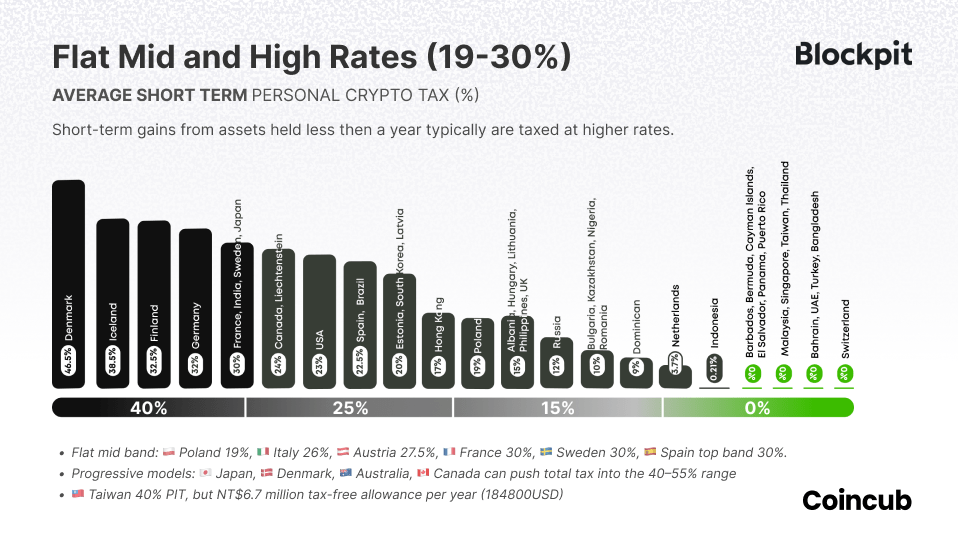
The next group treats crypto like any other capital asset, but at higher flat rates. This is the “shares and securities” band.
- Poland has had a 19% flat tax on capital gains, including crypto, since 2019.
- Italy has a 26% rate on crypto gains since 2023, with a small annual exemption.
- Austria has a 27.5% tax on crypto, aligned with its tax on dividends and interest.
- France has a 30% single flat tax (income plus social contributions) on most retail crypto gains, though a recent proposed amendment may change that.
- Sweden has a flat 30% tax rate on capital gains, including crypto.
- Spain has a progressive “savings income” bands that now top out at 30% on large gains, but still behaves like a flat regime for many mid-size portfolios.
- The United Kingdom pushes the 18 and 24% CGT bands for 2025/26, where crypto sits alongside other assets, plus a sharply reduced annual allowance.
This category of states tends to see crypto as part of the same pool as shares, funds, bonds, and other investment products. The rate no longer aims at “low enough to attract global money”. It simply reflects domestic policy on investment income.
For users, that means any optimization here might come from holding-period rules, allowances, or loss offsets, rather than from special crypto windows. In France, a casual investor pays 30%, but a full-time market maker risks being reclassified as a professional and subject to higher rates. In Italy, exemptions and step-up rules around 2023 will matter more than a minor rate change.
4.6 Progressive Income Models
This group of countries is where crypto profits tend to be mixed into salary, freelancing, and business income and taxed accordingly. There is no structural distinction between capital gains and other income streams.
- In Japan, all crypto profits are treated as miscellaneous income and are subject to a combined national and local tax rate of roughly 55% at the top bracket.
- In Denmark, most crypto activity is treated as speculative income, with personal tax rates exceeding 50% once municipal and labour contributions are taken into account.
- In Finland, capital income is 30% up to EUR 30,000 and 34% above that, and crypto-to-crypto trades trigger tax events.
- In Canada, 50% of capital gains are taxed at marginal income rates ranging from 15% to 33% at the federal level, plus provincial layers.
- In Australia and New Zealand, frequent trading or business-like activity subjects crypto to full income tax treatment, with top marginal rates of 45% in Australia and 39% in New Zealand.
- In Mexico, crypto is subject to the general income tax bands, ranging from around 1.9% to 35%.
In practice, many of these countries still refer to capital gains in their tax codes, but the treatment of crypto is closer to a pure income model. The tax office looks at your total position rather than a single trade you did on a Tuesday.
For a trader in these countries, the yearly outcome depends less on whether a specific token moved 20% and more on the overall pattern, such as turnover, net gains, classification as investment or business, and ability to recognise losses.
These countries are also where most of the “I did not know this was taxable” stories come from. People assume old capital gains logic, where only cashing out to fiat matters, while their system actually taxes swaps, staking income, airdrops, or even governance token allocations as they occur.
4.7 Long-Term Relief Regimes
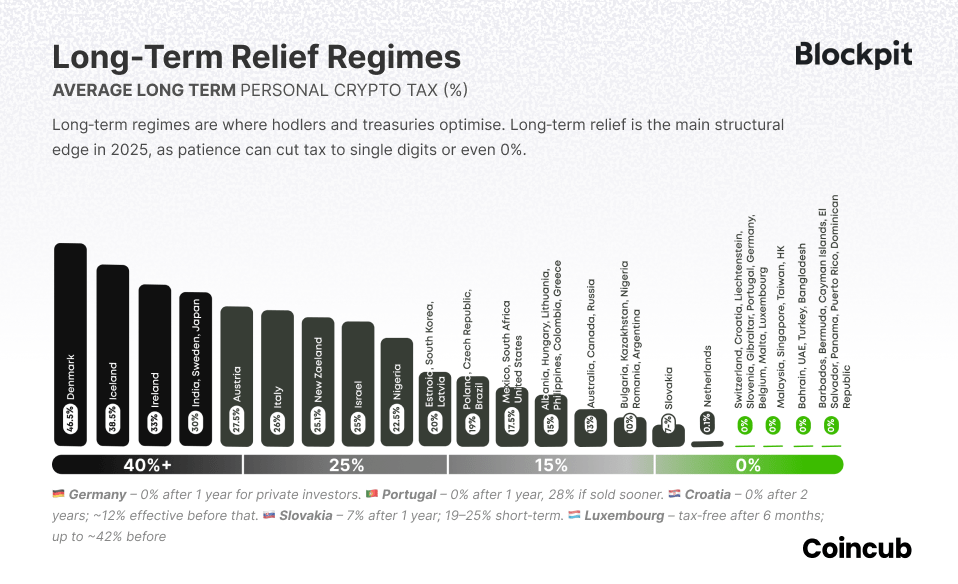
In these countries, policy choices really shape behavior, and holding periods matter.
- In Germany, private crypto gains are tax-free when the asset has been held for more than one year. Sales inside one year are taxed at the normal income tax rate (up to 45%) if total private sale gains exceed EUR 1,000 in the year.
- In Croatia, users pay 0% tax on crypto held for more than 2 years. Short-term gains face roughly 10% national tax plus city surtax, typically around 12% effective.
- In Luxembourg, crypto held for more than 6 months is treated as a tax-exempt private capital gain. Gains from shorter holding periods are speculative and taxed at progressive income rates, up to roughly 42%, with a small de minimis exemption.
- Since 2024, Slovakia has applied a 7% tax rate on crypto held for more than 1 year, with no health insurance levy on those gains. Shorter holdings still face 19 or 25% depending on income.
- Since 2023, Portugal has kept gains from crypto held for more than 1 year tax-free for non-professional investors, but taxes shorter-term gains at 28%.
- Slovenia operates a sliding scale for certain financial assets. It has been moving toward a more formal crypto tax, with either a low, flat transaction tax or a rate that falls as the holding period grows, down to zero after many years.
Speculation inside a year or two will cost real tax. Patience unlocks either a full exemption or a much lower rate. That not only rewards “hodlers” but also shapes where long-term corporate treasuries, family offices, and high-net-worth individuals prefer to park assets.
The German and Portuguese frameworks are essential for Europe because they sit inside the EU single market but push in very different directions. Germany pushes a simple binary: under a year, taxable; over a year, free. Portugal builds a sharper wedge between active trading and long-term holding and, at the same time, tightens reporting and Travel Rule implementation while providing some clear guidance. While the default flat rate is 28%, Portuguese residents can aggregate (englobamento) short-term crypto gains with their other income. For students, low-income earners, or those with no other income, this often results in a much lower effective tax rate (starting around 14.5%) than the flat 28%.
4.8 Wealth and Deemed-Return Systems
This group of countries taxes both the position and the exit.
In the Netherlands, Dutch residents pay tax not on actual realised gains, but on a deemed return on the value of their assets in “Box 3”. Crypto sits in that box together with bank deposits, portfolios, and other investments. The state calculates a synthetic return between roughly 1.8 and 5.5% depending on the size and composition of assets, and taxes that fictitious return at a flat rate, resulting in an effective annual burden of around 0.6 to 1.8% of asset value.
In simple terms, the tax office assumes your crypto earns a certain percentage, taxes that income every year, and does not wait for you to sell. Taxpayers can choose to be taxed on their actual return if it is lower than the deemed return. By 2025, this “rebuttal scheme” (tegenbewijsregeling) is the critical defense for holders in bear markets or low-yield positions.
Switzerland shares the same logic through its wealth tax. Private capital gains on crypto are exempt, but the total value of your portfolio is used to calculate canton-level wealth tax tables every year. The burden is smaller than that of income tax, but it is still present even if you do not trade.
Norway combines a flat 22% capital gains rate with a separate wealth tax of around 0.85% on net worth above a threshold. For an extensive crypto portfolio, this becomes functionally close to a hybrid with the progressive income model.
These systems rarely attract attention from retail traders. They matter a lot once balances cross certain thresholds. For high-net-worth holders, the question stops being “What is my CGT when I sell?” and becomes “What is my annual wealth and deemed-return drag if I stay here?”
4.9 Bans and Effectively Illegal Markets
The last bucket includes countries where crypto activity is banned or so restricted that there is no practical tax regime in place.
- Algeria criminalised the ownership, mining, and trading of crypto, with fines and jail time.
- China shut down most legal trading and mining.
- Bangladesh, Vietnam, Morocco, Libya, and a few others either prohibit use, block exchanges, or make crypto transactions unenforceable.
On paper, tax on crypto gains in these countries is 0%. In practice, the activity itself is the offence. That matters for this report because users in banned jurisdictions still appear in global on-chain data and on centralised exchanges that serve them indirectly. Their behaviour interacts with tax and reporting regimes elsewhere, especially once CARF forces more granular residency reporting. The tax burden falls where they routed through.
5.0 Closing Observations
Crypto tax is now all about how fast they plug exchanges and banks into CARF, DAC8, 1099-DA, and their own domestic rules. The regimes in this report show three clear paths: genuine 0% environments with residency strings attached, mainstream systems that treat crypto like any other asset, and outright bans where tax is irrelevant because activity is illegal. Everything else sits somewhere in between and changes quickly.
For people actually using crypto, the practical move is to pick a tax story that matches reality and stick to it. Decide if you are a long-term holder, an active trader, or effectively running a business. Keep one clean set of records that lines up with how your country treats that profile. If you rely on a 0% setup, make sure you also satisfy the boring parts like days in the country, centre of life, and where your fiat actually lands. That is what auditors look at when the marketing slogans fall away.
For companies, tax and reporting are now core infrastructure. If you sit between users and fiat, or if you hold any identifiable transaction history, you will be treated as a reporting node under CARF-style rules. The safe option is to build for the strictest environment you touch and then downgrade where you legally can. Clear labels for trades, swaps, staking and internal transfers, plus an export that matches what authorities expect, will matter more than any single headline rate.
For policymakers, the choice is between transparent, stable rules and ad hoc enforcement. Users can live with high taxes if the framework is clear and consistent. They will route around low nominal taxes if enforcement is arbitrary or if reporting rules feel like a trap. Countries that align rates, classifications, and data sharing into a coherent story will win the serious, long-term game. The others will be left with marketing decks and minimal volume.
Disclaimer
This report is intended for informational purposes only and should not be considered tax or legal advice. Cryptocurrency laws and tax regulations are complex and subject to frequent changes. Always consult a qualified tax professional or legal advisor before making any decisions related to cryptocurrency investments and taxation.
About Blockpit
Blockpit is a leading provider of crypto tax compliance solutions, simplifying tax calculation and reporting for individuals, institutions, and authorities in over 35 jurisdictions.
About Coincub
Coincub is a premier crypto intelligence provider, offering data-driven insights and analysis to help you navigate the cryptocurrency market.

 Canada
  UAE
UAE 








