Buy a Licensed Company
  Explore VASP Data
  Talk to an Expert

 Atis Shala
Atis is a senior analyst and community lead with four years of experience in crypto. He has a bachelor from the Rochester Institute of Technology.
Atis Shala
Atis is a senior analyst and community lead with four years of experience in crypto. He has a bachelor from the Rochester Institute of Technology.
Crypto Debit Cards: Fees, Taxes and How Payments Work

- The merchant almost never receives cryptocurrency. Visa and Mastercard settle the purchase in local fiat, and the crypto element happens upstream, inside the card programme.
- The most important question about any crypto card is its funding model: prepaid, exchange-funded, stablecoin-funded, or self-custodial. Fees, taxes, and custody all follow from that answer.
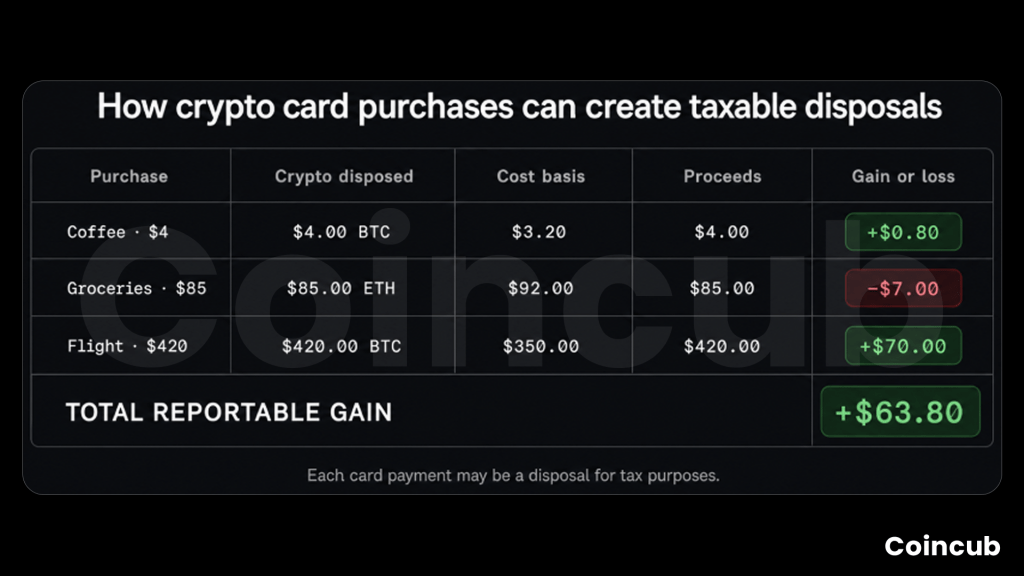
- In the United States, the IRS treats digital assets as property, so spending them on goods or services is a disposal. A $4 coffee paid in Bitcoin is a reportable capital-gains event with its own cost basis.
- Stablecoin purchases are usually still reportable disposals even when the gain or loss rounds to almost nothing, which creates recordkeeping work out of proportion to the tax owed.
- Headline fee schedules routinely omit the conversion spread, which is often the largest single cost. Ask for the all-in rate on a specific transaction rather than reading the fee page.
- “Zero foreign exchange fees” and “no transaction fee” can both be true while a purchase abroad still costs 1% to 3% once the spread and the network’s own FX rate are applied.
- Card networks operate stablecoin settlement between issuers and the network itself, which is a back-end treasury arrangement and has nothing to do with whether your coffee shop receives crypto.
What Happens Behind the Curtains of a Crypto Debit Card?
A crypto debit card looks, at the till, exactly like any other card. You tap, the terminal approves, the merchant hands over the coffee. Nothing about that moment is unusual, and that is precisely the point: card acceptance is the most solved problem in payments, and crypto cards are designed to borrow it wholesale.
Everything that makes these products distinctive happens in the seconds before authorisation and in the tax year afterwards. Somewhere in that window, the card programme decides whether to sell your Bitcoin, draw down a stablecoin balance, pull from a fiat float you pre-loaded, or reach into a wallet you still control. Each of those choices produces a different fee profile, a different custody exposure, and a different tax record. This article walks through the mechanics, prices the fees honestly, explains the tax position, and gives you a checklist for comparing cards.
What Is a Crypto Debit Card?
A crypto debit card is a payment card whose spending power derives from a digital-asset balance rather than a conventional bank account. It runs on standard Visa or Mastercard infrastructure, is issued by a licensed bank or e-money institution, and works at any merchant that accepts the network.

The word “crypto” in the product name describes the funding source, not what the merchant receives. In nearly all cases the merchant is paid in local fiat currency through the ordinary card-settlement process, exactly as they would be for any other card.
Debit and Prepaid Cards Versus Crypto Reward Credit Cards
Three products get confused, and the differences matter.
A crypto debit card draws on a balance you already hold, whether that balance sits in crypto, stablecoins, or pre-converted fiat. A prepaid crypto card is technically similar but requires an explicit top-up step before spending. A crypto rewards credit card is a conventional credit product: you borrow fiat, repay in fiat, and the crypto appears only as a rewards payout. That last product has no crypto disposal at the point of purchase at all, which makes its tax treatment considerably simpler.
This article covers the first two. If your card issues a monthly statement with a balance owed, you are holding a credit card and the tax section below applies only to the rewards you later sell.
How Does a Crypto Card Payment Work?
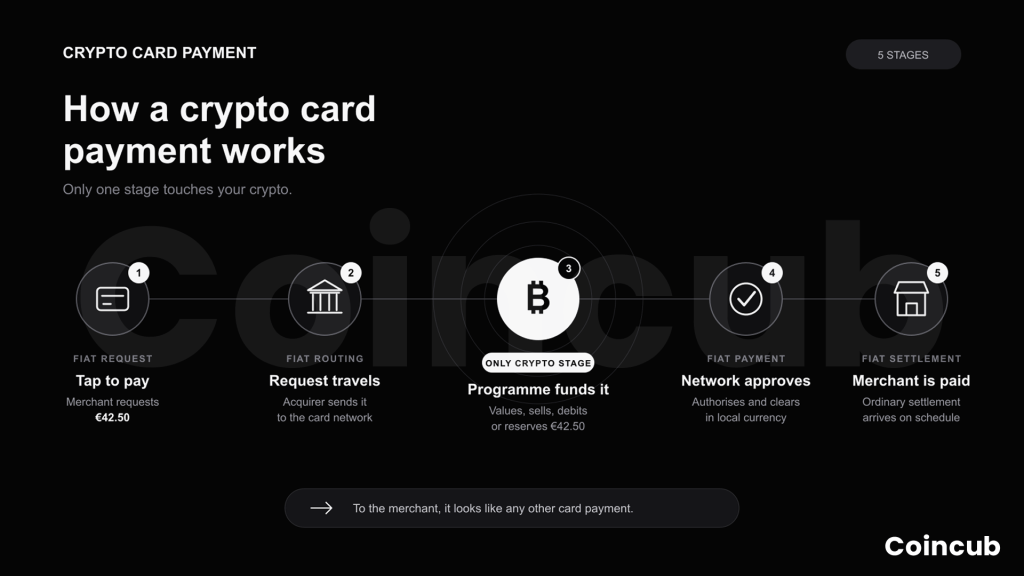
The transaction runs through five stages, and only one of them involves your crypto.
- The merchant requests authorisation in local currency. The terminal sends a request for, say, €42.50 through the acquiring bank to the card network.
- The card programme checks available balance. This is the moment your crypto matters. The programme values your holdings at its own reference rate and decides whether €42.50 is covered.
- Crypto is converted, reserved, or already pre-converted. Depending on the funding model, the programme sells the asset at or near checkout, debits a stablecoin balance, draws down a fiat float, or reserves value from a wallet you control.
- The network authorises and clears a fiat-denominated purchase. From this point the transaction is indistinguishable from any other card payment.
- The merchant receives ordinary card settlement in local currency, on the usual settlement timetable, from their acquirer.
The Stablecoin Settlement Layer Is a Different Thing Entirely
There is a genuine and growing use of stablecoins inside card networks, and it is routinely misreported. Visa has launched stablecoin settlement in the United States, allowing issuers and processors to settle their obligations to the network in USDC over blockchain rails rather than through wire transfers, with participating banks settling over Solana. Visa has described this reaching a multi-billion-dollar annualised run rate across several blockchains.
This is a treasury arrangement between financial institutions and the network. It changes how banks square up with Visa at the end of the day, giving them seven-day settlement availability and removing weekend float. It does not mean the merchant receives crypto, it does not change the consumer checkout experience, and it has no bearing on your tax position. Mastercard operates comparable programmes. When a card markets itself as “settling in stablecoins,” check whether that refers to this back-end layer or to something about your own account.
What Types of Crypto Debit Cards Are Available?
Funding model is the single most useful way to classify these products. Everything else follows from it.
| Model | When conversion happens | Who holds your assets | Typical tax pattern |
| Prepaid | Before spending, on top-up | Programme holds fiat float | One disposal per top-up |
| Exchange-funded | At or around checkout | Exchange or card provider | One disposal per purchase |
| Stablecoin-funded | At checkout, from a stable balance | Provider or exchange | Disposal per purchase, small gain or loss |
| Self-custodial | At the purchase transaction | You, until the transaction | Disposal per purchase, possible network fees |
Prepaid cards ask you to sell crypto and load fiat before you can spend. This is the most predictable model and the easiest to reconcile at tax time, because disposals happen in a handful of large, deliberate events rather than in dozens of small ones. The trade-off is that you hold an idle fiat balance, and you take the price risk of converting early.
Exchange-funded cards are the most common consumer model. Your assets sit in an exchange account, and the provider converts the selected asset at or around the point of sale. Convenience is high; visibility into the exact rate applied is often lower.
Stablecoin-funded cards narrow the problem. Because the spending balance is already dollar-referenced, you avoid volatility between top-up and purchase, and the gain or loss on each disposal is typically negligible. It is usually still a reportable disposal, which surprises people.
Self-custodial cards keep assets in a wallet you control until the purchase transaction executes. MetaMask has described this model for its card. It is the strongest answer to custody risk, and it introduces considerations the custodial models do not have, including onchain transaction costs and dependence on the smart-contract logic that authorises spending.
Choosing Between Crypto Debit Cards
If your main concern is tax admin, prepaid is the cleanest. Similarly, if it is convenience, exchange-funded wins. If it is volatility, stablecoin-funded. If it is counterparty risk, self-custodial. Very few people want all four properties at once, and no product currently delivers them.
Comparing Crypto Debit Cards
The funding-model framework becomes more useful applied to real products. The cards below illustrate each category rather than constituting a ranking.
| Card | Funding model | Custody | Distinguishing feature |
| KAST | Prepaid, stablecoin-loaded | Custodial | Converts stablecoins to a USD balance, tiered rewards |
| Gnosis Pay | Self-custodial | User-held via Safe | Spends directly from a smart-contract wallet |
| MetaMask Card | Self-custodial | User-held wallet | Funds from an existing MetaMask balance |
| Coinbase Card | Exchange-funded | Custodial | Draws on an existing exchange account |
| Crypto.com Card | Prepaid, staking-tiered | Custodial | Rewards scale with a staked token balance |
KAST: the Global Money App Powered by Stablecoins
KAST is a useful example of the prepaid model executed for a stablecoin-native audience. Reported terms describe stablecoin deposits converting to a USD balance at parity, virtual cards issued quickly, and rewards rising across paid tiers. Those tiers carry substantial annual fees, and a meaningful share of the advertised return arrives as platform points or tokens rather than cash. Anyone comparing it should convert points-denominated rewards into an expected cash value before setting them against the subscription cost.
Gnosis Pay and MetaMask Card
Gnosis Pay and MetaMask Card represent the self-custodial branch, where assets remain under user control until the purchase executes. This removes exchange counterparty risk and substitutes smart-contract risk in its place. Gnosis Pay reportedly suffered an exploit in June 2025 affecting a wallet module used by its accounts, which is the clearest available illustration that self-custody relocates risk rather than eliminating it.
Centralized Exchange Cards
Coinbase Card and Crypto.com Card anchor the custodial end, with deeper regional licensing and, in Crypto.com’s case, a rewards structure conditioned on staking a volatile token. A staking requirement is a capital commitment carrying its own price risk, and it belongs in the cost calculation rather than the benefits column.
The main cautions are fee schedules, supported countries and reward seasons. In this category, they change frequently, so verify current terms in the cardholder agreement for your jurisdiction. And much of the published comparison material is commission-funded, including rankings that appear editorial, so treat any list as a starting shortlist rather than evidence of security or value.
Which Fees Can a Crypto Card Charge?
The fee schedule and the actual cost of a transaction are different documents. Here is the full surface area.
| Fee type | Where it appears | Commonly disclosed? |
| Issuance, replacement, delivery | Fee schedule | Yes |
| Monthly or tier subscription | Pricing page | Yes |
| Inactivity fee | Cardholder agreement | Rarely |
| Crypto-to-fiat conversion spread | Embedded in the rate | Rarely as a number |
| Top-up fee | Fee schedule | Yes |
| Withdrawal or off-boarding fee | Fee schedule | Usually |
| Blockchain network fee | Onchain, self-custodial models | Varies |
| Foreign-exchange markup | Applied to the network rate | Partially |
| Dynamic currency conversion | Chosen at the terminal | Never by the issuer |
| ATM withdrawal fee | Fee schedule | Yes |
| ATM operator surcharge | Charged by the machine owner | No |
| Declined-payment or limit adjustments | Cardholder agreement | Rarely |
The Spread Is the Fee That Matters
Conversion spread is the difference between the rate the card programme uses and the market mid-price. It is usually not stated as a percentage anywhere in the fee schedule, because it is not structured as a fee. It is structured as a price.
This is how a card can accurately advertise “no transaction fee” while a $100 purchase costs $100.75. Coinbase, for example, states that supported spending can carry no Coinbase transaction fee, while spreads may apply to crypto purchases and sales and ATM operators may impose their own charges. Both statements are true and they describe different lines in your total cost.
The only reliable way to measure a spread is empirically. Make a small purchase, note the market price at that timestamp, and compare it against the rate the card applied. Repeat during a volatile period, because spreads frequently widen exactly when you would most want them not to.
Dynamic Currency Conversion Is a Trap Worth Naming
When a foreign terminal offers to charge you in your home currency, it is offering to apply its own exchange rate, which is generally worse than the card network’s. This has nothing to do with crypto, applies to every card ever issued, and routinely costs 3% to 6%. Always choose the local currency. A card advertising “zero FX fees” cannot protect you from a rate you agreed to at the terminal.
Building an All-in Cost Estimate
Price three representative transactions rather than reading the schedule:
- A domestic $50 purchase
- A foreign $200 purchase, declining dynamic currency conversion
- A $100 ATM withdrawal, including the operator surcharge
Do this for each card you are comparing, on the same day, and the ranking usually shifts from what the marketing pages suggest.
Do You Pay Tax When Using a Crypto Debit Card?
Using the United States as an example rather than a universal rule: the IRS treats digital assets as property, and general property tax principles apply. Disposing of property in exchange for goods or services is a taxable event, and spending cryptocurrency on goods or services is explicitly treated as one.
The gain or loss is the fair market value of what you received minus your cost basis in the crypto you spent, including acquisition fees. Those disposals are reported on Form 8949, which feeds into Schedule D.
Why the Coffee Example Is Not a Joke
Suppose you bought 0.05 BTC some time ago at an effective cost basis of $2,000, so $40,000 per BTC. Today you buy a $4 coffee with the card, and the programme sells the equivalent of 0.00005 BTC at $80,000 per BTC.
You disposed of crypto with a cost basis of $2 to acquire goods worth $4. That is a $2 capital gain. It is small, it is real, and it is reportable, with its own acquisition date, disposal date, proceeds, and basis. Do that twice a day for a year and you have roughly 700 line items.
Spending Fiat From a Card Is Different
This is the structural argument for prepaid models. If you sold crypto once, recognised the gain, and loaded $2,000 of fiat onto a card, the subsequent 400 purchases from that fiat balance are not crypto disposals at all. They are ordinary card spending. One reportable event replaces four hundred.
The same logic applies partially to exchange-funded cards where you convert deliberately in advance rather than at checkout.
Stablecoins Reduce the Tax Owed, Not the Reporting
A stablecoin held at $1.0002 and spent at $0.9999 produces a gain or loss so small it may round to zero, unlike with Bitcoin. It can still be a reportable disposal, because the reporting requirement attaches to the disposal, not to the size of the gain. This catches people who assume that “no gain” means “nothing to report.”
Some tax software and card providers now generate consolidated reports for exactly this reason. Whether those reports are accurate depends on whether the provider has correct cost-basis data, which it frequently does not if you moved assets in from elsewhere.
The Practical Recordkeeping Position
If you intend to use a crypto card for everyday spending in a property-treatment jurisdiction, decide your recordkeeping approach before the first purchase. The workable options are a card with genuine tax-export tooling, a prepaid model that collapses disposals into a few events, or a stablecoin balance combined with software that handles high-volume small disposals. Reconstructing a year of untracked micro-disposals in March is the outcome to avoid. Tax treatment varies substantially by country, and some jurisdictions exempt small personal transactions entirely, so confirm your own position rather than assuming the U.S. analysis applies.
What Are the Benefits and Drawbacks?
The Benefits of a Crypto Debit Card
The checkout experience is familiar and needs no explanation to a merchant. Acceptance is effectively universal wherever the network operates. Conversion is fast and requires no manual exchange withdrawal and bank transfer. Most cards support Apple Pay and Google Pay. Rewards programmes can be meaningful, particularly at higher tiers.
The Drawbacks of a Crypto Debit Card
Tax complexity is the headline problem in property-treatment jurisdictions. Custody exposure applies to every custodial model, meaning your spending balance is a claim on a company rather than an asset you hold. Spreads are hard to see and frequently larger than the disclosed fees. Geographic restrictions can change with little notice. Merchant-category exclusions block certain purchases, often including gambling and sometimes including other card programmes. Card holds on rental cars and hotels can lock up a disproportionate share of a modest balance. Account freezes for compliance review happen and can be slow to resolve. Reward conditions frequently require staking a token, holding a balance, or paying a subscription.
Evaluating Crypto Debit Card Rewards Honestly
A card offering 4% cashback in exchange for staking $4,000 of a volatile token and paying a monthly fee is not offering 4%. Compute the reward net of the subscription, the opportunity cost and price risk of the staked amount, the conversion spread on your typical spending, and the tax on both the disposals and the rewards themselves, which are generally taxable as income on receipt. Cards that look dominant on the headline number frequently do not survive this arithmetic, and cards with modest, unconditional cashback often do.
How Should You Compare Crypto Debit Cards?
Work through this checklist for each card, using the cardholder agreement rather than the marketing site.
| Check | What to establish |
| Funding and conversion model | Prepaid, exchange-funded, stablecoin, or self-custodial |
| Custody | Who controls the assets before authorisation |
| Supported assets and networks | Whether your actual holdings are spendable |
| Spread and rate source | Which reference rate, struck at which moment |
| FX and ATM charges | Markup percentage, free ATM allowance, operator surcharges |
| Limits and restrictions | Daily and monthly caps, blocked merchant categories |
| Tax export tools | Whether disposals export with cost basis attached |
| Chargebacks and fraud protection | What the network dispute process actually reverses |
| Country availability | Confirmed for your residence, with a date |
| Reward requirements | Subscription, staking, or balance conditions |
Two of these deserve emphasis. Chargebacks exist at the card-network level and may recover a disputed merchant payment, and they do not reverse the underlying crypto conversion, so a successful dispute may return fiat to a balance you funded by selling an asset at a price you cannot undo. Country availability should be date-stamped every time you record it, because these products change jurisdiction coverage frequently.
A Note on How Cards Get Ranked
Comparison sites, including this one, frequently earn commission on card signups. That funding model does not by itself make a ranking wrong, and it does mean a ranking is not evidence of security or value. Use rankings to build a shortlist, then verify each item on the checklist above against primary documents: the cardholder agreement, the fee schedule, and the provider’s own eligibility page for your country.
Community reports are useful in the same limited way. Forum discussions consistently surface complaints that “zero FX” marketing excludes conversion spreads, and confusion about whether ordinary purchases create taxable disposals. Those patterns are worth investigating and are anecdotal until confirmed against the card’s terms.
Frequently Asked Questions (FAQ)
Does the merchant receive cryptocurrency? +
Usually not. The merchant receives local fiat currency through the ordinary Visa or Mastercard settlement process. Any crypto conversion happens inside the card programme before authorisation, and the merchant’s experience is identical to accepting any other card.
Does using a crypto card sell my crypto? +
In most models, yes. Prepaid cards sell at top-up, exchange-funded and self-custodial cards convert at or around checkout, and stablecoin cards debit a stable balance. The exact timing and reference rate vary by provider and affect your cost.
Is every card purchase taxable? +
In jurisdictions treating crypto as property, including the United States, spending it on goods or services is generally a taxable disposal reportable on Form 8949. Spending fiat previously loaded onto a prepaid card is not a crypto disposal.
Are stablecoin card purchases taxable? +
Often yes as reportable disposals, even though the gain or loss is usually negligible. The reporting obligation attaches to the disposal itself rather than to the size of the gain, which creates recordkeeping work disproportionate to the tax actually owed.
Do crypto cards charge gas fees? +
Custodial cards typically handle conversion off-chain, so no network fee reaches you. Self-custodial models execute onchain transactions and can involve network costs, which vary with the chain used and congestion at the time of purchase.
Are crypto debit cards anonymous? +
No. Card issuance involves identity verification through regulated banking and payment partners, and transactions are recorded by the issuer and the card network. Some models add a public onchain record linking spending activity to a wallet address.
Can I dispute a crypto card purchase? +
Card-network dispute mechanisms generally apply to the fiat transaction. A successful chargeback returns fiat value, and it does not reverse the crypto conversion that funded the purchase, so you may not be restored to your original asset position.