Buy a Licensed Company
  Explore VASP Data
  Talk to an Expert

 Atis Shala
Atis is a senior analyst and community lead with four years of experience in crypto. He has a bachelor from the Rochester Institute of Technology.
Atis Shala
Atis is a senior analyst and community lead with four years of experience in crypto. He has a bachelor from the Rochester Institute of Technology.
The Legal Guide to Putting Bitcoin on the Balance Sheet

- ASU 2023-08 replaced the old cost less impairment model with fair value measurement, so Bitcoin gains and losses now hit reported net income every quarter.
- The two Strategy figures, a $12.7 billion uplift then a $12.5 billion loss twelve months apart, are the same policy producing opposite headlines. Study both before deciding.
- Disclosure now requires name, cost basis, fair value and units held for each significant holding, plus a full rollforward, which demands lot level tracking from day one.
- Governance, not accounting, is where this decision succeeds or fails. Board limits, a written policy and documented rationale are the real protections.
- Custody availability is a binding constraint. For most corporates, a regulated qualified custodian is the practical answer rather than self custody.
- Fair value for reporting does not align with tax treatment, so book to tax differences and deferred tax on unrealised gains must be tracked.
- The common failure modes are leverage, treating the allocation as a strategy, weak systems, missing exit conditions and underestimating security disclosure.
Why the Two Strategy Numbers Matter
Picture the CFO who has to explain to the board why reported earnings swung by roughly $25 billion across two quarters while the actual business barely changed. Before touching the mechanics, sit with those headline figures, because they contain the whole lesson. Strategy recorded a $12.7 billion uplift to retained earnings on adoption in early 2025, then reported a $12.5 billion loss a year later as Bitcoin declined toward the levels it reached in mid 2026. The operating business did not swing by $25 billion across those quarters. The accounting policy simply began reporting price movements that had previously been invisible, and it reported them in both directions.
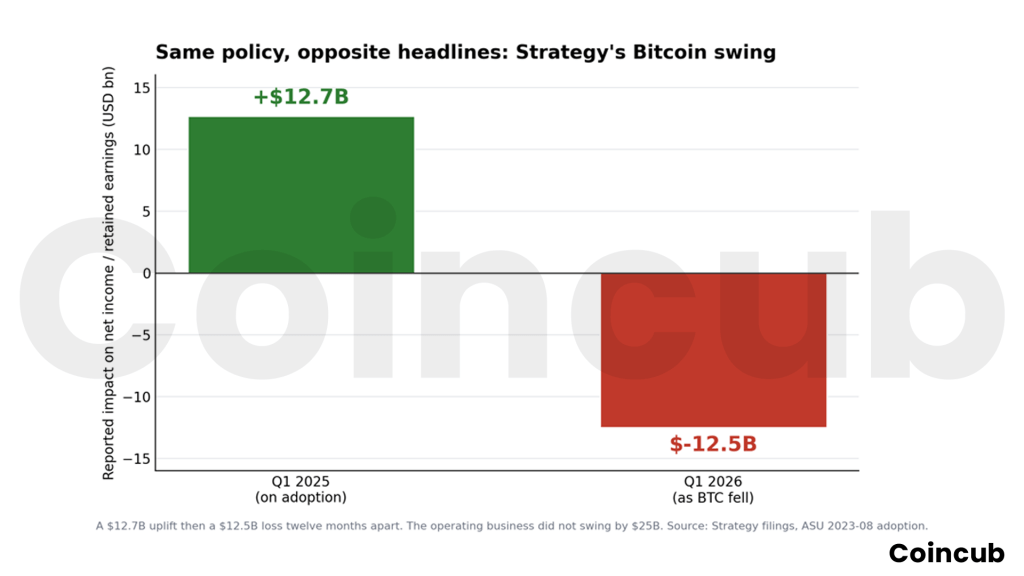
Any board considering this decision should look at both numbers together, not one in isolation. This guide covers the accounting treatment, the disclosure obligations, the governance requirements, the custody and legal structure questions, and the failure modes that have actually caused problems. It is general information rather than legal, tax or accounting advice, and every point here needs review by your own advisers against your specific facts.
The Accounting Rule That Changed Everything
ASU 2023-08, formally titled Intangibles, Goodwill and Other, Crypto Assets, Subtopic 350-60, was issued on 13 December 2023. It became mandatory for fiscal years beginning after 15 December 2024, with early adoption permitted. To appreciate why it mattered so much, you have to understand what it replaced.

The Old Model and Why It Misled
Under the previous treatment, Bitcoin was an indefinite lived intangible asset subject to cost less impairment. If the price fell below cost at any point during a period, the company recorded an impairment charge, and if the price later recovered, the company could not reverse it. Holdings were carried at the lowest price touched since acquisition, permanently. The result was systematically misleading financial statements. A company that bought Bitcoin at $30,000, watched it dip to $16,000, then saw it recover to $60,000, still carried the asset at $16,000. The balance sheet understated economic reality by a wide margin, and no mechanism existed to correct it.
What Fair Value Changed
ASU 2023-08 swept that model away and installed fair value measurement in its place. In scope crypto assets remain classified as intangible assets on the balance sheet, but they are now measured at fair value each reporting period, with changes in value flowing directly through net income. The table below shows the before and after at a glance.
| Feature | Before ASU 2023-08 | Under ASU 2023-08 |
| Measurement basis | Cost less impairment | Fair value each reporting period |
| Price increases | Never recognised until sale | Recognised in net income |
| Price decreases | Recognised, never reversible | Recognised, reversible in later periods |
| Balance sheet classification | Intangible asset | Intangible asset, separately presented |
| Earnings volatility | Downside only | Both directions, quarter to quarter |
| Disclosure detail | Limited | Name, cost basis, fair value, units held, plus rollforward |
| Transition method | Not applicable | Modified retrospective, cumulative adjustment to retained earnings |
What This Means for Your Income Statement
This is the part boards consistently underestimate, so it deserves emphasis. Fair value through net income means your reported earnings now move with the Bitcoin price. Not your cash flow, and not your operating performance, but your headline net income, the very number analysts quote and covenants sometimes reference. A quiet quarter for your business can now produce a dramatic quarter for your earnings, purely because of an asset you never intended to sell.
Four Consequences to Work Through First
Your finance team should walk through four consequences before any purchase.
First, earnings guidance becomes harder, because any forecast of net income now contains an implicit Bitcoin price forecast, which is why most companies guide on operating metrics and disclose the crypto position separately.
Second, debt covenants need review, since covenants tied to net income, EBITDA definitions or asset coverage ratios may behave unexpectedly, so read the actual covenant language before purchase rather than after a bad quarter.
Third, performance based compensation may distort, because incentives referencing net income or earnings per share can generate large payouts or shortfalls unrelated to management performance, so adjust the plan definitions in advance.
Fourth, analyst communication requires preparation, and the companies that handle it well report an adjusted figure excluding crypto fair value movements alongside GAAP results, using consistent methodology from the first quarter onward.
Disclosure Obligations for Putting Bitcoin on Balance Sheets
The standard introduced enhanced disclosure requirements that reach well beyond a single balance sheet line. For each significant crypto asset holding, you must report the name of the asset, the cost basis, the fair value and the number of units held. On top of that, you must present a rollforward showing additions, dispositions and fair value changes across the period, and adoption uses the modified retrospective method with a cumulative adjustment to retained earnings recorded at the start of the adoption period.
Two practical points follow, and both catch companies out. The rollforward requirement means your systems must track lot level data from the very first purchase, and retrofitting that later is painful and error prone. Separately, disclosing units held publicly reveals your position size to anyone who reads your filings, which carries security implications worth discussing with your risk team before, not after, the information becomes public.
Scope: What the Standard Covers and What It Does Not
ASU 2023-08 does not apply to every digital asset, and assuming it does is a subtle error. In scope assets must meet defined criteria, which broadly cover fungible, cryptographically secured assets on a distributed ledger that do not give the holder enforceable rights to underlying goods, services or other assets. Bitcoin comfortably meets those criteria.
Where Two Models Can Collide
Several categories fall outside the standard, however, including non fungible tokens, certain wrapped tokens, and assets issued by the reporting entity itself, all of which fall back to other guidance, often the older impairment model. The practical warning is to check scope before assuming treatment. A treasury holding Bitcoin plus a smaller position in a token that sits outside scope may end up applying two different measurement models at the same time, which is a genuine operational burden your accounting function should anticipate rather than discover.
Governance: The Board Process
The accounting, once understood, is the easy part. Governance is where this decision actually succeeds or fails, and it is where directors carry personal responsibility. A disciplined process protects both the company and the board, largely regardless of where the Bitcoin price ends up.
Five elements matter most.
- Board authorisation should come with explicit limits, specifying the maximum allocation as a percentage of treasury assets, the assets permitted, the custody arrangements required and the authority levels for execution, because open ended authorisation is a governance failure regardless of outcome.
- A written investment policy should state the purpose of the allocation, the target size, rebalancing rules and the conditions that would trigger a sale, and those sale conditions must be written while the position is comfortable, since they are impossible to write objectively during a drawdown.
- Documented rationale matters because directors owe fiduciary duties and the standard of review generally focuses on process rather than outcome, so the minute book should show what was considered, what advice was received and what alternatives were rejected.
- A liquidity analysis should establish what portion of treasury must remain available under stress and ensure the crypto allocation sits outside it, because a company forced to sell Bitcoin at a 50% drawdown to make payroll has made an operational error rather than an investment one.
- Finally, an ongoing review cadence, quarterly at minimum, should include a defined escalation path if the position exceeds policy limits through price appreciation.
The Decision Framework for Putting Bitcoin on the Balance Sheet
All of the above resolves into a sequence, and the order matters because several later steps are wasted effort if an earlier one fails. The figure below maps the path a board should follow before approving any allocation.
| Step | Question | What must be true to proceed | If the answer is no |
| 1 | Do we have surplus capital beyond operating and reserve needs? | Twelve to twenty four months of operating liquidity is secured elsewhere | Stop. This is not surplus capital. |
| 2 | Can our shareholders tolerate earnings volatility? | Board and major holders understand fair value swings hit net income | Stop or reduce size materially. |
| 3 | Do our debt covenants survive a 50% drawdown? | Covenant modelling completed at multiple price scenarios | Renegotiate before purchasing. |
| 4 | Is qualified custody available and insured? | Regulated custodian engaged, insurance terms reviewed | Stop. Self custody at corporate scale is a specialist function. |
| 5 | Can our systems produce lot level rollforward data? | Sub ledger tooling in place before the first purchase | Fix systems first. |
| 6 | Is the written policy approved and the rationale minuted? | Board resolution, limits, sale triggers and advice all documented | Complete governance before execution. |
Custody, Legal Structure and Tax
With governance in place, the operational questions come next, and each carries traps that only surface under stress. Custody, structure and tax should all be settled before the first purchase rather than improvised afterward.
Custody
For most corporates, a regulated qualified custodian is the practical answer. Self custody at corporate scale demands key ceremony procedures, multi signature arrangements, geographic key distribution, documented succession and regular audit, and companies that treat this casually eventually discover why banks employ vault procedures. Review your custody agreement for the terms that matter under stress, namely whether assets are segregated or commingled, what happens in custodian insolvency, what the insurance actually covers, and what the withdrawal process looks like during high volatility. That last point has caught out more firms than the first three combined.
Legal Structure and Tax
On structure, holding directly on the operating company balance sheet is simplest and most transparent, whereas a separate subsidiary can ring fence risk and simplify some reporting at the cost of complexity and potential tax consequences on transfer. Decide this before purchase, since restructuring afterwards can trigger taxable events.
On tax itself, fair value accounting for financial reporting does not necessarily align with tax treatment, and in many jurisdictions tax is triggered on disposal rather than on unrealised movements, creating book to tax differences that must be tracked, along with potentially substantial deferred tax positions on unrealised gains. This is jurisdiction specific and needs local advice. Insurance rounds out the list, because directors and officers policies may contain exclusions relevant to digital asset decisions, so review the policy language before the decision rather than after a shareholder complaint.
Failure Modes Worth Studying
Finally, learn from the mistakes others have already made, because they are remarkably consistent. Understanding these failure modes is often more useful than any argument in favour of the allocation.
The Five Recurring Mistakes
The first mistake is buying with borrowed money, since leverage converts a volatile asset into a solvency risk, and companies that funded Bitcoin purchases with debt discovered that mark to market losses and repayment obligations arrive together at the worst possible moment.
The second is treating the allocation as a strategy, where companies with weak core businesses adopted Bitcoin treasuries as a market narrative and, when the price fell, were left with both the original weak business and a large loss.
The third is inadequate systems, because companies that bought before establishing lot level tracking found the disclosure requirements extremely difficult to satisfy retrospectively, and auditors will ask for the rollforward.
The fourth is having no exit conditions, since without predefined sale triggers the decision to sell becomes an emotional judgement made under pressure, usually near the bottom.
The fifth is underestimating security disclosure, because publishing exact unit holdings as the standard requires tells the world how much you hold, so that disclosure must be coordinated with your physical and information security planning.
Where This Stands in Mid 2026
Step back and the overall picture is one of maturity. The accounting framework is settled and workable, the disclosure regime is demanding but clear, custody infrastructure is mature, and the institutional base is substantial, with 188 entities holding around 9% of Bitcoin’s total supply as of June 2026. The scaffolding for a corporate Bitcoin allocation now exists in a way it simply did not a few years ago.
The Lesson the Drawdown Taught
What the current market has demonstrated, through the drawdown from $126,000 in October 2025 to roughly $60,000 in July 2026, is that fair value accounting reports downside as loudly as it reports upside. Companies that adopted the standard during the appreciation phase and celebrated the retained earnings uplift are now reporting the reverse, and that is the standard working correctly rather than failing. It is also the single most important thing for a board to internalise before approving an allocation. If your organisation cannot comfortably report a large negative quarter caused entirely by a price movement in an asset you did not intend to sell, then the allocation is too large or the decision is premature. Everything else in this guide is detail. That test is the heart of it.
Frequently Asked Questions (FAQ)
How is Bitcoin accounted for on a corporate balance sheet in 2026? +
Under ASU 2023-08, Bitcoin is classified as an intangible asset but measured at fair value each reporting period, with gains and losses recognised in net income.
When did ASU 2023-08 take effect? +
It was issued on 13 December 2023 and became mandatory for fiscal years beginning after 15 December 2024, with early adoption permitted.
What must companies disclose about crypto holdings? +
For each significant holding: name, cost basis, fair value and units held, plus a rollforward of additions, dispositions and fair value changes.
Does fair value accounting affect debt covenants? +
It can. Covenants referencing net income, EBITDA or asset coverage may be affected by fair value swings, so review covenant language and model multiple price scenarios before purchasing.
How many companies hold Bitcoin on their balance sheet? +
As of June 2026, 188 entities including public companies and governments held approximately 1,893,116 BTC, around 9% of total supply.
Should a company self custody or use a custodian? +
Most corporates use a regulated qualified custodian. Self custody at corporate scale requires specialist key management, documented procedures and audit capability that few finance teams possess internally.