


 Buy a Licensed Company
  Explore VASP Data
  Talk to an Expert

 Dren Hima
 is Head of Research at Coincub, leading research across digital asset regulation, licensing, market structure, tokenization and institutional adoption.
Dren Hima
Dren Hima is Head of Research at Coincub, leading research across digital asset regulation, licensing, market structure, tokenization and institutional adoption.
Saylor’s Bitcoin Strategy: Is Strategy’s Corporate Treasury Safe?

- Strategy is more than a simple Bitcoin proxy. It’s a leveraged corporate treasury vehicle that uses equity issuance, convertible notes, and preferred stock to accumulate Bitcoin, with all the complexity that entails.
- The immediate fear of margin calls is overstated. Strategy holds Bitcoin outright, and its debt is mostly unsecured, with maturities staggered through 2032. Daily price swings don’t trigger collateral demands.
- The biggest risk is reflexivity. If MSTR loses its premium to NAV, the capital-raising engine weakens, and dilution risk climbs sharply.
- STRC improves flexibility but adds fixed obligations. Perpetual preferred stock removes maturity pressure but creates ongoing dividend obligations that must be serviced.
- The model is resilient. It may be structurally stronger than critics claim, but it depends heavily on equity market confidence and Bitcoin’s long-run performance.
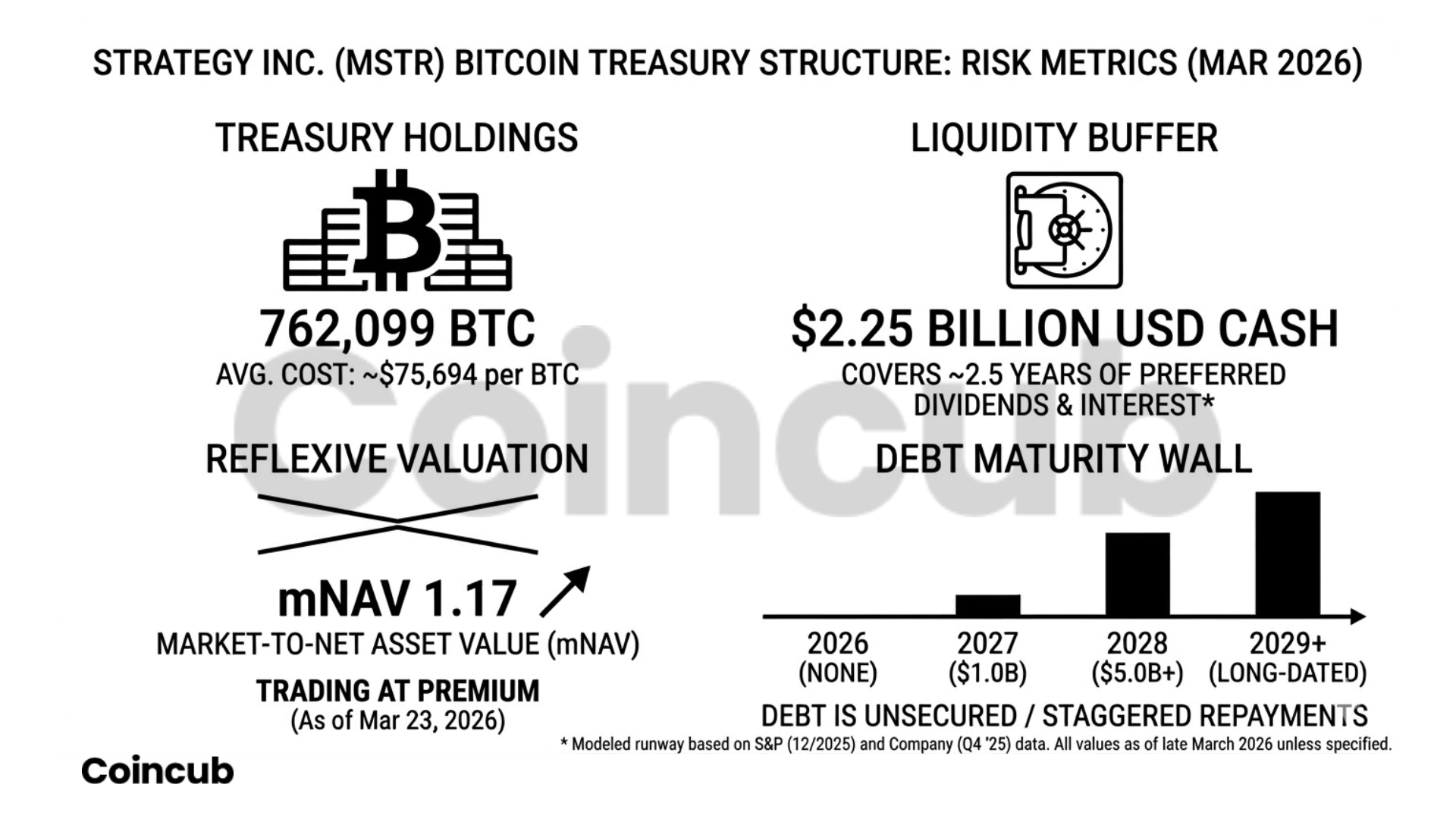
The idea of putting Bitcoin on a corporate balance sheet has gone from fringe experiment to serious institutional conversation in a few short years. Nobody has pushed that conversation further than Michael Saylor. Strategy Inc., which started life as an enterprise software company, has effectively reinvented itself as what Saylor calls a Digital Asset Treasury Company. By late March 2026, it held 762,099 Bitcoin acquired at an average cost of roughly $75,694 per coin. That’s about 3.6% of Bitcoin’s entire 21 million supply, with a market value of about $54-$57 billion.
For institutional investors and corporate governance boards, the core question is pretty direct. Does this model actually preserve corporate wealth, or is it a highly engineered bet dressed up as treasury management?
Strategy has built something genuinely resilient in certain ways, but resilient and safe are different things. That distinction is very important here.

The Macro Backdrop
To understand why Strategy’s equity has attracted serious institutional capital, you need to understand the environment in which it’s operating. Global markets in 2026 are navigating sticky inflation, uncertain central bank timelines, and equity markets heavily concentrated in a handful of tech names.
J.P. Morgan Global Research put a 35% probability on a U.S. and global recession in 2026. AllianceBernstein’s Strategic Investment Outlook for 2026 makes the case that, while the AI capex wave remains a dominant market force, there’s a legitimate macro argument for allocating to non-fiat assets like gold, silver, and cryptocurrency as a form of long-term purchasing power protection.
That said, there’s a meaningful leap between “Bitcoin makes sense as a non-fiat diversifier” and “a leveraged corporate treasury vehicle is the right way to get that exposure.” The former is a macro argument with real merit. The latter introduces structural risks that the underlying asset doesn’t carry on its own. Keeping those two things separate means a lot when you’re evaluating Strategy.
How the Capital Engine Works
Strategy’s entire model is built on a reflexive loop that performs well in bull conditions. Understanding it precisely is important because of what those mechanics imply when conditions reverse.
When Strategy’s stock trades at a premium to its Net Asset Value (the actual market value of the Bitcoin it holds), the company can issue new shares at that premium and immediately deploy the proceeds to buy more Bitcoin. Because new equity gets sold above the spot price of the underlying asset, the total Bitcoin held per share actually increases. Strategy tracks this as “BTC Yield,” their internal metric for demonstrating that dilution is ultimately accretive when executed from a premium position.
In late March 2026, the multiple, measured as mNAV, sat around 1.17. The company has also laid out the “42/42” plan: $42 billion in capital raises, split between $21 billion in equity and $21 billion in fixed-income securities over three years, targeting one million Bitcoin by the end of 2026.
On the debt side, the company has historically used unsecured convertible senior notes with blended effective interest rates that have sometimes come in below 1%. The idea is to capture the spread between the cost of borrowing in fiat and the anticipated long-run appreciation of Bitcoin.
The STRC Instrument
The most recent evolution in Strategy’s capital structure is STRC, its Variable Rate Series A Perpetual Stretch Preferred Stock. Saylor’s team calls it “Digital Credit,” and it addresses a specific structural vulnerability: refinancing risk on a growing pile of debt.
STRC is a perpetual preferred instrument with no maturity date. That eliminates the refinancing wall that traditional corporate bonds create. For March 2026, the company set STRC’s annualized dividend rate at 11.5%, high enough to attract income-focused institutional investors who wouldn’t otherwise touch a Bitcoin-adjacent equity. Within a single week in mid-March 2026, the company deployed $1.2 billion raised through STRC-linked offerings directly into Bitcoin purchases.
The tradeoff is a heavy fixed dividend obligation. Issuing STRC doesn’t immediately dilute common shareholders the way stock issuance does, but it creates ongoing financial obligations that must be serviced regardless of Bitcoin’s price.
To handle this, Strategy established a $2.25 billion U.S. dollar cash reserve, enough to cover roughly 2.5 years of dividend and interest payments without touching the Bitcoin treasury. That buffer is deliberate and specifically designed to prevent forced asset sales during market stress.
The Forced Liquidation Question
The most common anxiety around Strategy is the margin-call scenario: Bitcoin crashes, the company faces collateral demands, and it has to dump billions of BTC into a falling market. The mechanics here are frequently misrepresented, so it’s worth being precise.
Strategy’s debt consists primarily of unsecured convertible notes and perpetual preferred equity. The Bitcoin is held outright. It’s not posted as collateral in DeFi protocols and not pledged against prime brokerage lines where daily mark-to-market fluctuations trigger top-up demands. Creditors have no legal mechanism to demand more collateral because Bitcoin dropped 20% last Tuesday.
The nearest significant debt maturities, beyond near-term coupon payments, are in September 2027, with obligations staggered through 2032. The acute “someone pulls the rug tomorrow” version of the margin call narrative simply doesn’t hold up.
The Real Risk: Death by Dilution
“Not easily margin-called” doesn’t mean safe. Strategy’s model has a vulnerability that’s subtler than a dramatic forced liquidation and, in some ways, more dangerous because it can unfold gradually.
The whole strategy depends on MSTR equity maintaining a premium to NAV. When that premium exists, every capital raise is accretive. When it compresses, the machine starts working in reverse.
Strategy’s software business generated $123 million in revenue in Q4 2025, up 1.9% year-over-year. That revenue base can’t independently service the company’s debt obligations or fund acquisitions at scale. In Q4 2025, the company posted a $12.6 billion net loss, almost entirely driven by downward mark-to-market adjustments on Bitcoin under the new FASB fair value accounting rules. Paper loss, not cash loss, but a clear illustration of the earnings volatility this model creates.
The danger emerges if a prolonged crypto downturn pushes the mNAV below 1.0. At that point, the company might be forced to issue common equity at a discount to NAV just to service preferred dividends or refinance debt coming due between 2027 and 2032. Shareholder value deteriorates without a single Bitcoin being sold. Dilution accumulates. Dividends drag on returns. The mechanism that made the model work becomes the mechanism working against it.
Regulatory and Accounting Developments
MSCI: A Near Miss
In late 2025, MSCI proposed excluding Digital Asset Treasury Companies (entities that hold 50% or more of their total assets in digital currencies) from its Global Investable Market Indexes. The implication was significant: passive funds tracking those benchmarks would have been forced to sell Strategy, potentially triggering systematic billions in capital outflows.
On January 6, 2026, MSCI announced it wouldn’t proceed with the exclusion for the February 2026 index review. They determined that distinguishing between operating businesses that hold non-traditional assets and pure passive investment vehicles required further research and launched a broader consultation instead.
Strategy stayed in the index. But the episode made clear that the institutional classification debate around Bitcoin treasury companies isn’t settled, and a different outcome next time remains possible.
FASB’s Fair Value Accounting Shift
FASB’s Accounting Standards Update 2023-08, effective for fiscal years beginning after December 15, 2024, changed how Bitcoin holdings get reported materially. Previously, companies treated crypto as an indefinite-lived intangible asset: they recorded impairment when prices dropped but were unable to recognize gains until the asset was sold. That asymmetric treatment penalized holders.
Under the new rules, both unrealized gains and losses flow directly through net income based on current spot prices. More economically accurate. Also means earnings statements will look dramatic during both bull runs and downturns, as Strategy’s Q4 2025 results demonstrated.
S&P’s Credit Assessment
In late 2025, S&P Global Ratings assigned Strategy a B- Issuer Credit Rating with a stable outlook. B- sits firmly in speculative-grade territory. S&P explicitly flagged the vulnerabilities: extreme asset concentration, low organic dollar liquidity generation, and a currency mismatch between long Bitcoin positions and short U.S. dollar-denominated debt obligations. The stable outlook reflected confidence in near-term debt management, specifically citing the $2.25 billion cash reserve as a credit positive.
Direct Bitcoin vs. the MSTR Wrapper
For corporate boards and institutional allocators, this distinction is practically relevant.
Holding spot Bitcoin directly through cold storage or a regulated ETF eliminates corporate counterparty risk. No management team, no leveraged bets, no preferred dividend obligations, no equity dilution mechanics. You own the asset.
Investing in MSTR adds leverage, management risk, and premium volatility on top of Bitcoin’s already significant volatility. From August 2020 to August 2025, MSTR delivered annualized returns of roughly 100.5% compared to Bitcoin’s 59.2%. But MSTR’s annualized volatility was about 114%, compared with Bitcoin’s 65.6%. During bear markets, MSTR has historically suffered deeper drawdowns than Bitcoin itself, sometimes exceeding 80%. More upside, more downside, more complexity.
MSTR amplifies Bitcoin’s price movements through financial engineering. If that’s what you want, that’s exactly what you get.
The Bottom Line
Strategy has built something more resilient against acute market stress than critics typically acknowledge. Bitcoin isn’t collateralized. Debt maturities are staggered. The cash reserve is substantial. The company survived inside MSCI’s indexes. These aren’t trivial achievements.
None of that adds up to traditional safety, though. The model runs on equity market confidence. It requires MSTR trading at a premium to NAV. It needs ongoing access to capital markets to service debt and preferred dividends without liquidating the treasury. A sustained bear market that compresses the mNAV doesn’t trigger a dramatic margin call; it triggers a slow dilution spiral that’s less cinematic but potentially just as destructive.
Strategy has engineered a machine for maximizing Bitcoin accumulation through financial leverage. That machine is optimized. It consciously trades the security of an unleveraged balance sheet for the amplified risk-return profile of digital-asset exposure wrapped in a corporate structure. Whether that tradeoff makes sense depends entirely on your time horizon, risk tolerance, and conviction on Bitcoin’s long-term trajectory.
Frequently Asked Questions (FAQ)
What is Strategy’s Bitcoin treasury model?
The company raises capital through stock issuance, convertible debt, and preferred equity, then deploys that capital to buy Bitcoin.
Does Strategy own its Bitcoin directly?
Yes. The company holds spot Bitcoin outright rather than using synthetic exposure through derivatives or pledging it as collateral.
Is Strategy at risk of a margin call if Bitcoin crashes?
Not in the typical sense. Its Bitcoin isn’t posted as collateral for day-to-day margin maintenance, as it would be in a leveraged trading account.
What is the main risk in Saylor’s strategy?
Death by dilution: if the stock loses its premium to NAV, and the company has to raise capital on unfavorable terms to service its obligations.
What is BTC Yield?
Strategy’s internal metric for measuring whether Bitcoin holdings are increasing faster than share dilution on a per-share basis.
What is STRC, and why does it matter?
STRC is Strategy’s perpetual preferred stock. It lets the company raise capital without immediate common-share dilution, but it creates ongoing fixed dividend obligations.
Why does the premium to NAV matter so much?
Because the strategy is most accretive when Strategy can issue stock at a price above the value of the Bitcoin backing it. That’s what makes each capital raise additive rather than dilutive.
How did FASB accounting changes affect Bitcoin treasury companies?
Updated rules moved qualifying crypto assets to fair value accounting, improving transparency but making earnings statements significantly more volatile.
Did MSCI remove Strategy from its indexes?
No. MSCI chose not to exclude digital asset treasury companies in early 2026, though the classification debate remains open and unresolved.
Is Strategy safer than holding Bitcoin directly?
No. Direct Bitcoin exposure avoids corporate leverage, management risk, and dilution. Strategy layers all of those on top of Bitcoin’s existing volatility.