Buy a Licensed Company
  Explore VASP Data
  Talk to an Expert


Bitcoin Prediction Markets: The Price Isn’t the Forecast

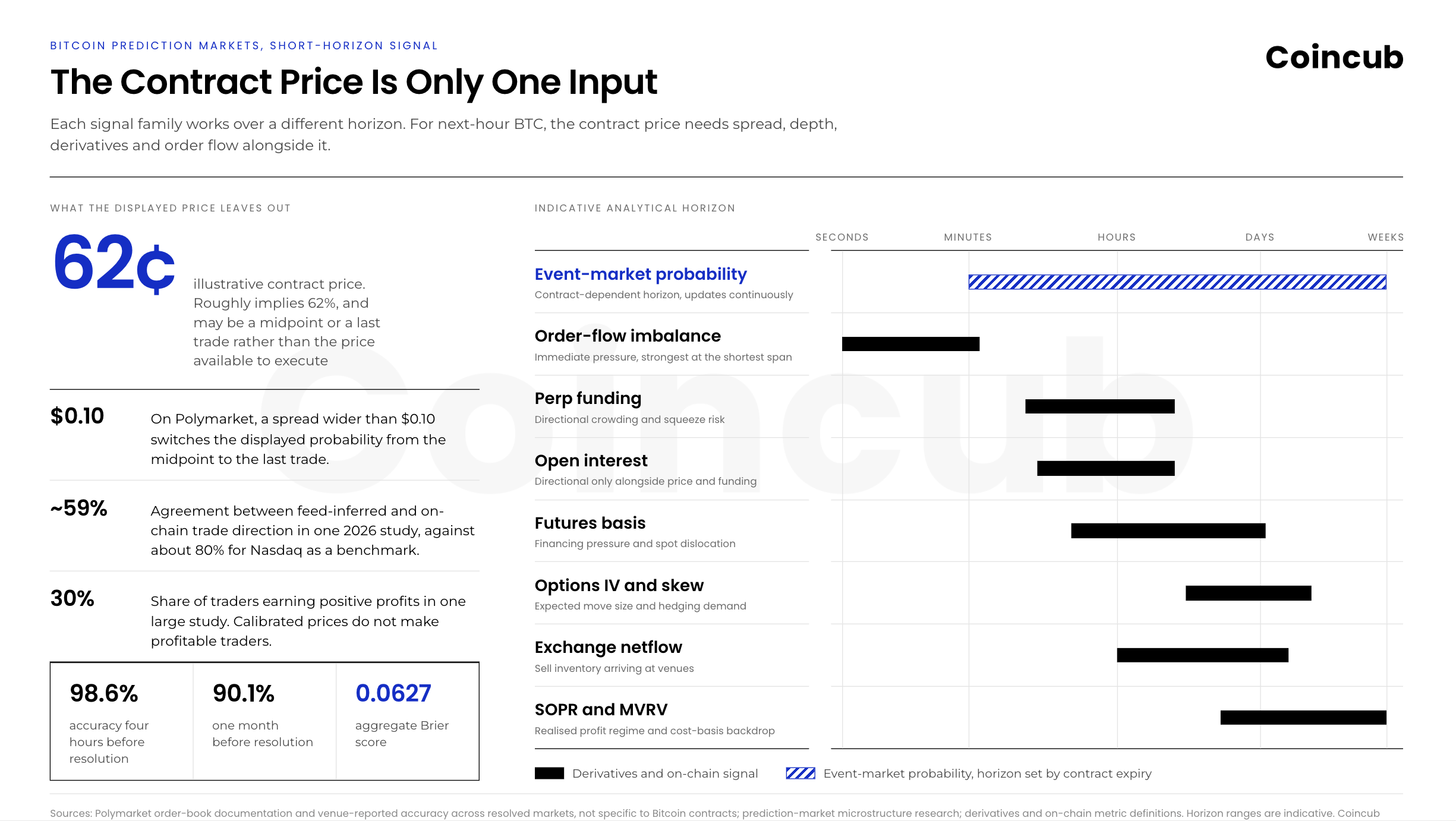
- The contract price is a weak standalone BTC forecast. Polymarket itself switches its displayed probability from the midpoint to the last trade once the spread crosses $0.10, so a print can be genuine consensus or just the last taker’s fill, and the number alone won’t tell you which.
- “Polymarket” is now two legally distinct venues, the independent non-CFTC international platform and the CFTC-regulated Polymarket US under QCX LLC, with different liquidity, rules, and compliance. Analyzing them as one contaminates any cross-venue read.
- The sharpest short-horizon BTC signal lives in the derivatives and on-chain layers around the event market, meaning perp funding, futures basis, open interest, DVOL and skew, and exchange netflow, with order-flow imbalance dominating at the minute scale.
- Accuracy is real but conditional. Polymarket reports 98.6% accuracy four hours out and a 0.0627 Brier, yet errors cluster early in a contract’s life and near resolution, and only about 30% of traders turn a profit.
- Settlement and question design decide whether a price reflects Bitcoin beliefs or resolution ambiguity. Benchmark-averaged settlement like Kalshi’s 60-second CF Benchmarks read resists single-tick manipulation far better than a lone print.
The number you see on a Bitcoin prediction market is the easiest thing to read and the least useful thing to trade on. A binary contract sitting at 62 cents looks like a 62% probability, and for a clean, well-specified, liquid question it roughly is. But that print hides the spread that produced it, the depth behind it, the fee you pay to touch it, and the difference between what the crowd believes and what the last desperate taker paid. Anyone forecasting short-horizon BTC off that single number is reading the label and skipping the ingredients.
The interesting story in this space is the gap between how prediction markets are marketed and what they deliver for Bitcoin. They are sold as crowd-sourced probability machines, and for the questions they are built for they earn that reputation. For short-term BTC, though, the sharpest information does not live in a dedicated event market at all. It lives in perpetual funding, futures basis, options-implied volatility, order-flow imbalance, and a handful of on-chain state variables, and the event market is at best one feature sitting on top of that stack. Treating the contract price as the forecast is the single most common mistake a competent analyst makes here, and it is worth understanding exactly why.

The stack changed, and “Polymarket” is now two different animals
By mid-2026 the venue landscape stopped being a list of websites and became a layered stack. There are trading venues, there are settlement and oracle layers underneath them, and there are adjacent derivatives surfaces whose prices you can transform into event probabilities. Confusing the layers is how people end up citing a thin market print as gospel.
Kalshi remains the strongest regulated U.S. venue for BTC event contracts, and its crypto settlement design tells you a lot about what institutional-grade resolution looks like. Kalshi settles its crypto contracts to a 60-second average of the relevant CF Benchmarks Real-Time Index, sampling one price per second over the final minute and averaging prints aggregated from multiple spot exchanges. That averaging is deliberate, because it makes a single-venue spoof in the closing seconds far less able to swing the payout, and it is the kind of design an analyst should look for before trusting any BTC contract’s settlement.
Polymarket is where most people’s mental model is now out of date, because it split into two legally distinct footprints that share a brand and almost nothing else. There is the international platform, which operates independently and states plainly that it is not CFTC-regulated, and there is Polymarket US, which came out of the firm’s $112 million acquisition of the CFTC-licensed exchange and clearinghouse QCEX and now runs as a regulated designated contract market under QCX LLC after the CFTC’s amended order of designation in late 2025. The two venues carry different liquidity, different contract rules, different APIs, and completely different compliance posture, and the separate Panama-registered entity behind the international side is its own live question. Anyone building a cross-venue BTC probability view has to keep them apart, because folding them together contaminates whatever you are measuring.
PredictIt is the venue whose constraints most practitioners still remember wrong, and while it will never carry a BTC contract it is worth correcting the record because it shows how much regulation shapes what a market can even do. The CFTC’s July 14, 2025 no-action amendment eliminated the old 5,000-trader-per-contract cap and replaced the $850 investment limit with the FECA individual campaign-contribution limit, stated in the letter as $3,500 and indexed from there, while transferring operation to a research consortium. PredictIt stays restricted to political events, so it is a contrast case rather than a BTC venue, but the lesson generalizes, because caps on traders and capital directly limit how much conviction a price can express, and a market with tight caps cannot be read the same way as one without them.
Underneath the retail-facing venues sit the decentralized oracle layers, and this is where “the market resolved wrong” usually turns out to mean “the question was badly built.” Omen runs on Gnosis conditional tokens and resolves through Reality.eth, where reporters post bonds on an answer and a challenger has to at least double the standing bond to overturn it, with Kleros available as an arbitrator of last resort. Augur took the harder line and made Invalid its own tradable outcome, backed by REP staking, dispute rounds, and a fork as the final backstop. Those bond-escalation and token-incentive systems are a different species from the official-source averaging Kalshi or CME use, and each has a distinct failure mode you have to price in.
Then there are the venues that are not event-prediction markets at all and yet carry more usable BTC information than most of them. Deribit and CME sell futures, perps, and options, and their prices are state prices on volatility, basis, funding, and term structure. Deribit lets you quote options directly in implied volatility and publishes DVOL, a 30-day forward-looking volatility gauge built from the options smile, and CME settles its bitcoin contracts to a regulated reference rate while offering short-dated weekly options built for exactly the event windows short-horizon forecasters care about. For minutes-to-hours BTC inference, these surfaces are the main course, and the binary threshold market is a garnish.
| Venue or layer | Status by mid-2026 | Mechanism | Settlement / oracle | Role in BTC forecasting |
| Kalshi | CFTC-designated contract market | Central orderbook | 60-second CF Benchmarks RTI average | Strongest regulated U.S. BTC event venue |
| Polymarket International | Independent | Off-chain CLOB, on-chain settlement | Platform oracle stack | Deepest crypto-native event liquidity |
| Polymarket US (QCX LLC) | CFTC-regulated DCM | Central orderbook | $1 / $0, regulated clearing | Regulated U.S. access and reporting |
| Omen | Decentralized, active | AMM / FPMM | Reality.eth bonds, Kleros arbitration | Case study in AMM pricing and oracle risk |
| Augur | Foundational, reboot phase | Orderbook + REP oracle | REP reporting, dispute, fork | Conceptual |
| Deribit / CME | Adjacent derivatives | Orderbook derivatives | Exchange index / delivery rules | Highest-density short-horizon BTC signal |
Why the quoted price lies to you
The price on screen is a starting point, and the tradable price is the thing you forecast and trade against. Polymarket is unusually honest about this in its own documentation, which states that the displayed probability is the midpoint of the best bid and best ask, and that it reverts to the last traded price whenever the spread widens past $0.10 because a spread that wide means too few orders sit on the book to trust the midpoint. That single rule should reshape how you read any Polymarket BTC market, because a print during a wide-spread moment is whatever the last person happened to pay rather than a consensus of the book, and the two can sit far apart. Kalshi’s orderbook makes the same economic point in plainer language, showing the highest bid, the lowest ask, and resting size, so your fill depends entirely on whether you cross the spread or post and wait.
The gap between the feed and the truth turns out to be larger than most analysts assume, and there is now hard evidence for it. A microstructure study built from a tick-level archive of 30 billion Polymarket order-book events joined to the authoritative on-chain trade record found that trade direction inferred from the public feed agrees with on-chain ground truth on only about 59% of buckets, well below the roughly 80% that the standard Lee-Ready method achieves on Nasdaq. The same work documents a longshot spread premium, a depth profile flatter than top-of-book intuition suggests, and a self-counterparty wash share with a median near 1% and a tail reaching 22%, all of which bite hardest exactly where BTC threshold markets get most interesting, which is near expiry when liquidity thins and informed flow arrives in bursts. If your inference about who is buying comes from the feed rather than the chain, you can get the sign wrong, and that is a sobering result for anyone treating the price as clean signal.
AMM venues trade one problem for another. Omen’s Fixed Product Market Maker will always quote you a price as long as the pool is funded, which sounds like liquidity until you price in the convex slippage baked into the invariant. A larger order walks the curve and pays progressively worse, and the liquidity provider absorbing the other side carries real inventory risk if the pool tips before resolution. Continuous availability is not the same as a tight market, and on an AMM the word “liquidity” often means “guaranteed execution at a price that gets ugly with size.”
Fees are the last thing standing between an informationally correct market and an uneconomic one, and they are not a rounding error. Polymarket US publishes a transparent taker formula where the fee scales with p(1−p), which peaks at a 50/50 market and shrinks toward the extremes, while makers pay nothing and collect rebates. Kalshi charges on expected earnings and waives ordinary fees on resting limit orders to reward displayed liquidity, and Deribit runs a standard maker-taker schedule with separate delivery fees. The consequence for forecasting is direct, because a fee-adjusted midpoint and an effective fill price tell you what the market really implies once friction is paid, and the raw last-trade print does not.
What moves BTC over minutes to hours
Short-horizon BTC predictability concentrates in market microstructure and cross-market state variables, and the strongest professional workflows look like a signal stack rather than a single model reading a single price. The event-market probability is one input, and it is usually not the most informative one.
Perpetual funding is the first place to look, because funding rates are the periodic payments that keep a perp’s price tethered to the index, and they read directly as positioning. Persistently positive funding means longs are crowded and paying to stay in, negative funding means the opposite, and either extreme flags squeeze risk that a binary threshold market prices slowly. Basis carries the same information from the futures side, and CME sells the trade explicitly, marketing BTIC as a way to trade the bitcoin basis against the BRR benchmark so that futures-versus-spot dislocations become observable and tradable rather than inferred.
Open interest adds the second dimension, and on its own it says nothing directional, since open interest is just the count of live long and short positions. Combined with price and funding it starts to talk, because rising price with rising open interest and strongly positive funding is the signature of a crowded trend vulnerable to a flush, while falling price with rising open interest usually means shorts are building into weakness. Options then translate a vague “BTC will move” view into a distribution, which is why Deribit’s DVOL and the shape of the skew are worth more than a directional guess. Put-heavy skew reveals hedging demand and downside fear, call richness into an event window reveals chase dynamics, and both are forward-looking in a way that a lagging spot chart is not.
On-chain state fills in the slower-moving backdrop, and the value is in the definitions being precise rather than vibey. Glassnode defines MVRV as market value over realized value, a read on whether the aggregate market sits above or below cost basis, and SOPR as the realized profit-or-loss ratio of coins moved on-chain, where a value above one means coins are moving at a profit on average. CryptoQuant’s exchange netflow, the difference between coins flowing onto and off of exchanges, is the most operationally useful of the set for a short horizon, because sustained inflows warn of sell inventory arriving at venues while outflows and falling reserves support a scarcity read. None of these is a crystal ball, and used as state context around an event window they sharpen a forecast that price alone leaves blurry.
Order flow sits at the fastest end and tends to dominate everything slower when the horizon shrinks to minutes. Order-flow imbalance, trade sign, queue depletion, and spread dynamics carry more signal at that resolution than any macro series, though the same research that finds the edge is candid that leakage and trading costs erase a lot of naive backtest performance. The academic record here is genuinely mixed and worth reading honestly. Work like Jaquart and coauthors on intraday Bitcoin prediction finds recurrent neural networks and gradient-boosted classifiers do beat naive directional benchmarks over 1-to-60-minute horizons using technical, blockchain, sentiment, and cross-asset features, but the newer survey literature is far more skeptical about whether those edges survive across regimes once you account for realistic fees and latency. The defensible stance is an ensemble that combines the market-implied probability, a derivatives-implied distribution, a microstructure overlay, and a disciplined judgmental check, validated out-of-sample and attributed after the fact, rather than any one model treated as truth.
| Signal family | Native horizon | What it tells you |
| Event-market midpoint | Nowcast | Fee-aware crowd probability, only as good as the spread |
| Perp funding | Hours | Directional crowding and squeeze risk |
| Futures basis | Hours to days | Financing pressure and spot dislocation |
| Open interest | Hours | Position build, directional only with price and funding |
| Options IV and skew | Days | Expected move size and hedging demand |
| On-chain netflow, SOPR, MVRV | Days to weeks | Sell inventory, realized P/L regime, cost-basis backdrop |
| Order-flow imbalance | Seconds to minutes | Immediate pressure, highest signal at the shortest horizon |
The accuracy evidence, read without flattering anyone
The case for prediction markets is real, and it is domain-conditional in ways the marketing skips. Polymarket’s own public statistics report 98.6% accuracy four hours before resolution, 90.1% one month out, and an aggregate Brier score of 0.0627 across resolved markets, which is a strong venue-level record. Independent research on large Polymarket datasets broadly supports the calibration story while adding texture the accuracy page leaves out, with the Reichenbach and Walther study finding prices well-calibrated and slightly better than bookmaker odds, but also that only about 30% of traders earn positive profits, that skill persists for a small subset, and that markets overtrade the default or “Yes” side. Errors cluster early in a contract’s life and again close to resolution, which is precisely when a short-horizon BTC forecaster is most tempted to lean on the print.
The longer historical record points the same way and predates crypto entirely. The Iowa Electronic Markets research found that vote-share market forecasts beat contemporaneous polls 74% of the time across five U.S. presidential elections, with the market’s relative advantage growing the further out from the event you looked. That is a genuine and durable result, and it is also about political vote shares with deep liquidity and clean resolution, which is a very different animal from a thin BTC threshold market expiring on a Friday.
The skeptical case deserves equal weight, because calibration is not a fixed property of “prediction markets” as a category. It depends on what is being predicted, when you sample the price, and the mix of trade sizes behind it, and liquidity is not a monotone good, since older work showed that some more liquid markets calibrate worse when liquidity pulls in uninformed flow or amplifies favorite-longshot distortion. On decentralized venues the contamination multiplies through oracle design, fragmented liquidity, fee asymmetry, and front-end display conventions like the midpoint-versus-last-price switch, all of which pollute the naive reading that price equals truth.
For BTC specifically there is a gap in the public record worth stating rather than papering over. The published accuracy work is overwhelmingly venue-wide, and almost none of it isolates BTC threshold or range contracts as a category, while the platform materials that do exist focus on infrastructure, APIs, and reporting. The honest conclusion is that the evidence for forecasting BTC from adjacent market signals, meaning derivatives, order flow, and onchain state, is stronger and better documented than the evidence for forecasting BTC from dedicated event contracts alone. That is an inference from the shape of the available sources, and it is exactly the kind of thing a serious desk should verify against its own data rather than take on faith.
The risks that turn a good forecast into a bad trade
Manipulation and strategic flow are the first hazard, and benchmark averaging and dispute systems reduce it without removing it. The integrity story broadened in 2026 beyond narrow price manipulation to the misuse of nonpublic information, most visibly when a White House teleprompter operator came under CFTC investigation over roughly $90,000 in suspicious Kalshi trades that the exchange itself flagged and referred. That case is a useful reminder that people with advance sight of market-moving information are a live risk on regulated event platforms, and that surveillance now catches some of it.
Thin liquidity is the second hazard and the most mundane, because a wide spread and a shallow book make any single print close to meaningless. Polymarket’s own documentation tells users to estimate fill prices by walking the book, and its US glossary defines slippage and price impact as first-class concepts, which is a tacit admission that the headline number and the achievable number diverge. A report that cites a lone last-trade print as a standalone BTC forecast, without noting depth and spread, is not a forecast anyone should size against.
Oracle and contract failure is the third hazard, and it is usually self-inflicted through sloppy question design. Omen’s resolution rules spend real effort on invalid and ambiguous markets, and Augur built an entire tradable Invalid outcome and fork mechanism, because badly worded questions are a common failure mode rather than an edge case. For BTC this is mostly avoidable, since a price question can be pinned to a timestamp, a time zone, and a named benchmark. “Will Bitcoin pump tomorrow” is unresolvable noise, whereas “Will BTC/USD settle above 70,000 at 16:00 UTC on 2026-07-31 per CF Benchmarks” is a real contract, and the difference is entirely in the engineering.
Regulatory regime change is the fourth, and it is now a standing feature rather than a tail risk. The CFTC’s June 2026 proposed framework for public-interest review of prediction-market event contracts signals that the definitions of what may even be listed remain in active flux, and the recent history of Polymarket’s 2022 enforcement settlement, its later U.S. regulated entity, and PredictIt’s rewritten caps all show that venue architecture can shift under you after a regulatory event. Regulatory metadata is part of the signal, and a desk that ignores it will eventually be surprised by a rule rather than a price.
Building a BTC forecast that survives contact with execution
Start with question engineering, because everything downstream inherits its ambiguity. Pin the timestamp, the time zone, the price source, and the settlement method, and refuse relative dates and informal verbs like pump, crash, or moon, using Omen’s invalid-market rules as a checklist for what not to do. A well-specified question is the cheapest accuracy you will ever buy.
Extract the market with microstructure in mind rather than reading a single number. For any binary BTC threshold market, capture best bid, best ask, midpoint, displayed last price, tick size, visible depth at several levels, and the fee-adjusted cost to cross, and keep the venue’s regulatory perimeter attached to every figure. Archive the raw data locally as you go, because venue retention windows change and historical order-book detail disappears faster than research needs it to, which turns a live feed into an un-reproducible one if you did not save it.
Fuse features instead of forecasting off one market. A production BTC short-horizon report should carry the event-market midpoint probability, perp funding, cross-venue open interest, front-month basis, Deribit or CME implied volatility and skew, exchange inflow and outflow, a reserve trend, a SOPR or realized-profit read, and a macro calendar of Fed meetings, CPI, payrolls, and ETF headlines, with each feature tagged by its native horizon and whether it is structural, slow, or reactive. The point of the tagging is to stop a weekly on-chain signal from being read as if it settles a market expiring in an hour.
Publish probabilities with their diagnostics rather than a bare direction call. For a binary market, report the midpoint probability, the spread, the estimated market-order fill, and at least one independent model probability for contrast, and for a range market report the full discrete distribution rather than only the modal bucket. Score everything after the fact with Brier and calibration plots, and then again with slippage-adjusted profitability and turnover, because a venue-wide Brier score is informative while a desk-level decision metric is the one that pays rent. Predictive accuracy that cannot be filled is not a trading forecast, and the distinction is the whole job.
Where the evidence genuinely runs out
Four questions stay open, and pretending otherwise would be dishonest. The first is whether dedicated BTC event markets add any incremental forecasting power once you already condition on derivatives and on-chain state, because both classes are useful and a clean horse race between them barely exists in public. The second is how to correct for venue-specific frictions when turning contract prices into comparable probabilities, since Polymarket International, Polymarket US, Kalshi, and the AMM venues each embed different spread, fee, and execution conventions, and a defensible cross-venue BTC probability index is still methodologically thin. The third is oracle governance, where fixed-source benchmark settlement handles BTC price contracts cleanly but decentralized venues still lack strong mechanisms for subjective or edge-case events. The fourth is whether machine-learning edges survive fees, latency, and shrinking data-retention windows, because the newest microstructure work is finally careful about leakage and cost, and live desk-level replication remains scarce.
None of that invalidates Bitcoin prediction markets, and it does set the bar for using them well. The venue price is a measurement that needs context, the sharpest short-horizon BTC information sits in the derivatives and on-chain layers around it, and the analyst’s edge is in fusing those signals and scoring the result against real execution rather than admiring a number on a screen.
Frequently Asked Questions (FAQ)
Are Bitcoin prediction markets accurate? +
Venue-wide, yes and conditionally. Polymarket's public data shows high accuracy near resolution and a low Brier score, and independent work finds prices well-calibrated and slightly better than bookmaker odds, but errors concentrate early and near expiry, and almost none of the published accuracy work isolates BTC contracts specifically.
Should I trade BTC off the Polymarket price? +
Not off the raw print. Read the fee-adjusted midpoint, the spread, and the depth, remember the platform swaps to last-trade above a $0.10 spread, and treat the market as one feature in a stack rather than the forecast.
What's the difference between Polymarket International and Polymarket US? +
The international platform operates independently and states it is not CFTC-regulated, while Polymarket US runs as a CFTC-regulated designated contract market under QCX LLC after the QCEX acquisition. Different liquidity, rules, APIs, and legal perimeter.
What actually predicts BTC over short horizons? +
Perp funding and basis for positioning, open interest read alongside price and funding, options-implied volatility and skew for the expected move, exchange netflow and SOPR/MVRV for the on-chain backdrop, and order-flow imbalance at the fastest end.
Why is Kalshi's Bitcoin settlement harder to manipulate? +
It settles to a 60-second average of the CF Benchmarks Real-Time Index, sampled once per second from multiple exchanges, which blunts a single-venue spoof in the closing seconds.