



 Buy a Licensed Company
  Explore VASP Data
  Talk to an Expert

 Atis Shala
Atis is a senior analyst and community lead with four years of experience in crypto. He has a bachelor from the Rochester Institute of Technology.
Atis Shala
Atis is a senior analyst and community lead with four years of experience in crypto. He has a bachelor from the Rochester Institute of Technology.
Top Cryptocurrencies to Buy Before They Hit $1 Million Per Token
- A $1 million token price only makes sense when supply is low enough to support it. Market cap, not the sticker price, decides what is realistic.
- Bitcoin is the only major cryptocurrency with a serious mathematical path to $1 million per coin, mainly because of its 21 million coin supply cap.
- Coins with billions or trillions of tokens, such as XRP, Dogecoin, and Shiba Inu, would need market values far beyond the global economy to reach $1 million.
- A cheap token price does not mean a coin has more upside. A low price can hide a huge supply and already-stretched valuation.
- Before buying any cryptocurrency, check supply, market cap, use case, adoption, liquidity, and tokenomics instead of trusting million-dollar price predictions.
A $1 million price tag on a single coin sounds thrilling, yet the number that matters most sits one layer deeper: supply. The price of one token tells you very little on its own. The combination of price and circulating supply, known as market capitalization, decides whether a $1 million target stays anywhere near reality. Out of more than 17,000 coins on the market in 2026, only a tiny group with very limited supply sits close to that conversation, and Bitcoin leads it by a wide margin. This guide breaks down the math, reviews the cryptocurrencies people mention most in these predictions, and shows you how to study any coin with clear eyes before you spend a dollar.
What $1 Million Per Token Actually Requires
Every coin price flows from one simple formula:
Market capitalization = token price multiplied by circulating supply.

A $1 million price therefore depends almost entirely on how many tokens exist. Picture a project with 1 billion coins. At $1 million each, its total value would reach $1 quadrillion, which is roughly twice the wealth of the entire planet. That single example shows why supply rules this topic. A small supply keeps a high price within reach, while a massive supply pushes a $1 million target far past anything the global economy could fund.
So the smarter question becomes: which coins carry a supply small enough that a very high price stays mathematically possible? Once you frame it that way, the field of candidates shrinks fast.
The Million-Dollar Math: Why Supply Decides Everything
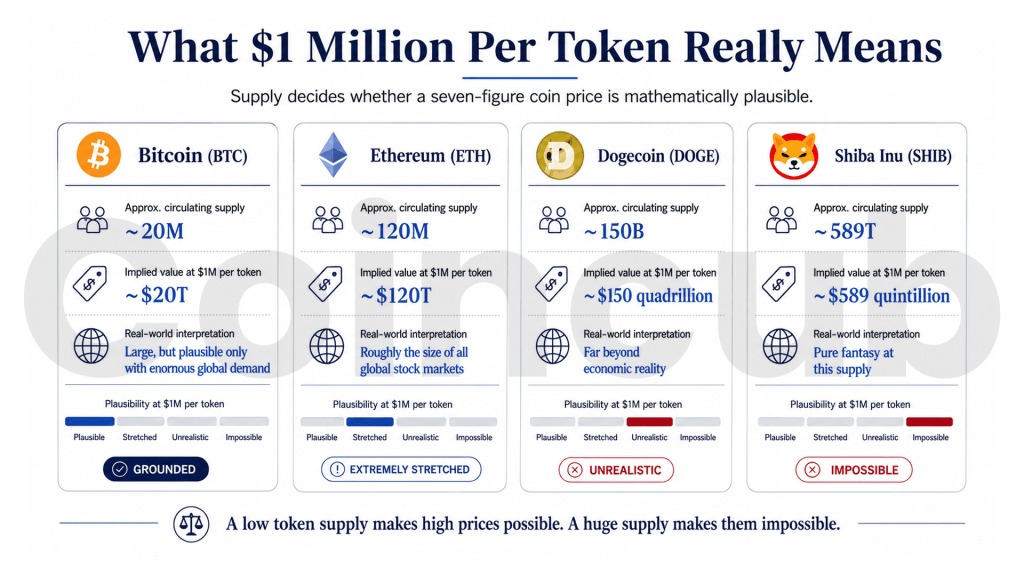
The table below shows what a $1 million price would mean for well-known cryptocurrencies, based on approximate circulating supply figures in 2026. For scale, the entire crypto market sits near $2.5 trillion, the US M2 money supply is around $22 trillion, global stock markets total roughly $120 trillion, and total global wealth hovers near $450 trillion.
| Cryptocurrency | Approx. circulating supply | Implied total value at $1M per token | Real-world comparison |
| Bitcoin (BTC) | ~20 million | ~$20 trillion | Close to the size of the US money supply |
| Ethereum (ETH) | ~120 million | ~$120 trillion | Roughly every stock market on Earth combined |
| BNB | ~140 million | ~$140 trillion | Larger than all public companies worldwide |
| Solana (SOL) | ~600 million | ~$600 trillion | Beyond total global wealth |
| XRP | ~60 billion | ~$60 quadrillion | Thousands of times all the money on Earth |
| Dogecoin (DOGE) | ~150 billion | ~$150 quadrillion | Far outside economic reality |
| Shiba Inu (SHIB) | ~589 trillion | ~$589 quintillion | Pure fantasy at this supply |
The pattern jumps off the page. The fewer the tokens, the more achievable a high price becomes. This is the single most useful idea for anyone scanning headlines about the “next million-dollar coin.” A low per-token price often hides an enormous supply, which means the room left to grow is already small.
Why the $1 Million Idea Spreads So Fast
The phrase travels well because it taps into a familiar feeling: the fear of missing the next Bitcoin or Ethereum. Early Bitcoin buyers turned tiny sums into fortunes, and that story repeats across social feeds every cycle. Marketers attach the million-dollar dream to cheap coins because the low price feels like easy upside. A coin trading at a fraction of a cent looks like it has endless space to climb, even when its supply makes a high price impossible. Understanding the supply trap protects you from the loudest and emptiest promises.
Cryptocurrencies People Mention in Million-Dollar Predictions
Several coins surface again and again in these conversations. Here is an honest look at each one, focused on supply, real-world use, and a realistic ceiling.
Bitcoin (BTC)
Bitcoin holds the strongest case by a wide margin. Its supply is capped at 21 million coins, and roughly 20 million already exist as of 2026. Several million more sit lost forever in forgotten wallets, which tightens the truly tradeable float even further. At $1 million per coin, Bitcoin would carry a market value near $20 trillion, close to the size of the entire US M2 money supply. Reaching that level would still demand enormous, steady demand from individuals, companies, and possibly governments over many years.
Bitcoin earns its place in the discussion through scarcity and adoption. Spot exchange-traded funds, corporate treasuries, and growing institutional interest pull from a shrinking pool of available coins. Several long-range forecasts from fund managers place Bitcoin in the hundreds of thousands of dollars over the coming decade, and a handful of bold voices point toward seven figures in the distant future. The hard cap keeps Bitcoin in the conversation while most other coins drop out.
Ethereum (ETH)
Ethereum powers a huge share of decentralized finance, stablecoins, and onchain applications. Its supply sits near 120 million coins, and a fee-burning mechanism slowly trims new issuance during busy periods. At $1 million per token, Ethereum would reach roughly $120 trillion, a figure close to the combined value of every stock market on Earth.
Strong adoption keeps Ethereum among the most valuable networks in the world. A seven-figure price, though, would require the planet to route a vast share of its wealth through one blockchain. Realistic long-term targets stay in the thousands, with the most optimistic models reaching low five figures. Ethereum remains a serious project with deep utility, yet the million-dollar label fits it poorly.
Lower-Supply Layer-1 Coins (Solana, BNB, and Peers)
Solana and BNB draw attention for speed, low fees, and active developer communities. Their supplies, in the hundreds of millions, push any $1 million target into territory larger than the global economy. These networks can still deliver meaningful growth measured in multiples during strong cycles. The per-token price, in the brightest scenarios, would climb into the thousands or low tens of thousands rather than anywhere near seven figures. They belong in a serious portfolio discussion based on adoption, yet the million-dollar framing overstates the math.
High-Supply and Meme Coins (XRP, Dogecoin, Shiba Inu)
Coins with billions or trillions of tokens generate the loudest “$1 million” hype, and the arithmetic rules that outcome out entirely. XRP, Dogecoin, and Shiba Inu would each need a market value many thousands of times larger than all the money on Earth to reach $1 million per coin. These assets can rally hard during bull markets and sometimes return large multiples in a short window. A seven-figure price, however, stays purely in the realm of fantasy. Any pitch that promises a million-dollar meme coin deserves to be read as a warning sign rather than a tip.
What Actually Drives a Cryptocurrency’s Price
Four forces shape crypto prices over the long run. Demand sits at the center, since prices rise when more people, funds, and institutions want to hold an asset than want to sell it. Scarcity amplifies that effect, which explains why a fixed supply like Bitcoin’s carries so much weight. Real-world use adds durability, because networks that settle payments, host applications, or secure value tend to attract steady, lasting demand. Regulation shapes the ceiling too, since clear rules invite large investors while legal uncertainty keeps them on the sidelines.
Market cycles tie these forces together. Crypto tends to move in multi-year waves, often linked to Bitcoin’s roughly four-year halving schedule, which cuts the supply of new coins entering the market. Prices climb as fresh demand meets tightening supply, then cool when enthusiasm fades. Together these factors, rather than the sticker price of any single token, determine how far a coin can realistically travel.
How to Evaluate a Cryptocurrency Before You Buy
A clear checklist helps you judge any coin on its merits. Begin with supply, since it anchors everything else. Find both the circulating supply and the maximum supply, then multiply by your dream price to see the implied market value; if that figure dwarfs the global economy, adjust your expectations downward. Next, study the use case, because strong projects solve a real problem such as fast payments, programmable money, or secure data storage. Adoption matters just as much, so look at active users, developer activity, and genuine partnerships as signals of lasting demand.
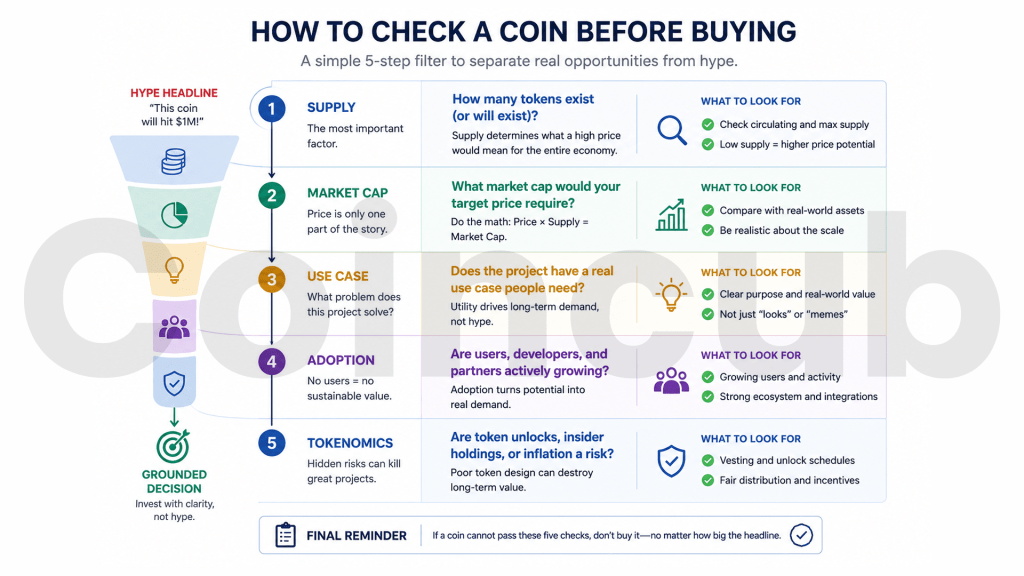
Examine the people behind the project too, since transparent founders, audited code, and a record of shipping features build confidence. Finally, weigh liquidity and tokenomics together: coins listed on major exchanges with healthy daily volume are easier to enter and exit, while heavy insider holdings or steep token unlock schedules can flood the market and drag prices down. Running every coin through this filter turns a flashy headline into a grounded decision.
Risks Worth Knowing
Crypto markets swing hard. Double-digit moves in a single day happen often, and deep drawdowns can erase years of gains within weeks. Scams cluster around hype, so any claim that guarantees a million-dollar coin deserves heavy skepticism. Many tokens that launched with grand promises have faded toward zero once attention moved on. Security adds another layer of risk, since lost keys, fake apps, and phishing sites drain wallets every single day. Spreading risk across assets, using trusted platforms, and investing only money you can comfortably afford to lose are the habits that protect long-term participants.
The Bottom Line
The phrase “buy before it hits $1 million” works beautifully as a headline, yet the real lesson lives in the math. Supply and market capitalization, rather than the price of a single token, decide what stays possible. Bitcoin owns the strongest claim because of its hard cap and deep adoption, while most other coins, especially high-supply meme tokens, face ceilings far beyond the reach of the global economy. Focus on fundamentals, study supply first, and treat every million-dollar promise with healthy caution.
Treat this article as general education built on market data available in 2026. Always consult a licensed financial professional and do your own thorough research before making any investment decision. Cryptocurrency carries substantial risk, and prices can fall sharply and quickly.
Frequently Asked Questions
Can any cryptocurrency realistically reach $1 million per token?
Only assets with a very small supply hold any realistic path, and Bitcoin leads that short list thanks to its 21 million coin cap. Even Bitcoin would need a market value near $20 trillion to get there, so any such move would stretch across many years and depend on massive global demand. Coins with billions or trillions of tokens face a hard mathematical wall that rules the target out.
Which cryptocurrency is most likely to reach the highest price per coin?
Bitcoin stands out because of its fixed supply paired with the broadest adoption in the market. Its built-in scarcity gives each coin room to climb as demand grows, which is why most seven-figure forecasts center on Bitcoin rather than high-supply alternatives.
Does a low token price mean a coin is a better buy?
A low price often misleads new buyers. A coin priced at one cent with a trillion tokens already carries an enormous market value, which leaves very little room to grow. Always judge a coin by its market capitalization and supply rather than the price flashing on the screen.
Are million-dollar meme coin predictions trustworthy?
Treat them as bright red flags. Meme coins with gigantic supplies would need to exceed all the wealth on Earth many times over to reach $1 million each. Such claims usually exist to lure buyers into hype-driven pumps that benefit early promoters.
How much should someone put into cryptocurrency?
Most financial educators suggest keeping high-risk assets to a small slice of a portfolio and using only money you can afford to lose. Your own goals, timeline, and comfort with sharp price swings should guide the final amount.
What is the difference between price and market cap?
Price is the cost of one token. Market cap is price multiplied by circulating supply, and it reflects the total value the market places on a project. Market cap offers a far better sense of a coin’s size and growth potential than the price alone.









