


 Buy a Licensed Company
  Explore VASP Data
  Talk to an Expert

 Atis Shala
Atis is a senior analyst and community lead with four years of experience in crypto. He has a bachelor from the Rochester Institute of Technology.
Atis Shala
Atis is a senior analyst and community lead with four years of experience in crypto. He has a bachelor from the Rochester Institute of Technology.
Blue-Chip DeFi: Why Uniswap and Aave Are 2026 Essentials
- Decentralized finance has evolved into a highly institutionalized $238.5 billion ecosystem, with Uniswap and Aave acting as its foundational, blue-chip pillars.
- Earning true blue-chip status in Web3 requires deep liquidity, battle-tested smart contracts, immense Total Value Locked (TVL), and decentralized governance capable of navigating severe crises.
- Uniswap remains the uncontested liquidity engine of crypto, driving permissionless token exchange through its Automated Market Maker model and continuous architectural evolution.
- Aave functions as the central bank of decentralized finance, utilizing strict overcollateralization and advanced features like flash loans to efficiently manage capital.
- The April 2026 Kelp DAO cross-chain exploit highlighted the systemic risks of DeFi composability by instantly turning a third-party bridge vulnerability into a $5.4 billion bank run on Aave.
- Despite this extreme stress test, Uniswap and Aave proved their essential status by maintaining their core operations and executing swift emergency governance to cap exposure.
- For modern investors, evaluating a protocol’s accepted collateral, associated bridge infrastructure, and safety modules is now just as critical as auditing its underlying code.
The State of DeFi in 2026
Decentralized finance has grown up. What began as a collection of experimental smart contracts running on Ethereum has matured, over the course of a decade, into a parallel financial system that now manages hundreds of billions of dollars in value. The overall DeFi market size reached approximately $238.5 billion in 2026, and analysts project it to approach $770.6 billion by 2031 on a 26.4% compound annual growth rate. This is no longer a niche corner of the internet reserved for cryptographers and idealists. Institutions participate. Regulators observe. And everyday users around the world borrow, lend, and swap assets without ever speaking to a banker.
Within this sprawling ecosystem, two protocols stand above the rest as the twin pillars of decentralized finance: Uniswap and Aave. One governs how tokens are exchanged. The other governs how capital is lent and borrowed. Together, they define what DeFi infrastructure means in 2026.
This article makes a specific case: Uniswap and Aave remain essential despite years of market volatility, regulatory pressure, and the devastating cross-chain exploits that rattled the ecosystem in April 2026. They are essential precisely because of how they respond to adversity. Understanding what makes them blue-chips, how they function, and how they behaved under genuine systemic stress is the foundation for any serious engagement with decentralized finance this year.

Defining Blue-Chip in Web3
In traditional finance, a blue-chip stock belongs to a company with a long track record, reliable earnings, and a reputation that has survived multiple market cycles. The term carries no guarantees, but it signals durability. In Web3, the concept translates with some important modifications.
A blue-chip DeFi protocol earns that designation through four characteristics. The first is deep, sustained liquidity. A protocol that processes billions of dollars in daily activity and maintains that volume across bear markets and bull markets alike has demonstrated that the market trusts it with serious capital. Shallow liquidity, by contrast, makes a protocol fragile and easy to manipulate.
The second characteristic is battle-tested smart contracts. DeFi’s history is littered with protocols that appeared sound until a single vulnerability allowed attackers to drain their treasuries. Blue-chip protocols have survived years of live deployment, multiple audits, and adversarial conditions. Their code has been subjected to the most brutal stress test available: real money under real attack.
The third characteristic is significant Total Value Locked, or TVL. TVL measures the aggregate value of all assets deposited into a protocol’s smart contracts. It functions as a proxy for user trust. When sophisticated participants are willing to lock billions of dollars into a protocol’s architecture, that collective judgment carries weight.
The fourth characteristic is strong decentralized governance. Protocols governed entirely by their development teams carry key-person risk. Blue-chip protocols have transitioned meaningful decision-making power to their token holders, who vote on risk parameters, treasury allocations, and protocol upgrades.
High-risk experimental protocols fail one or more of these tests. They may offer eye-catching yields, but those yields often reflect the premium the market demands for accepting unaudited code, thin liquidity, and governance concentrated in anonymous developer wallets.
Uniswap: The Uncontested Liquidity Engine
Uniswap is the primary venue through which the decentralized world exchanges tokens. It operates as a decentralized exchange, meaning there is no order book, no central operator matching buyers with sellers, and no custody of user funds. Instead, Uniswap uses an Automated Market Maker model, in which liquidity providers deposit pairs of tokens into smart contract pools, and the protocol’s mathematical formula prices each swap automatically.
The formula at the core of Uniswap’s AMM model, the constant product function (x × y = k), ensures that as one token in a pool is bought, its price rises relative to the other. Liquidity providers earn a proportional share of the fees generated by every swap through their pool. This mechanism, first introduced with Uniswap V1 in 2018, is now the standard blueprint against which all competing DEX designs are measured.
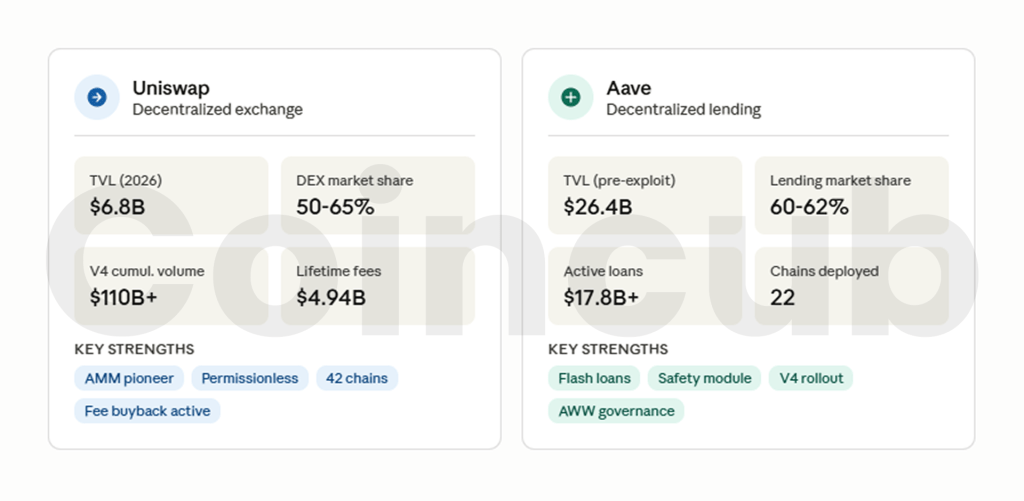
The protocol’s evolution has been disciplined and iterative. Version 2 introduced direct token-to-token pools without requiring ETH as an intermediate. Version 3 introduced concentrated liquidity, allowing liquidity providers to allocate capital within specific price ranges and dramatically improve capital efficiency. Moving on, Version 4, released in late 2024, introduced a hooks system that allows developers to customize pool logic at the contract level, enabling limit orders, dynamic fee tiers, and other advanced functionality without forking the core protocol. Since V4’s launch, Uniswap has processed more than $110 billion in cumulative trading volume, reaching $1 billion in TVL within just 177 days of deployment, a faster milestone than V3 achieved.
Uniswap Dominates in Trading Volume
Uniswap’s dominance in trading volume has remained consistent. The protocol processes between 50% and 65% of weekly DEX volume across all chains, depending on market conditions and competitor activity. Its lifetime cumulative trading fees now exceed $4.94 billion. Layer 2 networks have become increasingly central to this volume, accounting for 67% of V4 transaction activity. Unichain, Uniswap’s own Layer 2, now handles nearly 50% of V4 transaction volume, signaling a deliberate push toward scalable, low-cost infrastructure.
Governance has also matured. The Uniswap Foundation has introduced strategic accountability structures, and the UNI token gained direct economic relevance in December 2025 when the protocol activated a fee switch routing 17% of swap fees toward buying back and burning UNI on Ethereum and later on Optimism, Arbitrum, Base, and other chains. This structural change ties the token’s value directly to protocol usage.
What Uniswap provides in 2026 is irreplaceable: a permissionless, always-available venue for token discovery and exchange that any wallet, any protocol, and any application can use without seeking permission. Every DeFi protocol that needs to swap tokens routes through it.
Aave: The Central Bank of Decentralized Lending
If Uniswap is where capital moves, Aave is where capital works. Aave functions as a decentralized money market, allowing users to deposit assets to earn yield and borrowers to take out loans without a credit check, a bank account, or a counterparty relationship.
The mechanism is straightforward in concept. Depositors supply assets to Aave’s liquidity pools. Borrowers draw from those pools by posting collateral that exceeds the value of what they borrow. This requirement, known as overcollateralization, is the protocol’s core risk management mechanism. If a borrower’s collateral value falls below the required threshold, Aave’s liquidation engine automatically repays the loan by selling a portion of the collateral at a discount, compensating liquidators for the service. The protocol assumes no credit risk in the traditional sense because collateral must always exceed debt.
By mid-2025, Aave’s TVL reached approximately $41.1 billion, a financial footprint comparable to a mid-tier U.S. bank. The protocol commands 60% to 62% of the DeFi lending market, spans 22 chains, and generates hundreds of millions of dollars in annual fees. Aave V3, the current production version, introduced efficiency improvements including E-Mode, which increases borrowing capacity for correlated asset pairs, and cross-chain liquidity portals. V4, which is being developed in parallel, will introduce a modular hub-and-spoke architecture designed to unify liquidity across networks and target institutional-scale adoption. Aave’s Horizon platform, aimed at institutional participants, already holds $550 million in net deposits.
Crypto Flash Loans: Aave’s Moat
One of Aave’s most powerful and technically sophisticated features is the flash loan. A flash loan allows a user to borrow any amount from Aave’s pools with no collateral, on one strict condition: the borrowed amount must be returned within the same blockchain transaction. If it is not, the entire transaction reverts as though the borrow never happened. This atomicity makes flash loans safe for the protocol while enabling powerful use cases for developers, including arbitrage, collateral swaps, and self-liquidations.
Beyond V4’s technical roadmap, governance has sharpened Aave’s economic model. The DAO’s “Aave Will Win” framework routes 100% of revenue from all Aave-branded products directly to the community treasury, establishing a fully token-centric model. The DAO has also activated AAVE token buybacks using treasury reserves, directly linking protocol success to token value. These governance decisions reflect an organization that has moved beyond survival mode and into long-term capital allocation.
Stress Testing the System: The April 2026 rsETH Exploit
On April 18, 2026, decentralized finance faced one of its most severe stress tests. Understanding this event requires clarity on a specific point: Aave’s smart contracts were not hacked. What happened was a cascading failure that began at a different protocol entirely and spilled into Aave through the very feature that makes DeFi powerful: composability.
The Root Cause: A Bridge Exploit at Kelp DAO
Kelp DAO is a liquid restaking protocol. It takes user-deposited ETH, routes it through EigenLayer to generate additional yield on top of standard Ethereum staking rewards, and issues a receipt token called rsETH. Because DeFi is permissionless, the exploiters can trade and post this rsETH as collateral on lending protocols like Aave.
To make rsETH usable across more than 20 different blockchains, Kelp relies on a cross-chain bridge built on LayerZero infrastructure. On April 18, the Lazarus Group exploited a vulnerability in this bridge’s message verification system. By forging cross-chain messages, the attackers tricked the bridge into releasing 116,500 rsETH (worth approximately $292 million, roughly 18% of the token’s entire circulating supply) to an attacker-controlled address without any corresponding assets being locked on the source chain. Kelp’s emergency multisig froze the protocol’s core contracts 46 minutes after the drain was complete. Two follow-up attempts, each targeting another 40,000 rsETH, were blocked after the pause.
The exploit is now the largest DeFi hack of 2026.
The Spillover: How a Kelp Problem Became an Aave Problem
The attackers did not immediately attempt to liquidate the stolen rsETH on open markets. Instead, they deployed the stolen tokens as collateral on Aave V3. Using that collateral, they borrowed approximately 74,000 legitimate ETH directly from Aave’s lending pools.
This maneuver is the clearest illustration of DeFi composability as a double-edged mechanism. Because Aave had allowlisted rsETH as acceptable collateral, and because its liquidation logic had no way to detect that the posted collateral was backed by nothing, the protocol processed the borrow as any other transaction. The attackers walked away with real ETH. Aave was left holding rsETH that could not be sold and an ETH borrow position that could not be recovered.
The Immediate Fallout: A $5.4 Billion Bank Run
The consequences were immediate and severe. Aave’s ETH utilization rate climbed to 100%, meaning the protocol had zero liquidity buffer remaining. Every available ETH in the pool was now borrowed. Regular depositors who attempted to withdraw their ETH found the pool empty.
Panic spread quickly. Sophisticated users understood what bad debt at Aave meant for depositors, and they acted accordingly. Justin Sun of the Tron Foundation was the first major whale to exit, withdrawing 65,584 ETH worth approximately $154 million in a single onchain transaction. Dozens of large holders followed. According to onchain tracking by Lookonchain, the total ETH withdrawn from Aave over the following hours surpassed $5.4 billion. The protocol’s total value locked dropped from $26.4 billion on April 18 to roughly $20 billion by the following day. The AAVE token fell approximately 16% over this period.
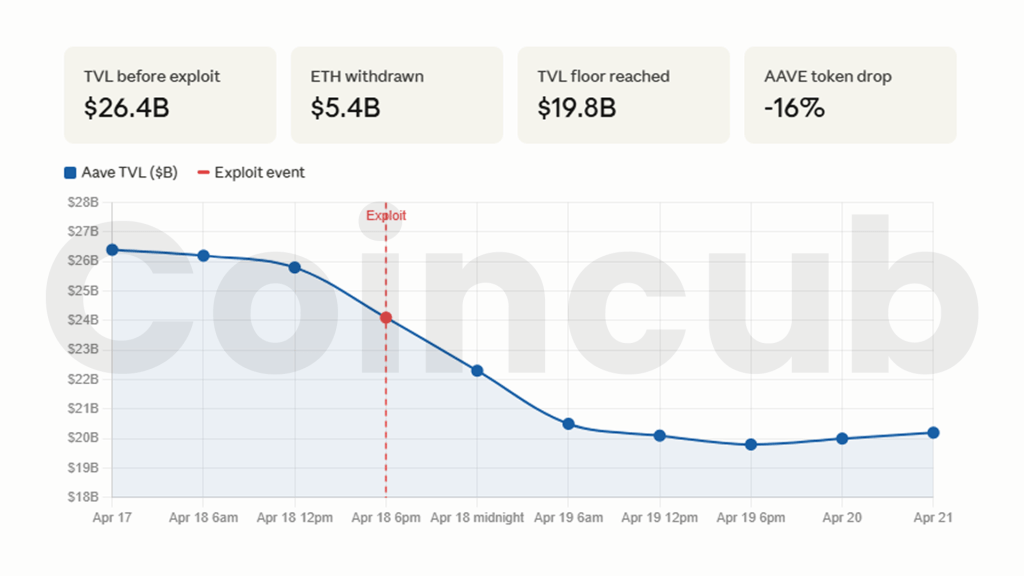
WETH is 39.49% of all loans on Aave, meaning the attack hit the exact collateral-to-WETH pairing that dominates the protocol’s entire loan book. The concentration made the damage particularly severe and concentrated.
Aave’s Response: Emergency Measures and the Road to Recovery
Aave’s response was fast and structured. The Aave Guardian initiated emergency freezes on all rsETH and wrsETH markets across both V3 and V4 at 18:52 UTC on April 18, within minutes of identifying the exploit. Founder Stani Kulechov confirmed publicly that Aave’s internal contracts were not compromised and that the protocol’s pools remain operational. The freeze halted any new deposits into, or borrowing against, the compromised rsETH market, capping further exposure.
Handling the bad debt is more complex. Aave is currently evaluating how to address the roughly $196 million deficit left by the stolen ETH positions. The primary backstop for exactly this scenario is the Aave Safety Module, a pool of staked AAVE tokens held as protocol insurance. In black-swan events that create irrecoverable bad debt, the Safety Module can be slashed and the recovered AAVE sold to cover the protocol deficit, distributing the cost among stakers rather than depositors. The language from Aave’s team shifted during the crisis from a firm commitment to use the Safety Module toward a more measured acknowledgment that all resolution paths are being evaluated, a signal that the scale of the bad debt pushed the team toward caution before committing to a specific remedy.
Aave’s governance is widely expected to implement tighter risk parameters specifically for Liquid Restaking Tokens. The rsETH exploit exposed a gap between the perceived safety of an LRT and the actual risk profile of its underlying bridge architecture. Future allowlisting decisions for LRTs will likely include deep scrutiny of cross-chain infrastructure, verification redundancy, and bridge architecture audits as mandatory criteria before any token is accepted as collateral.
Why Do Uniswap and Aave Remain 2026 Essentials?
The April 2026 rsETH exploit did not reveal that Aave is broken. It revealed that DeFi composability creates systemic exposure that no individual protocol can fully control and that crisis response capability is a defining feature of protocols worth trusting. Both observations strengthen the case for Uniswap and Aave as blue-chips rather than weakening it.
Consider Aave’s response timeline. The Guardian froze the rsETH markets within minutes. The founder communicated publicly and accurately. The Safety Module exists precisely for bad debt scenarios. These are the behaviors of a mature, well-governed institution, not a team scrambling without a plan.
Uniswap’s role in this story is also instructive. Onchain data confirmed that the attackers routed stolen assets through Uniswap to liquidate positions. This is not a flaw. Uniswap is permissionless by design, and that permissionlessness is its most fundamental feature. Censoring transactions based on the identity of the sender would undermine the protocol’s entire value proposition. The fact that it functioned correctly under intense adversarial conditions during a crisis is evidence of its resilience, not its weakness.
DeFi Composability as a Moat… or a Ditch
DeFi composability is the concept at the center of both the risk and the opportunity. Because you can combine Uniswap, Aave, and dozens of freely like financial building blocks, developers can construct complex financial products that would require years of regulatory approval in traditional finance. A single transaction can flash-borrow from Aave, swap through Uniswap, provide liquidity to a yield protocol, and repay the borrow, all in one atomic operation. This composability is the source of DeFi’s extraordinary capital efficiency. It is also the channel through which a single bridge exploit at Kelp DAO became a liquidity crisis at the world’s largest decentralized lender.
The lesson is not to avoid composability. It is to understand it deeply and price the risk accordingly. Protocols that have navigated extreme stress tests, implemented emergency response mechanisms, and emerged with their architecture intact are exactly the ones worthy of the blue-chip label. Uniswap and Aave have earned that designation through adversity, not despite it.
Final Thoughts: Blue Chip DeFi and Security
Blue-chip DeFi in 2026 means something specific. It means protocols with deep liquidity, battle-tested code, strong decentralized governance, and demonstrated ability to function under adversarial conditions. By every one of those measures, Uniswap and Aave hold a position that no other protocols in the space currently match.
For investors and participants approaching DeFi this year, the key takeaways are worth stating plainly. First, protocol quality and systemic risk are separate concerns. Aave’s smart contracts were not hacked in April 2026. The risk came from the asset it accepted as collateral and from the bridge architecture of a third-party protocol. Evaluating what a protocol accepts as collateral, what bridges it trusts, and what its Safety Module can realistically absorb is as important as evaluating the protocol’s own code.
Second, the Safety Module and governance mechanisms are not theoretical safeguards. They are live infrastructure that the community can activate at any time. Understanding how losses are distributed in worst-case scenarios before depositing is basic risk management.
Third, Uniswap’s role as permissionless infrastructure means it will always be accessible by both legitimate participants and adversarial ones. Its value comes from its neutrality. Investors who want exposure to DeFi trading activity should evaluate Uniswap on its protocol revenue, governance trajectory, and V4 adoption curve. Whether bad actors route transactions through it or not doesn’t change the tech.
DeFi’s most resilient protocols are not the ones that have never been tested. They are the ones that absorbed the test and kept running. In 2026, that distinction is the most important one you can make.
Frequently Asked Questions (FAQs)
What is a blue chip DeFi protocol?
A blue-chip DeFi protocol is a highly trusted decentralized financial application characterized by deep liquidity, battle-tested smart contracts, billions in Total Value Locked (TVL), and strong decentralized governance. Industry standards include Aave and Uniswap.
What is a blue chip crypto?
A blue-chip cryptocurrency is a well-established cryptocurrency with a massive market capitalization, high liquidity, and a proven track record. Bitcoin and Ethereum are the primary examples of blue-chip crypto assets.
Is Aave a good coin?
AAVE is a premier governance token because it underpins the largest decentralized lending protocol in Web3. Its value relies on protocol revenue, staking utility in the Safety Module, and active community-led buyback mechanisms.
How to use Aave to make money?
Users generate passive income on Aave by depositing supported crypto assets, like Ethereum or stablecoins, into liquidity pools. Borrowers pay interest to access these funds, which then the protocol distributes to depositors as continuous yield.
Is Uniswap exchange safe?
Uniswap is a highly secure due to its battle-tested, heavily audited smart contracts and non-custodial design. However, while the protocol itself is safe, users must remain cautious at all times.