


 Buy a Licensed Company
  Explore VASP Data
  Talk to an Expert

 Atis Shala
Atis is a senior analyst and community lead with four years of experience in crypto. He has a bachelor from the Rochester Institute of Technology.
Atis Shala
Atis is a senior analyst and community lead with four years of experience in crypto. He has a bachelor from the Rochester Institute of Technology.
AI Copy Trading: How Autonomous Agents Reshape Crypto Markets
Key Takeaways:
- Artificial intelligence agents now autonomously execute trillions of dollars in transactions. They replace legacy, rigid trading bots with hyper-fast decision engines that read real-time market data and social sentiment in milliseconds.
- AI copy-trading completely eliminates fear, greed, and fatigue. The software perfectly mirrors top-tier professional traders using cold, mathematical logic around the clock.
- Retail investors no longer need complex coding skills. Modern exchanges allow users to deploy sophisticated neural networks and copy the smart money simply by typing conversational commands into a terminal.
- Algorithmic overfitting, rapid edge decay, and API vulnerabilities threaten unguarded capital. Investors must actively set strict security parameters and avoid treating AI as an infallible money printer.
The “Terminator” Retail Trader
Manual day-trading is dead. To survive, the everyday investor must shift from clicking buy buttons to acting as a high-level portfolio manager who directs a diversified fleet of specialized machine agents.
Global finance no longer relies on human vocal cords. The days of floor traders shouting across crowded exchange pits belong strictly to history books. Today, silent server rooms hold the real power. Algorithms execute millions of orders in the blink of an eye, completely dominating market liquidity. For years, Wall Street institutions monopolized these high-speed tools, leaving everyday investors to fight for scraps. The rise of decentralized finance and artificial intelligence finally leveled that playing field.

We now operate inside the agentic economy. Analysts at McKinsey recently projected that artificial intelligence agents will soon mediate between $3 trillion and $5 trillion in global financial transactions. This staggering figure represents a fundamental change in how capital moves. We have moved far past simple automation. Traditional trading bots simply followed rigid, pre-programmed rules. If an asset hit a specific price, the bot triggered a buy order. Those legacy bots lacked nuance and adaptability.
The modern financial landscape demands a far more sophisticated approach. The sheer volume of global market data easily overwhelms the human brain. Geopolitical news, social sentiment shifts, and macroeconomic data points update every single millisecond. Human traders simply cannot process this information fast enough to stay competitive. The market required a technological leap to bridge the gap between raw data and profitable execution.
Narrow Down: Enter the AI Agent
This technological leap brings us directly to the modern AI agent. Within the cryptocurrency sector, an AI agent operates as a highly advanced, autonomous software program capable of independent decision making. These agents never wait for a human user to push a button. They read the market, assess risk parameters, and execute complex trading strategies entirely on their own.
When developers apply this technology to copy trading, the results permanently alter the retail investment experience. A copy-trading AI agent actively scans public blockchains and exchange leaderboards to identify highly profitable, professional traders. The agent then perfectly mirrors those specific trades in real time for the retail user. Everyday investors no longer need to spend thousands of hours studying candlestick patterns or order book depth. They simply deploy an agent to follow the smart money.
The digital asset space provides the perfect infrastructure for this technology. In March 2026, Coinbase CEO Brian Armstrong highlighted a critical reality about the future of global markets. He noted that the industry will soon see more artificial intelligence agents executing transactions than actual human beings. The underlying logic remains undeniable. A machine cannot easily walk into a traditional bank, present physical identification, and open a corporate checking account. Legacy finance creates too much friction. However, an AI agent can instantly generate a cryptocurrency wallet and interact with decentralized protocols without asking for permission. This seamless integration makes crypto the native currency of the machine economy.
The Evolution of Following the Smart Money
For decades, retail investors desperately tried to peek over the shoulders of institutional giants. They knew the game was rigged in favor of large firms with faster information and deeper pockets. Everyday traders wanted to follow the “smart money” to level the playing field. This deep desire birthed the first generation of social copy trading platforms in the mid-2010s. These legacy systems allowed users to link their personal exchange accounts to the public profiles of popular human traders. When the designated influencer bought Bitcoin or Ethereum, the platform automatically mirrored the exact same trade for all their followers.
While revolutionary at the time, human-led copy trading carried fatal, undeniable flaws. By copying another person, you essentially outsourced your financial future to a stranger on the internet. You also inherited all of their biological and psychological limitations. Human traders inevitably need sleep, meaning they miss crucial market movements during offshore trading sessions. They get distracted. They step away from their monitors.
Most dangerously, human traders suffer from severe emotional bias. When a market crashes unexpectedly, fear completely paralyzes the human mind. Conversely, during a massive bull run, greed blinds them to obvious risks. After suffering a heavy financial loss, human traders frequently engage in “revenge trading.” They take wild, over-leveraged risks to aggressively win back their lost capital. These emotional spirals routinely liquidate entire follower portfolios in a matter of hours.
Artificial intelligence agents completely eliminate these devastating human vulnerabilities. By replacing the human influencer with an autonomous machine, the investment model shifts from emotional guesswork to pure mathematical precision.
The Paradigm Shift: Human vs. Machine Execution
| Limitation | Legacy Human Trader | AI Copy-Trading Agent |
| Uptime | Requires sleep, food, and breaks. | Operates 24/7/365 without interruption. |
| Data Processing | Reads one chart or news article at a time. | Scans thousands of data points in milliseconds. |
| Emotional Control | Susceptible to fear, greed, and panic. | Executes logic without emotional interference. |
| Risk Management | Prone to breaking rules after losses. | Strictly enforces coded risk parameters. |
The modern AI agent never panics during a black swan market event. It simply recalculates the market probabilities and adjusts the portfolio according to cold, hard logic. This natural evolution finally grants retail investors access to the same ruthless, institutional-grade execution that Wall Street hedge funds have monopolized for a decade.
Unpacking the Technology
To truly trust an AI agent with your capital, you must understand exactly how the underlying technology actually works. We must demystify the machinery. Modern copy-trading agents do not rely on simple coding scripts. They utilize a complex architecture of deep learning and natural language processing to navigate the chaotic cryptocurrency markets.
First, the agent acts as a hyper-speed information sponge. Through natural language processing (NLP), the software reads and interprets millions of text-based data points in milliseconds. It scans breaking regulatory news from global governments, monitors social media sentiment across X and Reddit, and analyzes developer activity on GitHub repositories. A human might take thirty minutes to read a new regulatory proposal from the SEC. The AI agent digests the entire document, assesses its probable market impact, and executes a trade before the human finishes the first paragraph.
Second, the agent deploys deep learning neural networks to master technical analysis. These networks scan years of historical market data across multiple market cycles. They search for hidden liquidity patterns and subtle price correlations that traditional human charting completely misses. While a retail trader looks at a basic moving average, the neural network analyzes thousands of variables simultaneously to predict the next price movement with high statistical probability.
Once the agent identifies a profitable setup, it moves to the execution phase. This phase showcases where the machine truly outpaces the human mind. The agent instantly calculates the exact risk tolerance of your specific portfolio. It determines the optimal position size to prevent dangerous overexposure. Finally, it routes the trade directly to the blockchain or centralized exchange via secure API connections.
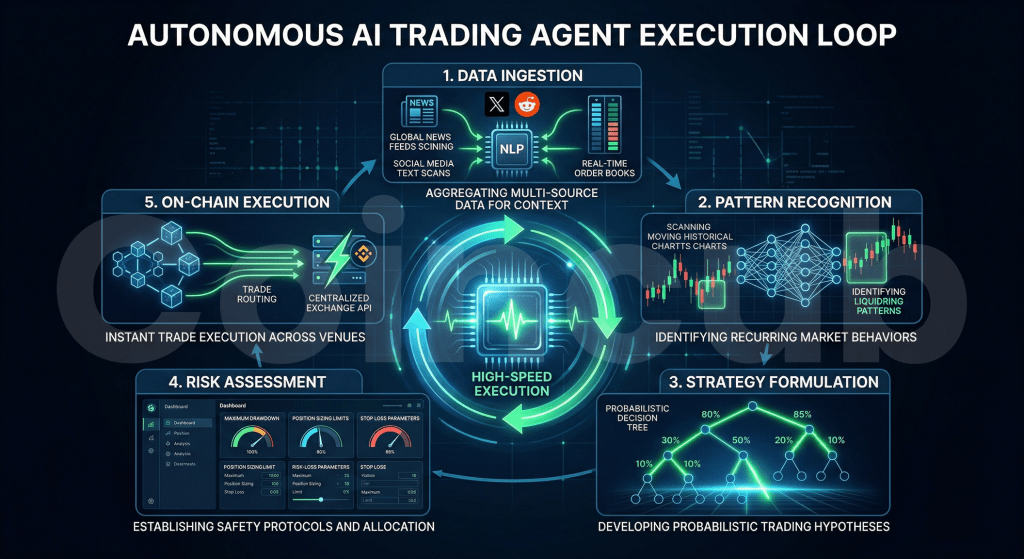
The AI Agent Execution Loop
- Data Ingestion: The agent aggregates global news, social sentiment, and real-time order book data.
- Pattern Recognition: Neural networks cross-reference current conditions against historical market cycles.
- Strategy Formulation: The system builds a definitive trading hypothesis based on probability.
- Risk Assessment: The agent calculates precise stop-loss and take-profit levels tailored to the user’s account size.
- On-Chain Execution: The software fires the order directly to the exchange network in milliseconds.
This continuous loop repeats thousands of times per second. By combining NLP with deep learning, the AI copy-trading agent transforms raw market noise into actionable, calculated investments. The technology strips away the guesswork, leaving only data-driven execution.
Market Adoption and Institutional Rollouts
The financial industry no longer views artificial intelligence as a futuristic experiment. Market adoption exploded over the past twelve months. A recent 2026 Deloitte survey revealed a staggering metric. AI agents now actively manage over $1 trillion in assets globally. This massive shift proves that institutional capital and retail liquidity both deeply trust machine execution over human intuition. Traditional asset managers find themselves scrambling to adapt as automated capital completely commands the market structure.
Top-tier cryptocurrency exchanges recognized this trend early and immediately upgraded their infrastructure. They stopped forcing users to build complex algorithms from scratch using complicated coding languages. Instead, platforms integrated native agentic ecosystems directly into their user interfaces. The March 2026 upgrade to the Bybit AI Trading Skills Hub perfectly illustrates this evolution of copy trading. Bybit transformed its legacy bot system into a fully autonomous copy trading hub accessible to everyone.
Retail Investors + AI Agents
Retail investors now interact with these advanced platforms using simple conversational commands. You do not need a computer science degree to participate. A user simply types a natural language prompt into the terminal interface. You might command the system to “find a lead trader with a 70 percent win rate over the last six months who trades Solana and only takes low risk positions.” The AI agent instantly scans the entire exchange leaderboard, identifies the exact professional trader matching those parameters, and locks onto their portfolio.
Once connected, the agent perfectly mirrors the lead trader. When the human professional executes a buy order for Solana, the AI agent replicates that exact trade in the retail user’s account a fraction of a second later. It automatically scales the trade size to match the specific account balance of the follower.
Consider the scale of this adoption across major trading venues:
| Exchange Platform | 2026 AI Integration Level | Core Feature |
| Binance | Advanced | Auto-balancing neural portfolios |
| Bybit | Comprehensive | AI Skills Hub with NLP copy trading |
| OKX | Advanced | Signal bot marketplace with machine learning |
| Coinbase | Developing | Agentic wallet infrastructure |
These institutional rollouts democratize elite financial strategies. They remove the immense technical barriers that historically kept everyday people locked out of high frequency trading systems.
The Inherent Risks and Security Roadblocks
Despite the incredible technological leaps, investors must confront the severe risks associated with autonomous execution. Handing your capital over to a machine requires a clear understanding of systemic vulnerabilities. We must address the technical limitations objectively, stripping away the marketing hype to expose the real dangers.
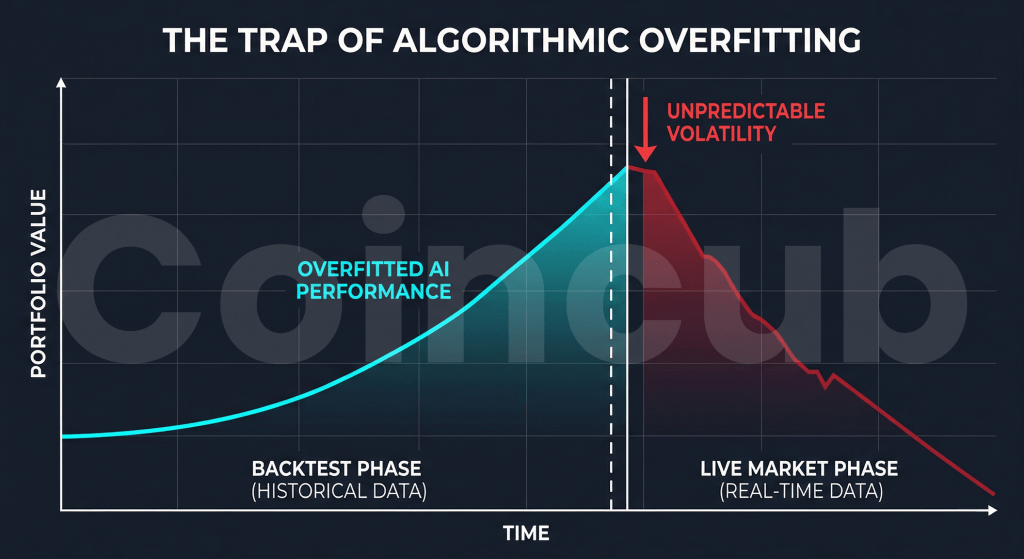
Algorithmic overfitting represents the most common trap for new investors. Developers often train their AI models on historical market data until the software achieves a 100 percent win rate in simulations. However, the past never perfectly predicts the future. An overfitted agent performs flawlessly in a backtest but completely fails when a live market shock occurs. When an unpredictable geopolitical event crashes the price of Bitcoin, the overfitted model freezes or makes catastrophic errors because it cannot recognize the new variables.
Edge decay creates another massive roadblock. In financial markets, an “edge” refers to a unique, profitable strategy. When a single human trader discovers a profitable inefficiency, they make money quietly. If an AI agent allows ten thousand retail users to instantly copy that exact same trade, the market immediately absorbs the inefficiency. The sheer volume of copycat capital destroys the profitability of the original trade. The edge decays rapidly as the strategy becomes too crowded.
API Connections as a Weak Spot Against Hackers
Furthermore, security threats multiply when autonomous software handles liquid capital. Hackers constantly target the API connections that link the AI agent to the cryptocurrency exchange. If a malicious actor intercepts that connection, they can drain the user’s account in seconds.
Leading platforms combat these specific threats by implementing strict dual-source verification systems. This security protocol prevents catastrophic supply chain attacks. When the AI agent decides to execute a trade, the system requires secondary confirmation from an isolated, independent data oracle before routing the order. This ensures no hacker injected malicious code to manipulate the pricing data.
Key AI Copy Trading Risks
- Overfitting: Perfect historical backtests fail during real world volatility.
- Edge Decay: Profitable strategies lose power when thousands of users copy them simultaneously.
- API Vulnerabilities: Weak exchange connections invite direct wallet drains.
- Flash Crashes: Autonomous agents triggering massive sell-offs based on false news data.
Investors must treat AI agents as powerful tools rather than infallible money printers. Prudent risk management still dictates long term success.
The Future of Retail Investing
The financial markets stand at the precipice of a permanent transformation. Artificial intelligence copy-trading agents fundamentally democratize professional execution for the everyday investor. For the first time in history, retail participants do not need a Wall Street background or millions of dollars in capital to access elite quantitative strategies. These autonomous systems level the playing field. They strip away human emotion, operate around the clock, and react to global data in milliseconds.
However, this technological leap does not eliminate the human investor. It simply redefines their role. Retail traders will no longer spend their days staring endlessly at candlestick charts. They will no longer manually click buy or sell buttons while fighting off panic or greed. Instead, human investors will evolve into high-level portfolio managers. They will allocate capital across a diverse fleet of specialized machine agents. One agent might handle low-risk stablecoin arbitrage, while another perfectly copies a top-tier Ethereum trader during periods of high market volatility or a Bitcoin trader during mining hash rate volatility.
The New Investor Workflow
- Shift Focus: Move away from manual day-trading and focus on high-level capital allocation.
- Diversify Agents: Deploy multiple bots across different assets to hedge against localized market crashes.
- Monitor Risk: Regularly update the maximum drawdown limits and stop-loss parameters for every active agent.
The future of retail investing relies on this powerful synergy between human strategy and machine execution. Investors who stubbornly cling to manual day-trading will eventually find themselves outpaced by algorithms. Those who learn to direct these AI agents will unlock unprecedented opportunities in the digital asset space. The machines now do the heavy lifting. The human mind must focus on the broader vision.
Frequently Asked Questions (FAQs)
What exactly is an AI copy-trading agent?
An AI copy-trading agent operates as an autonomous software program that links your account to a professional trader. The artificial intelligence uses natural language processing and deep learning to evaluate market conditions. When the lead trader makes a move, the agent instantly mirrors that exact trade in your portfolio. It automatically sizes the position according to your specific account balance and risk settings, removing the need for you to monitor the markets yourself.
Do I need coding skills to deploy one?
You absolutely do not need coding skills. Modern cryptocurrency exchanges build these tools specifically for everyday users. You interact with the agent using simple, conversational commands. You just type out what kind of strategy or trader you want to follow, and the platform handles all the complex backend programming automatically.
How much capital do I need to start using this technology?
The barrier to entry remains incredibly low. Most major exchanges allow you to deploy an AI agent with as little as fifty or one hundred dollars. Because the software fractionalizes the trades, your agent can perfectly copy a millionaire investor using only a tiny fraction of a Bitcoin or Solana.
Are my funds safe from hackers when an agent controls them?
Leading platforms utilize strict security protocols, including dual-source verification and encrypted API connections, to protect your capital. The agent itself only holds the permission to execute trades. It cannot withdraw your funds to an external wallet. However, you must always use reputable exchanges and secure your account with hardware-based two-factor authentication to prevent unauthorized access.
Can an AI agent lose my entire portfolio?
Yes, the risk of total loss still exists. If the professional trader you copy makes a catastrophic error, your agent will copy that exact error. Furthermore, sudden market flash crashes can bypass standard stop-loss protections before the system executes the exit order. You must actively manage your risk. Never allocate your entire portfolio to a single agent or a single trading strategy. Treat the AI as a powerful tool, not a magical guarantee of profit.