Buy a Licensed Company
  Explore VASP Data
  Talk to an Expert

 Atis Shala
Atis is a senior analyst and community lead with four years of experience in crypto. He has a bachelor from the Rochester Institute of Technology.
Atis Shala
Atis is a senior analyst and community lead with four years of experience in crypto. He has a bachelor from the Rochester Institute of Technology.
The IRS and AI Audits
- The IRS is not letting AI conduct audits on its own; human examiners still handle audits, issue notices, and apply established taxpayer-rights protections.
- AI is increasingly being used to help the IRS identify risk, prioritize cases, and support enforcement and compliance operations before a formal audit begins.
- The agency’s use of AI has expanded rapidly, with GAO reporting 126 active IRS AI use cases as of June 2025, up from 10 in August 2022.
- IRS policy requires human review of AI outputs, along with governance, privacy safeguards, monitoring, and appeal or remedy processes for higher-impact uses.
- Supporters argue AI can improve enforcement by reducing false positives, spotting complex noncompliance, and helping the IRS target limited resources more effectively.
- Critics warn that AI-assisted enforcement raises serious concerns about opacity, errors, data quality, bias, and protection of taxpayer rights.
What are IRS AI Audits?
The phrase “IRS AI audits” sounds like something out of a dystopian tax thriller: a machine scans your return, labels you suspicious, and spits out an audit notice before a human ever gets involved. That is not the most accurate way to understand what is happening. The real story is more subtle and, in some ways, more important. The IRS is increasingly using artificial intelligence and advanced analytics to help identify risk, prioritize enforcement work, and support compliance operations, while the formal audit process itself still involves human examiners, written notices, and established taxpayer rights.
That shift matters because it changes where the government’s attention goes. In March 2026, GAO reported that the IRS had 126 active AI use cases as of June 2025, up from 10 in August 2022, and said those use cases span areas including taxpayer service and audit selection. At the same time, the IRS has adopted a formal AI governance policy and related privacy rules that require inventories, impact assessments, monitoring, and, in key situations, human review and remedy processes.
So the core question is not whether the IRS has handed audits over to robots. It has not. The better question is how AI is changing case selection, compliance strategy, and the practical risk landscape for taxpayers and tax professionals.

What “AI Audits” Actually Means
Start with the most important clarification: an AI system is not the same thing as an audit. Under the IRS’s public audit guidance, audits are still examinations of returns and records, taxpayers are notified by mail, and the audit itself is conducted by correspondence or in-person review. The agency also says returns may be selected through random selection, computer screening, or related examinations tied to other taxpayers or transactions.
What AI changes is the front end and support layer. GAO says the IRS has used AI for many years in operations that include audit selection, and TIGTA recently reported that the Large Business & International division’s Large Partnership Compliance Program uses AI to create a more comprehensive risk assessment and assist classifiers in selecting returns for examination. That is a very different proposition from saying AI independently audits taxpayers. It means AI helps decide where human attention should go first.
The IRS’s own internal rules reinforce that distinction. Its privacy policy says verification includes a human review process before taking adverse action based on AI-supported data, and its AI governance policy says IRS personnel must not use AI outputs in government business without direct human review to confirm the information’s accuracy. That is a human-in-the-loop model, not a machine-run adjudication system.
How AI Fits Into the IRS Audit Process
In practice, AI can influence several stages before and around an audit. The first is return selection and risk scoring. The IRS has long used computer screening, but newer AI and machine-learning tools appear to expand that function by spotting patterns across larger datasets and surfacing cases more likely to involve noncompliance. TIGTA’s March 2026 report on large partnership examinations states that the IRS’s Partnership Model Project uses AI and machine learning to improve data evaluation and assist in selecting returns for examination.
| Audit Stage | Traditional IRS Approach | New AI-Assisted Approach |
| Return Selection | Standard computer screening and random selection. | Machine learning spots anomalies across massive datasets to score risk. |
| Workload Prioritization | Manual triage of flagged returns. | Algorithms review data volumes to rank high-priority, high-yield cases. |
| Case Development | Manual review of referrals and case building. | Large language models assist in organizing and escalating enforcement leads. |
The second stage is workload prioritization. GAO’s 2026 report describes AI use cases that review large volumes of tax and other data to identify high-priority work. It also notes that some AI use cases could reasonably sit at the intersection of operational efficiency and compliance, such as improving efficiency in an audit-selection process. That matters because “AI audits” often begins with triage: deciding which piles deserve scarce examiner time.
The third stage is case development and referral review. In a February 2026 IRS publication, the agency said it was focusing efforts to launch an approved large language model to assist with the review and prioritization of referrals received in Exempt Organizations enforcement operations. Separately, GAO found examples of AI-enabled tools used to help build criminal cases that were not fully reflected in the IRS inventory at the time of its review.
Auditing Procedure: Does AI Play a Role?
Even so, the audit itself remains governed by conventional procedure. The IRS’s audit page makes clear that notices come by mail, document requests are specific, and taxpayers have rights to representation, explanation, privacy, and appeal. AI may increasingly shape how the IRS gets to your file, but it does not erase the legal and procedural framework that follows.
Current IRS Use of AI and Internal Governance
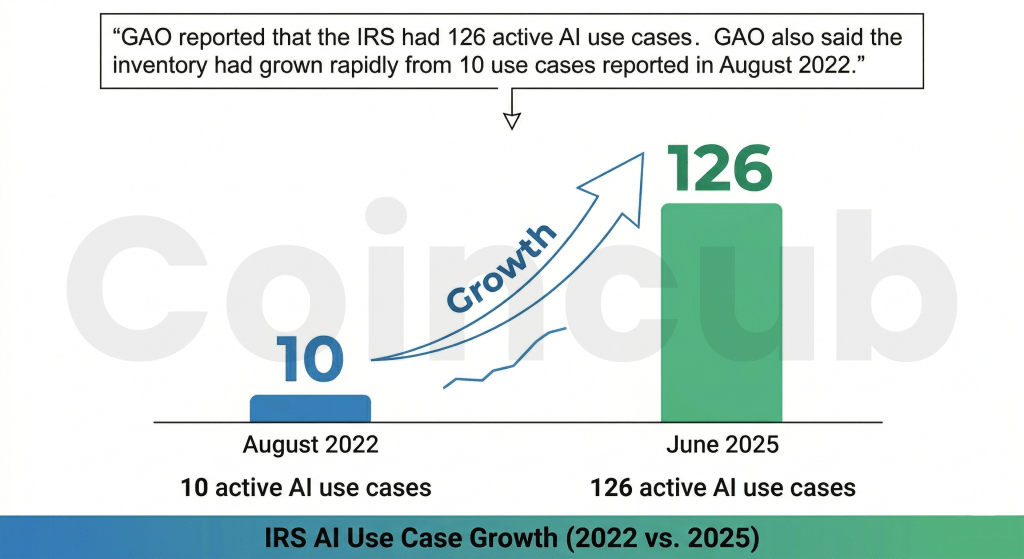
One reason this topic deserves attention is scale. GAO reported that the IRS had 126 active AI use cases in its inventory as of June 2025, including 65 that were too sensitive for public reporting or exempt because they were research-and-development efforts. GAO also said the inventory had grown rapidly from 10 use cases reported in August 2022. That is not a side experiment anymore. The more AI is advancing, the more it is becoming an expanding operational layer for the IRS.
The IRS has responded by formalizing governance. Its current AI governance policy, published in February 2026, requires business units to document AI use cases in an inventory, maintain model and data inventory entries, determine whether a use case is “high-impact,” and apply minimum risk-management practices when the stakes are higher. Those practices include pre-deployment testing, impact assessments, ongoing monitoring for adverse impacts, human oversight, and remedies or appeals.
The privacy layer is equally important. The IRS’s AI privacy guidance says the agency must document how AI use meets privacy principles, use only IRS-approved AI, avoid using sensitive taxpayer data to train public AI models, and, where practical, provide ways for people to contest inaccurate information or determinations based on incomplete data. It also says the IRS should be able to explain, as much as practical, how AI made a decision in privacy documentation.
Why the IRS Is Using AI
The simplest answer is math. The IRS sits on enormous volumes of tax, payment, and information-return data, and it cannot manually examine everything with equal intensity. In March 2026, IRS CEO Frank Bisignano told Congress that the agency is using AI and advanced analytics to identify high-risk areas of noncompliance and fraud with greater accuracy, with the goal of focusing enforcement personnel on higher-value work and reducing false positives.
There is also a resource angle. GAO said the IRS plans to use more AI in the future even after staff losses in AI-related roles, while the National Taxpayer Advocate reported that the agency expects lower staffing and budget levels in FY 2026 and plans to rely more heavily on technology, including AI, to offset those losses. Whether that strategy succeeds is another question, but the incentive is obvious: more data, fewer people, and a persistent tax gap create pressure to automate triage.
Potential Benefits of AI-Driven Audit Support
Used well, AI could make enforcement smarter rather than just harsher. Better models can help the IRS focus on returns that are more likely to involve real noncompliance, which should reduce wasted audits and improve the agency’s ability to find complex issues that old screening methods miss. That is the theory behind using AI for high-risk areas and reducing false positives, a point the IRS itself has emphasized.
There is also a fairness argument in the background. If the IRS can improve case selection, it may be able to spend less time chasing weak leads and more time on sophisticated evasion, abusive transactions, and fraud patterns hidden inside large datasets. TIGTA’s discussion of AI in large partnership selection and the IRS’s own statements about targeting high-risk noncompliance both point in that direction.
Risks, Criticisms, and Controversies
The biggest risk is opacity. Taxpayers may receive a notice without understanding that an AI-assisted system helped elevate their case, and even if they know AI played a role, they may not understand why the system viewed their return as risky. The IRS’s privacy policy effectively acknowledges this problem by stating that openness includes the ability to understand how AI made a decision and by requiring documentation around decision-making processes where practical.
The next risk is error. AI systems are only as good as their data, design, and monitoring. The IRS’s privacy guidance explicitly warns about data-quality issues, misunderstanding of data or directives, and the need for human review before adverse action. Its governance policy likewise requires monitoring for adverse impacts and human oversight for higher-impact uses. Those rules exist because false positives and poorly explained decisions are not theoretical concerns.
There is also a managerial problem. GAO’s March 2026 report found that over 25 percent of IRS AI use cases lacked information on how they were supposed to benefit the agency, that some AI-enabled tools used to help build criminal cases were omitted from the inventory, and that no single entity was responsible for managing AI investments across the agency against service-wide goals. In other words, the IRS may be expanding AI faster than it is mastering the governance of that expansion.
Finally, there is a taxpayer-rights concern. The National Taxpayer Advocate has warned that AI-driven compliance activity must protect the rights to quality service, to challenge the IRS’s position, and to appeal an IRS decision in an independent forum. That is especially important if stronger AI targeting lowers “no-change” audit rates not because the IRS found better cases, but because audited taxpayers are less likely to respond or contest the notice.
Legal, Privacy, and Fairness Concerns
Legally, the most sensitive question is not whether the IRS may use AI at all, but how much weight AI outputs carry in decisions that affect people’s rights, liabilities, and burdens. The IRS’s privacy policy says individuals should be able to contest determinations based on incomplete, inaccurate, or out-of-date information, and it calls for a human consideration and remedy process for rights-impacting AI. That language matters because it frames AI as support for decision-making, not as a substitute for due process.
Privacy is the other major concern. The IRS specifically prohibits using sensitive but unclassified data, including PII and tax information, to train public AI models. It also requires documentation such as Privacy Threshold Assessments and Privacy and Civil Liberties Impact Assessments when appropriate. Given the sensitivity of tax records, any AI program touching enforcement will live or die on whether taxpayers believe those safeguards are real rather than performative.
Fairness sits between those two issues. The agency may legally use tax data to detect potential noncompliance or fraud, and its privacy policy says that still fits within the broad purpose of tax administration. But lawful use is not the same thing as good use. Poorly designed systems can amplify old enforcement patterns, over-target certain categories of filers, or create a black-box effect that is hard to challenge. The current IRS rules show awareness of those risks, but awareness is not the same thing as proof they have been solved.
What Should Taxpayers and Tax Professionals Do?
For taxpayers, the practical lesson is boring but important: documentation matters more, not less, in an AI-assisted enforcement environment. If returns are increasingly screened for anomalies, outliers, and patterns, then consistency across filings, information returns, and supporting records becomes even more valuable. The IRS still conducts audits through notices, records requests, and examiner review, so the old fundamentals remain the best defense.
For tax professionals, the real adjustment is strategic. Assume the IRS is getting better at connecting dots across forms, entities, counterparties, and transaction patterns, especially in higher-risk segments. That does not mean every aggressive position will trigger an audit, but it does mean unexplained inconsistencies, weak substantiation, and sloppy reporting are more likely to stand out in a system designed to prioritize risk.
And if a notice arrives, speed matters. The IRS audit page says taxpayers are notified by mail, can request time extensions in some cases, and have rights to representation and appeal. Those protections still matter in an AI-shaped system, because the best response to automated triage is still a disciplined human rebuttal backed by facts.
What Comes Next for the IRS and AI
The direction of travel is clear: more AI, more analytics, and more pressure to turn those tools into measurable enforcement gains. The IRS has already formalized an AI governance regime, GAO has documented rapid growth in use cases, and IRS leadership is openly describing AI as part of its strategy to focus enforcement resources where they matter most.
At the same time, the oversight story is still unfinished. GAO’s newest report says the IRS needs to address skills gaps, improve information quality in its AI inventory, and better align AI investments with agency-wide goals. That means the next phase of the debate will not just be about whether AI works, but whether the IRS can govern it competently, explain it clearly, and use it without eroding taxpayer trust.
One likely outcome is that public language around “AI audits” will remain messy even as the underlying process becomes more sophisticated. The better frame is this: audits will still be conducted by people under established rules, but AI will increasingly shape which returns are elevated, which referrals are prioritized, and which enforcement resources are deployed first.
Final Verdict
The IRS is not replacing auditors with AI. It is doing something arguably more consequential: using AI to decide where human auditors, investigators, and compliance staff should spend their time. That makes “AI audits” a misleading phrase if it suggests a fully automated enforcement machine, but a useful one if it captures how deeply AI may influence the selection and prioritization process.
That shift could improve enforcement by reducing false positives, surfacing complex noncompliance, and helping the IRS work more effectively with limited resources. It could also create new problems around opacity, bias, data quality, and taxpayer burden if governance lags behind deployment. Right now, the official record supports a balanced conclusion: the IRS is moving decisively toward AI-assisted enforcement, but the legitimacy of that move will depend on transparency, human oversight, and the agency’s willingness to protect taxpayer rights as aggressively as it protects revenue.
Frequently Asked Questions (FAQs)
Does the IRS use AI for audits?
Yes, but not as an autonomous auditor. The IRS uses AI to help select returns, score risk, prioritize workloads, and support case development. Formal audits still involve human examiners, mailed notices, document requests, and taxpayer rights such as appeal protections.
Is AI taking over the IRS?
No. The article says AI is becoming an expanding operational layer across the IRS, but it is not replacing auditors or taking over enforcement decisions. Humans must review outputs, verify accuracy, and preserve privacy, remedy, and appeal protections for taxpayers.
Can AI do a financial audit?
AI can assist parts of a financial audit by analyzing data, spotting anomalies, and organizing leads, but it does not replace human judgment in the IRS context. According to the article, audits still require review, notices, evidence requests, and procedure.
What is the IRS policy on AI?
The IRS policy requires approved AI use, documented inventories, model and data records, impact assessments, predeployment testing for high impact systems, ongoing monitoring, and direct human review of outputs. It also bars training public AI models on sensitive taxpayer data.