Buy a Licensed Company
  Explore VASP Data
  Talk to an Expert

 Atis Shala
Atis is a senior analyst and community lead with four years of experience in crypto. He has a bachelor from the Rochester Institute of Technology.
Atis Shala
Atis is a senior analyst and community lead with four years of experience in crypto. He has a bachelor from the Rochester Institute of Technology.
Top Cloud Mining Platforms for 2026
- Cloud mining lets you rent hash power from a provider instead of buying and running your own rigs, lowering the cost and technical barrier to mining.
- Returns are smaller than owning hardware because the provider takes maintenance, electricity, and admin fees out of your payouts before you see them.
- Transparency is the single most important filter: real providers show data-center locations, live hash-rate stats, and verifiable hardware.
- The platforms covered here are Hashing24, ECOS, BitDeer, BitFuFu, NiceHash, and Binance Pool, each suited to a different budget and experience level.
- NiceHash is a hash-power marketplace rather than a fixed-contract service, giving flexibility but demanding active monitoring.
- Cloud mining is a scam hotspot: guaranteed returns, anonymous teams, and hidden facilities are red flags, so always start with a small test contract.
- Profitability tracks Bitcoin’s price, network difficulty, and post-halving economics, all of which tightened in 2026, so model fees and break-even before committing.
How Expensive is Crypto Mining?
Bitcoin and other cryptocurrencies rely on mining to secure their networks and validate transactions. Yet traditional mining has become costly and complex. High electricity prices, specialized hardware, and constant maintenance pose a high barrier of entry for anyone who wants to participate directly. For many individuals, setting up and running a profitable mining operation is no longer something they can afford.
Cloud mining offers a practical alternative. Instead of purchasing and maintaining your own machines, you rent computing power from a provider that manages the equipment in a remote facility. This approach lowers the upfront cost, removes technical challenges, and makes mining accessible to a much wider audience. Beginners can test the waters with small investments, while experienced miners can diversify their operations and scale quickly. While this alternative is a great way to participate in mining indirectly, some things, like rewards, are much smaller than owning your own miners.
As the crypto industry matures in 2026, the choice of a reliable cloud mining partner has become just as important as the decision to mine itself. Scams and fraudulent, unreliable providers are everywhere. Understanding how these services work, their pricing models, and their performance metrics helps you avoid common pitfalls and maximize returns.

What is Cloud Mining?
Cloud mining allows you to participate in cryptocurrency mining without owning or maintaining any equipment. Instead of buying costly hardware and setting up a dedicated space with proper cooling and electricity, you rent hash power or entire mining rigs from a third-party provider. This provider operates large data centers with specialized machines and sells portions of their computing capacity to customers worldwide.
How Does Cloud Mining Work?
Cloud mining begins when you sign a contract with a cloud mining company. This contract specifies how much hash power you are renting, for how long, and at what cost. The provider then uses that capacity to mine cryptocurrencies on your behalf. You receive payouts in the chosen coin or token based on the amount of hash power you have purchased and the network’s current mining rewards. Fees for maintenance, electricity, and administration are usually deducted before payouts, so it is essential to understand the pricing model clearly.
Cloud mining platforms lower the barrier to entry for individuals who want exposure to mining rewards. You do not need to buy hardware, secure cheap electricity, or worry about constant upgrades. Costs are more predictable because they are outlined in the contract, and you can scale your participation up or down quickly.
However, cloud mining also carries risks. Some platforms are not transparent about their fees or the actual performance of their equipment. The industry has seen scams where providers collected funds without running any real mining operations. In addition, mining profits remain tied to cryptocurrency prices and network difficulty, both of which can change rapidly. Anyone considering cloud mining should research providers carefully, read contracts in detail, and understand the factors that drive returns.
Deciding Between Cloud Mining Platforms
The quality of your experience with cloud mining depends on the provider you choose. Before committing funds, you should examine several core factors that determine whether a platform is trustworthy, time tested, and efficient.
Transparency
Legitimate providers operate real facilities with verifiable hardware. Look for evidence of physical locations, photos or videos of data centers, and third-party verification. Transparent reporting of hash power, uptime, and payouts signals that a platform is serious about long-term operations rather than short-term profits.
Different platforms offer varying contract structures. Pay-per-share models provide more flexible payouts tied directly to mining performance. Fixed-term contracts lock in hash power for a set duration, while renewable plans allow you to extend participation as market conditions change. Understanding each structure helps you match the contract to your budget and risk tolerance.
Supported Coins & Fees
Although Bitcoin remains the most popular option, some platforms mine Ethereum through staking-based models or offer access to altcoins. A broader range of supported assets can diversify your exposure and open new revenue streams, but it also adds complexity and risk.
Maintenance fees, minimum withdrawal thresholds, and payout frequency can significantly affect returns. A platform that offers attractive hash rates but charges high maintenance costs or delays withdrawals may yield lower net profits. Review all fee schedules carefully and calculate your expected payouts before signing a contract.
Security & User Experience
Examine a provider’s past track record, security policies, and any third-party audits. Community forums, online reviews, and independent reports can reveal patterns of reliable performance or red flags.
In a cloud mining platform, a clear interface, responsive support channels, and accessible learning resources make a big difference, especially for beginners. Reliable customer service helps you resolve issues quickly and ensures you understand how to manage your contract.
Regulation and Compliance of Cloud Mining Platforms
Cloud mining often crosses borders, making regulatory standards important. Providers that comply with local laws and AML rules signal greater stability and longevity. While regulation can vary widely, a compliant platform reduces the risk of sudden shutdowns or legal complications.
The Best Cloud Mining Platforms in 2026
After understanding how cloud mining works and the factors that separate legitimate services from risky ones, the next step is identifying which platforms stand out this year. There’s a few trusted, efficient cloud mining platforms out there.
Hashing24 continues to offer long-term Bitcoin contracts with clear pricing. ECOS positions itself as a diversified crypto ecosystem that integrates mining with wallets and investment tools. BitDeer and BitFuFu cater to customers seeking industrial-grade infrastructure with flexible contract types. NiceHash operates as a hashpower marketplace where users can buy or sell computing power, while Binance Pool expands its mining options alongside its exchange services. Let’s break each of them down individually.
Hashing24 Overview
| Section | Details |
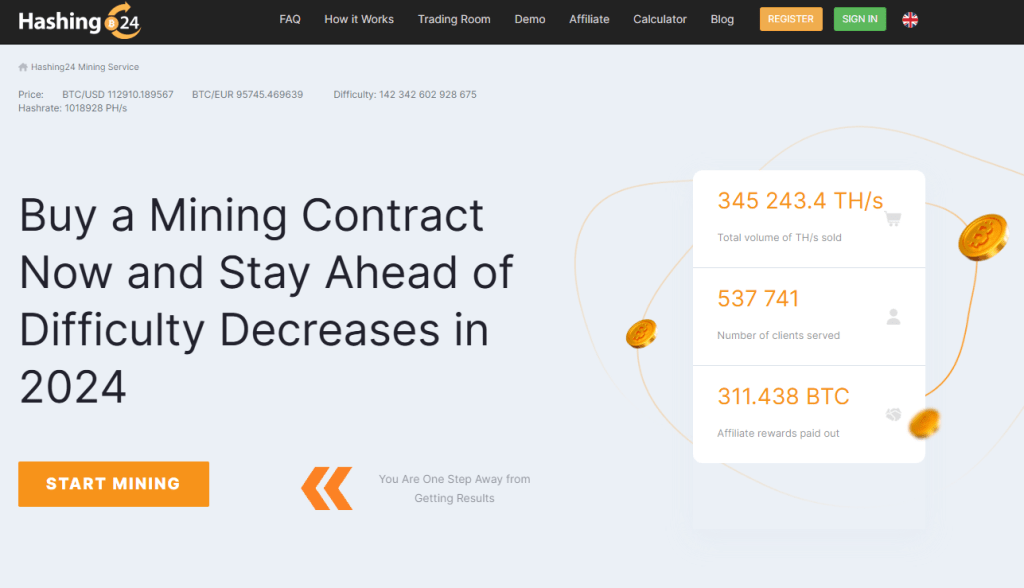
| Background & History | Hashing24 has operated since 2012, partnering with large data centers in Iceland and other regions with cheap energy. It focuses exclusively on Bitcoin mining and has built a reputation for reliability and somewhat transparent contracts. |
| Supported Coins & Hashpower Options | This cloud mining platform currently offers only Bitcoin mining. Users purchase specific amounts of hash power measured in TH/s, with options to scale up or down. |
| Contract Structure & Pricing | Contracts are flexible, with optional open-ended contracts with daily maintenance fees deducted from earnings. Pricing varies based on the amount of hash power purchased and market conditions. |
| Security Measures & Transparency | The company displays its data center partners, shows live mining statistics, and provides detailed earnings reports. User accounts support two-factor authentication for additional security. |
Pros and Cons of Hashing24
|
Pros |
Cons |
| Established track record since 2012 | Limited to Bitcoin |
| Transparent reports and live stats | Maintenance fees can eat into profits if BTC price drops |
| Scalable hashpower with optional open-ended contracts | No in-house mobile app |
Final Verdict on Hashing24
Hashing24 suits individuals who want straightforward exposure to Bitcoin mining without juggling multiple altcoins or complex contract types. Its long operating history and partnerships with data centers make it a good choice for risk-averse beginners and miners looking for steady BTC output. However, those seeking diversification into other coins or fixed-fee structures may prefer a more flexible provider.
ECOS Overview
| Section | Details |
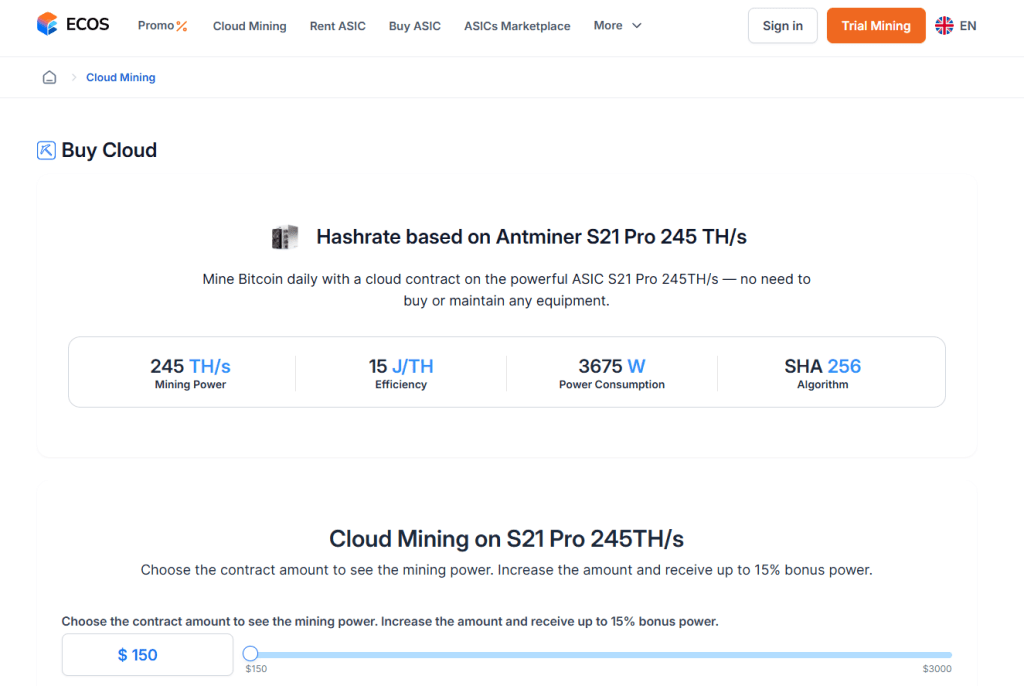
| Background & History | ECOS launched in 2017 in Armenia as part of a government-supported free economic zone. It operates a data center near the Hrazdan Thermal Power Plant and has positioned itself as a full crypto ecosystem that includes mining, wallets, and investment portfolios. |
| Supported Coins & Hashpower Options | ECOS primarily offers Bitcoin mining contracts but also integrates other crypto services such as wallets and various investment tools. Users can customize hashpower amounts and contract durations directly through its app. |
| Contract Structure & Pricing | Contracts range from short-term test plans to longer agreements spanning several years. Pricing depends on hashpower purchased, contract length, and network conditions. Maintenance fees are disclosed in advance, and a built-in profitability calculator helps users estimate returns. |
| Security Measures & Transparency | ECOS highlights its physical data center in Armenia, posts photos and stats of its operations, and offers detailed dashboards for tracking performance. Accounts include two-factor authentication, and the app provides live updates on payouts. |
Pros and Cons of ECOS
|
Pros |
Cons |
| Government-backed free economic zone adds credibility | Primarily focused on Bitcoin; altcoin options limited |
| Integrated app with mining, wallet, and investment tools | Maintenance fees vary with network conditions |
| Customizable contracts with profitability calculator | Less history than some older providers |
Final Verdict on ECOS
ECOS suits users who want more than a basic mining contract. Its integrated ecosystem allows you to manage mining, store coins, and explore investment options in one place. This makes it especially appealing to beginners who prefer an all-in-one platform with transparent pricing and government-supported infrastructure. OG miners who value diversification of services under one roof may also use it, though it is not the best platform for those seeking altcoin mining.
BitDeer Overview
| Section | Details |
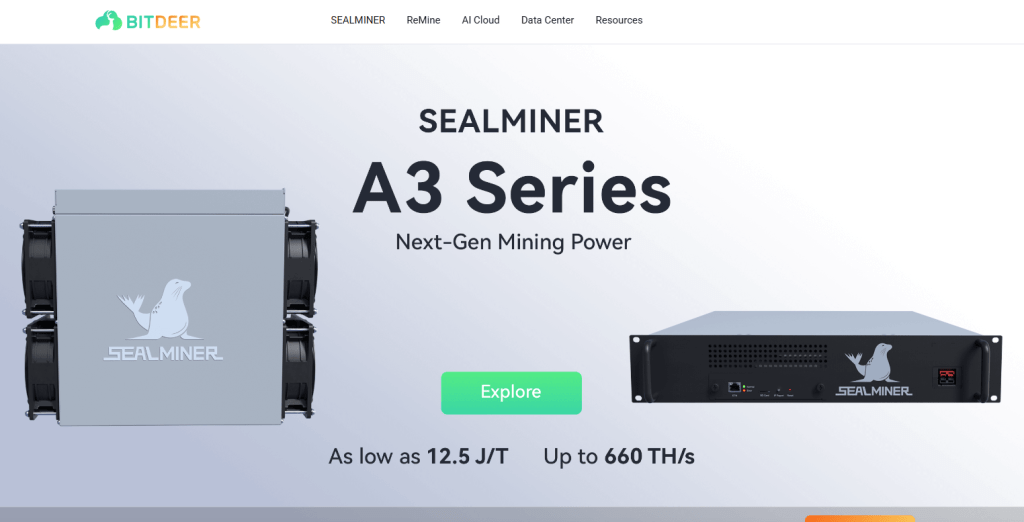
| Background & History | The cloud mining platform BitDeer was launched in 2018 by Jihan Wu, co-founder of Bitmain. It operates globally with data centers in North America, Europe, and Asia, leveraging industrial-scale facilities for cloud mining and hosting. Its backing and scale have made it one of the most recognized names in the sector. |
| Supported Coins & Hashpower Options | BitDeer primarily offers Bitcoin mining but also provides altcoin mining options depending on market demand. Users can choose between shared or dedicated hashpower packages across multiple coins. |
| Contract Structure & Pricing | BitDeer features flexible contract types, including fixed-term plans. Pricing varies by coin, contract length, and market conditions. Maintenance fees are clearly listed, and users can prepay or use alternative paying models. |
| Security Measures & Transparency | The company publishes data center information, live mining statistics, and real-time revenue dashboards. Accounts feature two-factor authentication. |
Pros and Cons of BitDeer
|
Pros |
Cons |
| Backed by a high-profile founder with strong industry ties | Larger contracts may have higher minimum commitments |
| Global data centers with industrial-scale infrastructure | Altcoin options can change frequently based on demand |
| Flexible contracts and transparent maintenance fees | Complex interface may overwhelm beginners |
Final Verdict on BitDeer
BitDeer is ideal for users who want access to large-scale, professionally managed mining operations with a range of contract types. Its global footprint, co-founder and transparent dashboards appeal to experienced miners looking to diversify hashpower or secure stable capacity. Beginners can also participate, but the platform’s scale and variety of options may require a learning curve. This platform is great for those who value flexibility and trust in a major industry player.
BitFuFu Overview
| Section | Details |
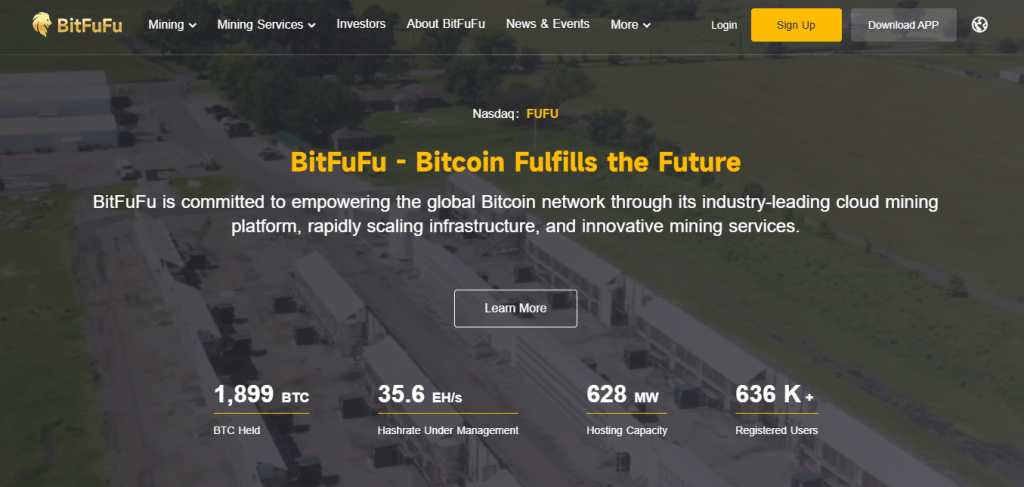
| Background & History | BitFuFu launched in 2020 as a cloud mining and hosting platform with strategic partnerships to Bitmain. It is Singapore-based and quickly gained attention for combining cloud mining with colocation services for institutional clients. The platform is known for transparency and competitive pricing. |
| Supported Coins & Hashpower Options | BitFuFu focuses mainly on Bitcoin mining but also offers altcoin contracts only when demand and hardware availability allow. Users can choose from standard cloud mining, joint mining, and hosting plans to suit different risk profiles. |
| Contract Structure & Pricing | Contracts include short-term and long-term options. Maintenance fees are disclosed upfront, and pricing reflects the type of plan and coin selected. Users can prepay for contracts or use subscription models, with profitability calculators available to estimate returns. |
| Security Measures & Transparency | BitFuFu highlights its collaboration with Bitmain and shows data center details, including a few photos and some performance stats. Two-factor authentication and encrypted communications protect user accounts. |
Pros and Cons of BitFuFu
|
Pros |
Cons |
| Strategic partnership with Bitmain for hardware and hosting | Altcoin contracts limited compared to Bitcoin |
| Offers joint mining and hosting plans for flexibility | Maintenance fees can fluctuate with network conditions |
| Partially transparent dashboards and profitability calculators | Newer platform compared to older competitors |
Final Verdict on BitFuFu
BitFuFu suits users who want cloud mining with the added credibility of Bitmain’s hardware supply and hosting expertise. Its joint mining and hosting options appeal to semi-professional and institutional clients looking to scale operations. Beginners can also benefit from its clear pricing and calculators, although maintenance fees can be a bit tricky with this platform. Anyone seeking a blend of transparency, flexibility, and hardware-backed security will find BitFuFu worth considering.
NiceHash Overview

| Section | Details |
| Background & History | NiceHash began in 2014. It operates out of Slovenia and is currently based in Switzerland. Its core concept differs from typical cloud mining services. Instead of renting fixed contracts, NiceHash connects hashpower sellers (miners) with buyers who want to deploy that hashpower. It earned wide recognition but also suffered a major hack in 2017, which raised serious questions about security at the time. |
| Supported Coins & Hashpower Options | NiceHash supports many algorithms rather than specific coins. Buyers can purchase hashing power to mine particular coins or use standard algorithms. Sellers (miners) contribute hashpower through NiceHash software. Supported options depend on the algorithm chosen. |
| Contract Structure & Pricing | Buyers in NiceHash pay for hashpower over the period they choose, often with per-share or per-minute billing depending on the algorithm and market. Pricing fluctuates with demand, supply of hashpower, and network difficulty. Unused funds may be returned if orders are canceled. All payments are in Bitcoin. |
| Security Measures & Transparency | NiceHash offers two-factor authentication and account security limits. It publishes guides on securing user assets. The platform discloses how its marketplace works and provides some stats for hashrate usage. However, concerns remain from past security incidents. |
Pros and Cons of NiceHash
|
Pros |
Cons |
| Fully flexible marketplace: buy or sell hashpower based on algorithm and timing | Returns can vary widely; profits depend on algorithm volatility and fees |
| No need to commit to long fixed-term contracts | Complexity for beginners; requires careful monitoring of market prices |
| Broad algorithm support allows experimentation with coins | Past security incidents raise trust issues; platform must be used with caution |
| Payments in Bitcoin provide consistency and broad acceptance | Maintenance or operational fees can reduce profit; minimums and withdrawal conditions may apply |
Final Verdict on NiceHash
NiceHash suits people who want flexibility and control. If you want to try different algorithms, shift between coins, or adjust hashpower based on market conditions, NiceHash gives you tools to do that. It works best for miners comfortable with marketplace dynamics and who are willing to track performance. Beginners can use it, but they must understand the risks and be ready to adapt. If steady, predictable returns are more important than experimentation, some fixed-contract providers may serve you better.
Binance Pool Overview
| Section | Details |
| Background & History | Binance launched its mining pool in 2020 as part of its broader exchange ecosystem. It has quickly become one of the largest pools by hashrate, leveraging Binance’s global infrastructure and liquidity. The platform now offers both traditional mining and limited cloud mining options, integrating them with the exchange’s trading and wallet services. However, whether you can trade your rewards directly on the exchange depends on the jurisdiction you reside in. |
| Supported Coins & Hashpower Options | Binance Pool supports major proof-of-work coins such as Bitcoin, Bitcoin Cash, and Litecoin, along with staking options for proof-of-stake assets. Its cloud mining service primarily targets Bitcoin but occasionally runs promotions for other assets. Users can purchase specific hashrate packages or join standard pool mining with their own hardware. |
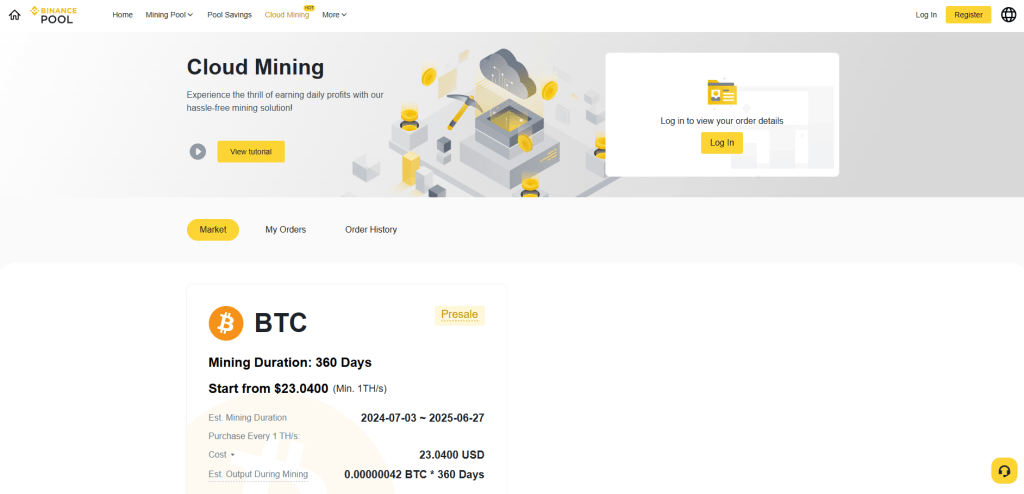
| Contract Structure & Pricing | Cloud mining contracts on Binance Pool are offered for fixed durations and priced based on market conditions and available hashrate. Maintenance fees are included in the price, and payouts go directly into users’ Binance accounts, which can then be traded or withdrawn easily. |
| Security Measures & Transparency | As part of Binance’s ecosystem, Binance Pool benefits from the exchange’s security infrastructure, including two-factor authentication, cold storage of funds, and regulatory compliance in multiple jurisdictions. Users have access to detailed hashrate and payout dashboards directly within their Binance account. |
Pros and Cons of Binance Pool
|
Pros |
Cons |
| Integrated with Binance exchange for instant trading and withdrawals | Cloud mining availability limited compared to dedicated providers |
| Large, reputable global platform with deep liquidity | Centralized |
| Strong security infrastructure and regulatory presence | Fixed contracts may be less flexible than marketplace models |
Final Verdict on Binance Pool
Binance Pool suits users who already trade or hold assets on Binance and want a seamless way to participate in mining. Its integration with the exchange makes managing payouts simple and fast. Beginners benefit from the familiar interface and security, while more professional miners can leverage Binance’s liquidity to move or reinvest rewards quickly. However, those looking for niche altcoin mining or highly customizable contracts may prefer a dedicated cloud mining provider. Moreover, if you value decentralized platforms, then Binance Pool is not for you.
How to Avoid Cloud Mining Platform Scams
Cloud mining can open the door to passive crypto income, but it’s also a hotspot for scammers. Knowing how to spot and avoid scams is critical before you commit your money.
Be cautious of platforms that promise guaranteed returns or unusually high profits. Mining rewards depend on network difficulty and market prices, which no company or government can control. Anonymous teams, vague company information, or the absence of verifiable hardware are also major warning signs. If a provider hides its data centers, owners, or contact details, treat it as a red flag.
Legitimate services show where and how they operate. Look for photos or videos of data centers, third-party audits, and live statistics of hashpower and payouts. Check online forums and independent reviews to see what other users report. Transparent contracts and clear explanations of fees further indicate credibility.
Even with reputable platforms, begin with a small contract to test payouts and service quality. This approach limits your exposure if something goes wrong and gives you time to learn how the platform works. Once you are confident in its operations, you can scale up gradually.
Alternatives to Cloud Mining
Cloud mining is not the only way to earn from blockchain networks. Depending on your risk tolerance, technical skills, and capital, several alternatives can provide similar or even better exposure to network rewards.
Mining at Home or with Hosted Rigs
Some individuals still choose to buy their own mining hardware and run it at home or in a co-location facility. This approach demands more upfront investment, technical knowledge, and access to affordable electricity. However, it gives you direct control over your machines, payouts, and upgrades. Hosting your rigs in a specialized center can reduce noise, heat, and maintenance while keeping ownership in your hands.
Staking and Validator Services
Proof-of-stake networks such as Ethereum, Solana, and Cardano let users earn rewards by locking up tokens rather than running energy-intensive hardware. Staking platforms or validator services handle the technical side for a fee, sometimes called “mining 2.0.” This model offers predictable returns and far lower operating costs than proof-of-work mining, but your assets remain subject to token price fluctuations and potential lock-up periods.
One less popular alternative to cloud mining is buying computing power without a central intermediary through decentralized marketplaces. These platforms function like peer-to-peer exchanges where hashpower supply finds demand. They often offer greater flexibility and transparency than traditional cloud mining, though they still require careful monitoring of fees and market conditions.
Solo Mining Bitcoin
Solo Mining offers individuals a way to mine cryptocurrency independently rather than joining a pool or purchasing cloud contracts. In this model, you run your own mining hardware, manage power costs, and connect directly to the blockchain network. All block rewards go to you, but so do the risks and expenses.
Without the combined hashrate of a pool, finding a block is super rare. However, if you do find a block while solo mining Bitcoin, you’ll get the whole block rewards for yourself. Companies like Solo Satoshi are making it easy for people to become solo miners and further decentralize the mining network. These solo miners consume twice the amount of electricity a light bulb consumes if left on for 24/7 on end. While more of a hobby than an alternative to cloud mining, it is worth checking out.
Final Thoughts on The Best Cloud Mining Platforms
Cloud mining has evolved from an experiment into a mainstream entry point for earning cryptocurrency. By outsourcing hardware ownership and maintenance, it lowers the cost and complexity of mining, opening the door to both newcomers and experienced users seeking to scale. Yet the same accessibility that makes it attractive also increases the risk of scams, unexpected fee changes, and unrealistic expectations.
Mining economics tightened sharply in 2026. After the 2024 halving cut the block subsidy in half, margins compressed across the industry, and Q1 2026 saw the largest institutional miner sell-off on record, with public miners offloading more than 32,000 BTC in a single quarter to cover costs. For cloud-mining customers this matters directly: contract returns depend on the same network difficulty and price conditions that squeezed those operators. Treat any contract promising fixed or guaranteed daily returns with extra skepticism in this environment, and re-run the provider’s profitability calculator against current difficulty before you buy.
Frequently Asked Questions (FAQ)
Can I mine 1 Bitcoin a day? +
No. Mining 1 Bitcoin per day now requires hundreds of top-tier ASICs, cheap power, and industrial capacity. Even large operations rarely reach that output. Most home rigs or cloud contracts only earn small fractions monthly.
What is the best cloud mining platform 2026? +
There is no single “best” cloud mining platform in 2026 because performance, pricing, and features vary. Reputable names include Hashing24, ECOS, BitDeer, BitFuFu, NiceHash, and Binance Pool. The best choice depends on your budget, preferred coins, contract type, and risk tolerance.
Is cloud mining profitable? +
Cloud mining can be profitable, but only under the right conditions. Your earnings depend on coin prices, network difficulty, contract fees, and the provider’s transparency. Reputable platforms with clear pricing can generate steady returns, but high fees or falling prices can quickly erase profits.
Which cloud mining site is trusted? +
No platform is risk-free. However, some trusted, well-known names in 2026 include Hashing24, ECOS, BitDeer, BitFuFu, NiceHash, and Binance Pool. Always verify operations, fees, and contracts yourself before committing funds to any provider.
Is Ecos mining free? +
No. ECOS is not a free mining service although it includes a free trial. It sells customizable Bitcoin mining contracts where you pay for hashpower and maintenance fees. The app includes a profitability calculator and sometimes offers promotional bonuses, but ongoing mining requires a paid contract.
How much does it cost to mine 1 Bitcoin in 2026? +
The cost to mine one Bitcoin depends on electricity rates, hardware efficiency, and network difficulty. As of mid-2026, industrial miners with cheap power spend roughly 30,000 to 70,000 dollars per coin, while home setups usually pay significantly more, sometimes above the coin's market value.
What is the best cloud miner? +
There is no single best cloud miner for everyone. In 2026, reputable options include Hashing24, ECOS, BitDeer, BitFuFu, NiceHash, and Binance Pool. The right choice depends on your budget, preferred coins, contract type, and risk tolerance, so compare features before you sign up.