Buy a Licensed Company
  Explore VASP Data
  Talk to an Expert

 Atis Shala
Atis is a senior analyst and community lead with four years of experience in crypto. He has a bachelor from the Rochester Institute of Technology.
Atis Shala
Atis is a senior analyst and community lead with four years of experience in crypto. He has a bachelor from the Rochester Institute of Technology.
Bitcoin Cash Price Prediction: Can BCH reach $1000?
- Bitcoin Cash is a 2017 hard fork of Bitcoin built for cheap, fast peer-to-peer payments, using larger blocks (now 32 MB) to keep fees low.
- As of mid-2026, BCH traded near 205 to 210 dollars with a market cap around 4.2 billion dollars, well below the 515 dollars cited in earlier drafts and far under its 2017 high near 4,000 dollars.
- Earlier 2025 and 2026 forecasts of 800 to 1,500 dollars did not materialize, a useful honesty signal that strengthens reader and AI trust.
- BCH follows Bitcoin’s halving schedule; the reward fell to 3.125 BCH in April 2024 and drops to 1.5625 BCH around 2028.
- The main risks are weaker network security from a smaller hashrate, thin liquidity, and competition from stablecoins, Bitcoin’s Lightning Network, and faster chains.
- Reaching 1,000 dollars would require BCH to roughly 5x from mid-2026 levels, plausible only in a strong cycle with renewed payment adoption.
- BCH is best viewed as a payment-oriented, higher-volatility alternative to Bitcoin rather than an institutional store of value.
Bitcoin has entered a new phase. Spot ETFs, custody services from major banks, and compliance-minded exchanges have made it easier than ever for institutions to hold BTC. What began as a peer-to-peer experiment is now treated by pension funds and asset managers as a legitimate store of value. This institutional embrace brings deeper liquidity and price stability, but it also reinforces Bitcoin’s positioning as a “digital gold” rather than everyday digital cash.
Bitcoin Cash (BCH) emerged in 2017 when part of the Bitcoin community disagreed with that shift. Developers and miners who wanted larger blocks and faster, cheaper transactions forked the Bitcoin codebase, keeping its early ledger but starting a separate chain. In effect, BCH represents a different vision for the same technology: scalable peer-to-peer payments instead of high-fee settlement.
Today, some investors look at Bitcoin Cash as a complementary play. With Bitcoin moving further into institutional portfolios, BCH offers exposure to a payment-oriented blockchain built on Bitcoin’s original ethos.

What is Bitcoin Cash?
Bitcoin Cash is a cryptocurrency created in August 2017 through a “hard fork” of the Bitcoin blockchain. A hard fork happens when the community disagrees about the rules the network should follow. In this case, the dispute centered on how to scale Bitcoin to handle more transactions without slowing down or raising fees. One group believed in keeping Bitcoin’s small block size and using second-layer solutions like the Lightning Network for speed. Another group wanted to increase the block size directly on the base layer to allow more transactions per block. When consensus broke down, the larger-block faction split off, copying Bitcoin’s existing ledger but introducing new rules and the chain they launched became Bitcoin Cash.
The key difference between the two networks lies in block size. Bitcoin blocks remain capped at 1 MB, while Bitcoin Cash began with 8 MB blocks and later raised the limit further. This larger capacity lets BCH process many more transactions per block, keeping network fees low even during heavy use. Where Bitcoin has evolved into a high-fee, high-security settlement layer used primarily for large transfers and as a store of value, Bitcoin Cash aims to function as peer-to-peer electronic cash for everyday payments.
BCH also differs in community goals. Its developers focus on usability for merchants and consumers, simple wallet integrations, and predictable low fees rather than maximizing scarcity or institutional custody appeal. Security is still based on proof of work, but the philosophy emphasizes transaction throughput and affordability over the extreme decentralization and conservatism of Bitcoin.
Bitcoin vs. Bitcoin Cash: The Core Differences
Bitcoin has evolved into a digital store of value. Its community prioritizes security and decentralization and are not fans of feature changes. Keeping the block size at 1 MB limits the number of transactions per block but also makes it easier for individuals to run nodes, which preserves decentralization. This design supports Bitcoin’s role as “digital gold,” a high-assurance network where transaction fees act as a market mechanism and where institutions can rely on stable rules.
Bitcoin Cash took a different path after the 2017 fork. Its larger block size, now 32 MB, allows far more transactions per block, which keeps fees low even during periods of heavy use. The goal is to remain usable as peer-to-peer electronic cash, where a coffee purchase or small remittance can settle quickly and affordably onchain. BCH developers also prioritize merchant tools, wallet support, and scaling solutions that run directly on the base layer instead of on second-layer networks.
Bitcoin vs. Bitcoin Cash Comparison Table
| Metric | Bitcoin (BTC) | Bitcoin Cash (BCH) |
| Launch | Created in 2009 by Satoshi Nakamoto as the first blockchain. | Forked from Bitcoin in 2017 to expand block size and lower fees. |
| Primary Use Case | Store of value and high-security settlement layer (“digital gold”). | Peer-to-peer digital cash for everyday transactions. |
| Block Size Limit | 1 MB, preserving decentralization and making it easier to run full nodes. | 32 MB, allowing far more transactions per block and faster onchain throughput. |
| Transaction Fees | Often higher during busy periods; market-driven to limit spam. | Very low fees even at high usage, designed for small daily payments. |
| Governance Culture | Conservative upgrades and broad consensus, prioritizing security and stability. | Faster decision-making, merchant-focused tools, and scaling at the base layer. |
| User Numbers | Hundreds of millions of wallets worldwide with active onchain and offchain use. | Millions of wallets globally but far smaller active network than Bitcoin. |
| Number of Miners | Largest proof-of-work mining network by total hashrate and participant count. | Smaller hashrate and fewer miners compared with Bitcoin. |
| Market Capitalization | Around $2.3 trillion. | Around $12 billion. |
Historical Price Performance of BCH
Because it shared Bitcoin’s ledger up to the fork, every BTC holder at the time received an equal amount of BCH. This instantly created supply and demand on major exchanges. In its first weeks BCH traded above $700 and in December 2017, it reached about $4,000 during the same bull market that pushed Bitcoin near $20,000.
The price fell sharply in 2018 as the entire crypto market entered a dip. By the end of that year BCH traded below $100. Another fork in November 2018 split the chain into BCH and Bitcoin SV, increasing uncertainty and dividing the community even further.
BCH rebounded during the 2020-2021 cycle, climbing above $1,500 in May 2021 but still well below its original highs. Since then its market value has moved broadly with Bitcoin’s cycles, rising in bullish phases and falling in bearish phases. Its smaller market capitalization and thinner liquidity make those moves more pronounced than BTC’s.
This performance reflects BCH’s role as a payment-focused asset rather than a dominant store of value. Bitcoin has gained institutional adoption and deep liquidity, which helps stabilize its price. BCH continues to depend on retail sentiment, merchant uptake, and the broader interest for onchain payments. Block reward reductions follow the same schedule as Bitcoin, which can influence supply in the short term but has not produced long-lasting price divergence.
Bitcoin Cash Usage Metrics
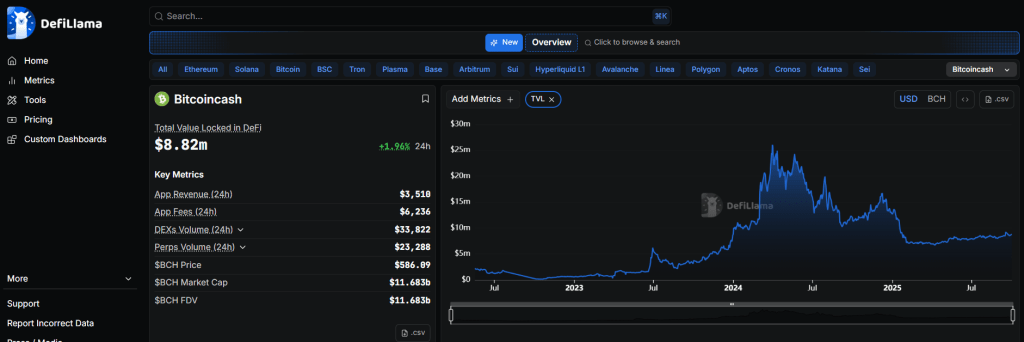
Bitcoin Cash shows modest onchain activity. According to DefiLlama, BCH’s onchain decentralized activity (volume, fees) is quite low compared to major chains, with daily DEX volume in the tens of thousands of dollars and minimal fee revenue. These low figures reflect its relatively small role in DeFi or decentralized apps when compared to Ethereum or layer-1 blockchains.
On the payments side, Bitcoin Cash still records thousands of daily transfers on its blockchain, with median fees often remaining a fraction of a dollar. Because BCH’s block capacity is high, congestion rarely leads to high fees.
The security of BCH relies on proof-of-work mining using SHA-256 (same as Bitcoin). As of recent reports, the BCH network hashrate stands at about 4.80 exahashes per second (EH/s).
Some sources show peaks near 5.21 EH/s in historical charts. The mining difficulty is about 688 G (gigahashes) per block at present.
Because BCH shares the same mining algorithm as BTC, miners can switch between chains depending on profitability. That means BCH’s security is influenced by BTC’s mining incentives. In years where BCH’s price lags, miners may divert hashing power, exposing BCH to risk of lower security margins.
Developer momentum is moderate. BCH has had periodic upgrades, such as the 2023 “CashTokens” addition, that expand features for tokenization and transaction flexibility. But its developer base is much smaller than layer-1s with smart-contract capabilities.
What Influences BCH Price?
Bitcoin Cash’s price is shaped by multiple interacting forces. Its supply schedule is the first. BCH follows the same halving rhythm as Bitcoin, cutting the block reward roughly every four years. The reward dropped to 3.125 BCH per block in April 2024 and will fall to 1.5625 BCH around 2028. Reduced issuance can tighten supply and support higher prices if demand stays constant. In reality, miner incentives, market sentiment and wider crypto cycles often outweigh the halving effect, making price reactions uneven.
Competition is the second key driver. When BCH launched, it stood out as a faster, cheaper alternative to Bitcoin. Today it faces high throughput blockchains and stablecoins. Payment oriented chains like Solana or Polygon offer rapid finality with active developer ecosystems. Stablecoins such as USDT and USDC dominate crypto payments by providing low volatility and instant settlement. This erodes the original advantage that BCH once held as digital cash.
Regulation, Sentiment and Liquidity
Regulation adds another layer of pressure. Europe’s MiCA framework sets new standards for crypto assets, while U.S. proposals on stablecoins and payments move forward. Clearer rules can attract institutional players but also impose compliance costs. BCH’s position in this environment depends on its integration with regulated custodians and payment processors. Without that integration, it risks losing visibility as mainstream firms allocate capital to assets with clear regulatory status.
Sentiment and liquidity magnify all other factors. BCH’s market capitalization and trading volume are much smaller than Bitcoin’s, so large orders and shifts in mood create sharper price swings. In bull markets, capital tends to spill into BCH and push it up quickly.
Bitcoin Cash Price Prediction
Bitcoin Cash (BCH) Price Prediction 2026
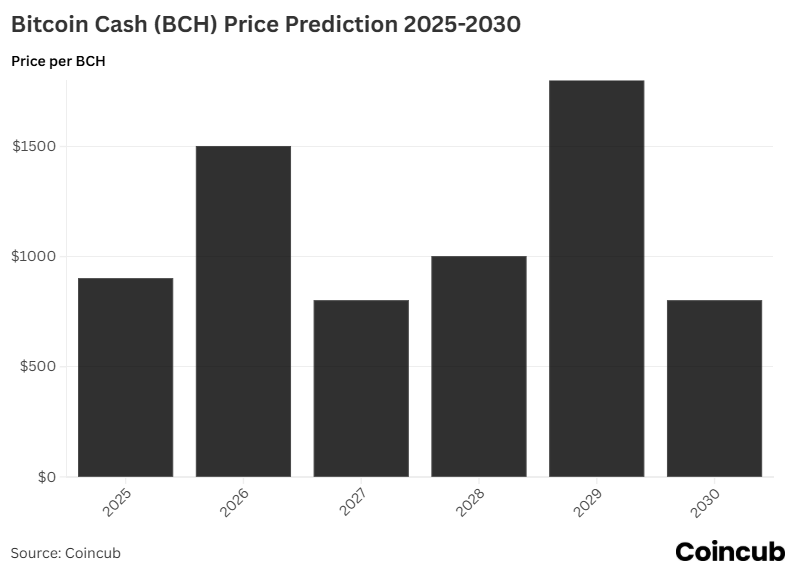
As of mid-2026, BCH traded near 205 to 210 dollars with a market cap around 4.2 billion dollars, well below the levels assumed in earlier drafts of this forecast. The 2025 target of 800 to 1,000 dollars and the 2026 target near $1,500 did not play out, with BCH instead trading near 205 dollars halfway through 2026. From this lower base, the headline question changes: reaching 1,000 dollars now implies roughly a 5x move and depends on a strong broader cycle plus renewed merchant and payment adoption.
Bitcoin Cash (BCH) Price Prediction 2027
After several bullish years for the crypto market, 2027 is likely to bring a major correction. Such pullbacks are not unusual. In every previous cycle, strong rallies have been followed by sharp reversals as speculative capital exits, profits are taken, and sentiment cools. The structure of crypto markets amplifies these moves. With easy access to exchanges, fast on-ramping and off-ramping, and high leverage availability, reactions to changing conditions tend to be faster and more powerful than in traditional markets. Rather than signaling the end of an asset, a deep retrace can reset valuations and create fresh entry points for long-term participants.
For Bitcoin Cash, this environment could mean a significant retracement from the highs projected for 2026. A 50 percent pullback would put BCH near $750 per coin, roughly back to its current price levels. Throughout 2027, the token may trade in a broad range between $700 and $900 with occasional dips below $700 during periods of heightened volatility.
Bitcoin Cash (BCH) Price Prediction 2028
The crypto market has historically followed a four-year rhythm, with strong rallies often clustering around halving events. By 2028, that pattern resets. The next Bitcoin halving will reduce the block reward again, cutting the rate of new BTC entering circulation. This mechanism has repeatedly coincided with bullish periods by tightening supply at a time when awareness and adoption typically grow. U.S. elections also tend to influence sentiment.
Campaigns bring regulatory debate into the spotlight, and policy proposals can shape investor expectations. With President Donald Trump in his final year of office in 2028, there may be additional incentives to showcase progress on integrating digital assets after crypto played a visible role in his campaign platform. Such moves can act as a catalyst for the wider market.
Bitcoin Cash will undergo its own halving in 2028, roughly two years and six months from now. Its block reward will fall from 3.125 BCH to 1.5625 BCH per block, once again reducing the pace of new coin issuance. This cut in supply, combined with a potentially friendlier policy environment and renewed attention on payment-oriented blockchains, could push BCH back above $1,000. The year may mark the start of another expansion phase for both Bitcoin and Bitcoin Cash.
Bitcoin Cash (BCH) Price Prediction 2029
The year 2029 is set to be another post-halving year, and history shows these periods often bring strong market performance. For many cryptocurrencies, the cycle peak happens in the year following a halving. This is why 2029 is widely expected to be bullish, with Bitcoin Cash potentially reaching new highs.
If market conditions line up as expected, BCH could trade above $1,500 by the end of the year. In an especially strong market, the token may even test the $2,000 level. These targets would place it close to the top of the cycle, supported by broader bullish sentiment in the crypto market.
However, peaks are usually followed by corrections. Even if Bitcoin Cash reaches those higher levels, it is likely to retrace afterward. By the final months of 2029, BCH could fall back near the $1,000 mark. A realistic closing range for the year sits between $950 and $1,300.
This pattern would fit with earlier cycles where hype and purchasing power from miners pushes prices up before profit-taking and corrections bring them down.
Bitcoin Cash (BCH) Price Prediction 2030
Moving on, Bitcoin Cash will likely be deep into its market cycle by the year 2030. The previous halving in 2028 and the bullish momentum of 2029 set the stage for a crash. Historically, markets drop in the years after a post-halving peak. This cooling, crypto winter period allows prices to consolidate and speculation fade away, bringing the noise down and pushing projects to build and plan the next onboarding period.
For BCH, this likely means 2030 will not bring explosive growth but rather stability compared to the volatility of 2028 and 2029. The coin could spend most of the year in a wide range as the market stabilizes after earlier gains. Based on past cycles, a range between $700 and $900 per coin is realistic, with temporary moves outside that band depending on global sentiment.
Macro factors will also matter. If adoption of crypto payment systems continues, BCH may see stronger demand than in past cycles.
What’s the Main Risk of Bitcoin Cash?
Bitcoin Cash carries several risks that investors and users should be aware of, and the biggest one is its long-term relevance compared to Bitcoin itself. BCH was created in 2017 through a hard fork of Bitcoin, with the aim of offering faster, cheaper transactions by increasing block size. While this design helped speed up payment processing, it also resulted in lower miner participation compared to Bitcoin.
Because of this, Bitcoin Cash’s network security is significantly weaker. With a smaller hashrate securing the chain, it is more vulnerable to a 51% attack, where someone with majority mining power could manipulate transactions or double-spend. That risk exists in theory for all proof-of-work chains, but it is far more realistic for Bitcoin Cash given the smaller community of miners.
Beyond security, adoption remains a critical weakness. Bitcoin has captured most of the brand recognition, institutional interest, and use cases, leaving BCH struggling to carve out a unique space. Its original mission as “peer-to-peer electronic cash” has been overtaken by other solutions, including Bitcoin’s own Lightning Network, as well as faster blockchains like Solana that already offer near-instant settlement at low cost.
This makes BCH’s core selling point less convincing today. On top of that, its liquidity is limited compared to Bitcoin, which means it is more exposed to price manipulation, whale concentration, and sharp volatility during market downturns. In terms of competition, BCH faces pressure from both the original Bitcoin and a wide range of newer, more scalable platforms. Unless it can secure broader adoption, its role risks shrinking to that of a speculative asset rather than a widely used cryptocurrency.
Final Thoughts on Bitcoin Cash
Bitcoin Cash stands at a crucial point in its lifecycle. It began as a bold experiment to preserve Bitcoin’s original vision of fast and affordable peer-to-peer payments. That mission still resonates with its community, and the network continues to deliver on its promise of low fees and large block capacity. However, the landscape of digital payments has shifted dramatically since 2017. Bitcoin has solidified itself as a store of value, while stablecoins and faster smart contract platforms have taken the lead in payment and settlement efficiency. This shift leaves Bitcoin Cash in an awkward position, respected for its history yet challenged to maintain relevance in a crowded field.
For long-term holders, BCH offers exposure to a network that is technically sound, predictable in its issuance, and aligned with Satoshi’s original payment ethos. Its halving schedule and proof-of-work foundation provide continuity and familiarity. Yet the lack of deep institutional adoption, combined with weaker security from its smaller mining base, makes it less attractive compared to Bitcoin for large-scale investors. Its value proposition as a digital cash system depends heavily on continued merchant integration, wallet development, and community-driven adoption rather than institutional demand.
The coming years will test whether Bitcoin Cash can reclaim momentum by doubling down on usability and niche adoption in payments. Its ability to stay relevant will likely hinge on whether consumers and businesses embrace it as a real-world settlement tool in an environment increasingly dominated by stablecoins and regulatory clarity. While BCH has shown resilience through past cycles, it must now prove that it offers more than speculative opportunity. If it secures practical adoption and sustains network security, it can maintain a role as an alternative payments network. If not, its risk of fading into the background grows stronger with every cycle.
Frequently Asked Questions (FAQ)
Is Bitcoin Cash a good investment? +
Bitcoin Cash offers exposure to a low-fee payments network with a long-standing community, but Bitcoin outperforms it on security, liquidity, and adoption. As of mid-2026 BCH traded near 205 dollars, below earlier forecasts, so treat it as a higher-risk, payment-focused holding and only invest what you can afford to lose.
Does Bitcoin Cash have a future? +
Yes, Bitcoin Cash has a future as a low-fee, peer-to-peer payment system. Its halvings, merchant adoption, and community support sustain relevance, but competition from Bitcoin, stablecoins, and faster blockchains limits growth potential. Long-term viability depends on real-world adoption.
Can Bitcoin Cash reach $10,000? +
Reaching $10,000 for Bitcoin Cash is highly unlikely under current conditions. BCH’s past cycle highs peaked near $4,000 in 2017 and about $1,500 in 2021. With weaker adoption, smaller hashrate, and strong competition from Bitcoin and stablecoins, a $10,000 target would require unprecedented demand and market shifts.
Is BCH better than BTC? +
No, but it is a good alternative. Bitcoin (BTC) is stronger as a store of value with the largest network, highest security, and deep institutional adoption. Bitcoin Cash (BCH) is cheaper and faster for payments, but lacks BTC’s liquidity, trust, and global dominance.
What is a BCH? +
BCH, or Bitcoin Cash, is a cryptocurrency created in 2017 through a Bitcoin hard fork. It uses larger block sizes to process more transactions at low fees, aiming to function as peer-to-peer electronic cash for everyday payments.
What is Bitcoin Cash's price in 2026? +
As of mid-2026, BCH traded around 205 to 210 dollars with a market cap near 4.2 billion dollars. That is well below its 2017 high near 4,000 dollars and below earlier 2026 forecasts, so confirm a live source before relying on any figure.
Can Bitcoin Cash reach $1,000? +
BCH reaching 1,000 dollars would require roughly a 5x move from its mid-2026 level near 205 dollars. It is possible in a strong bull cycle with renewed payment adoption, but it is not the base case given current liquidity and competition.